Shopify Affiliate Alternatives for Ecommerce Creators
Shopify pays a one-time bounty. These store builder, print-on-demand and funnel programs help ecommerce creators match what their audience actually buys.
Oct 12, 2026 · 7 min read
The Shopify Affiliate Program is the default pick for anyone who teaches people to sell online, and for good reason: it pays a flat bounty per qualified merchant, and our directory lists it at $150 per referral on a 30-day cookie. But a one-time bounty on a single platform is a narrow way to monetize an ecommerce audience. Many of your readers will never open a Shopify store, and the ones who do will also need designs, fulfillment, funnels and hosting.
This guide is for ecommerce creators (YouTubers, bloggers, newsletter writers and course builders in the "start an online store" niche) who want Shopify affiliate alternatives that match what their audience actually buys. We compare the strongest options on payout model, cookie window and payout terms, then give you a simple rule for which to promote where.
Most ecommerce audiences need more than one platform. Your affiliate stack should reflect that.
Why look beyond Shopify at all
Shopify is a strong program, but three structural limits push creators to diversify:
One-time payout. The listing in our directory marks Shopify's program as non-recurring. You are paid once per merchant, no matter how long that merchant pays Shopify.
Audience mismatch. A large share of "how to sell online" viewers are artists, coaches, service businesses or hobby sellers. A full ecommerce platform is often more than they need, and they bounce instead of converting.
Single point of failure. Programs change terms. If your entire ecommerce income depends on one bounty schedule, a single policy update can cut your revenue overnight.
The fix is not to drop Shopify. It is to build a stack: one or two store builders for different buyer types, plus programs for the tools a new store owner buys next. If you are new to how retail and platform payouts differ, our explainer on how ecommerce affiliate marketing works covers the mechanics.
What to look for in an alternative
Before comparing names, decide what "better than Shopify" means for your channel. Four terms matter more than the headline rate:
Payout model. Flat bounty, one-time percentage, 12-month revenue share or lifetime recurring. This decides whether you are paid once or for years.
Cookie window. Ecommerce tutorials are research content. Viewers often watch, leave, and sign up weeks later, so a 45- or 90-day cookie captures sales a 30-day window misses. Our explainer on attribution windows shows why this matters.
Payout threshold. A low minimum means smaller channels actually get paid. A high one can hold your money for months.
Audience fit. A program your viewers do not need will not convert at any rate.
The alternatives at a glance
Every figure below comes from the program's listing in the Affground directory. Terms change, so confirm the current rate on the program page before you publish a comparison of your own.
Program
What you promote
Commission
Cookie
Payout
Shopify (baseline)
Ecommerce platform
~$150 flat per qualified merchant
30 days
Net-30, $10 min
Squarespace
Website + store builder
$100–$200 flat per new website subscription
45 days
Monthly, $10 min
Wix
Website + store builder
$100 flat per new Premium plan
30 days
Monthly, $300 min
Hostinger
Hosting + website builder
40% base, up to 60% per new sale (one-time)
30 days
Monthly, $100 min (PayPal)
Elementor
WordPress builder (for WooCommerce stores)
45–55% of first purchase
45 days
~Net-60, $200 min
Printful
Print-on-demand fulfillment
10% of referral's orders for 12 months
30 days
Monthly
Printify
Print-on-demand fulfillment
5% of referral's orders for 12 months
90 days
Monthly
ClickFunnels
Funnels + checkout pages
30% recurring, up to 40% for top affiliates
45 days
Twice monthly, $100 min
Systeme.io
All-in-one funnels, email, courses
60% lifetime recurring
365 days
Monthly, $30 min
Two patterns stand out. Store builders mostly pay flat bounties, so they compete with Shopify on the size of the bounty and the cookie length. Fulfillment and funnel tools pay ongoing commissions, which is where long-term income for an ecommerce channel tends to come from.
How the payout models really compare
A flat bounty and a recurring percentage are not directly comparable, so compare them on the same question: how much do you earn from one referred store over its first year?
Flat bounty (Shopify, Squarespace, Wix). Predictable and paid early. Your earnings are capped the day the merchant signs up.
One-time percentage (Hostinger, Elementor). Scales with the plan the buyer picks. Longer plans mean bigger single payouts, but renewals are excluded.
12-month revenue share (Printful, Printify). You earn a slice of the merchant's orders for a year. A store that takes off pays far more than a bounty. A store that never sells pays close to nothing.
Recurring subscription share (ClickFunnels, Systeme.io). You earn as long as the customer stays subscribed. That rewards audiences that stick with tools for years.
The practical takeaway: use bounties for broad, top-of-funnel content where many viewers sign up and few become serious sellers, and use revenue-share programs for committed sellers whose success you can actually influence through tutorials. Our guide to CPA vs revenue share vs hybrid goes deeper on the trade-off.
Matching programs to your audience
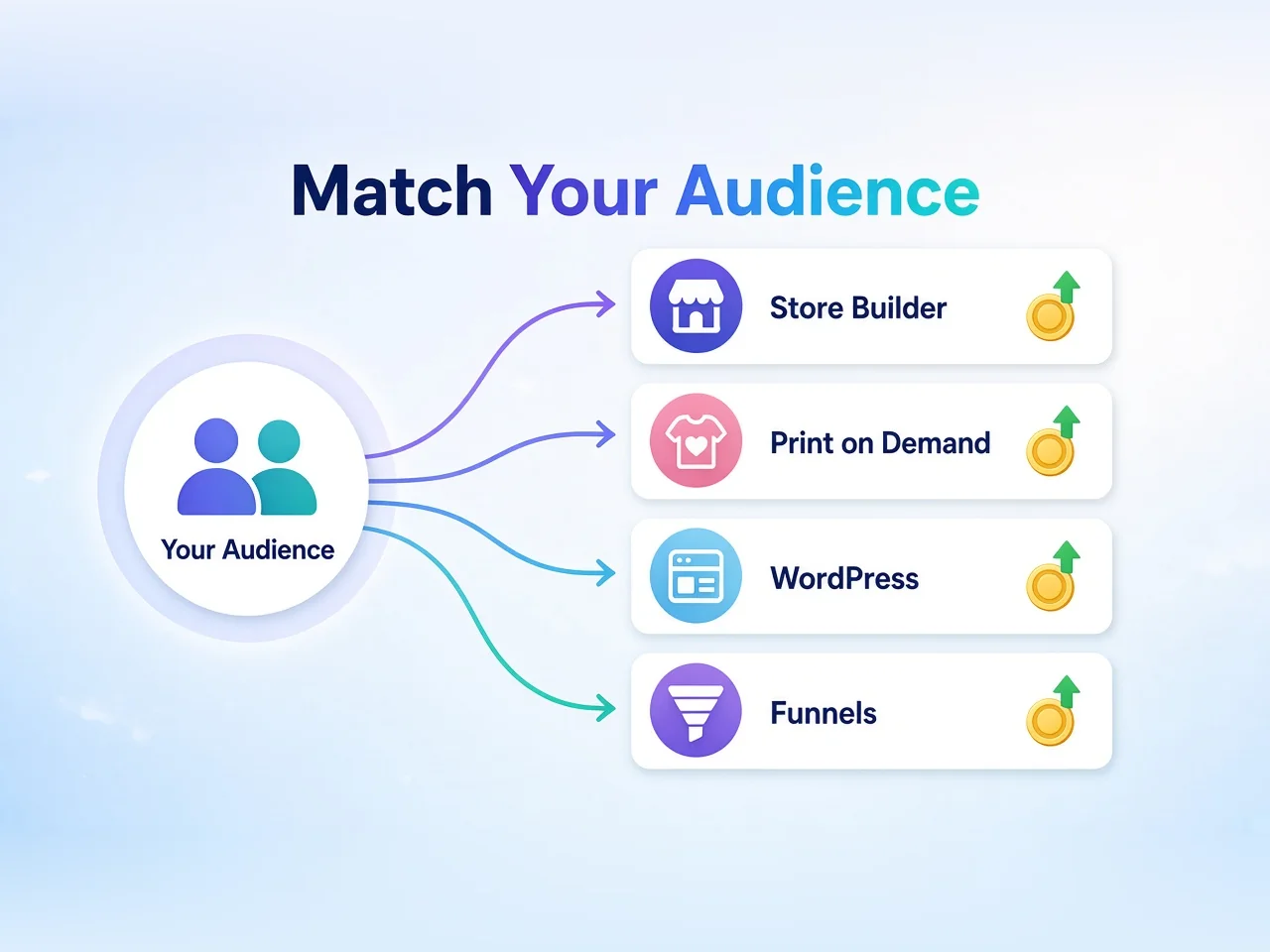
Route each audience segment to the program that fits what they are building.
The right alternative depends less on commission and more on who is watching. A simple routing rule:
If your audience is mostly…
Lead with
Add as a secondary link
Designers, artists and creatives
Squarespace
Printful or Printify
First-time sellers on a budget
Wix or Hostinger
Printify
WordPress users and bloggers
Elementor (with WooCommerce)
Hostinger
Merch sellers and YouTubers
Printful
Squarespace or Shopify
Info-product and course sellers
Systeme.io
ClickFunnels
Serious DTC brands
Shopify
Printful, ClickFunnels
If you cannot tell which group dominates, check your search console queries and video comments. People describe what they are building in their own words, and that language tells you which program will convert. Our post on finding affiliate programs for your niche has a fuller process.
The shortlist
These are the programs we would put in front of an ecommerce audience that has outgrown a single Shopify link. Each card pulls live terms from the Affground directory.
A few notes on reading the list. Squarespace has the most generous builder terms in our directory: a higher bounty ceiling than Shopify's listed figure, a 45-day cookie and a $10 minimum. Wix pays a solid flat fee, but its $300 payout threshold makes it a better fit for creators with steady volume. Printify's 90-day cookie is unusually long for fulfillment, which helps with tutorial content that people bookmark and come back to weeks later.
Common mistakes
Promoting a store builder to people who need a fulfillment tool. Someone who already sells on Etsy does not need a new platform. They need print-on-demand or a funnel.
Ignoring payout thresholds. A $300 minimum on a program you mention once a month can leave earnings stranded for a long time.
Comparing headline rates across different models. "60%" of a one-time hosting sale and "10% for 12 months" of a merch store's orders are different bets. Compare first-year value instead.
Burying the disclosure. Ecommerce tutorials are full of links. A clear disclosure near the top protects trust and keeps you compliant; see how to add affiliate disclosures.
Never updating old comparisons. Builder bounties change often. A stale "Shopify vs Wix" table loses credibility fast.
Step-by-step: building your ecommerce affiliate stack
01Audit your audience. List the top five things viewers say they are building or selling.
02Keep Shopify for serious sellers. It still converts best with people who want to scale a product brand.
03Add one alternative builder. Squarespace for creatives, Wix or Hostinger for budget beginners, Elementor for WordPress audiences.
04Add one revenue-share tool. Printful or Printify for merch, Systeme.io or ClickFunnels for digital products.
05Map each tutorial to one primary program. One clear recommendation per piece converts better than a wall of links.
06Track by placement. Use sub-IDs per video or post so you can see which program wins for which topic; our guide to sub-IDs in affiliate tracking explains the setup.
07Review quarterly. Move your primary link when the data, or the program's terms, shift.
Affground's verdict
Shopify belongs in an ecommerce creator's toolkit, but it should not be the whole toolkit. Pair one alternative store builder with one revenue-share program matched to what your audience actually sells, and you turn a single one-time bounty into a portfolio that keeps paying after the signup.
Frequently asked questions
What are the best Shopify affiliate alternatives?
For ecommerce creators, the strongest alternatives in the Affground directory are Squarespace and Wix for store builders, Hostinger and Elementor for WordPress and budget sites, Printful and Printify for print-on-demand, and Systeme.io and ClickFunnels for funnels and digital products. The best choice depends on what your audience is building.
Is the Shopify affiliate program recurring?
No. Shopify's program pays a one-time flat bounty per qualified merchant referral rather than a share of ongoing subscription fees. Our directory lists it at around $150 per referral on a 30-day cookie.
Which store builder affiliate program pays more than Shopify?
Squarespace lists $100 to $200 per qualifying new website subscription with a 45-day cookie and a $10 payout minimum, so its upper range exceeds Shopify's listed bounty. Wix pays a flat $100 per new Premium plan but requires a $300 balance before payout.
Are print-on-demand affiliate programs worth promoting?
They can be, especially for merch-focused audiences. Printful pays 10% of a referral's orders for 12 months and Printify pays 5% for 12 months with a 90-day cookie. Earnings depend on how much the referred store actually sells, so they reward audiences of committed sellers.
Should I stop promoting Shopify?
No. Shopify still converts well with sellers who want to build a serious product brand. The goal is to add one alternative builder and one revenue-share tool so your income does not depend on a single one-time bounty.
How do I compare a flat bounty with a recurring commission?
Estimate the first-year value of one referred customer for each program. A flat bounty pays once and early, while a 12-month or lifetime revenue share can earn more over time but pays little if the customer churns or never sells.
Which alternative is best for WordPress and WooCommerce audiences?
Elementor fits WordPress audiences best, paying 45% to 55% on first purchases with a 45-day cookie. Pair it with a hosting program such as Hostinger, which pays 40% base and up to 60% per new sale.
Do I need to disclose affiliate links in ecommerce tutorials?
Yes. Place a clear disclosure near the top of the post or video description, before the first affiliate link, so viewers know you may earn a commission. It protects trust and keeps you aligned with advertising rules.