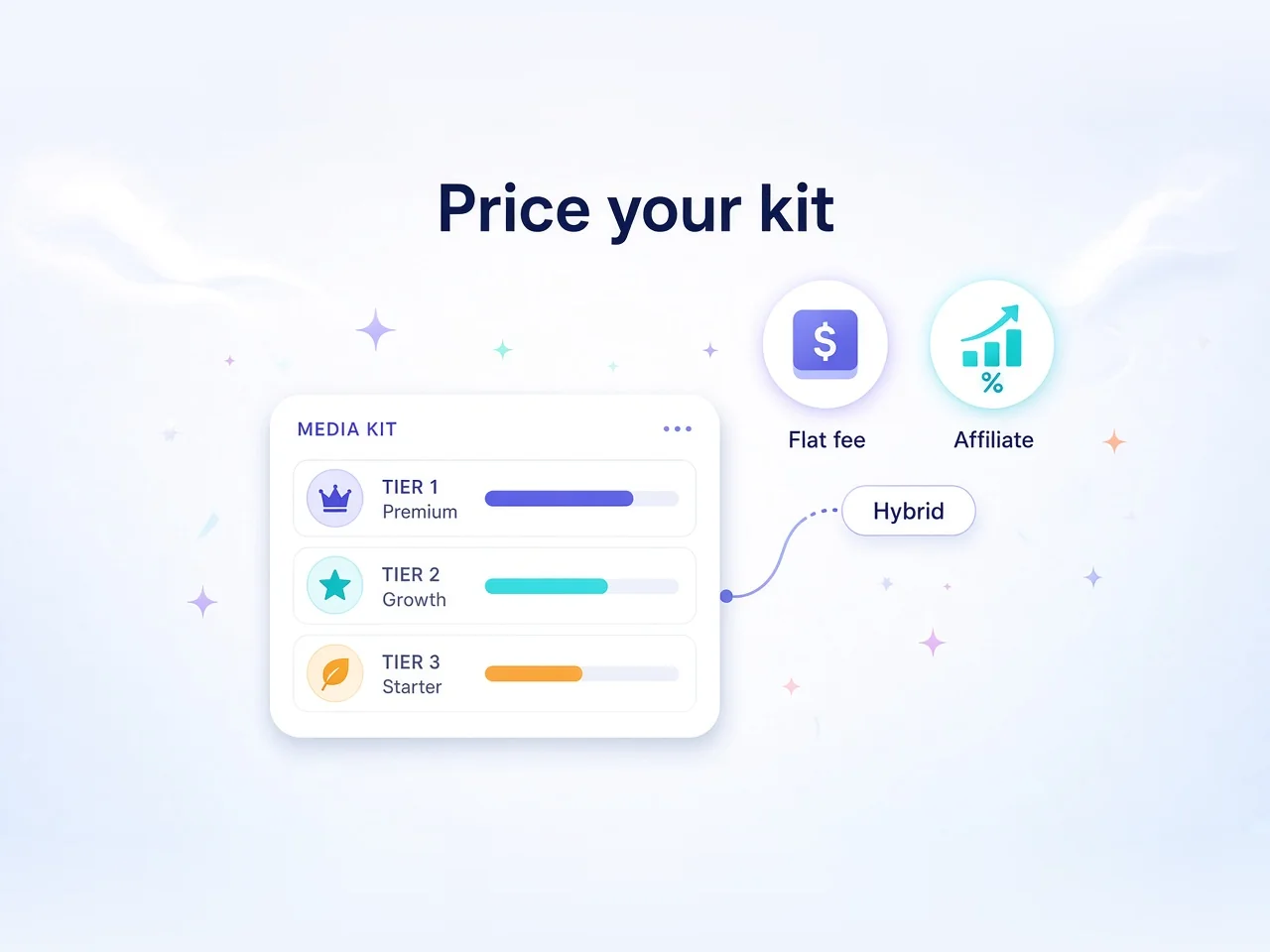
Price creator partnerships as a flat fee plus affiliate upside. Here is the hybrid model brands expect, with estimate ranges and a reusable kit structure.
Oct 9, 2026 · 8 min read
Brands do not buy "a post." They buy reach, trust and a commercial outcome — usually a mix of awareness and tracked sales. A strong media kit prices that clearly: a flat fee for the placement, plus an affiliate (or hybrid) upside so the brand only over-indexes when the content converts.
This guide is for creators, bloggers and newsletter operators who already earn affiliate commissions and want to pitch brands without guessing rates. You will leave with a hybrid pricing frame, plausible industry ranges framed as estimates, and a shortlist of networks brands already use to track the performance half of the deal.
What brands expect from a media kit
A usable kit is short. One PDF or Notion page that answers: who you reach, how they buy, what a placement costs, and how performance will be measured. Brand partnership managers skim for:
Audience — size, geography, niche, and proof (analytics screenshots, not vibes).
Past results — two or three case snippets with honest ranges (clicks, conversion, revenue), not fabricated ROAS.
They are not looking for a novel. They are looking for a professional who understands that sponsored content and affiliate tracking are different products that often sell together.
Flat + affiliate hybrid — the model that fits most pitches
Pure flat fees pay you whether the piece converts or not. Pure affiliate pays only on sales — fine for evergreen SEO, weak for a brand that wants a guaranteed launch-week push. The hybrid most brands recognize is:
01Flat fee covering creation, edits, and a defined usage window.
02Affiliate commission (or a CPA/bonus) on tracked sales during and after the window.
03Optional performance kicker if sales clear a threshold.
That structure aligns incentives: the brand pays for professional production and placement; you still earn more when the audience buys. It also matches how many in-house partner teams already think — they budget a content line item and a performance line item.
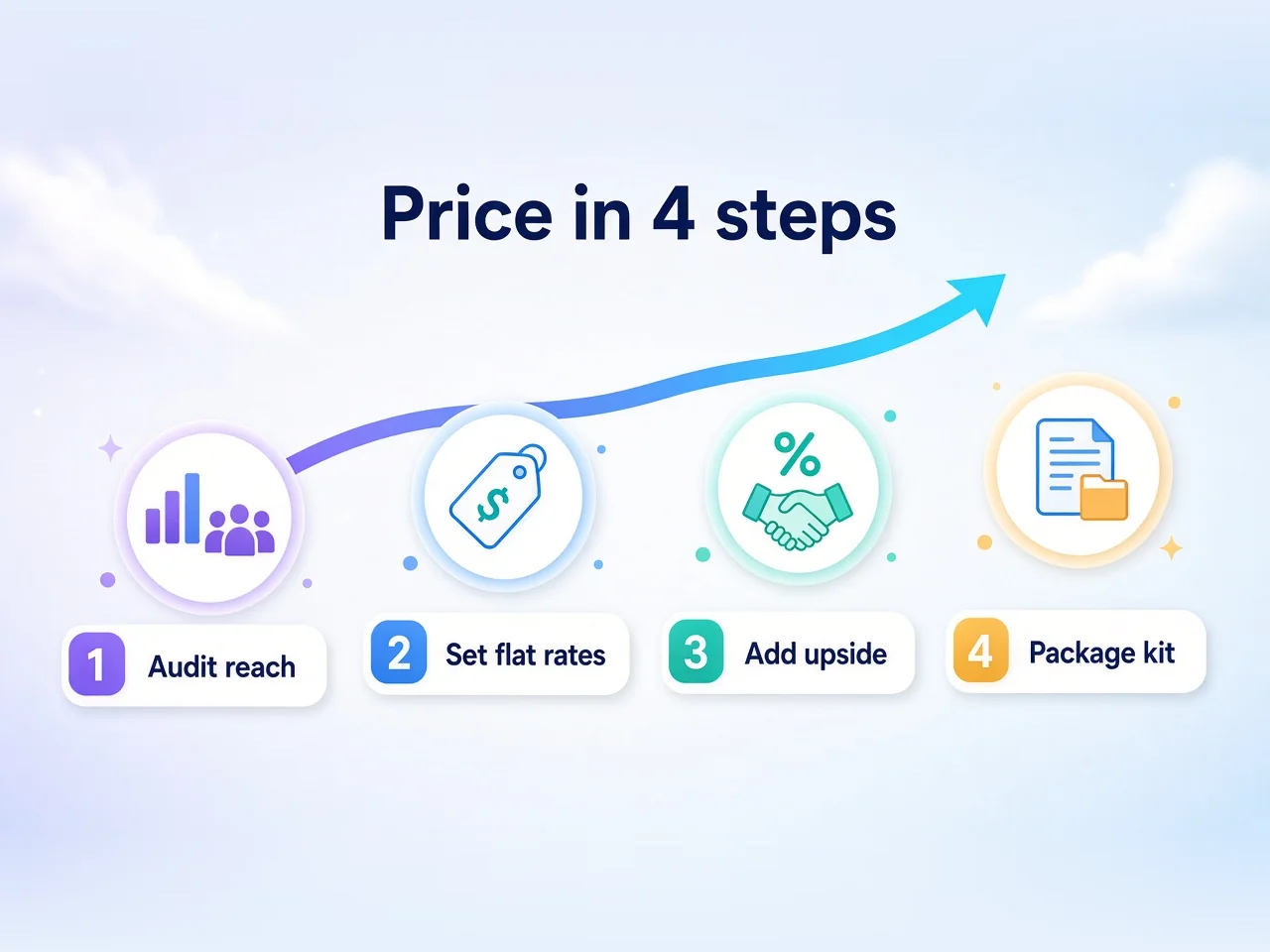
Price the kit in four steps — audience proof first, hybrid offer last
Industry rate ranges (estimates, not rate cards)
Public "influencer rate cards" vary by platform, niche and geography. Use the table below as planning ranges, then adjust for your real engagement and vertical. Premium finance or B2B audiences often price above lifestyle at the same follower count; micro-creators with high purchase intent can out-earn larger accounts with soft engagement.
Placement (typical)
Flat fee range (estimate)
Affiliate / hybrid note
Blog product review (1,500+ words)
$150–$800
Often + standard program commission
Dedicated newsletter feature
$200–$1,500
Code or deep link; open-rate proof helps
YouTube integration (60–120s)
$500–$5,000+
Higher when demo is hands-on
Instagram Reel / Story package
$100–$2,000
Stories cheaper; Reels closer to feed posts
Bundle (blog + email + social)
$800–$6,000+
Hybrid upside usually attached
These bands are illustrative industry estimates, not Affground guarantees. Brands in competitive niches (beauty, fitness, SaaS) may sit at the high end; newer sites should start lower and raise rates after two or three documented wins. If you already negotiate commission lifts inside programs, pair that skill with flat fees — see how to negotiate higher affiliate commissions.
How to set your number without undercharging
Work backwards from time and opportunity cost, then sense-check against audience value.
01Cost floor. Hours to research, draft, film, edit and revise × a realistic hourly rate, plus any shoot or tool costs. Never pitch below this unless you are deliberately trading for equity or exclusivity.
02Audience multiplier. Unique monthly visitors or engaged email subs in the relevant niche — not vanity totals. A 20k-subscriber vertical newsletter can beat a 200k general Instagram.
03Scarcity and fit. Limited slots per month, or a category where you are the obvious shortlist, support higher flats.
04Usage rights. Whitelisting, paid amplification, or perpetual rights should cost extra — list them as add-ons, not freebies.
05Affiliate stack. State the default commission path (your existing program rate) and whether you will accept a custom code or deep link for cleaner reporting.
Write rates as a menu, not a single number. Brands like choosing a package. A common three-tier layout:
Standard — one format, 30-day usage, affiliate link included.
Launch — multi-format bundle, priority slot, weekly reporting for two weeks.
Partner — quarterly retainer, hybrid kickers, early product access.
What to put on the performance half of the pitch
Brands care about attribution almost as much as creative. Spell out:
Network or platform used for tracking (Impact, CJ, Awin, ShareASale, etc.).
Cookie window and whether last-click or another model applies on that program.
Whether you will use a unique code, deep link, or UTM-tagged URL.
When they get a report (e.g. 7 / 30 / 60 days) and what metrics you share.
Strong product reviews still do the selling — pricing gets you in the room; reviews that convert keep the hybrid deal profitable. If the brand needs a dedicated URL, affiliate landing pages are the usual asset.
Networks creators already use when pitching brands
Most brand deals that include affiliate upside run through networks the merchant already joined. Pitching is easier when you can say "I'm already approved on your Impact / CJ / Awin program" than when you ask them to invent tracking from scratch. These are common homes for the performance side of a hybrid deal:
Keep the PDF under ~8 pages. Update rates quarterly. Archive old screenshots so you never send stale analytics.
Negotiation levers brands actually respond to
When a brand pushes back on your flat fee, trade scope — do not silently slash the number. Useful levers:
Fewer formats for the same fee, or the full bundle at the listed price.
Shorter usage window (30 days vs 90 / perpetual).
No paid whitelisting unless they add a line item.
Affiliate-only evergreen after a paid launch window — the flat covers the spike; commission covers the long tail.
Exclusivity — category exclusivity for 30–60 days should raise the flat fee, sometimes 20–50% depending on how much competing revenue you forgo.
Put red lines in writing before the call: minimum flat you will accept, whether you allow them to rewrite your captions, and whether competitor mentions are allowed in the same piece. Creators who skip red lines end up with endless revisions and a fee that no longer covers the work.
If the brand only wants affiliate with no flat, treat that as a normal program relationship — not a media-kit deal. Point them to your existing reviews and commission path, and save the kit for partners who have a content budget.
Common mistakes
Leading with follower count. Purchase intent and niche fit beat raw reach in most affiliate brand deals.
One flat number for every format. A Reel and a 2,000-word review are not the same product.
Giving away perpetual usage. Price whitelisting and paid boost rights as add-ons.
No proof section. Even small case studies beat polished design with empty claims.
Underpricing to "get the logo." Logos do not pay hosting bills; raise rates after each documented win.
Ignoring disclosure rules. Sponsored + affiliate must be clear in the live content, not only in the kit.
A simple pricing workflow you can reuse
01Audit last 90 days of traffic and email engagement for the niche you will pitch.
02Set a cost-floor rate per format from hours × hourly rate.
03Map three packages (Standard / Launch / Partner) with flat fees above that floor.
04Attach your default affiliate path and reporting cadence to every package.
05Sense-check against the estimate table above; adjust for niche premium or early-career discount.
06Send the kit; after two wins, raise Standard by 10–20% and rebuild the proof tiles.
Affground's verdict
Price the work as a flat fee and the upside as affiliate — never confuse the two. Brands expect a clear menu, honest audience proof, and a tracking path they already understand. Start with a cost floor, publish three packages, and let documented results — not follower vanity — move your rates up.
Frequently asked questions
Should my media kit use a flat fee or affiliate commission?
Most brand pitches work best as a hybrid: a flat fee for creation and placement, plus affiliate (or CPA) upside on tracked sales. Pure affiliate suits evergreen SEO; pure flat suits awareness-only campaigns with no performance tracking.
How much should I charge for a sponsored blog review?
Illustrative industry estimates often fall roughly in the $150–$800 range for a substantial review, depending on niche, traffic quality and usage rights. Set a cost floor from your hours, then raise rates after documented results.
What do brands look for in a creator media kit?
Clear audience proof, format menu, rates, a performance/tracking path, and a couple of honest case snippets. Keep it short — partnership managers skim for fit and professionalism, not a long essay.
How do I price usage rights and whitelisting?
List them as add-ons. A standard package might include a 30-day organic usage window; paid whitelisting, ads amplification or perpetual rights should increase the flat fee rather than being given away.
What if a brand only wants affiliate with no flat fee?
Treat that as a normal affiliate-program relationship, not a media-kit sponsorship. Point them to your existing reviews and commission path, and reserve the kit for partners with a content budget.
Which networks do creators use when pitching brands?
Deals with affiliate upside often run through networks the merchant already uses — commonly Impact, CJ Affiliate, Awin, ShareASale, Rakuten Advertising, PartnerStack or link platforms like Skimlinks. Being pre-approved speeds the pitch.
How often should I update my media kit rates?
A practical cadence is quarterly, or after every two documented brand wins. Refresh analytics screenshots so you never send stale proof.