A practical system to find niche affiliate programs via directories, networks, brand partner pages, and competitor research—plus a scorecard before you apply.
Oct 2, 2026 · 8 min read
Finding the right affiliate programs for your niche is a research problem, not a luck problem. The publishers who monetize cleanly start from audience intent, then work outward through directories, networks, and brand partner pages—instead of joining every network and hoping something sticks. This how-to is for bloggers, newsletter operators, and creators who already have a topic focus and need a repeatable discovery process.
Start with the niche, not the network
Before you open any dashboard, write down three lists:
01Products and tools your audience already asks about (comments, emails, search queries, DMs).
02Buying jobs you help with (compare, replace, upgrade, learn, gift, switch).
03Hard constraints—geo, compliance (finance/health/claims), and content formats you can actually ship on a weekly cadence.
Those lists decide which programs are relevant. A “high paying” offer outside your niche is noise: it inflates dashboards and dilutes trust. Affground’s network directory is a useful first map of major platforms; vertical shortlists such as Best SaaS affiliate programs or Best email marketing affiliate programs show how a niche filter looks when the shortlist work is already done for you.
If you cannot name ten products your readers already research, pause discovery and ship more problem-solving content first. Programs amplify an audience; they do not create one.
Four reliable discovery channels
1) Curated directories and comparison hubs
Public directories and niche roundups compress research time. Use them to shortlist brands, then verify terms on the official program page—directories lag, and commissions change. Prefer sources that show cookie windows, network homes, and payout notes—not only headline rates.
Treat Affground the same way you treat any serious directory: start from structured listings, click through to live program terms, and keep your own spreadsheet of cookie, commission, payout, and traffic rules. Directory snapshots are a starting line, not a contract.
2) Affiliate networks (breadth + ops in one login)
Networks host hundreds or thousands of merchant programs under shared tracking and payout plumbing. For most content niches, the practical starting set is:
ShareASale (Awin family) — strong U.S. specialty and DTC density
Awin Global — broader international advertiser graph
CJ Affiliate — large brand roster, mature reporting
Impact — enterprise and partnership-style programs
Cookie defaults in directories are snapshots (often roughly 30–45 days at the network level on Affground’s cards); advertisers still set the live window. Join with a real site URL, clear niche description, and traffic-source honesty—thin profiles get slow or negative approvals.
When you search inside a network, filter by category first, then sort by relevance or EPC if the UI exposes it. Save merchants to a watchlist before you mass-apply. For how ShareASale and Awin relate as platforms, see ShareASale vs Awin; for enterprise-style network trade-offs, see Impact vs CJ Affiliate.
Many of the best niche fits never show up in your first network search. Use targeted queries:
[brand] affiliate program
[brand] partner program / referral program
site:brand.com affiliate or site:brand.com partners
Then check footers for Partners, Affiliates, Creators, or Ambassadors. SaaS and B2B tools especially hide strong recurring offers on /partners pages. Creator or ambassador programs sometimes pay differently from the classic CPS affiliate track—read which actions qualify.
If a brand fits but has no public page, a short, specific outreach email still works: who you are, monthly sessions or subscribers, two sample URLs, and the exact product you would promote. Vague “I want to be an affiliate” pitches get ignored.
4) Competitor and creator reverse-engineering
Scan disclosed affiliate links in competitor reviews, YouTube descriptions, podcast show notes, and newsletter footers. Note recurring merchants—not to copy blindly, but to learn which brands already pay for your niche’s attention. Cross-check each on a network or direct partner page before you apply. If five independent sites in your niche promote the same tool, that is a signal worth scoring—not automatic proof it will convert for you.
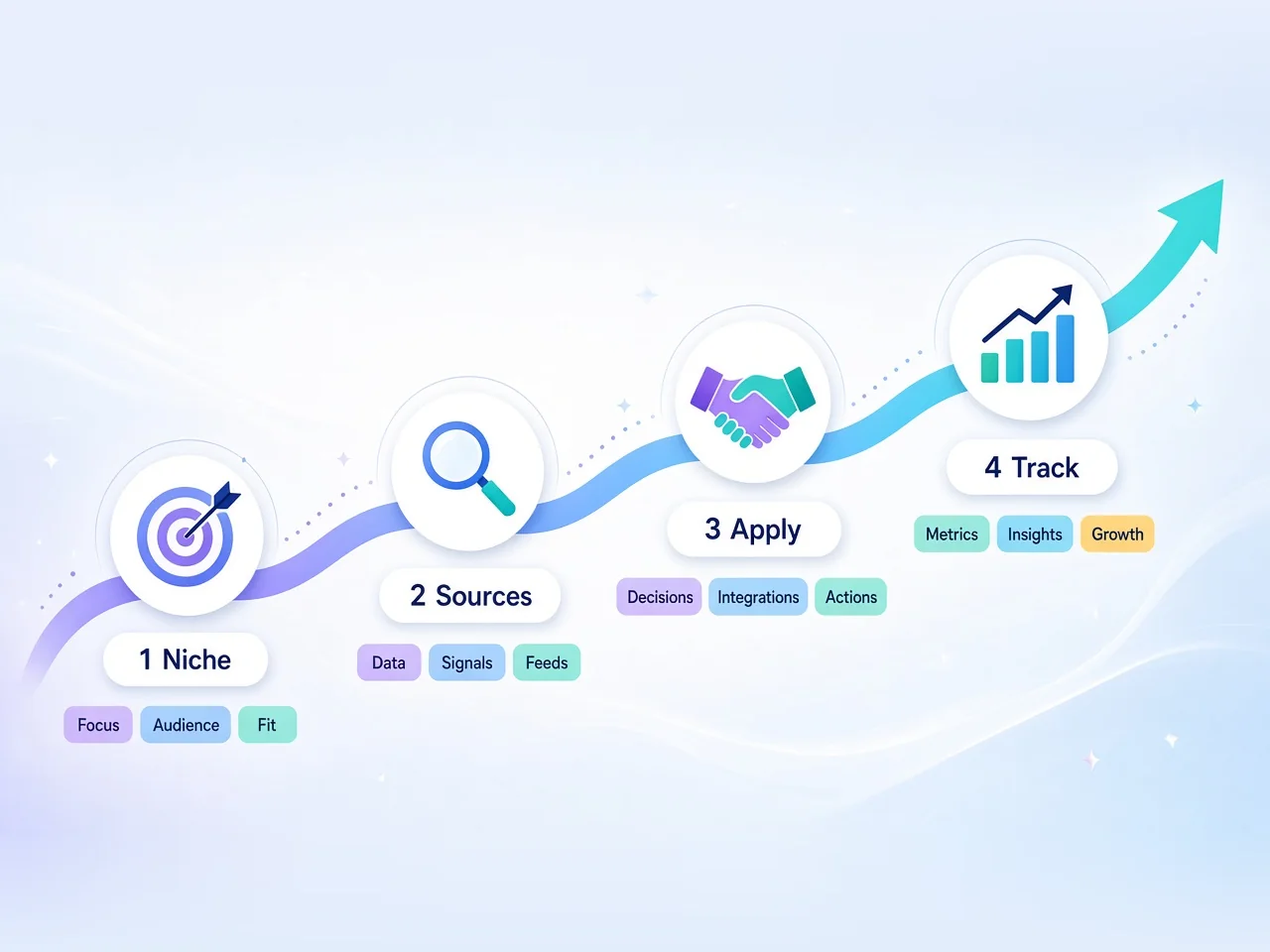
Four stages from niche definition to tracked promotions
How to evaluate a program before you apply
Build a one-page scorecard. Exact fields beat vibes:
Check
What “good enough” looks like
Audience fit
Readers already use or research the product
Commission model
% of sale, CPA, or recurring—matches your content cycle
Cookie / attribution
Window long enough for your typical research time (see affiliate cookies)
EPC / conversion clues
Network stats or public case studies if available—not required, but useful
Payout terms
Clear minimum, method, and validation lock
Creative & deep links
Product-level links, not homepage-only redirects
Traffic policy
Allows your channels (content, email, social, paid—if you use them)
Brand safety
Claims you can support without stretching compliance
Reject programs that fail fit even if the rate looks exciting. A 40% digital info offer that alienates a trust-based audience is a brand tax, not a win. Likewise, a famous brand with a 24-hour cookie may still lose to a quieter merchant with a 45-day window if your content is mid-funnel.
Also sanity-check lock periods (how long commissions stay pending for returns) separately from cookie duration—they solve different problems and are often confused.
Application workflow that gets more approvals
01Polish the destination first. One strong pillar URL beats ten thin stubs.
03Show niche proof. Two or three URLs that already mention related products.
04Apply in batches of 5–10 closely related merchants, not 80 random ones.
05Follow up once after a week if the network allows messaging; do not spam.
06Track declines. “Coupon site only” or “insufficient traffic” tells you what to fix next sprint.
If you need leverage later, how to negotiate higher affiliate commissions covers what managers usually want to see (volume, quality, creative tests). Do not ask for a bump on day one with zero clicks.
Organize discovery so it compounds
Keep a simple sheet (or Notion table) with columns: brand, network/direct, cookie, commission, status (researching / applied / approved / rejected), primary URL you’ll promote, subID convention, and notes. Revisit monthly. Programs you rejected for a short cookie might improve; brands you loved might cut rates or tighten coupon rules.
Document why you approved or rejected each program in one sentence. Future you will forget whether a decline was about traffic quality or coupon policy. That note saves re-applying blindly three months later when the merchant reopens content affiliates.
When a page is ready to convert, pair the right offer with a focused landing experience—structure matters as much as the link. See How to build an affiliate landing page once you have approvals in hand. For Amazon-heavy niches, decide deliberately whether a marketplace program or a merchant network offer is the better hero link (Amazon Associates vs ShareASale once that comparison is live, or run the same cookie-vs-catalog logic yourself).
Common mistakes
Joining networks before defining the niche. You will drown in irrelevant merchants.
Trusting directory rates forever. Always confirm on the official program terms.
Promoting before approval. Dead links and “pending” CTAs train readers to bounce.
One mega-network dependency. Diversify across at least two homes so a single TOS change does not zero your month.
Ignoring disclosures. Material-connection language belongs next to the recommendation, not buried in a footer maze (WordPress disclosure how-to).
Chasing only recurring SaaS when your audience buys physical goods. Match commission shape to purchase behavior.
Step-by-step checklist (run this week)
01Write your three niche lists (products, buying jobs, constraints).
02Pull 15 candidate brands from directories + competitor disclosures.
03Open accounts on the networks that host the densest matches (often ShareASale/Awin, CJ, Impact).
04For each candidate, fill the scorecard; cut anything that fails fit or policy.
05Apply to your top 8 with polished URLs and honest traffic notes.
06On approval, deep-link the exact product page, add disclosure, and tag the click (subid / campaign) so you can see which URL earns.
07After 30 days, keep the programs that produce tracked revenue or clear learning; pause the rest.
08Schedule a monthly 45-minute discovery block so the pipeline never goes cold.
Affground's verdict
Start from the niche, then use directories and networks as search engines—not as your strategy. Affground and the major networks get you to merchants faster; brand partner pages and competitor reverse-engineering catch the programs directories miss. The publishers who win treat discovery like a weekly ops habit: scorecard, apply, track, prune.
Frequently asked questions
What is the fastest way to find affiliate programs in my niche?
List products your audience already researches, then search those brand names plus “affiliate program” or “partner program,” and scan major networks (ShareASale/Awin, CJ, Impact) filtered by category. Directories speed shortlisting; official program pages confirm terms.
Should I join an affiliate network or go direct to brands?
Start with networks for breadth, shared reporting, and payout plumbing. Add direct brand partner pages when a hero product is missing from your networks or offers better recurring terms. Most serious publishers mix both.
Which affiliate networks should beginners join first?
For many content niches, ShareASale (Awin family), Awin Global, CJ Affiliate, and Impact cover a large share of mainstream merchants. Join the one or two that host the densest matches for your niche first—do not open six empty dashboards.
How do I know if an affiliate program is worth applying to?
Score audience fit, commission model, cookie/attribution window, payout terms, deep-link creatives, traffic policy, and brand safety. Reject high rates that fail fit or policy. Cookie length should match how long your readers typically take to buy.
Why was my affiliate application rejected?
Common reasons include thin or brand-mismatched content, unclear traffic sources, coupon-only positioning when the merchant wants content, or incomplete site details. Fix the destination pages, restate your niche honestly, and reapply to better-matched merchants.
Are affiliate program directories accurate?
They are useful for discovery and comparison, but rates, cookies, and availability change. Treat directory numbers as snapshots and always verify on the merchant’s or network’s live program terms before you publish claims or build a whole content cluster.
How many affiliate programs should I promote?
Quality over quantity. Many niche sites do well with a tight core of approved programs that match their top URLs, then expand monthly. Promoting dozens of weak fits usually hurts conversion and tracking clarity.
Where does Affground fit in finding programs?
Use Affground’s network and program directory as a structured starting map—compare listings, then click through to apply on the official network or brand page. Pair that with your own niche scorecard and competitor research so you are not dependent on any single source.