eCommerce is where affiliate marketing was born and still thrives: recommend physical products, earn a cut when people buy, never touch inventory. This guide covers how it works — the players, the click-to-commission journey, whole-cart credit and cookie windows, the content that converts shoppers, and how to build a store-referral site that earns.
Jul 17, 2026 11 min read
Every time you read a product review, click through to a store, and buy the thing — someone may have just earned a commission for pointing you there. That someone is an eCommerce affiliate, and the model quietly powers a huge slice of online retail: widely cited industry figures suggest affiliate marketing influences a meaningful share of eCommerce orders, and global online retail itself runs into the eCommerce is where affiliate marketing was born, and it's still where most affiliates earn.
trillions of dollars a year.
The appeal is obvious. You don't build the product, hold stock, run a warehouse, or handle a single return — you recommend things people already want to buy and earn a cut when they do. But eCommerce affiliate marketing has its own mechanics, its own content that converts, and its own quirks (product feeds, deep links, seasonal peaks, thin electronics margins) that separate the affiliates who earn from the ones who just plaster links everywhere.
This is the complete guide to how eCommerce affiliate marketing works: the players, the click-to-commission journey, how commissions actually work on physical products, the content that converts shoppers, and how to build a store-referral business that earns. Written for publishers, reviewers and content creators who want to turn product recommendations into income. (New to the model entirely? Start with what affiliate marketing is.)
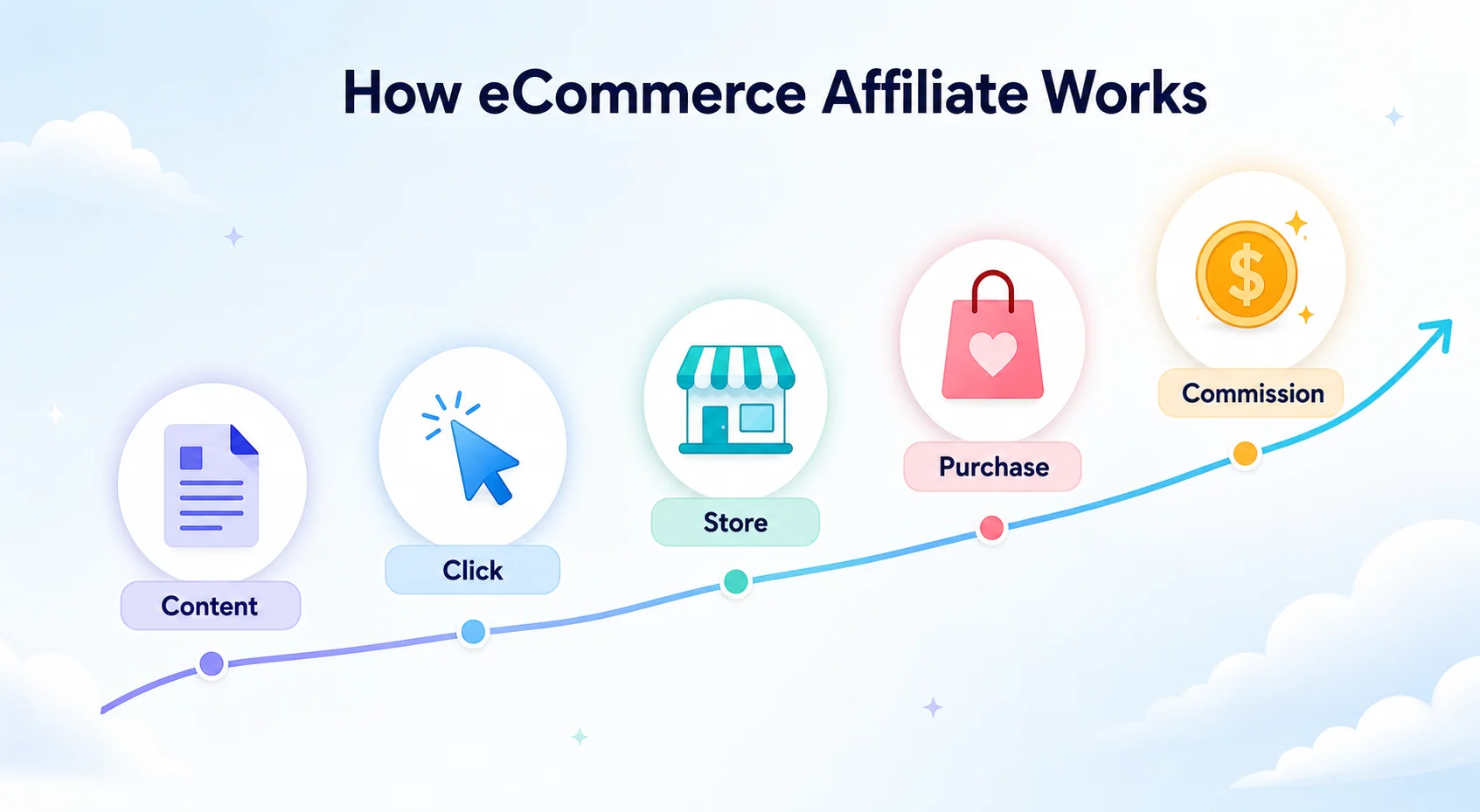
The eCommerce affiliate journey — from a product recommendation to a tracked click, a store purchase, and a paid commission.
What is eCommerce affiliate marketing?
eCommerce affiliate marketing is the practice of earning commission by referring customers to online stores. A publisher recommends a product using a special tracked link; a reader clicks it, buys from the store; and the store pays the publisher a percentage of the sale. It's performance-based retail: the store only pays when a real purchase happens, and the affiliate only earns when their recommendation actually sells something.
What makes it eCommerce specifically is that you're promoting physical or online-store products — electronics, fashion, home goods, beauty, gear — sold through a shop's checkout, rather than software subscriptions or services. That changes the dynamics: purchases are often one-off (not recurring), driven by product research, and clustered around seasonal shopping moments. It's the most beginner-accessible corner of affiliate marketing, because everyone already buys physical things and everyone already asks friends "which one should I get?"
Affground's take: eCommerce affiliate marketing is just being the well-informed friend everyone texts before buying — at scale, and paid. You already tell people which blender, which running shoe, which laptop to get. The model simply pays you a cut when your honest recommendation leads to a purchase, without changing the advice you'd have given for free. The product you're really selling isn't the blender; it's the trusted decision.
How it works, step by step
Behind every eCommerce commission is a short, tracked journey:
1You join a store's program (or a network). You get approved and receive tracked affiliate links for the store's products.
2You create content that recommends products — a review, a comparison, a gift guide — with your links embedded.
3A reader clicks your link. A cookie or server-side record tags the visit as yours, and they land on the store.
4They shop and buy — often not the exact product you linked, but anything in their cart counts, within the cookie window.
5The sale is tracked and attributed to you, and a commission — a percentage of the order — is recorded.
6The commission clears and gets paid, after the store's return/validation window closes.
The two quiet superpowers of eCommerce tracking are in steps 4 and 5: most programs credit you for the whole cart, not just the linked item, and the cookie window (often 24 hours to 30 days) means purchases made days later still count. Send someone to a store for a $20 gadget and earn on the $300 basket they actually check out with. (For the mechanics, see how affiliate tracking works.)
The players in an eCommerce affiliate deal
Four parties make every commission happen:
The merchant / store — the online retailer whose products sell; they fund the commission. Could be a giant marketplace or an independent Shopify shop.
The affiliate / publisher (you) — you create content and place tracked links, sending shoppers to the store.
The customer — your reader, who clicks and buys.
The affiliate network — the platform most stores use to run their program: it generates links, tracks sales, handles attribution and pays you. Some large retailers run programs in-house; most plug into a network.
How eCommerce commissions actually work
Commissions on physical products behave differently from SaaS or services, and the details decide your earnings:
Factor
How it works in eCommerce
Why it matters
Commission rate
A % of the sale, varying by category
Electronics pay little; fashion/niche pay more
Whole-cart credit
Usually the entire order counts
You earn beyond the item you linked
Cookie window
Often 24 hours to 30 days
Longer windows capture the slow buyer
Average order value
Bigger baskets, bigger commission
High-AOV niches earn more per sale
Returns / reversals
Refunded orders claw back commission
Return-heavy categories erode earnings
The category effect is the big one. A 3% commission on electronics (razor-thin retail margins) is very different from a 10–15% commission on fashion, beauty or specialty gear. The highest-earning eCommerce affiliates gravitate toward higher-margin, higher-commission categories and toward products with high average order values, because the math — rate × basket size × conversion — beats chasing the highest-traffic but lowest-paying products.
What makes eCommerce affiliate different
A few dynamics are specific to selling physical products, and mastering them is the edge:
Product data feeds — stores provide feeds of live prices, images and availability that you plug into comparison tables and buyer's guides. Dynamic, always-current content converts far better than static links.
Deep links — link to the exact product page, not the homepage. Relevance drives conversion; a shopper who wanted a specific item should land on it.
Coupons and deals — discount codes and deal roundups give shoppers a reason to buy now, and deal content is some of the highest-converting in eCommerce.
Seasonal peaks — Black Friday, Cyber Monday, the holidays and category seasons (back-to-school, summer gear) are when eCommerce affiliate income spikes. Publish ahead of them.
Reviews and comparisons — physical products invite exactly the research content affiliates do best: "best X," "X vs Y," hands-on reviews.
The content that converts shoppers
eCommerce affiliate income follows content built for the moment of decision. The formats that reliably convert:
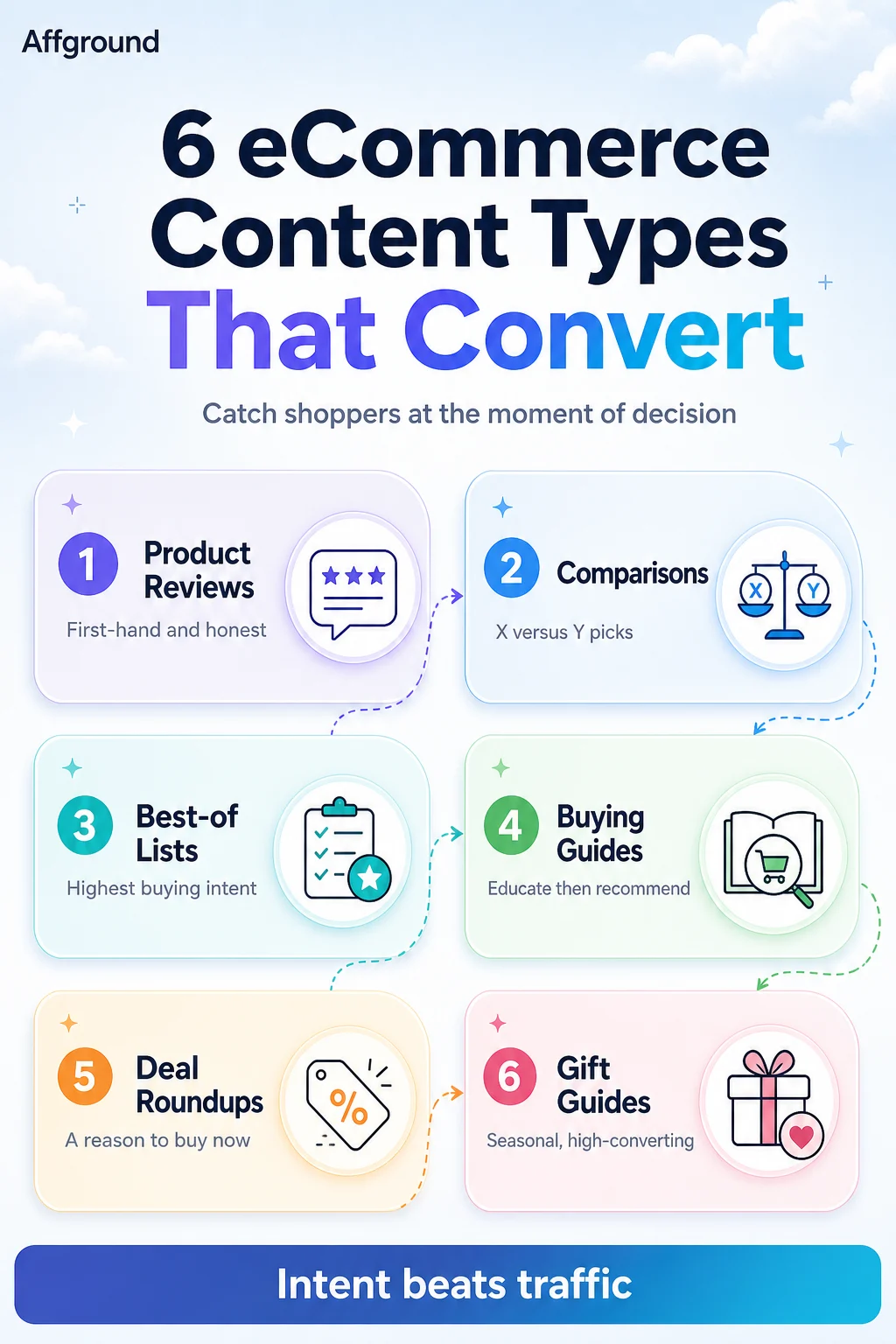
The eCommerce affiliate content that converts — decision-stage formats that catch shoppers with a wallet already open.
Product reviews — first-hand, honest, detailed. The bedrock of eCommerce affiliate.
Comparisons ("X vs Y") — help a reader choose between two options they're already weighing.
"Best X for Y" lists — the highest-intent format; the reader has decided to buy and just needs the pick.
Buying guides — educate a shopper through a considered purchase, then recommend.
Deal roundups — timely discounts that trigger immediate buying.
Gift guides — seasonal, occasion-driven, and famously high-converting around the holidays.
What unites them is buying intent. A reader searching "best noise-cancelling headphones under $200" has a wallet half-open; a reader on a generic "10 cool gadgets" listicle is just browsing. Point your best links at the high-intent content and the same traffic earns multiples more.
Affground's rule: write for the shopper who has already decided to buy and is choosing which one — not the one who's merely curious. Reviews, comparisons and "best X for Y" catch buyers at the decision; generic listicles catch browsers. Intent, not traffic, is what turns eCommerce content into commission.
Where eCommerce affiliate marketing happens
Most eCommerce affiliate activity runs through retail-focused affiliate networks, which bundle thousands of store programs behind one login, dashboard and payout — plus the product feeds and deep-linking tools eCommerce needs. Marketplaces like Amazon Associates run their own huge in-house program, and platforms like Shopify let independent stores run programs directly. For most publishers, a network is the fastest on-ramp:
Browse the full affiliate networks directory to filter by vertical, commission type and cookie window, then shortlist the networks whose retail brands fit your niche.
Commission benchmarks by category
Where you focus decides your ceiling. Here's the rough shape of eCommerce commissions across common categories:
Category
Typical commission
Note
Electronics / tech
~1–4%
Thin margins, but high AOV and volume
Fashion & apparel
~5–15%
Higher rates, big repeat buying
Beauty & cosmetics
~5–15%
High rates, loyal repeat purchasers
Home & garden
~3–10%
Solid AOV on furniture and appliances
Specialty / niche gear
~8–20%
Best rates, passionate buyers
Luxury / high-ticket
Varies, big per-sale
Few sales needed to earn well
(Ranges are indicative and vary widely by store and network.) Two lessons stand out. Electronics pay a low percentage but can still earn through sheer volume and basket size, while niche, beauty and fashion pay generous rates on passionate, repeat buyers. The sweet spot for most affiliates is a category with healthy commission and products their audience genuinely researches before buying.
How to start an eCommerce affiliate site
1Pick a niche you can be credible in — a product category you actually know and buy in. Depth beats a generic "deals" site.
2Join a retail network (plus any direct store programs that fit) to get links, feeds and deep-linking.
3Publish decision-stage content — reviews, comparisons and "best X for Y" guides for your niche.
4Use deep links and product feeds so readers land on the exact product and your tables stay current.
5Plan around seasonal peaks — ship gift guides and deal content ahead of the big shopping moments.
6Disclose your links, and track what converts — double down on the products and pages that actually earn.
Common eCommerce affiliate mistakes
Chasing low-margin electronics only — huge search volume, tiny commissions; balance with higher-rate categories.
Linking to the homepage — always deep-link to the exact product; relevance converts.
Missing seasonal windows — publishing gift and deal content too late to rank and earn.
Thin, low-intent content — generic listicles browsers scroll past instead of decision-stage guides buyers act on.
Promoting products you haven't researched — recommendations that don't fit torch the trust that makes you convert.
Affground's verdict
eCommerce affiliate marketing is the most accessible, most proven corner of the whole industry: recommend physical products people already want, earn a cut when they buy, and never touch inventory or shipping. The mechanics are simple — tracked links, whole-cart credit, a cookie window, a commission percentage — and the model rewards exactly what a good publisher already does: research products honestly and help people choose. The store handles everything after the click; you get paid for the recommendation.
The affiliates who win at it aren't the ones with the most links — they're the ones who build genuine authority in a category, write for shoppers at the moment of decision, lead with the content that converts, and follow the margin instead of the raw search volume. Do that, exploit the eCommerce-specific tools (feeds, deep links, deal and gift content, seasonal timing), and product recommendations become one of the most durable income streams online. Affground's bet: as retail keeps moving online, the publishers who are genuinely useful to shoppers — not just link-stuffed — will own the eCommerce affiliate economy.
Frequently asked questions
What is eCommerce affiliate marketing?
eCommerce affiliate marketing is earning commission by referring customers to online stores. You recommend a physical or online-store product with a tracked link; a reader clicks it and buys from the store; and the store pays you a percentage of the sale. It's performance-based retail — the store only pays when a real purchase happens — and it covers products like electronics, fashion, home goods and beauty rather than software or services.
How does eCommerce affiliate marketing work?
You join a store's program or a retail network and get tracked links, then create content (reviews, comparisons, guides) with those links. When a reader clicks, a cookie or server-side record tags the visit as yours and sends them to the store. If they buy within the cookie window, the sale is attributed to you and a commission — a percentage of the order — is recorded, then paid after the return window closes. Most programs credit you for the whole cart, not just the item you linked.
How much do eCommerce affiliates earn?
It depends heavily on category, because commission is a percentage of the sale. Electronics pay low rates (around 1–4%) due to thin retail margins, while fashion, beauty and specialty niches pay much more (roughly 5–20%). Actual earnings are rate times average order value times conversion, so a modest rate on a high-value basket can beat a big rate on cheap items. The best-earning affiliates pick categories with healthy commissions and products people genuinely research before buying.
Do you earn on the whole cart or just the product you linked?
In most eCommerce programs, you earn on the entire order — not just the specific item you linked. If a reader clicks your link for a $20 accessory and checks out with a $300 basket, you typically earn commission on the whole $300, as long as the purchase happens within the cookie window. Whole-cart credit and the cookie window are two of the quiet advantages that make eCommerce affiliate income add up.
Which is the best affiliate network for eCommerce?
The largest retail-focused networks — ShareASale, CJ Affiliate and Rakuten Advertising, among others like Awin — are common starting points because they bundle thousands of store programs with the product feeds and deep-linking tools eCommerce needs. Amazon Associates runs its own huge in-house program, and platforms like Shopify let independent stores run programs directly. The best choice depends on which retail brands in your niche each network carries, so compare their merchant rosters and terms.
What content converts best for eCommerce affiliate marketing?
Decision-stage content converts best: first-hand product reviews, head-to-head comparisons, 'best X for Y' lists, buying guides, deal roundups and seasonal gift guides. What they share is buying intent — a reader searching 'best noise-cancelling headphones under $200' is ready to buy and just choosing which one, whereas a generic 'cool gadgets' listicle attracts browsers. Pointing your best links at high-intent content earns far more from the same traffic.
How do you start eCommerce affiliate marketing?
Pick a product niche you can be genuinely credible in, join a retail network (plus any direct store programs that fit) to get tracked links and feeds, and publish decision-stage content — reviews, comparisons and 'best X for Y' guides. Use deep links so readers land on the exact product, plug product feeds into your comparison tables, plan gift and deal content around seasonal peaks, disclose your links, and track which products and pages actually convert so you can double down on them.