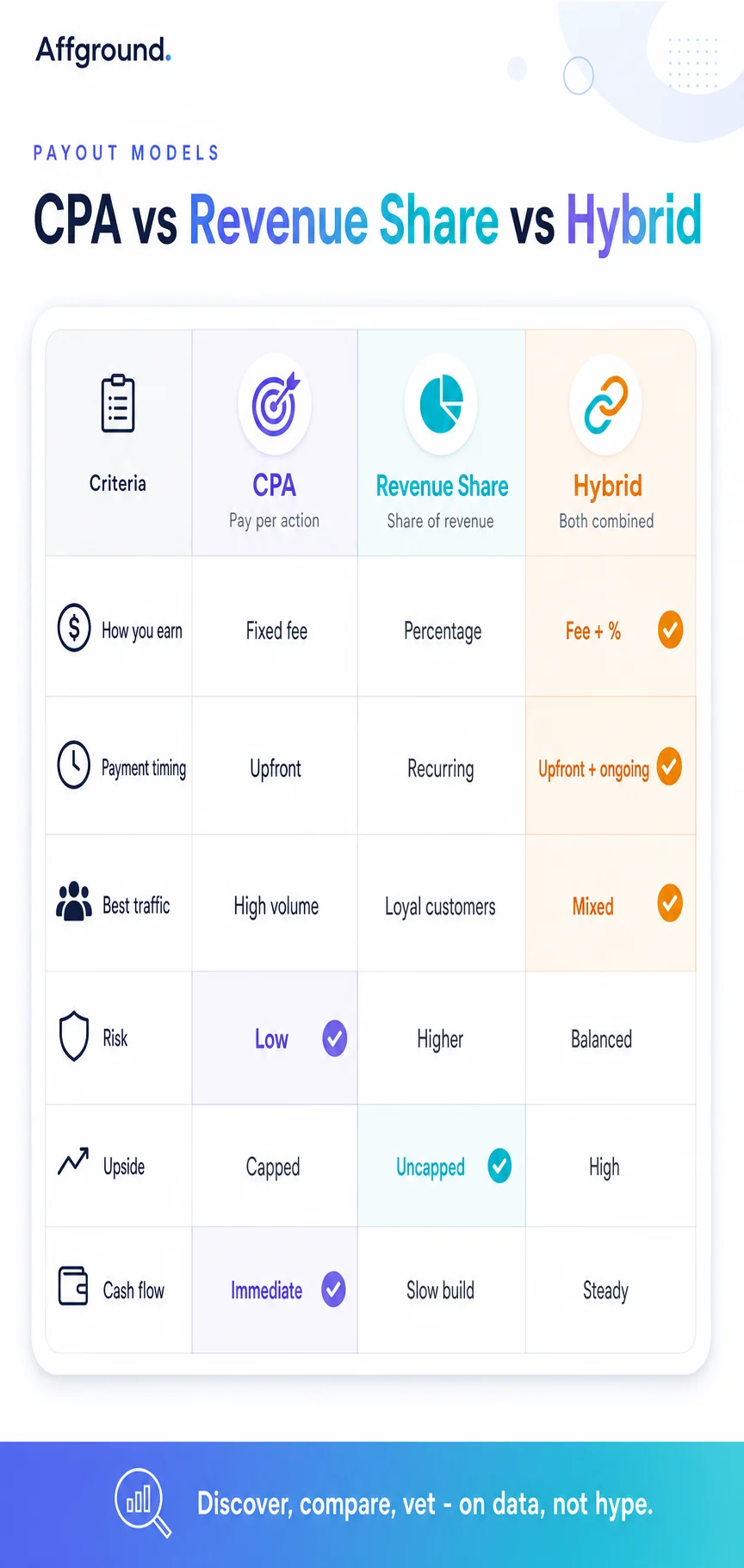
CPA pays a fixed fee per action, revenue share pays a recurring cut, and hybrid blends both. Here is the in-depth comparison — the real math, when each model wins, the fine print, and how to choose the right one for your traffic.
Jul 9, 2026 · 16 min read
Every affiliate deal you will ever be offered comes down to one question hiding in the fine print: how, exactly, do you get paid? Get the answer right and a modest amount of traffic can fund a business. Get it wrong — chase the flashy percentage, ignore the timing — and you will work hard for a fraction of what you actually earned.
There are three answers, and they define the entire economics of affiliate marketing: CPA (a fixed fee per action), Revenue Share (a percentage of ongoing revenue), and Hybrid (a blend of both). They are not interchangeable. Each rewards a different kind of traffic, pays on a different timeline, and carries a different kind of risk.
This is the comprehensive, no-hand-waving guide to all three. We will define each properly, run the actual math side by side, show exactly when each one wins, decode the fine print that quietly makes or breaks your earnings, and give you a framework to pick the right structure for traffic. By the end, you will read a commission offer the way a pro does.
your
CPA vs revenue share vs hybrid — CPA wins on certainty and speed, revenue share on upside, hybrid on balance.
The three models at a glance
Before we go deep, here is the whole thing in three sentences:
CPA (Cost Per Action) pays you a fixed amount every time your referral completes an action — usually a sale or signup. One action, one payout, done.
Revenue Share (RevShare) pays you a percentage of the revenue your referral generates, often recurring for as long as they stay a customer.
Hybrid combines the two: a smaller upfront CPAplusongoing RevShare, so you get paid today and tomorrow.
Think of it as a spectrum from certainty to upside. CPA is the certain, immediate money. RevShare is the patient, compounding money. Hybrid deliberately sits in the middle.
CPA (Cost Per Action): get paid per action
CPA is the simplest model to understand and the easiest to forecast. You send a customer, they complete the qualifying action — a purchase, a signup, a deposit, a form submission — and the merchant pays you a fixed, agreed amount. A $50 CPA means $50 per conversion, whether the customer goes on to spend $10 or $10,000.
Why affiliates love it:
Predictable. You know exactly what each conversion is worth, which makes forecasting and reinvestment easy.
Immediate. You are paid at the point of conversion, not months down the line — great for cash flow.
Volume-friendly. For high-traffic, lower-commitment audiences, a fixed fee per action adds up fast and does not depend on whether the customer sticks around.
Clean. No worrying about churn, refunds eroding a percentage, or lifetime-value calculations.
The trade-off:
Capped upside. You get paid once. If the customer you sent becomes a $5,000-a-year whale, you still only got your $50.
You are paid for the action, not the value. A merchant offering CPA has usually priced it around their average customer — so if you send unusually valuable customers, you are leaving money on the table.
CPA dominates in performance marketing, lead generation, app installs, and any vertical where volume and predictability matter more than long-term value.
Revenue Share (RevShare): get paid a cut, often forever
RevShare flips the logic. Instead of a fixed fee, you earn a percentage of the revenue your referral generates — 20%, 30%, sometimes more — and in many programs that continues for the customer's entire lifetime. Send someone who pays $40 a month on a 30% deal, and you earn $12 every month for as long as they stay.
Why affiliates love it:
Uncapped, compounding upside. One loyal, high-value customer can pay you for years. A mature RevShare portfolio behaves like a dividend.
Aligned incentives. You and the merchant both want the customer to stay and spend — so you are rewarded for sending quality, not just volume.
Passive-feeling income. Customers you referred long ago keep paying out while you work on new content.
The trade-off:
Slow to build. Early months can feel thin; the money compounds later, not now.
You inherit the merchant's risk. If customers churn, refund, or the product's retention is weak, your income suffers — factors you do not fully control.
Fine print matters enormously. "Percentage of what?" and "for how long?" decide your real earnings far more than the headline rate.
RevShare rules in SaaS, iGaming, finance, hosting and subscriptions — anywhere customers pay on an ongoing basis. We go deep on it in our dedicated guide to what revenue share is.
Hybrid: the best of both worlds
Hybrid is exactly what it sounds like: a combination of CPA and RevShare. A typical hybrid deal pays you a smaller upfront fee when the customer converts, plus an ongoing revenue share for as long as they stay. For example: $30 on signup, then 15% recurring.
Why affiliates (and smart merchants) love it:
*Cash flow and upside.* You get paid something immediately to fund your work, and you keep earning if the customer sticks — you are not forced to choose between now and later.
De-risked acquisition. The upfront fee cushions you against slow starts and covers your acquisition effort, while the RevShare preserves the long-term compounding.
Fairer for quality traffic. If you send valuable, loyal customers, the RevShare portion rewards you for it — unlike pure CPA.
The trade-off:
Lower numbers on each side. The upfront CPA is usually smaller than a pure-CPA deal, and the RevShare percentage is usually lower than a pure-RevShare deal. You trade the peak on either axis for balance across both.
More complex to track. Two payout mechanics mean two sets of terms to understand.
For many established affiliates, hybrid is the pragmatic default — it hedges the biggest weaknesses of the other two models at once.
The core trade-off: a one-time payout you can bank now versus recurring revenue that compounds later.
CPA vs Revenue Share vs Hybrid: the full comparison
Here is how the three stack up across the criteria that actually decide your earnings:
CPA
Revenue Share
Hybrid
How you earn
Fixed fee per action
% of ongoing revenue
Upfront fee + ongoing %
Payment timing
Once, upfront
Recurring, often lifetime
Upfront + recurring
Cash flow
Immediate
Slow to build
Steady from day one
Upside
Capped
Uncapped, compounds
High, balanced
Risk
Low (paid at conversion)
Higher (depends on retention)
Balanced
Best traffic
High-volume
Loyal, high-value
Mixed / most audiences
Best verticals
Leadgen, apps, retail
SaaS, iGaming, finance
Almost anywhere
Predictability
High
Low early, high later
Medium-high
The pattern is clear: CPA optimizes for certainty and speed, RevShare for upside and alignment, and Hybrid for balance. None is "best" — the right one depends entirely on your traffic and your patience.
The math: the same 100 customers, three ways
Nothing makes this concrete like numbers. Imagine you send a subscription product 100 paying customers over a year. The product costs $40/month, and the average customer stays 18 months (a $720 lifetime value). You are offered three deals:
CPA: $60 per customer, once.
RevShare: 25% recurring, for the customer's lifetime.
Hybrid: $25 upfront + 10% recurring.
CPA: 100 × $60 = $6,000, paid roughly as they sign up. Fast and certain.
RevShare: 25% of $40 is $10/month per customer × 18 months = $180 each. 100 × $180 = $18,000 — but spread over roughly two years.
Hybrid: $25 upfront × 100 = $2,500, plus 10% of $40 is $4/month × 18 months = $72 each × 100 = $7,200. Total = $9,700 — with $2,500 arriving immediately and the rest compounding.
So on these numbers, RevShare earns the most if the customers stay and you can wait ($18k). CPA earns the least in total but pays fastest and carries zero retention risk ($6k now). Hybrid lands in between ($9.7k) with money upfront and ongoing. Now change one assumption — say customers only stay 4 months — and the picture flips: RevShare drops to $4,000, CPA still pays $6,000, and hybrid pays $2,500 + $1,600 = $4,100. Retention is the variable that decides which model wins.(Illustrative figures — but the mechanics are exactly how it works.)
When CPA is the right call
Reach for CPA when:
Your traffic is high-volume and lower-commitment — casual, broad, one-and-done visitors who convert but may not stick.
You need predictable cash flow — you are starting out, running paid media, or reinvesting fast and cannot wait for RevShare to compound.
The product has weak retention or high refunds — a fixed fee paid at conversion insulates you from what happens next.
You want simple forecasting — CPA makes it easy to calculate EPC and ROI per campaign.
CPA is the model of now: certain, fast, and volume-friendly.
When Revenue Share is the right call
Reach for RevShare when:
You send loyal, high-value customers — engaged, well-matched buyers who stay for the long haul.
The product is sticky — subscriptions, SaaS, memberships and services with strong retention.
You can be patient — you are building a durable, content-led asset and can wait for the compounding to kick in.
Lifetime value is high relative to a one-time fee — do the math: a modest percentage of a big LTV usually beats a flat CPA.
RevShare is the model of later: patient, compounding, and aligned.
When Hybrid is the right call
Reach for Hybrid when:
You want both cash flow and upside and refuse to choose between them.
You are testing a new program — the upfront fee de-risks the experiment while the RevShare captures the long-term potential if it works.
Your traffic is mixed — some customers churn quickly, others stay for years; hybrid pays you fairly across both.
You are negotiating — hybrid is often the easiest structure to agree on, because it balances the merchant's and the affiliate's risk.
Hybrid is the model of balance: a little now, more later, less all-or-nothing.
Affground's take: if you are unsure which model fits, default to hybrid and let the data teach you. It is the lowest-regret choice — you get paid something immediately (so a dud program does not cost you months) while keeping the compounding upside (so a winner keeps paying). Certainty for the downside, upside for the winners. That is just good risk management.
Which model is most common in your vertical?
Different industries gravitate toward different structures, and knowing the norm helps you spot a good — or bad — deal:
SaaS & software — RevShare and hybrid dominate, thanks to recurring subscriptions and strong retention. Lifetime or long-window recurring is the prize.
iGaming (casino & sportsbook) — RevShare, CPA and hybrid all thrive; the hybrid "CPA + RevShare" deal is extremely common. Watch for negative carryover on the RevShare portion.
Finance & crypto — a mix: CPA for account signups and deposits, RevShare for a cut of ongoing trading fees, hybrid for both.
E-commerce & retail — usually a percentage of each sale (a form of RevShare per order) or a flat CPA per sale; true lifetime recurring is rarer.
Lead generation & apps — CPA and CPL rule, because the "action" — a lead or an install — is the whole product and lifetime value is harder to attribute.
If a program offers you a structure that is unusual for its vertical, that is not automatically bad — but it is a prompt to ask why, and to model whether it actually pays.
Related models you'll also hear about
CPA, RevShare and hybrid are the big three, but you will bump into a few cousins — all variations on "what triggers your payout":
CPL (Cost Per Lead) — a fixed fee per lead rather than a sale: a form fill, free trial or quote request. It is essentially CPA with a lower bar (and a lower value), common in finance, insurance and lead generation.
CPS (Cost Per Sale) — often used interchangeably with CPA in retail, but strictly it means a payout tied to a completed sale, frequently as a percentage of the order rather than a flat fee.
CPC (Cost Per Click) — you are paid per click you send, regardless of whether it converts. Rare in affiliate programs, more common in ad networks.
CPM (Cost Per Mille) — payment per thousand impressions. This is an advertising model, not really affiliate — you earn from displaying ads, not from referrals converting.
The key distinction: CPA, CPL and CPS pay for outcomes you drive; CPC and CPM pay for traffic or attention. Affiliate marketing lives firmly in the outcome camp — which is exactly why CPA, RevShare and hybrid are the structures that matter most.
The fine print that changes everything
Two deals with identical headline numbers can pay wildly differently once you read the terms. Watch for:
Net vs gross (RevShare & hybrid). Is your percentage calculated on the full amount the customer pays (gross) or after fees, taxes, refunds and chargebacks (net)? Net can be meaningfully smaller.
Negative carryover (mostly iGaming RevShare). Does a losing month roll a negative balance into the next, eating future earnings? A monthly reset is far safer.
The "lifetime" definition (RevShare & hybrid). "Lifetime" sometimes means the customer's whole tenure, sometimes a capped window of 12 or 24 months. Confirm which.
Qualifying action & baseline (CPA & hybrid). What exactly counts as the "action"? A signup, a first deposit, a retained customer? Some CPA deals only pay for customers who pass a quality bar or stay past a refund window.
Chargebacks & clawbacks (all three). If a customer refunds, your commission is usually reversed. High-refund products quietly erode earnings under any model.
Caps and tiers. Some deals cap total payout; others unlock better rates above volume thresholds. Know where you stand.
Affground's rule: the structure is the product, not the headline number. Before you celebrate any offer, find the words "net," "lifetime," "qualifying," "chargeback" and "cap" in the terms. If they are not there, ask — and if the answers are vague, treat that as information.
How to match the model to your traffic
The single best predictor of which model will earn you the most is the nature of your traffic:
Broad, high-volume, casual traffic (viral content, deals sites, wide-net SEO) points to CPA — bank the fixed fee before the customer churns.
Niche, high-intent, loyal traffic (expert reviews, trusted newsletters, tight communities) points to RevShare or Hybrid — your customers stay, so let the percentage compound.
Mixed or unknown traffic (you are still learning what converts) points to Hybrid — it pays fairly regardless of how long customers stay, and the data tells you where to lean next.
The mistake is picking a model based on its biggest number instead of your actual audience. Match the structure to the behavior of the customers you send, and the earnings follow.
How to negotiate a better structure
Commission structures are more flexible than the signup page implies — especially once you can prove your traffic converts. Levers to pull:
Ask to switch models. If a program defaults to CPA but your customers have great retention, ask for RevShare or a hybrid — you may earn far more.
Bring data. Nothing moves terms like showing a manager your conversion quality, retention or volume. Evidence earns better deals.
Negotiate the base, not just the rate. Moving from "net" to "gross," removing carryover, or extending the lifetime window can be worth more than a few extra percent.
Trade volume or exclusivity for a better structure. Offer a dedicated review or a volume commitment in exchange for a hybrid or a higher RevShare.
Get a manager. Direct programs and larger networks can approve custom structures a self-serve signup never will.
Affground's take: the published structure is a starting point, not a law. The affiliates earning the most rarely take the default deal — they matched the model to their traffic, brought receipts, and asked.
Common mistakes to avoid
Judging by the headline number. A 40% RevShare on net after heavy refunds can lose to a 20% gross deal — or to a clean CPA. Always model the real math.
Ignoring your cash-flow reality. Chasing lifetime RevShare when you need money this month to reinvest can starve your growth. Sometimes CPA's speed is worth more than RevShare's ceiling.
Forgetting retention. RevShare and hybrid live or die on whether customers stay. Promoting a high-churn product on RevShare is a slow way to earn nothing.
Never re-negotiating. Your traffic improves; your deal should too. Affiliates leave money on the table by never asking to switch structures.
One model everywhere. Different programs and audiences suit different structures. Smart affiliates run a mix — CPA where speed matters, RevShare where loyalty pays, hybrid when unsure.
Where to find flexible commission deals
The programs and networks that let you choose or negotiate your structure are worth prioritizing. A practical starting shortlist spanning a major network, a SaaS partnership platform and a self-serve performance platform:
CPA, Revenue Share and Hybrid are not rivals — they are three tools for three jobs. CPA buys you certainty and speed. Revenue Share buys you upside and alignment. Hybrid buys you balance, hedging the weaknesses of both. The "best" model is simply the one that matches the traffic you actually have and the cash flow you actually need.
So do the boring, profitable thing: model the real math (rate × conversion × lifetime value), read the fine print (net, lifetime, qualifying, chargebacks), and match the structure to your audience's behavior. When you are genuinely unsure, hybrid is the lowest-regret default. Master that, and you stop being the affiliate who chases the biggest percentage — and become the one who quietly earns the most. As always, Affground's bet is on the operators who decide on data, not hype.
Frequently asked questions
What is the difference between CPA and revenue share?
CPA (cost per action) pays a fixed fee each time your referral completes an action, like a sale or signup — once, upfront. Revenue share pays a percentage of the ongoing revenue that customer generates, often recurring for their lifetime. CPA is predictable and immediate; revenue share starts slower but can earn far more from loyal customers.
What is a hybrid commission model?
A hybrid deal combines CPA and revenue share: a smaller upfront fee when the customer converts, plus an ongoing percentage of their revenue for as long as they stay. It gives you immediate cash flow and long-term upside at once, which is why many established affiliates treat it as the default, lowest-regret structure.
Which pays more — CPA, revenue share or hybrid?
It depends on retention. For loyal, high-value customers, lifetime revenue share usually earns the most over time. For high-volume or low-retention traffic, CPA often earns more because it is paid upfront regardless of churn. Hybrid lands in between with money now and later. Always model rate times conversion times lifetime value before deciding.
Is hybrid always the best choice?
Not always, but it is the lowest-regret default when you are unsure. Hybrid pays less on each individual axis than a pure CPA or pure revenue share deal, so if you know your traffic well — high-volume suits CPA, loyal suits revenue share — a pure model can out-earn it. Hybrid shines when your traffic is mixed or the program is unproven.
What does net vs gross mean for revenue share and hybrid?
It defines what your percentage is calculated on. Gross is the full amount the customer pays; net is what is left after fees, taxes, refunds and chargebacks. A net-revenue deal can pay noticeably less than a gross one at the same headline rate, so always confirm which base applies before signing.
Can I negotiate which commission model I get?
Often, yes — especially once you can prove your traffic converts. Many programs default to one model but will switch you to revenue share or hybrid, adjust the base, or extend the lifetime window if you bring data on your conversion quality, retention or volume. The published structure is usually a starting point, not a hard limit.
Which commission model is best for beginners?
If you need predictable income and are still learning what converts, CPA or hybrid is usually the safer start — you get paid at conversion rather than waiting months for revenue share to compound. As you learn which brands your audience stays loyal to, you can shift those to revenue share or hybrid for more long-term upside.
What is negative carryover?
It is a clause, common in iGaming revenue share and the revenue-share portion of hybrid deals, where a month in which referred players win more than they lose creates a negative balance that rolls into your next month, reducing future earnings. A program that resets the balance monthly is much safer for an affiliate.