Click windows, view-through windows and multi-touch attribution explained: how networks match sales to your clicks, typical window lengths, what shortens them, and how to plan content around them.
Oct 8, 2026 · 7 min read
An attribution window is the stretch of time after someone clicks or sees your link during which a sale can still be credited to you. It sounds like a footnote in the program terms, but it often decides more of your income than the commission rate: the same link can pay on a purchase made weeks later, or earn nothing because the buyer waited 25 hours.
This guide is for affiliates and publishers who want to understand what they are actually being credited for. We cover the three ideas that get blurred together, click windows, view-through windows and multi-touch attribution, how networks apply them, the real numbers you will see in program terms, and how to plan content around them.
Every affiliate click starts a clock; the window decides whether the sale is still yours.
What an attribution window is
When a reader clicks your affiliate link, the tracking system records that click with your publisher ID and a timestamp. If the reader converts before the window closes, the conversion is matched back to that click and you earn the commission. After the window closes, the click still exists, but it no longer counts.
Programs usually describe this as a cookie duration ("30-day cookie") because, historically, the click was stored in a browser cookie. Today the record may live in a first-party cookie, a server-side click ID, or a postback, but the idea is the same: a lookback period in which a conversion can be tied to your referral. Our explainer on what an affiliate cookie is covers the storage side in detail.
How it works, step by step
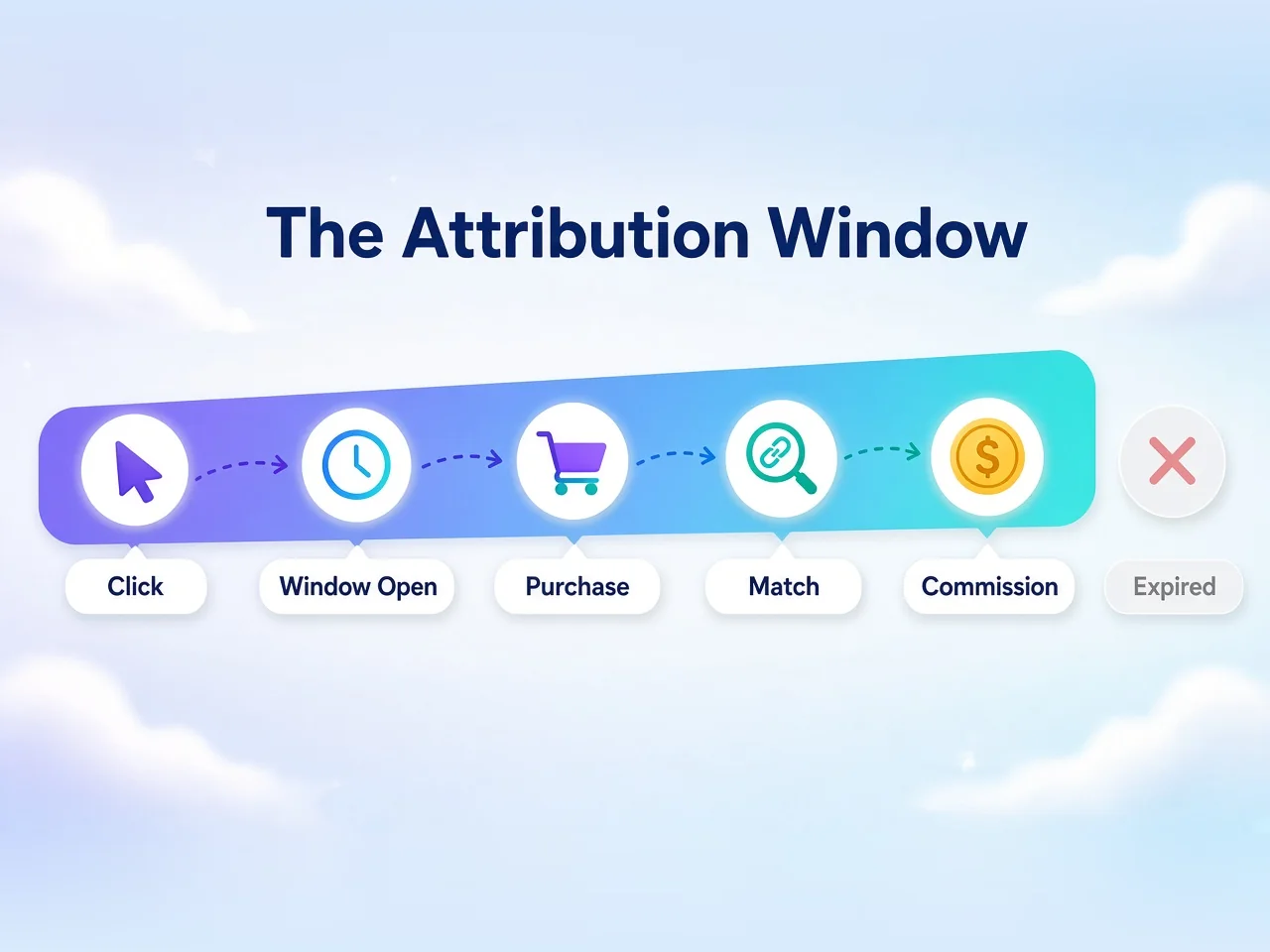
01Click. The reader clicks your link; the network logs a click ID and starts the clock.
02Window open. The reader browses, compares and leaves. The click record waits.
03Conversion. The reader buys. The advertiser fires a pixel or postback with the order details.
04Matching. The network looks back for a valid click inside the window, applies the program's attribution rule, and credits the winning publisher.
05Lock period. The commission sits as pending until returns and cancellations clear, then it is approved.
The window is a lookback: a sale inside it is matched to your click, a sale after it is not.
Two rules matter at the matching step. First, most affiliate programs use last-click attribution: if two publishers both sent the same buyer, the most recent valid click wins. Second, a new click from another affiliate usually overwrites yours, even if your window has days left. A long cookie protects you from time; it does not protect you from a competitor's coupon link clicked at checkout.
Click windows vs view-through vs multi-touch
These three terms get used interchangeably. They are not the same thing.
Concept
What triggers credit
Where you see it
What it means for affiliates
Click-through window
A click on your link, then a conversion inside N days
Almost every affiliate program ("30-day cookie")
The standard. Your income depends on the window length and on not being overwritten
View-through window
An ad impression with no click, then a conversion inside N days
Display, video and social ad platforms
Rare in affiliate programs; mostly an advertiser reporting metric
Multi-touch attribution
Credit split across several touchpoints in the journey
Analytics tools and some enterprise partnership platforms
Can reward early-funnel content that last-click ignores, if the advertiser pays on it
View-through is common in paid media. Google Ads, for example, defaults to a 30-day click-through conversion window and a 1-day view-through window for display campaigns, and Meta's default reporting setting is 7-day click and 1-day view. Affiliate programs rarely pay on views because an impression is weak evidence of influence and easy to inflate.
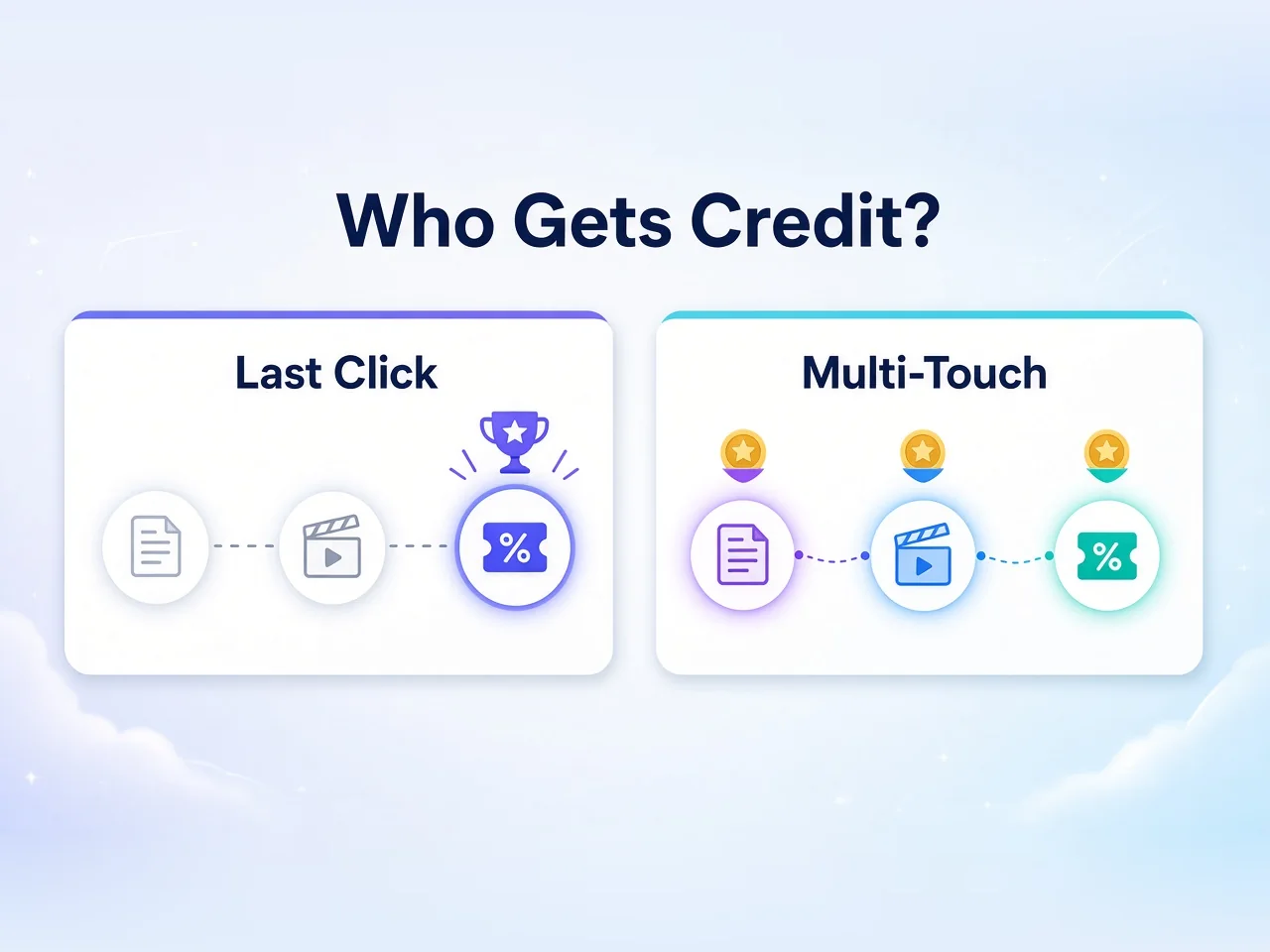
Multi-touch models include first-click, linear (equal split), time-decay and position-based. Google Analytics 4 now defaults to data-driven attribution for reporting. In affiliate programs, the more common version is a rule set rather than a true model: some advertisers on enterprise platforms pay a different rate to content partners that introduced the customer versus coupon partners that closed the sale. Ask your affiliate manager whether anything beyond last click applies.
Last-click gives all the credit to the final touch; multi-touch models spread it across the journey.
The numbers you will actually see
Window lengths vary enormously. These defaults come from Affground's listing data; individual brands on a network often set their own.
Program or network
Default window in listing
Notes
Amazon Associates
1 day
Items added to the cart within that day can still credit if bought within 90 days
Udemy (via Rakuten)
7 days
Short window on a deal-driven catalog
Awin
30 days
Network default; brands vary
Impact.com
45 days
Network default; brands vary
CJ Affiliate
45 days
Network default; brands vary
ClickBank
60 days
Applies across most marketplace products
PartnerStack
90 days
Common for B2B SaaS programs
Digistore24
180 days
Long window for digital products
The pattern is consistent: impulse retail runs short, considered purchases run long. SaaS and digital products, where buyers trial, compare and wait for approval from a manager, tend to come with 60–180 days. Marketplaces with fast checkout run hours to days.
What shortens a window in practice
The number in the terms is a maximum, not a promise. Real windows are often shorter because of:
Browser privacy limits. Safari's Intelligent Tracking Prevention caps cookies set by scripts at 7 days, and can cut that to 24 hours in some cross-site tracking scenarios. A "90-day cookie" stored that way may expire long before day 90.
Cookie clearing and device switching. A click on mobile followed by a purchase on desktop is lost unless the advertiser can match the user across devices.
Overwrites. Coupon and cashback extensions frequently take the last click right before checkout.
Ad blockers that strip tracking parameters or block the conversion pixel.
This is why tracking method matters as much as window length. Programs that use server-side or postback tracking keep the click record on the server rather than in the browser, so the stated window survives privacy limits far better. See server-side tracking and pixel vs postback tracking.
A practical framework
Use the window to decide what to write and where to send readers:
Short windows (under 7 days): favour bottom-of-funnel content, deal roundups and comparison pages where the reader is ready to buy now. Deep-link straight to the product.
Medium windows (30–45 days): reviews and buyer's guides work well; readers can research and come back.
Long windows (60 days and up): tutorials, learning paths and educational content earn here, because the reader can take weeks to decide.
Then check the tracking method. A long window on browser-only cookies is worth less than a medium window on server-side tracking.
Where to start
These networks and programs in the Affground directory show the range of attribution windows, from long SaaS and digital-product windows to large retail networks where each brand sets its own.
Comparing rates without windows. 10% on a 90-day window often outearns 15% on a 24-hour one.
Assuming the window can't be overwritten. Last click usually wins, whatever your cookie length.
Trusting the stated window on browser-only tracking, especially with a large Safari audience.
Confusing view-through ad metrics with affiliate commissions you will actually be paid.
Not asking. Attribution rules are negotiable for strong partners; our guide to negotiating higher commissions covers how to raise it.
Step-by-step: audit your attribution
01List your top programs with their window length, attribution rule and tracking method.
02Tag links with sub IDs so you can see click-to-conversion lag by page; see how to use sub IDs.
03Compare typical conversion lag against each program's window.
04Move short-window programs to bottom-of-funnel pages and long-window programs to educational content.
05Ask managers whether they use server-side tracking or any rule beyond last click.
Affground's verdict
An attribution window is a lookback rule, not a guarantee. Read it together with the attribution rule and the tracking method, and weight programs by how long your readers really take to buy. Long windows on server-side tracking are where patient, high-quality content gets paid fairly.
Frequently asked questions
What is an attribution window in affiliate marketing?
It is the period after a click during which a conversion can still be credited to the affiliate who sent it. Programs usually express it as a cookie duration, such as a 30-day cookie.
Is an attribution window the same as a cookie duration?
In practice, yes. Cookie duration is the older term because clicks were stored in browser cookies; today the click may be stored server-side or passed via postback, but the lookback period works the same way.
What happens if another affiliate's link is clicked after mine?
Under last-click attribution, which most affiliate programs use, the most recent valid click usually wins and overwrites yours, even if your window has time left.
Do affiliate programs pay on view-through conversions?
Rarely. View-through windows are common on ad platforms for reporting, but affiliate programs almost always require a click because an impression alone is weak evidence of influence.
What is multi-touch attribution?
It splits credit across several touchpoints in a buyer's journey using models such as first-click, linear, time-decay or position-based. Some advertisers apply rules that reward content partners differently from coupon partners, so ask your manager what applies.
How long is the Amazon Associates attribution window?
Amazon uses a 24-hour window, but items added to the cart during that window can still earn commission if purchased within 90 days.
Why do my conversions seem lower than the cookie length suggests?
Browser privacy limits such as Safari's Intelligent Tracking Prevention, cookie clearing, device switching, ad blockers and last-click overwrites all shorten real windows. Server-side or postback tracking helps preserve credit.
Is a longer attribution window always better?
A longer window is better on its own, but weigh it with the commission rate, attribution rule and tracking method. A long window on browser-only cookies can be worth less than a medium window on server-side tracking.