Sub IDs turn one blended conversion rate into campaign, creative and geo data. Parameter names by network, a naming system, and setup steps.
Oct 5, 2026 · 7 min read
A sub ID is a short label you add to an affiliate link so your reports tell you where a click came from, not just that it happened. Without sub IDs, a network dashboard shows one blended conversion rate for everything you do. With them, you can see that one email converts far better than your sidebar banner, or that one country is quietly losing you money on a paid campaign.
This tutorial is for publishers and media buyers who already have approved links and want cleaner data. It covers what sub IDs are, the parameter names the major networks use, a practical naming system for campaign, creative and geo splits, and the mistakes that corrupt reports.
What a sub ID is (and isn't)
A sub ID is a pass-through value. You append it to your tracking link as a query parameter, the network stores it with the click, and it shows up again next to any conversion that click produces. The network doesn't interpret it. It just carries your label from click to report.
That makes sub IDs different from two things they're often confused with:
Your affiliate ID identifies you to the network and decides who gets paid. You never change it.
UTM parameters are read by the advertiser's analytics, not by the network's commission reporting. They help the brand, not your payout reports.
Sub IDs are for your analysis. On some platforms they're private; on others one slot is shared with the advertiser. Knowing which is which matters, as you'll see below. For the wider mechanics of how a click becomes a credited sale, see how affiliate tracking works.
How sub IDs flow through the system
The path is the same on almost every network:
01A visitor clicks your link, which carries your values, for example sub1=email&sub2=oct-launch.
02The network's tracking server logs the click with those values attached and redirects to the advertiser.
03If the visitor converts inside the attribution window, the conversion is matched to the original click.
04Your conversion report (or a postback to your tracker) returns the sub ID values alongside the commission.
That last step is why sub IDs are essential for paid traffic. Media buyers usually pass their tracker's click ID into one sub ID slot so the network can send it back in a server-to-server postback, which ties revenue to the exact ad, keyword and placement. If you haven't set that up yet, our explainer on pixel vs postback tracking covers the difference.
Sub ID parameters by network
Every network names the parameter differently, and the limits vary. This table summarises each network's own help documentation; check your dashboard's link builder before going live, because platforms update these over time.
Network
Parameter(s)
Slots
Notes from network docs
Impact.com
subId1, subId2, subId3, sharedid
3 + 1 shared
Sub IDs visible to you only; sharedid is also visible to the brand and must be letters and numbers. Up to 255 characters.
CJ Affiliate
sid
1
Case-sensitive. Keep to 64 characters or fewer. Don't use 0, and never put personal data in it.
Awin
clickref, clickref2 to clickref6
6
Keep each under 50 characters to see the full value in reports. Lowercase recommended. Only the first ClickRef is visible to advertisers.
ShareASale
afftrack
1
Affiliate-defined tracking value appended to the link.
ClickBank
tid
1
Tracking ID appended to the HopLink.
MaxBounty
s1 to s5
5
Returned in postbacks as #S1# to #S5#; s2 is the common slot for a tracker click ID.
Rakuten Advertising
u1
1
Signature tracking value.
Two takeaways. First, single-slot networks (CJ, ShareASale, ClickBank, Rakuten) force you to pack several dimensions into one string, so your naming convention has to be parseable. Second, shared slots like Impact's sharedid and Awin's first ClickRef are visible to the advertiser, so keep anything commercially sensitive out of them.
A naming system that survives six months
The best sub ID scheme is boring, consistent and machine-readable. Here is a convention that works on both multi-slot and single-slot networks.
Assign each dimension a fixed position and never reuse it for something else
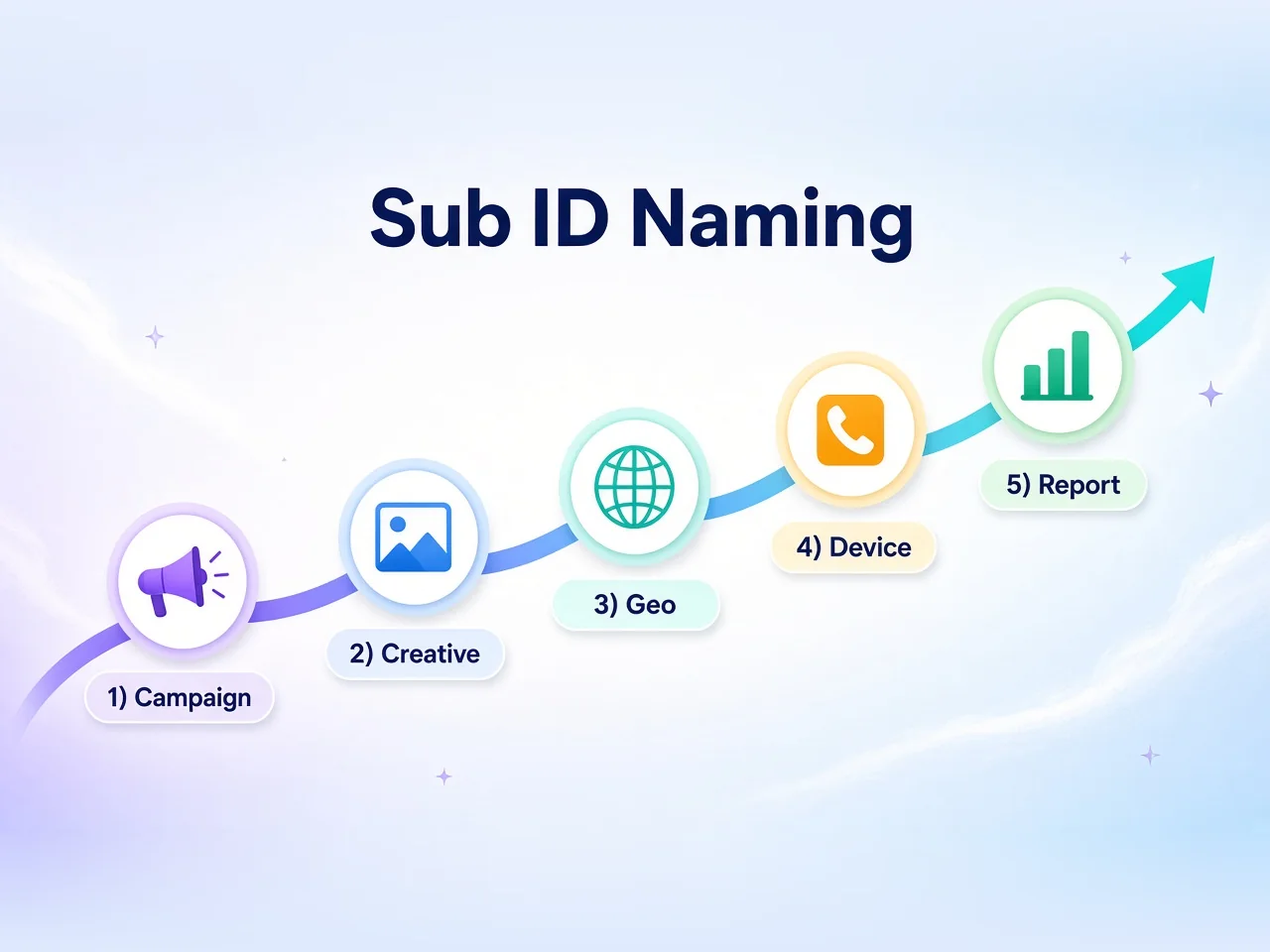
Pick a fixed order of dimensions. For most publishers that's:
01Source or campaign: seo, email, yt, fb, nl-oct
02Creative or placement: review-table, cta-top, banner-300, video-desc
03Geo: two-letter country code like us, gb, de
04Device: m or d
05Page or ad ID: a short slug or numeric ID
On multi-slot networks, give each dimension its own slot and keep the mapping identical everywhere. For example, on MaxBounty you might use s1=campaign, s2=tracker click ID, s3=creative, s4=geo, s5=device. On Impact, subId1=campaign, subId2=creative, subId3=page.
On single-slot networks, join the dimensions with a delimiter, always in the same order. A value like email_nl-oct_cta-top_us_m can be split back into columns in a spreadsheet in one step. Hyphens inside values and underscores between them is a simple rule that keeps parsing clean.
Keep a dictionary. A one-page sheet listing every code and what it means saves you when you come back to a report in three months and can't remember what cta2b was.
In each case, you can filter the network report by creative or geo and compare EPC directly. Our guide on what EPC means shows how to read that comparison.
Turning sub ID data into decisions
Tagging is only half the job. The payoff comes from reading the report the same way every time. Export conversions with sub ID columns, split any packed single-slot values into separate columns, and look at each dimension on its own before combining them.
Question
Group the report by
What to do with the answer
Which placements earn?
Creative or placement
Move the best call to action higher on more pages
Which traffic sources pay?
Campaign or source
Shift effort or budget toward the sources with the best EPC
Which countries convert?
Geo
Exclude losing geos from paid campaigns, localise content for winners
Is mobile underperforming?
Device
Fix the mobile layout or offer before buying more mobile traffic
Give each test enough clicks to mean something before acting. A placement with a handful of clicks and one sale hasn't proven anything yet; wait for a meaningful sample, then compare.
Where to start
These networks all document sub ID support in their link tools, and between them cover content, brand and CPA work.
Digital marketplace with high-commission recurring offers
Affiliate NetworkEducationeCommerceHealth & Nutra
Commission
CPS / RevShare
Min payout
$10
Cookie
Common mistakes
Putting personal data in a sub ID. Emails, names or phone numbers don't belong in a tracking parameter. CJ's documentation prohibits it outright, and it's a privacy risk on any network.
Changing the order halfway through. If s3 means creative in September and geo in October, your history is unusable.
Using illegal characters. Spaces, &, #, quotes and slashes can break links or truncate values. Stick to lowercase letters, numbers, hyphens and underscores.
Exceeding length limits. Long values get cut off silently, and you won't notice until a report looks wrong.
Leaking strategy in shared slots. Advertisers can see shared values, so don't put margins, other brands' names or traffic-source secrets there.
Tagging only some links. Untagged clicks pile up as a blank row that hides the real performance of everything else.
Step-by-step setup
01List the questions you want answered (which page, which email, which country converts best).
02Choose up to five dimensions that answer them and fix their order.
03Write your code dictionary in a shared sheet.
04Check each network's parameter name and character limits in its link builder.
05Rebuild your links with sub IDs, starting with your top ten earning pages or campaigns. For WordPress sites, tracking affiliate links in WordPress covers link managers that make this easier.
06For paid traffic, pass your tracker click ID into one slot and set up a postback.
07After two weeks, export conversion reports by sub ID and cut the placements and geos that drag EPC down.
Affground's verdict
Sub IDs are the cheapest optimisation tool in affiliate marketing. They cost nothing, take an afternoon to set up, and turn a single blended number into decisions you can act on. Pick a fixed order, keep a dictionary, keep personal data out, and treat any shared slot as public.
Frequently asked questions
What is a sub ID in affiliate marketing?
A sub ID is a custom label you append to an affiliate link as a query parameter. The network stores it with the click and shows it next to any resulting conversion, so you can see which campaign, page, creative or country produced the sale.
What is the difference between a sub ID and a UTM parameter?
Sub IDs are read by the affiliate network and appear in your commission reports. UTM parameters are read by the advertiser's analytics tools. Sub IDs help you optimise your own earnings; UTMs mainly help the brand understand its traffic.
What is the sub ID parameter on CJ, ShareASale and Awin?
CJ Affiliate uses sid, ShareASale uses afftrack, and Awin uses clickref plus clickref2 to clickref6. Impact.com uses subId1, subId2 and subId3 plus a shared sharedid, ClickBank uses tid, and MaxBounty uses s1 to s5.
Can advertisers see my sub IDs?
It depends on the network and slot. Impact.com's sub IDs are partner-only but its sharedid is visible to the brand, and on Awin only the first ClickRef is visible to advertisers. Treat any shared slot as public and keep sensitive details out of it.
How long can a sub ID be?
Limits vary. CJ recommends keeping the sid to 64 characters or fewer, Awin advises keeping each ClickRef under 50 characters to see the full value in reports, and Impact.com allows up to 255 characters. Short, consistent codes are safer everywhere.
Can I put a customer's email in a sub ID?
No. Personal data such as emails, names or phone numbers should never go into a tracking parameter. CJ's documentation prohibits it, and it creates privacy and compliance risk on any network.
How do I track multiple things with only one sub ID slot?
Combine dimensions into one value with a consistent delimiter and fixed order, such as source_page_placement_geo. You can split the value back into columns in a spreadsheet when you analyse the report.
Which sub ID should I use for a tracker click ID?
Use one dedicated slot and never reuse it. On MaxBounty, s2 is the common convention for a tracker click ID, which the network then returns in its postback so your tracker can match revenue to the original ad click.