Lead with a verdict, prove hands-on testing, write honest cons and disclose clearly. The review structure that earns trust, rankings and clicks.
Oct 7, 2026 · 7 min read
Most affiliate reviews fail the same way: they summarise the sales page, list features anyone could copy, and end with a "check price" button. Readers notice, and so does Google, whose reviews system is built to reward reviews that show first-hand testing, real comparisons and honest drawbacks over thin summaries.
A review that converts does the opposite. It gives a clear verdict early, proves you used the product, says who it's not for, and makes the next click obvious. This guide is for bloggers, niche-site owners and creators who want reviews that earn trust, rank, and still meet the FTC's disclosure rules.
A converting review is built on testing and honesty, not on adjectives
What a converting review actually does
A product review has one job: help a reader who is close to buying make a confident decision. That reader already knows the product exists. They want to know whether it works, whether it suits them, what it costs in practice and what the catch is.
That's why honest reviews convert. A reader who sees real drawbacks believes the praise, and a reader who's told "skip this if you need X" trusts you enough to click when it does fit. Hype does the reverse: it makes every claim on the page suspect.
The rules you're writing under
Three sets of rules shape every affiliate review. None of them is optional, and all of them push in the same direction: show your work and be upfront.
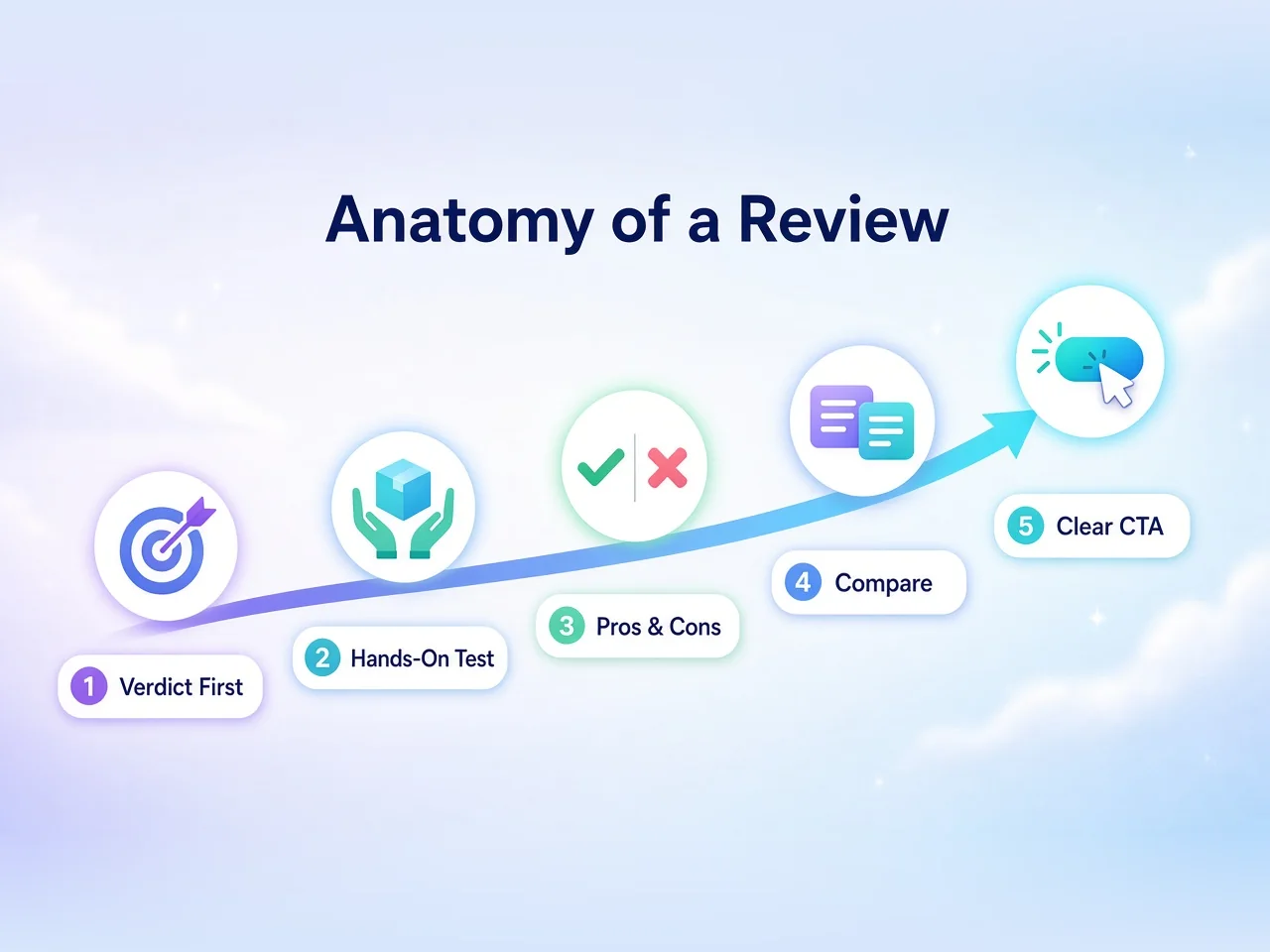
Each section answers the next question a near-buyer has
1. Lead with the verdict
Open with a short summary box: who the product is for, who should skip it, your overall rating and the single biggest reason to buy or not. Many readers decide from this block alone, so put your primary call-to-action here too.
2. Prove the hands-on test
Explain how you tested: how long, on what, against what. Use your own photos, screenshots or short clips, and include measurements where they matter, such as battery life, load times, setup minutes or cost per month at your usage. This is the section copycat reviews can't fake, and it's the strongest trust signal you have.
3. Give real pros and cons
Write cons that would actually change someone's decision, not "it's a bit pricey". Specific drawbacks ("the free plan caps you at three projects") make specific praise believable.
4. Compare with the alternatives
Name the two or three products a reader is most likely weighing and say when each one is the better pick. Linking out to a competitor you'd genuinely recommend costs you a click and earns you credibility. A short comparison table works well here.
5. Close with a clear call-to-action
End with a restated verdict and one obvious next step. Use descriptive button or link text (for example, "See current plans and pricing") rather than vague labels, and send the click to the most relevant page using a deep link, not the homepage.
Adapting the structure to the review format
The five-part structure holds across formats, but the emphasis shifts with what the reader is deciding.
Format
Reader's question
What to emphasise
Single-product review
"Is this one right for me?"
Testing evidence, specific drawbacks, who should skip it
Head-to-head (X vs Y)
"Which of these two?"
Side-by-side table, a clear winner for each use case
Roundup ("best X for Y")
"Which should I shortlist?"
Consistent criteria, a "best for" label on every pick
Long-term or update review
"Does it hold up?"
What changed since launch, cost over time, reliability
In a roundup, use the same testing criteria for every product and state them up front, so the rankings read as a method rather than a preference. In a head-to-head, resist calling a single overall winner when the honest answer depends on the use case; naming a winner per use case converts better because every reader leaves with an answer.
Long-term reviews are underrated. A follow-up after six months of real use answers the question buyers care about most and that launch-week reviews can't: whether the product is still worth paying for.
Placing CTAs without being pushy
Calls-to-action should appear where a reader is ready to act, not every two paragraphs.
Placement
Purpose
Typical form
Verdict box
Readers who decide fast
Primary button
After the testing section
Readers convinced by evidence
Inline text link
Comparison table
Readers choosing between options
One link per row
Conclusion
Readers who read everything
Primary button, restated verdict
Keep link text honest about where it goes, and put the disclosure above the first link rather than only in the footer. Track each placement separately with sub IDs so you know which ones earn; our guide to sub IDs in affiliate tracking shows how.
Where to find products worth reviewing
The best review candidates are products you'd use anyway, from programs with fair terms and reliable tracking. These networks and programs carry thousands of merchants across most niches.
The reviews that convert are the ones a reader can't find anywhere else. Test the product yourself, say plainly who it's for and who it isn't, disclose clearly, and make the next step obvious. Honesty isn't a trade-off against conversions; in reviews, it's the thing that produces them.
Frequently asked questions
How long should an affiliate product review be?
Long enough to show real testing, pros and cons and comparisons, and no longer. Many strong reviews land between 1,200 and 2,500 words, but evidence matters more than length.
Do I need to disclose affiliate links in reviews?
Yes. The FTC expects a clear and conspicuous disclosure of any material connection, placed close to the claims and links, not only in a footer. Many programs also require specific wording.
Can I write a review without using the product?
You can summarise a product, but it won't be a credible review. Google's guidance rewards evidence of hands-on use, and the FTC requires endorsements to reflect honest experience.
Where should I put affiliate links in a review?
Place calls-to-action at decision points: the verdict box, after the testing section, in the comparison table and in the conclusion. Track each placement separately with sub IDs.
Should I include negatives in an affiliate review?
Yes. Specific drawbacks make your praise believable and help readers self-select, which usually improves conversion rather than hurting it.
Are AI-generated or fake reviews allowed?
No. The FTC's rule on consumer reviews and testimonials, in force since October 2024, prohibits fake reviews, including AI-generated ones, and allows civil penalties.
How often should I update product reviews?
Update whenever pricing, plans or major features change, and review high-traffic reviews on a regular schedule so recommendations stay accurate.
Oct 10, 2026 · 7 min read
Best Software Affiliate Programs for Bloggers
The tools that run your blog are the easiest to sell honestly. Compare hosting, page builder, SEO and email affiliate programs by commission, cookie and recurring pay.