Clicks with no commissions isn't failure — it's usually a broken link in a six-step chain. Here's how to tell whether you even have a problem yet, and a diagnostic to find and fix the exact step that's leaking.
Aug 7, 2026 · 8 min read
Getting clicks but no sales is the most common — and most misread — problem in affiliate marketing. A clicked link feels like the hard part is done, so a flat $0 in commissions reads as total failure. It usually isn't. A click and a sale are separated by a chain of steps, and a break anywhere in that chain — wrong intent, a short cookie window, a leaky tracking link, an offer that converts poorly — shows up as the exact same symptom: traffic in, nothing out.
This guide is for affiliates, bloggers and publishers who are sending real clicks and seeing nothing back. We will map the precise path a click takes to become a tracked commission, show what a normal conversion rate actually looks like (so you know whether you have a real problem or just a small sample), and give you a to find the one link in the chain that is broken — then fix it.
diagnostic checklist
First: is this even a problem yet?
Before diagnosing, check the math. Affiliate conversion rates are far lower than most beginners expect. Commonly cited industry figures put the average affiliate conversion rate around 0.5%–1% for general traffic, rising to roughly 1%–5% for warm, high-intent audiences. Take a 1% rate: you need about 100 clicks to expect a single sale — and that is an average, not a promise. Normal variance means your first sale might land at click 40 or at click 250.
So 30 clicks and no sale is not a diagnosis; it is noise. Give an offer at least 100–200 clicks before you conclude anything. If you have sent 500+ relevant clicks and still have zero tracked sales, now you have a signal worth investigating.
Benchmark
Typical range
What it tells you
Affiliate conversion rate
0.5%–1% general · 1%–5% high-intent
Share of clicks that become sales
Clicks per sale (at ~1%)
~100
Rough expectation, never a guarantee
Cookie window
24 hours → 365 days
How long after a click a sale still counts for you
Cart abandonment
~70%
Even ready buyers leave — not your fault
EPC (earnings per click)
Varies by program
What affiliates actually earn per click
How a click becomes a commission
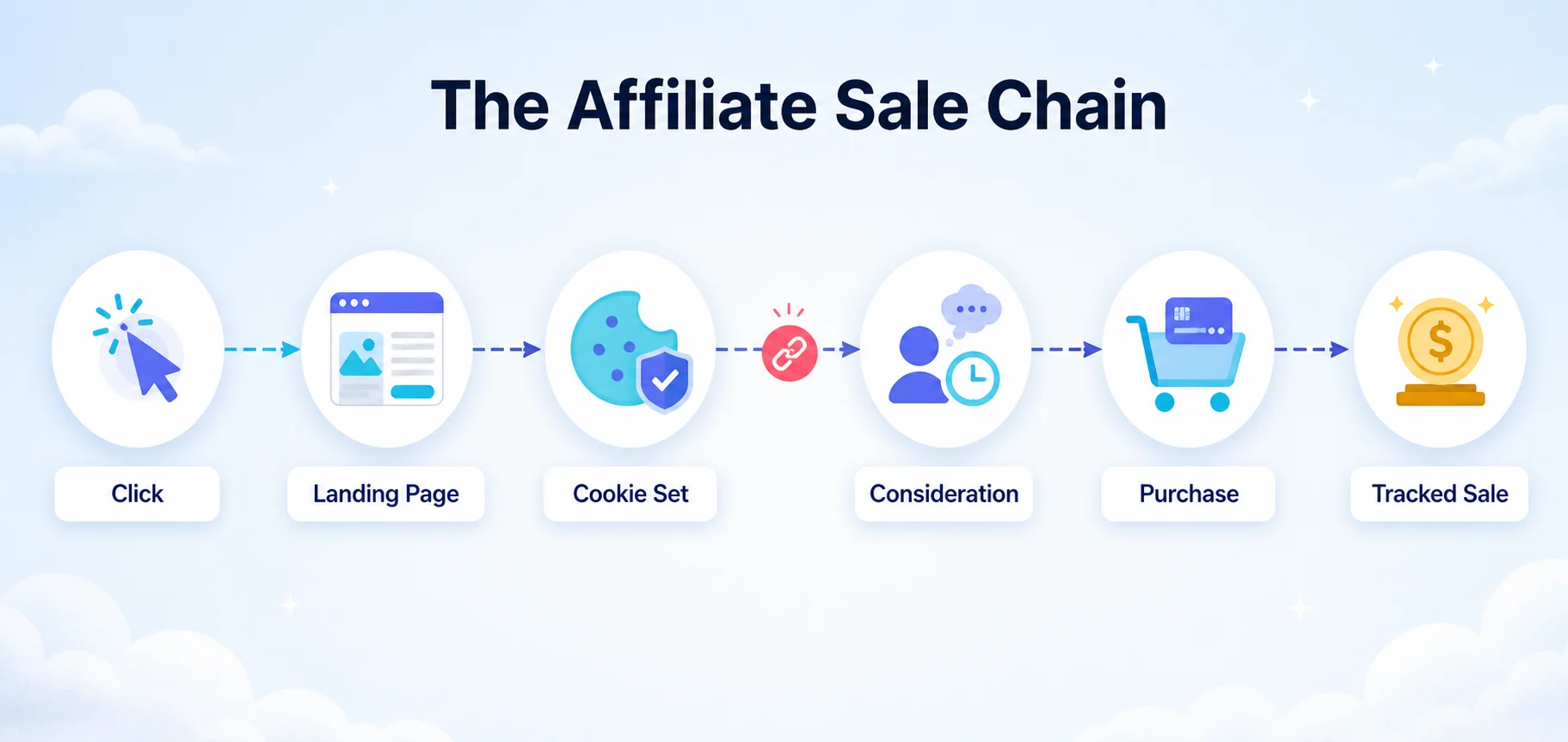
A commission only pays if every link in the chain holds — a break anywhere reads as clicks with no sales.
Every affiliate sale runs through the same chain, and a commission only pays if every link holds:
01Click — the visitor taps your tracked link.
02Landing — they arrive on the merchant's page (not a broken redirect or a geo-blocked page).
03Cookie set — the merchant drops a tracking cookie tagged with your affiliate ID.
04Consideration — they evaluate, often leave, maybe return.
05Purchase — they buy within the cookie window.
06Tracked & approved — the sale is attributed to you, survives the refund/return period, and gets approved.
Clicks only measure step 1. Commissions require all six. When someone says "clicks but no sales," the failure is almost always hiding in steps 2–6 — and the right fix depends entirely on which one.
The real reasons clicks don't convert
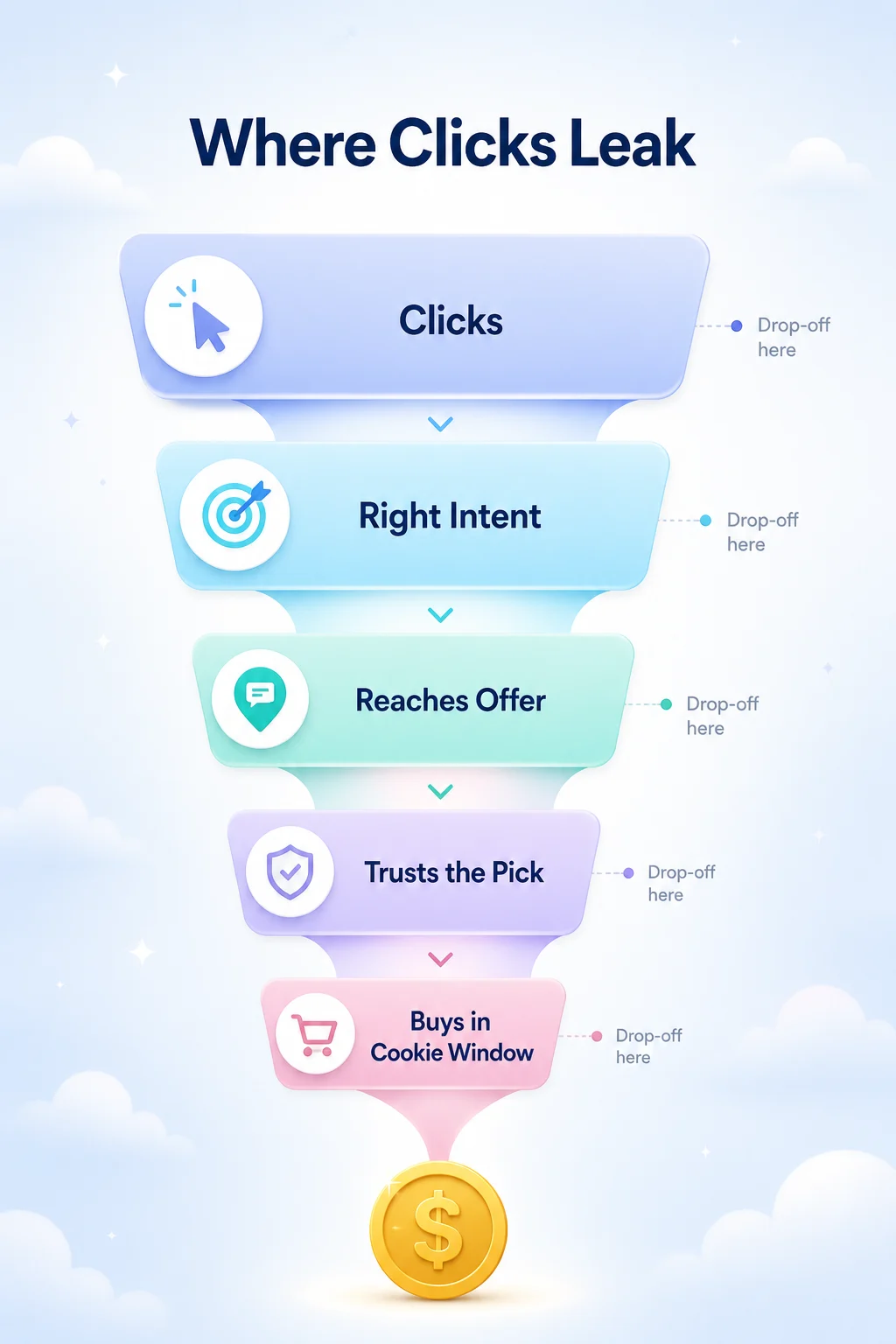
Each stage between a click and a commission sheds volume — your job is to find which stage is leaking hardest.
Nine causes account for nearly every flat line. Work through them roughly in this order.
1. Intent mismatch — the number-one cause
Top-of-funnel readers ("what is X") are not buyers ("best X for Y"). If the traffic is informational and the offer is transactional, you get curiosity clicks and no wallets. Match the offer to the intent of the page it sits on.
2. The sample is too small
Covered above, but worth repeating because it silently wastes weeks of "fixes." Don't optimise on 40 clicks.
3. The cookie window is too short
A 24-hour cookie (Amazon-style) only pays if the buyer purchases that day. A 30-, 90- or 365-day window forgives the normal delay between discovery and purchase. Short windows quietly kill conversions on any considered purchase.
4. Tracking is actually broken
The silent killer. Common failures: the affiliate ID is missing or malformed in the link, a redirect or URL shortener strips the tracking parameter, the merchant's page never sets the cookie, or the browser blocks it. Test your own link end to end before you ever blame your content.
5. Cookie loss and browser privacy
Safari's ITP, third-party-cookie restrictions, ad blockers, and users clearing cookies all erase attribution. Some genuine sales simply never get tracked — which is why server-side postback tracking matters, and why comparing your on-site clicks to the network's recorded clicks is worth doing.
6. The offer or landing page converts poorly
You picked it, but you don't control it. A confusing checkout, a forced trial, a surprise price, or an out-of-stock product tanks conversion no matter how good your traffic is. Check the program's EPC — it reveals what other affiliates earn per click before you send more.
7. Price and audience fit
If the audience can't afford the product or doesn't need it, clicks are just window-shopping. High-ticket and B2B offers convert slowly and in small numbers by nature.
8. Long sales cycle and timing
B2B SaaS, hosting migrations, and expensive tools have research cycles measured in weeks. The sale may still be coming — inside a long cookie window. Don't judge a 90-day-cycle offer on 14 days of data.
9. Attribution loss and leakage
Last click usually wins: if the buyer later taps a coupon-site link or the brand's own retargeting ad, that touch can steal your commission. Coupon fields on the checkout page are a classic silent drain.
A 6-step diagnostic
Run these in order — each isolates one link in the chain:
01Confirm the sample. 100+ clicks to that specific offer? If not, keep publishing; there is nothing to fix yet.
02Test the link yourself. Open it in a fresh incognito window, complete a real or test purchase where possible, and confirm it appears in your affiliate dashboard. This one step catches most "no sales" cases.
03Reconcile the click counts. Compare clicks in your analytics against clicks in the network dashboard. A large gap points to tracking or redirect loss.
04Read the EPC and cookie window. A low network EPC means the offer converts poorly for everyone; a short cookie means attribution is expiring. Either is a reason to switch programs.
05Audit the intent. Is the page transactional ("best," "review," "vs," "pricing") or informational? Move commercial links onto commercial pages.
06Check the destination. Does the link land on a live, in-region, in-stock page with an easy checkout? Fix broken or geo-blocked redirects.
Where to start: programs that give conversions a chance
If your tracking is clean and your intent is right, the last lever is the offer itself. Programs with long cookie windows, recurring commissions, and a published EPC stack the odds in your favour — they forgive slow buyers and prove that real affiliates earn on them:
Longer cookie windows — up to 365 days here — and recurring payouts mean a click today can still pay months from now, the exact opposite of a 24-hour window that expires before the buyer has even decided. Browse the full directory to filter programs by cookie window and payout.
Common mistakes
Quitting at 30 clicks. That is noise, not data.
Never testing your own link. The most common cause is also the easiest to miss.
Ignoring EPC and cookie window when choosing offers — the two numbers that most predict earnings.
Blaming your content first, before ruling out tracking, sample size, and the offer.
Affground's verdict
"Clicks but no sales" is rarely one big failure — it is a specific broken link in a six-step chain, and it is diagnosable. Rule out sample size, test your tracking end to end, then match intent to offer and choose programs with long cookie windows and a proven EPC. Do that, and clicks stop being vanity metrics and start being income.
Frequently asked questions
How many affiliate clicks does it take to get a sale?
At a typical ~1% conversion rate you need roughly 100 clicks per sale on average — but that is an average, not a guarantee. Give any offer at least 100–200 clicks before concluding it does not convert.
What is a normal affiliate conversion rate?
Commonly cited figures put general affiliate traffic at 0.5%–1%, and warm, high-intent audiences at roughly 1%–5%. Rates vary widely by niche, offer and traffic quality.
Why do I get clicks but no sales on Amazon Associates?
Amazon's tracking cookie lasts only 24 hours, so a click only pays if the visitor buys that same day. Considered purchases made later simply are not attributed to you.
How do I know if my affiliate link tracking is broken?
Open your link in a fresh incognito window, complete a real or test purchase, and check whether it appears in your affiliate dashboard. Also compare clicks in your analytics against the network's recorded clicks — a big gap signals tracking loss.
Can browser privacy settings stop affiliate sales from tracking?
Yes. Safari's ITP, third-party-cookie blocking, ad blockers and cookie clearing all erase attribution, so some genuine sales are never tracked. Programs using server-side postback tracking are more resilient.
Does the cookie window really affect conversions?
Significantly. A 24-hour window only captures same-day buyers, while 30–365-day windows credit you for the normal delay between discovery and purchase — which is most sales.
Should I switch affiliate programs if I am getting no sales?
Only after ruling out small sample size, broken tracking and intent mismatch. If those are clean, check the program's EPC and cookie window — a low EPC or short cookie is a good reason to move to a better-converting offer.