A shortlist-first guide to fashion affiliate programs: how retail commissions, cookies and returns really pay, the networks that carry the brands, and a three-layer portfolio for creators.
Oct 6, 2026 · 7 min read
Fashion is one of the easiest niches to start in and one of the hardest to profit from. Almost every apparel, footwear and accessories brand runs an affiliate program, but commission rates in retail fashion usually sit in single digits to mid-teens, cookie windows are short, and returns quietly claw back a share of what you thought you'd earned.
This guide is for creators, stylists and fashion bloggers who want a shortlist that pays rather than a list of every logo with a signup page. We cover how fashion programs actually pay, where the brands live, the numbers to compare, and a simple way to build a portfolio that survives return season.
Fashion affiliate income is a portfolio game: retail breadth plus a few higher-margin labels.
What counts as a fashion affiliate program
A fashion affiliate program pays you a share of sales you refer to an apparel, footwear, jewellery, bag or accessories retailer. They come in three shapes:
Department stores and big retailers — huge catalogs, recognisable names, modest rates. They convert well because shoppers already trust them.
Direct-to-consumer labels — smaller catalogs, stronger brand stories, and often higher rates because they have healthier margins and fewer middlemen.
Luxury and designer retailers — high order values, lower percentage rates, and stricter approval for publishers.
Most of these programs don't run in-house. They sit on affiliate networks such as Rakuten Advertising, CJ, Impact, Awin and ShareASale, which handle tracking, reporting and payouts. If you are new to that split, our explainer on affiliate programs vs affiliate networks covers the difference.
How fashion programs pay
Fashion is almost entirely CPS (cost per sale) — you earn a percentage of the net order value after returns and cancellations. That word net is where fashion differs from most niches.
Online apparel has some of the highest return rates in ecommerce; commonly cited industry estimates put them in the 20–30% range, and higher for categories where fit is uncertain. Many programs lock commissions for 30–90 days before approving them, then reverse anything that came back. Your dashboard's "pending" number is not your income until the lock period passes.
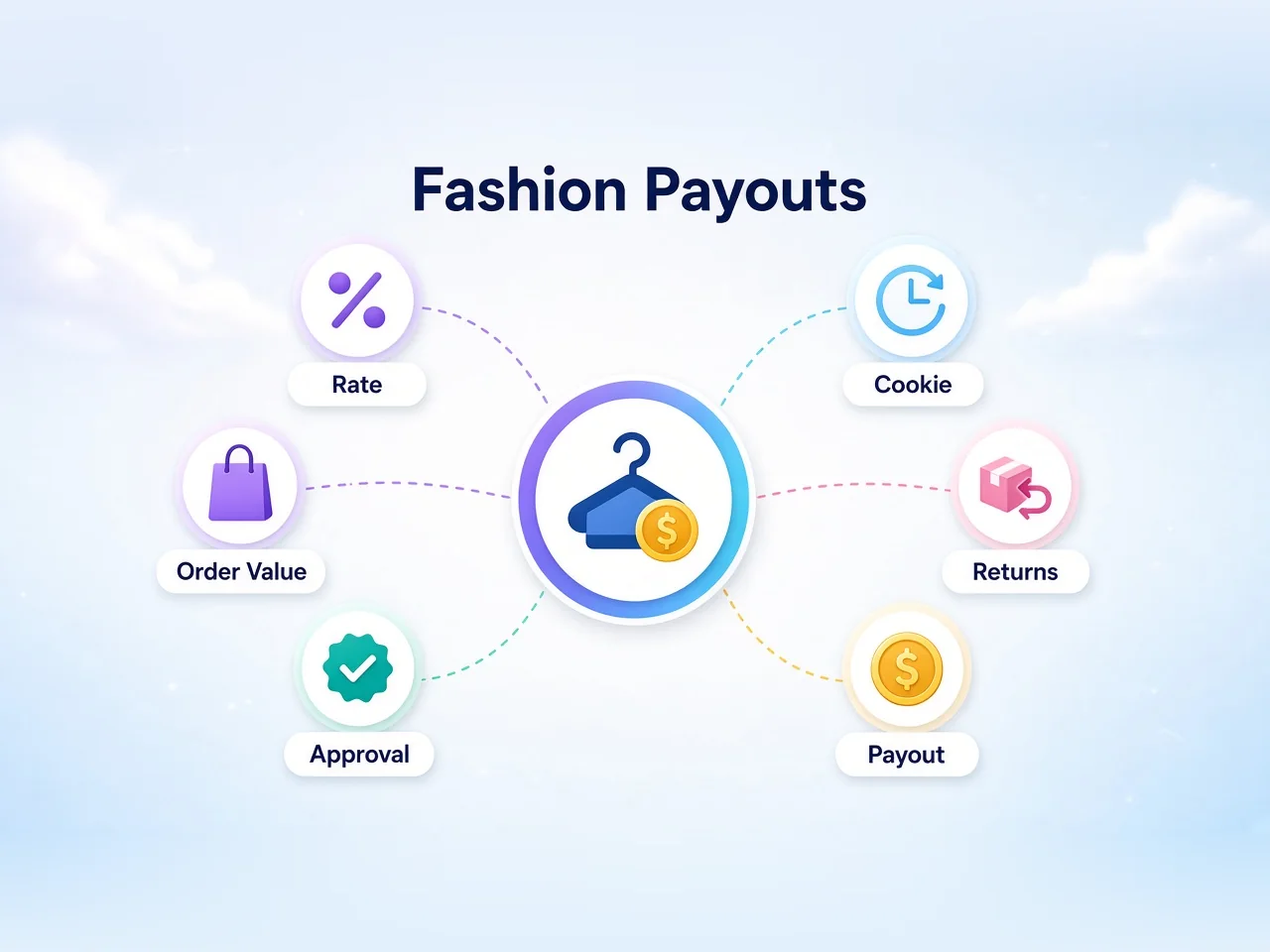
Six levers decide what a fashion program really pays — the headline rate is only one of them.
Six levers decide real earnings:
01Commission rate — the headline percentage.
02Cookie window — how long after the click a sale still credits you.
03Average order value (AOV) — a 6% rate on a $300 basket beats 12% on a $40 one.
04Return and reversal rate — the haircut applied after the lock period.
05Approval odds — premium programs often reject small or unfocused sites.
06Payout terms — threshold and frequency, set by the network.
Beginners over-index on the first lever. The cookie window and return rate usually decide more of the outcome than the rate itself.
The numbers to compare
Rates vary by brand and change often, so treat the ranges below as typical bands seen across network program listings, not guarantees. Always check the live terms before you build content around a program.
Program type
Typical commission
Typical cookie
Order value
Watch out for
Department store / big retailer
~2–8%
1–14 days
Medium
Category exclusions, low rates on sale items
DTC apparel & footwear label
~8–20%
14–30 days
Medium
Smaller catalog, stock-outs
Luxury / designer retailer
~3–12%
7–30 days
High
Strict approval, brand-bidding rules
Jewellery & accessories
~8–20%
14–30 days
Low–high
Wide AOV spread
Marketplace (e.g. Amazon fashion)
Single digits
24 hours
Low–medium
Very short cookie
The networks carrying most fashion programs also differ on payout mechanics. These figures come from Affground's listing data:
Network
Default cookie in listing
Payout cadence
Minimum payout
Rakuten Advertising
30 days
Net 60
$50
CJ Affiliate
45 days
Net 30
$50
Impact.com
45 days
Net 15
$25
Awin
30 days
Monthly
$20
ShareASale
30 days
Net 15
$50
Amazon Associates
1 day
Net 60
$10
Network defaults are a starting point; each brand on the network sets its own cookie and rate. Our guide to how affiliate cookies work explains why a short window hurts fashion in particular — people browse outfits for days before they buy.
The best fashion affiliate programs and networks
Rather than chase individual brand pages that change every season, start with the networks and tools that give you the widest set of fashion merchants under one login, one tax form and one payout. Big retail lives heavily on Rakuten and CJ; mid-size DTC labels are common on Impact, Awin and ShareASale; Skimlinks and Sovrn convert your existing outbound links across thousands of retailers automatically; and Amazon covers the long tail of basics.
Earn category-based commissions on Amazon products
Affiliate ProgrameCommerce
Commission
CPS / RevShare
Min payout
$10
Cookie
Session
A sensible order for most creators: join two networks with strong retail coverage, add an automated link tool for the brands you mention but don't have direct deals with, and keep Amazon for basics only.
A practical framework: build a three-layer portfolio
Fashion rewards breadth and depth. A portfolio approach stops one program change from wrecking your month.
Layer 1 — Anchor retailers (2–3). Department stores or big multi-brand retailers your audience already shops. Lower rates, high trust, high conversion. These fill your "shop the look" links.
Layer 2 — Margin labels (3–5). DTC brands in your exact style niche — sustainable basics, modest fashion, plus-size, streetwear, running. Higher rates and longer cookies. These earn dedicated reviews and try-on content.
Layer 3 — Automated coverage. An auto-linking tool so every brand you mention earns something, even without a direct relationship.
Then review the mix every quarter. Drop programs whose approved earnings (after returns) consistently lag their pending totals, and push the labels where your audience actually keeps what it buys.
Common mistakes
Comparing headline rates only. A 15% program with a 7-day cookie and heavy reversals can pay less than a 7% one with 30 days and low returns.
Ignoring returns in forecasts. Plan on approved earnings, not pending.
Linking to the homepage. Send readers to the exact product or category; a homepage click wastes intent. See our guide to deep linking in affiliate marketing.
Featuring out-of-stock items. Seasonal pieces sell out fast; refresh evergreen posts every few weeks.
Skipping disclosure. Fashion content on Instagram and TikTok gets scrutinised. Our WordPress disclosure guide covers the basics for your site.
Breaking brand rules. Many luxury programs ban trademark bidding, coupon sites or certain social placements. Read the terms before you apply.
Step-by-step: from zero to your first fashion commissions
01Define your style lane — one audience, one aesthetic, one price band. Approval teams want to see focus.
02Apply to two networks with strong retail coverage and complete your profile with traffic, audience and sample content.
03Shortlist 8–10 brands your audience already buys, then apply to them inside the networks.
04Add an auto-linking tool for everything else you mention.
05Build evergreen pages first — capsule wardrobes, "best jeans for…", size and fit guides — then layer seasonal lookbooks on top.
06Tag every link with sub IDs so you can see which posts and platforms drive sales. Our sub ID guide shows a naming system.
07Review approved earnings after 90 days and rebalance toward programs that hold their sales.
Affground's verdict
The best fashion affiliate program is rarely the one with the biggest percentage. Pick programs on cookie length, order value and return behaviour, run them through two or three solid networks, and let automated linking cover the long tail. That mix pays more reliably than chasing the highest rate on the page.
Frequently asked questions
What commission do fashion affiliate programs pay?
Most retail fashion programs pay a percentage of the net sale, typically in single digits for big retailers and marketplaces and roughly 8–20% for direct-to-consumer labels and accessories brands. Rates change often, so check live program terms.
Why do fashion affiliate earnings drop after the pending period?
Fashion has high return rates, and most programs pay on net order value. Commissions stay pending for a lock period, often 30–90 days, and returned or cancelled orders are reversed before approval.
Which affiliate networks have the most fashion brands?
Rakuten Advertising, CJ Affiliate, Impact, Awin and ShareASale all carry large numbers of apparel, footwear and accessories merchants. Automated tools like Skimlinks and Sovrn //Commerce cover thousands more without individual applications.
Is Amazon Associates good for fashion content?
It is useful for basics and the long tail, but its 24-hour cookie and modest category rates make it weaker than dedicated fashion programs for considered purchases where shoppers browse for days.
How long are cookie windows in fashion affiliate programs?
They vary by brand. Big retailers often run short windows of a day to two weeks, while many DTC labels offer 14–30 days. Longer windows suit fashion because shoppers often compare outfits over several days.
Do I need a big audience to join fashion affiliate programs?
Not always. Networks and automated linking tools accept smaller sites, but premium and luxury programs often want a clear style focus, quality content and steady traffic before approving you.
What fashion content converts best for affiliates?
Evergreen, intent-led content such as capsule wardrobe guides, fit and sizing guides, and best-of roundups in a specific style or price band tends to convert better than broad trend posts.
Can I mix fashion affiliate programs from different networks?
Yes. Most creators run two or three networks plus an auto-linking tool. Use sub IDs to see which programs and posts actually hold their sales after returns.