Affiliate Program vs Affiliate Network: The Difference
An affiliate program is one brand's offer; an affiliate network is a marketplace of thousands. Here is the real difference — how each works, the honest pros and cons, and exactly when to choose one, the other, or both.
Jul 3, 2026 · 15 min read
If you have spent any time reading about making money online, you have hit these two terms within about thirty seconds of each other — affiliate program and affiliate network — usually used as if they are interchangeable. They are not. Confusing them is one of the most common beginner mix-ups in the whole industry, and it quietly leads people to sign up for the wrong thing, in the wrong order, and wonder why it feels harder than it should.
The good news: the difference is genuinely simple once someone explains it without the jargon. A program is one brand's affiliate offer. A network is a marketplace that bundles thousands of programs behind a single login. That is the whole thing in two sentences — but which one you should join, and when, is where it gets interesting.
This guide breaks it all down: what each one actually is, how they work, their honest pros and cons, where the oddball "ad network" fits in, and a simple framework for choosing. By the end you will never mix them up again.
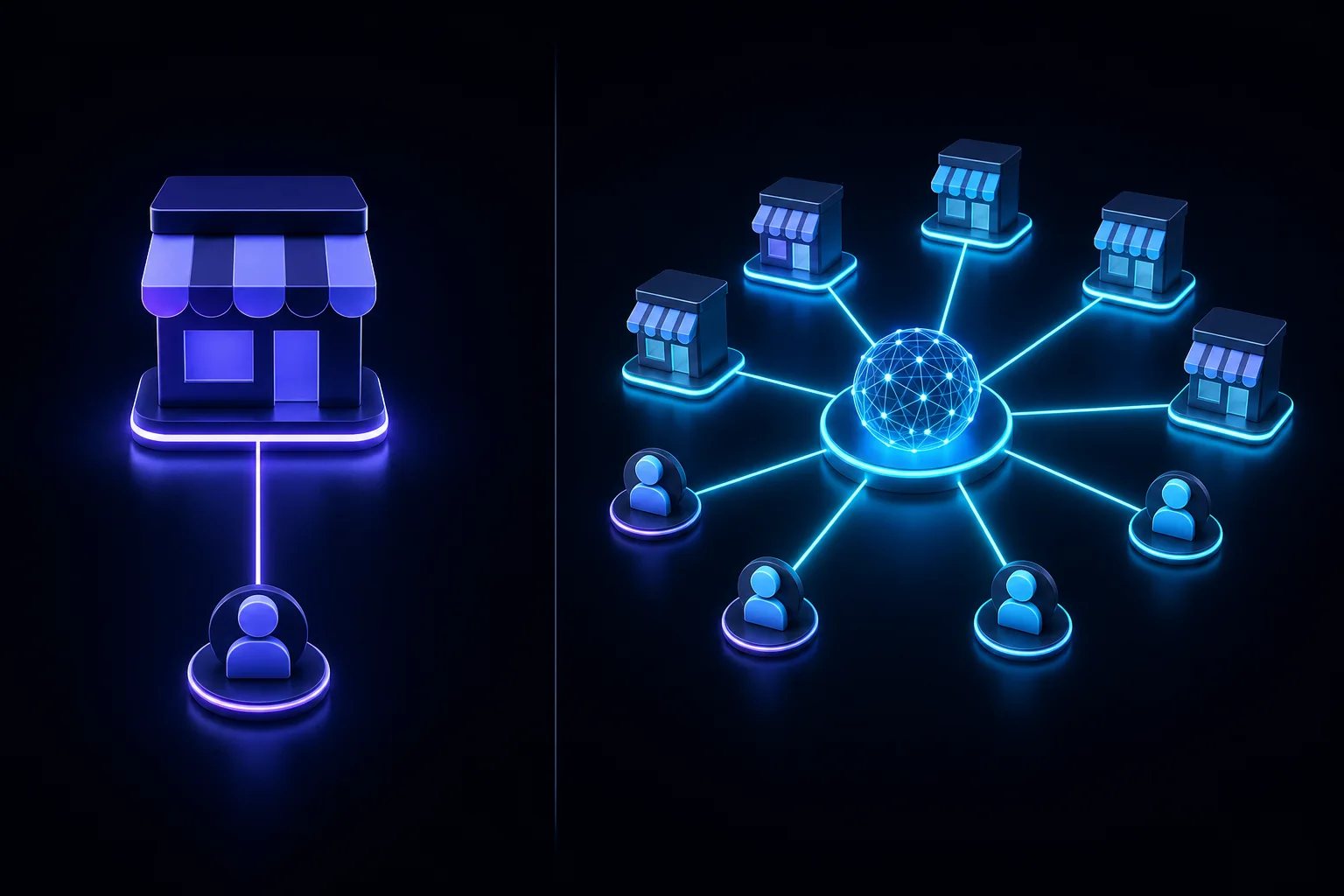
Affiliate program vs affiliate network — a program is one brand's offer, a network aggregates thousands into one platform.
The short answer
In one line each:
An affiliate program is run by a single brand — you sign up directly with that company to promote their products. (Think: the Shopify Affiliate Program.)
An affiliate network is a third-party platform that hosts thousands of brands' programs in one place — you sign up once and can promote many brands from a single dashboard, with one consolidated payout. (Think: ShareASale or Awin.)
That is it. A program is a store; a network is a shopping mall full of stores. Everything else in this article is just the useful detail underneath those two sentences.
What is an affiliate program?
An affiliate program is a brand's own system for paying partners to send it customers. The company sets the commission, the rules, the cookie window and the payout terms, and it manages the whole relationship itself. You apply directly with that brand, get your tracking links, promote their products, and get paid by them.
Programs come in two flavors:
In-house programs, run entirely on the brand's own infrastructure or a self-hosted affiliate plugin. You deal directly with the company, and often with a dedicated affiliate manager.
Programs hosted on a network — the brand runs its program but uses a network's technology to handle tracking and payments. Confusingly, these are both a program and on a network, which is exactly why people get muddled.
The defining trait of a program is focus: it is one brand, one set of products, one relationship. If you have an audience that is perfect for a specific company — you run a Shopify tutorial channel, say — joining that brand's program directly is often the highest-paying, most tailored route. You get the brand's full attention, sometimes better commissions, and a direct line to the people who run it.
The trade-off? Every program is a separate signup, a separate login, a separate payout, and a separate set of terms to track. Join ten programs directly and you are managing ten of everything.
What is an affiliate network?
An affiliate network is a middleman platform that sits between publishers and thousands of brands. Instead of hunting down and applying to programs one by one, you join the network once and get access to a searchable marketplace of advertisers — each with their own commissions and terms — all managed through a single dashboard.
The network's job is to handle the messy infrastructure that neither side wants to build alone:
Tracking — generating your links and attributing sales reliably.
Reporting — one dashboard showing performance across every brand you promote.
Payments — collecting from all those advertisers and paying you in one consolidated payout, on a predictable schedule.
Trust & vetting — screening advertisers and publishers so both sides deal with legitimate partners.
For that convenience, the network takes a cut — usually a percentage on top of what the advertiser pays, or baked into the commission — which is the main reason direct programs can sometimes pay a little more.
The killer feature of a network is breadth and simplicity: apply once, promote across dozens of niches, and never juggle ten logins or chase ten separate payments. For most new publishers, that convenience is worth far more than the small margin a network takes.
A network's superpower: many brands, one dashboard, one consolidated payout.
A quick history: how networks were born
Affiliate marketing started direct. In the late 1990s, brands like Amazon launched their own in-house programs — you signed up with the company, full stop. It worked, but it created a mess: every publisher had to find, join and manage dozens of separate programs, and every brand had to build its own tracking and payment plumbing from scratch.
Networks emerged to solve exactly that pain. Pioneers in the late 1990s and early 2000s realised that a shared platform could sit in the middle — hosting many brands' programs, standardising the tracking, and handling payments for everyone. Publishers got one login instead of fifty; brands got instant access to a pool of vetted publishers without building infrastructure. Both sides won, and the network model exploded.
Today the two coexist. Big brands often run both — an in-house program for their closest partners and a network presence for reach. This history explains why the line between "program" and "network" is so fuzzy: networks were literally invented to host programs, so most programs you meet today live on one.
The core difference in one idea: direct vs aggregated
Strip everything back and the entire distinction comes down to one word: aggregation.
A program is a direct relationship with one brand. A network aggregates many brands into one relationship with you. Every pro and con of each flows from that single fact:
Direct means a tighter relationship, potentially higher pay, and full attention — but more admin, because you repeat the whole process for every brand.
Aggregated means one signup, one dashboard, one payout, and huge variety — but a middleman takes a cut and you are one of thousands, not a VIP.
Neither is "better." They are answers to different questions. The direct program optimizes for depth with one brand; the network optimizes for breadth across many.
Affground's take: beginners almost always overthink this. The honest advice is to start with a network to learn what actually converts for your audience without drowning in admin — then go direct with the two or three brands that earn you the most, where a better rate and a real relationship are worth the extra logins. Breadth first, depth second.
Affiliate program vs affiliate network, side by side
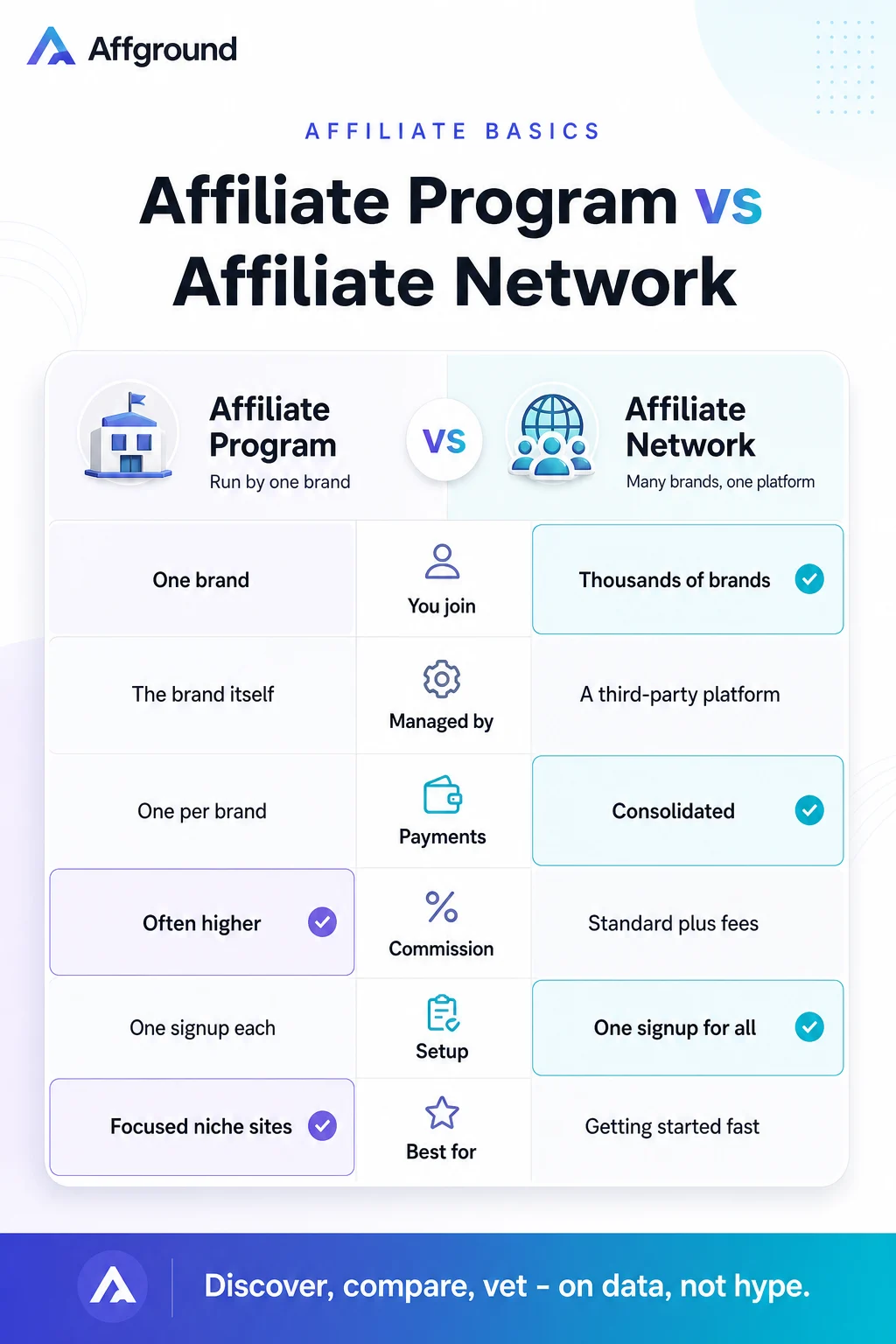
Here is the whole comparison at a glance:
Affiliate Program
Affiliate Network
What it is
One brand's own offer
A marketplace of many brands
You join
Each brand separately
Once, for thousands of brands
Managed by
The brand itself
A third-party platform
Commissions
Often higher (no middleman)
Standard, minus the network's cut
Payments
One per brand
Consolidated into a single payout
Setup
A signup per program
A single application
Support
Direct, sometimes a manager
Through the network
Best for
Focused, high-fit niche sites
Getting started, breadth, convenience
How joining a program directly works
The direct route is straightforward:
01Find the brand's program. Search "brand name + affiliate program" — most companies with one have a dedicated page in their footer.
02Apply directly. You submit your site, traffic sources and promotion methods to the brand itself.
03Get approved and grab your links. Once accepted, you get your unique tracking links, often through the brand's own dashboard or a self-hosted tool.
04Promote and get paid by the brand. You deal with the company directly — including for payment, which comes from them on their schedule and terms.
The experience is intimate: you are a partner of that brand, and if you perform, you may get a dedicated affiliate manager, custom commissions and early access to promotions. The downside is repetition — each new brand means starting this whole process again, with another login and another payout to track.
How joining through a network works
The network route front-loads one application and then opens a marketplace:
01Apply to the network once. You are vetted a single time.
02Browse the marketplace. Search thousands of programs by niche, commission type and payout terms.
03Join individual advertisers within the network. Many approve instantly; some still require their own approval — but it is all inside one platform.
04Promote across brands from one dashboard. Your links, reporting and performance all live in one place.
05Get one consolidated payout. The network collects from every advertiser and pays you together, on a reliable schedule.
The experience is efficient: you can promote a dozen unrelated brands without a dozen logins, compare performance side by side, and trust that the payment plumbing just works. The cost is a little distance from the brands themselves — you are one publisher among many, and the network takes its margin.
The pros and cons of going direct
Why publishers go direct:
Higher commissions are common, since there is no network taking a cut.
Real relationships — dedicated managers, custom deals and insider access for good partners.
Brand-specific perks — exclusive promos, higher tiers and early product access.
Full data ownership in in-house setups.
The downsides:
Admin overload — every brand is a separate signup, login, payout and set of terms.
Fragmented payments — ten programs can mean ten small payouts, each with its own threshold.
Inconsistent tech — some in-house programs have clunky dashboards and shaky tracking.
Harder discovery — you have to find each program yourself.
The pros and cons of going through a network
Why publishers use networks:
One application, thousands of brands — instant breadth.
Consolidated payments — one reliable payout instead of many.
One dashboard — unified tracking and reporting across every brand.
Trust and vetting — advertisers and publishers are screened, reducing fraud and non-payment risk.
The downsides:
A middleman's cut — commissions can be slightly lower than direct.
You are one of many — less individual attention than a direct partner gets.
Payout thresholds and fees — some networks hold payments until you hit a minimum.
Approval still required — for individual advertisers within the network, sometimes.
"Wait, where do ad networks fit?"
Here is a third term that trips people up: an ad network is not the same as an affiliate network, even though they sound like cousins.
An affiliate network connects publishers to brands' affiliate programs — you earn a commission when your referral converts into a sale or lead. It is performance-based and relationship-driven.
An ad network connects publishers to advertisers who buy ad space — you earn from impressions or clicks on ads shown to your audience (think display, native or push ads). It is inventory-based and largely automated.
Put simply: with an affiliate network you recommend products and earn on results; with an ad network you rent out space on your site and earn on traffic. Many publishers use both — affiliate links inside the content, ad-network units around it. If you want to go deeper on the third category, browse our ad networks directory.
When to choose a direct program
Go direct when:
You have a tight, high-fit audience for a specific brand — the commission bump and relationship are worth the admin.
A brand you love is not on any network, or offers meaningfully better terms direct.
You are already earning well with a brand and want a dedicated manager and custom deals.
You value data ownership and control over convenience.
Direct is the depth play — it shines when one or two brands are central to your whole content strategy.
When to choose a network
Go with a network when:
You are just starting out and want to learn what converts without drowning in admin.
You promote across many niches and want variety from one login.
You value simplicity — one dashboard, one payout, reliable tracking.
You want the safety of vetting and consolidated, predictable payments.
The network is the breadth play — it is the fastest, lowest-friction way to get real experience and real income.
Can you do both? (Yes — and you probably should)
Here is the secret the "vs" framing hides: this was never really an either/or. The most successful publishers run a portfolio — networks for breadth and discovery, direct programs for their highest-earning relationships.
A typical evolution looks like this: start on one or two networks to learn fast and earn early. Watch which brands actually convert for your audience. Then, for the two or three that consistently earn, check whether going direct unlocks a better rate, a dedicated manager or exclusive deals — and if it does, add the direct relationship on top. You keep the network's convenience for the long tail and gain the direct program's upside where it counts.
Affground predicts: as more programs run on networks anyway, the hard line between "program" and "network" will keep blurring — but the strategic move stays the same. Use networks to discover and diversify; go direct to maximize your winners. The publishers who treat it as a portfolio, not a religion, will always out-earn the ones arguing about which is "better."
Popular affiliate networks to know
A few well-established networks publishers routinely start with — apply once and browse thousands of brands across every niche:
Want to weigh specific options against each other? Use our comparison tool to line up networks and programs side by side, or browse the full networks and programs directories. New to all of this? Start with our guide to what affiliate marketing is.
A real example: how one publisher uses both
Meet a hypothetical publisher — call her Maya, who runs a home-office review site. Here is how the program-versus-network question plays out in real life, not theory.
Maya starts on a network because she is testing everything: standing desks, monitors, webcams, software. One application gives her hundreds of relevant brands, one dashboard to see what converts, and one monthly payout. Within a few months the data is clear — two brands drive most of her income: a desk company and a project-management app.
So she goes direct with those two. The desk brand's in-house program pays a higher rate and assigns her a manager who sends exclusive discount codes her readers love. The SaaS app offers a recurring commission direct that beats the network's flat rate. Everything else — the long tail of occasional earners — stays on the network, because managing forty direct logins for small payouts would be madness.
The result is the best of both worlds: network convenience for breadth, direct relationships for her winners. That portfolio approach, not a dogmatic choice between the two, is what actually maximizes income.
How to decide: a 4-question framework
Still unsure? Answer these:
01Are you new, or scaling an established audience? New means start with a network. Established with clear winners means add direct programs.
02One niche or many? Many means a network's breadth wins. One tight niche means direct programs for the key brands.
03Is a specific brand central to your content? If your whole site is about one company's ecosystem, join it directly.
04Do you value convenience or control more? Convenience means network. Control, rate and relationship mean direct.
If your answers point both ways, that is not indecision — it is the correct answer. Do both.
Common myths, cleared up
"Networks always pay less." Not necessarily. A network's cut can be tiny, and the extra brands and easier management often net you more overall than a handful of higher-rate direct programs you barely maintain.
"Direct programs are only for big publishers." False. Many brands welcome small, high-fit affiliates directly — a focused niche site can get personal attention a giant generalist never would.
"You have to pick one." The most expensive myth of all. Serious publishers run both, and the "vs" is really an "and."
"A network and an ad network are the same thing." Different beasts entirely — one pays you for conversions, the other for ad impressions. Mixing them up leads to the wrong signups.
Affground's verdict
The "affiliate program vs affiliate network" debate has a boring, correct answer: they are different tools for different jobs, and mature publishers use both. A program is one brand's direct offer — deeper, often higher-paying, more admin. A network is a marketplace of thousands — broader, simpler, with a middleman's cut. Start with a network to learn and earn without friction, then go direct with the brands that prove themselves.
Get the mental model right — direct depth versus aggregated breadth — and you will not only stop confusing the two, you will build a smarter income mix than most affiliates ever bother to. As always, Affground's advice is to choose on evidence, not hype: watch what actually converts, follow the data, and let it tell you where to go deep and where to stay broad.
Frequently asked questions
What is the difference between an affiliate program and an affiliate network?
An affiliate program is run by a single brand — you join that one company directly to promote its products. An affiliate network is a third-party platform that hosts thousands of brands' programs in one place, so you join once and can promote many brands from a single dashboard with one consolidated payout. A program is one store; a network is a mall of stores.
Is it better to join an affiliate program directly or through a network?
Neither is universally better. Direct programs often pay more and offer dedicated managers and custom deals, but each is a separate signup and payout. Networks give you breadth, one dashboard and one payment in exchange for a small cut. Most publishers start with a network for convenience, then go direct with their highest-earning brands.
Do affiliate networks cost money to join?
For publishers, joining a reputable affiliate network is almost always free. The network makes money by taking a cut from advertisers, or by building it into commissions — not by charging affiliates. Be wary of any network that asks publishers for an upfront fee to join.
Can a brand be both a program and on a network?
Yes — and this is what confuses people. Many brands run their affiliate program on a network's technology, so the same offer is both a program (the brand's) and on a network (the platform hosting it). Some brands even run an in-house program and a network-hosted one at the same time.
What is the difference between an affiliate network and an ad network?
An affiliate network connects you to brands' affiliate programs, where you earn a commission when your referral converts into a sale or lead. An ad network connects you to advertisers buying ad space, where you earn from impressions or clicks on ads. Affiliate is performance-based recommending; ad networks are renting out space on your site.
Do you make more money with a program or a network?
Per sale, a direct program often pays slightly more because there is no network taking a cut. But a network can earn you more overall by giving you access to far more brands with much less admin, so you can promote more offers. For most publishers, the best answer is a mix of both.
Which should a beginner start with?
A network. It lets you apply once, browse thousands of brands, and learn what converts for your audience without juggling dozens of separate signups and payouts. Once you know which brands earn you the most, you can add direct programs on top for better rates and relationships.