What Is an Affiliate Cookie? Duration, Types & Attribution
Plain-English affiliate cookies: how click-to-credit works, typical duration ranges, first vs last click, and how browser privacy limits change tracking.
Sep 30, 2026 · 7 min read
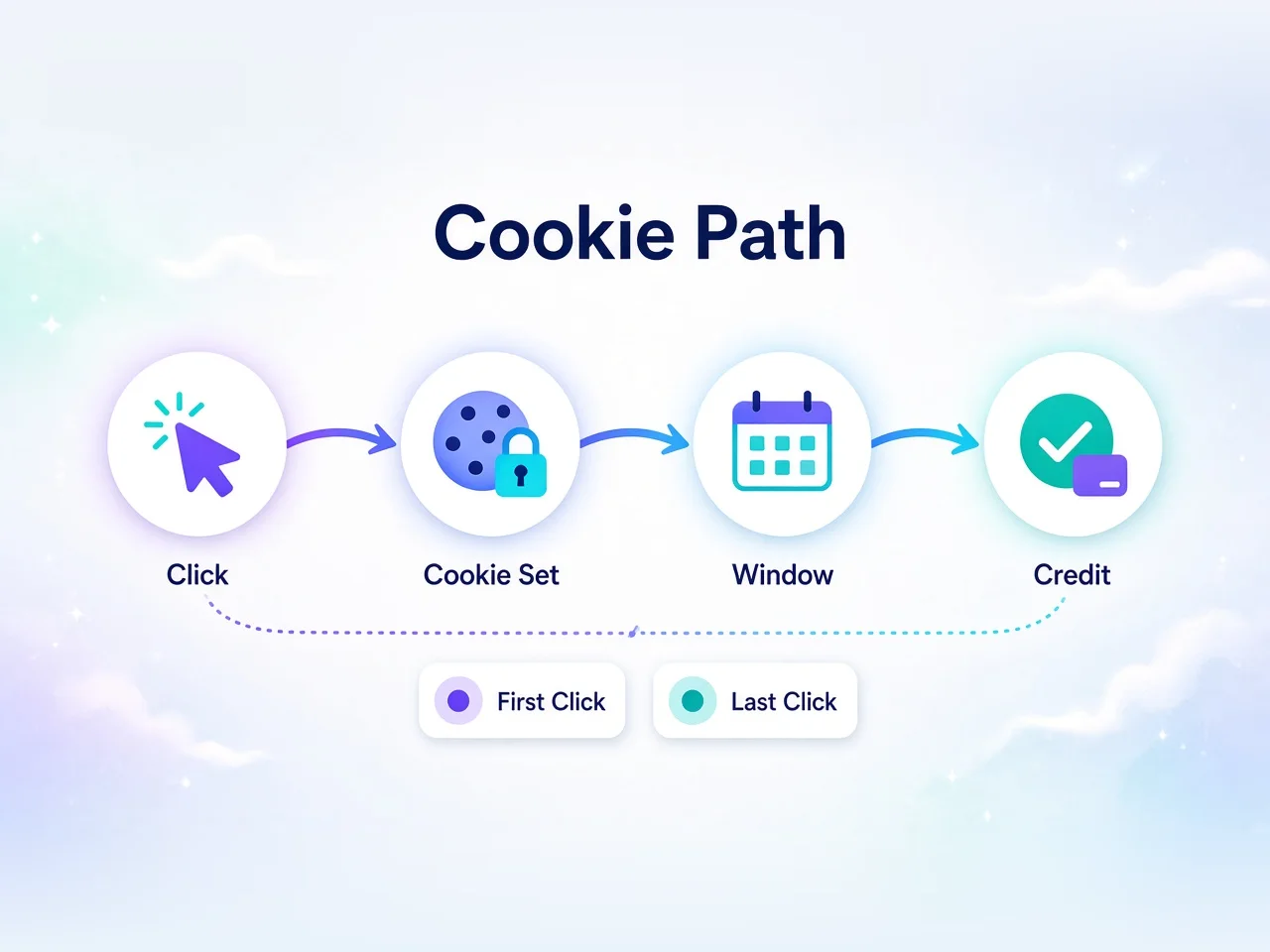
An affiliate cookie is the small tracking signal a network or advertiser sets after someone clicks your link — the piece that later answers “who gets credit if this visitor buys?” Without that window of attribution, affiliate marketing collapses into guesswork. Cookie duration, first-click vs last-click rules, and browser privacy changes (ITP/ETP-style limits) quietly decide more earnings than the headline commission rate.
This explainer is for publishers, affiliate managers, and marketers who want the mechanism in plain language — click → cookie → conversion window → credit — before they argue about rates. Exact day counts always live in ; ranges below describe typical industry practice, not a universal law.
program terms
What an affiliate cookie is
When a reader clicks an affiliate link, the network (or advertiser platform) usually drops a browser cookie or equivalent identifier tied to your publisher ID, the offer, and often a click/subID. If that visitor converts inside the allowed cookie window, the network attributes the sale (or lead) to you under the program’s rules.
Cookies are not the only tracking method — server-to-server postbacks, first-party pixels, and fingerprint-assisted models also appear — but “cookie” remains the everyday word publishers use for the attribution window. For the wider stack, see how to track affiliate links in WordPress and how affiliate tracking software works.
A few load-bearing terms:
Cookie duration — how long after the click a conversion can still credit you (often measured in days).
Cookie type — commonly framed as fixed/session-style windows in directory data; live programs add lock periods and exceptions.
Attribution model — usually last click or first click (sometimes hybrid / view-through for specific channels).
Lock / validation window — time after conversion before the commission is confirmed (returns, fraud checks).
Publishers sometimes confuse the marketing cookie window (can this click still earn?) with the payment validation period (will this commission survive returns and fraud review?). Both matter; only the first is what people usually mean by “30-day cookie.”
How the click-to-credit path works
Click sets a cookie; conversion inside the window credits the publisher under first- or last-click rules.
The core loop is simple:
01Click — The user hits your tracked link (deep link, redirect, or network hop).
02Cookie set — The network writes an identifier for your publisher account and the offer, with an expiry tied to the program’s duration.
03Browse / decide — The user may leave, come back days later, or convert immediately.
04Conversion inside the window — Purchase, signup, or qualified lead fires; the network checks whether a valid cookie (or fallback ID) still applies.
05Credit under attribution rules — First-click, last-click, or a hybrid decides which publisher wins if multiple cookies exist.
If the cookie expired, was overwritten by another affiliate’s later click, blocked by the browser, or cleared by the user, you typically earn nothing for that conversion — even if your content started the journey.
Duration ranges in practice
Directory defaults and program terms are not the same thing. Affground listings often show network-level cookie defaults in the 30–45 day band for major CPS networks, but live merchant programs commonly run shorter or longer windows by vertical:
Vertical pattern (typical practice)
Cookie window you often see
Why it matters
Impulse / low-consideration retail
Often a few days to ~2 weeks
Fast decisions; short windows still convert
Mid-funnel content ecommerce
Often ~2–4 weeks
Research cycles need breathing room
Considered retail / travel
Often ~30 days (sometimes longer)
Carts and trips take time
SaaS / high-ticket B2B
Often longer windows or hybrid models
Longer sales cycles; verify program terms
Finance / regulated offers
Highly program-specific
Compliance and approval rules dominate
Treat these as typical industry practice, not promises. Always verify the live program card: some offers use 24-hour windows; others stretch much longer; some add brand-exclusion or last-click-only rules that shrink what the marketing page implies. When two programs pay similar commissions, the longer verified cookie usually wins for content sites with longer research cycles — a theme that also shows up when you negotiate higher commissions.
First click vs last click
Attribution decides which affiliate gets paid when a user clicked more than one partner before converting.
Last-click attribution credits the most recent valid affiliate click before conversion. It is the default on many retail CPS programs because it is simple to explain and favors the closer. Coupon, deal, and loyalty publishers often benefit under last-click rules when they sit at the end of the path.
First-click attribution credits the earliest valid click inside the window. It favors content and discovery publishers who introduce the brand — review sites, SEO guides, YouTube explainers — and can under-reward the closer unless the program uses a hybrid.
Hybrids and assisted models (less common on classic networks, more common on enterprise partnership platforms) may split credit, weight channels, or combine click with view-through rules. If your traffic is mid-funnel content, a last-click-only brand with aggressive coupon partners can look “broken” even when your EPC on first-touch programs is healthy. Read the attribution line in the program terms the same way you read the commission percentage — it is a commercial rule, not a moral judgment about whose content “deserved” the sale.
Browser privacy: ITP, ETP, and what publishers should actually do
Modern browsers increasingly limit third-party cookies and shorten how long some identifiers persist. Industry shorthand for this includes Apple’s Intelligent Tracking Prevention (ITP) style limits and Firefox-style Enhanced Tracking Protection (ETP), alongside broader privacy sandbox / third-party cookie deprecation work across the web. Exact behaviors change by browser version and are not something to invent as legal claims — the operational point for affiliates is simpler:
Relying only on long-lived third-party cookies is riskier than it was a decade ago.
Networks and advertisers increasingly push first-party tracking, server-to-server postbacks, and cleaner redirect designs.
Mobile in-app browsers and strict privacy settings can truncate or block expected cookie behavior.
What to do in practice:
Prefer programs and networks that document modern tracking (first-party, S2S, reliable deep links).
Test conversions on the devices and browsers your audience actually uses.
Do not promise readers (or yourself) a cookie length the live program no longer supports.
Privacy changes do not “kill affiliate marketing,” but they punish sloppy tracking and magical thinking about 90-day third-party cookies that never get verified.
Where cookies show up in practice
Cookie defaults in Affground’s directory are a useful mid-funnel reference when you shortlist networks — then you still verify per program. These four CPS / partnership platforms are common places mid-size and growth publishers study cookie and payout terms side by side:
Affground currently lists ShareASale and Awin Global with ~30-day fixed-style defaults, and CJ Affiliate / Impact.com with ~45-day defaults — snapshots that help compare networks, not substitutes for merchant-level terms. For a head-to-head on enterprise vs classic CPS, see Impact vs CJ Affiliate; for mid-market catalog and payout fit, see ShareASale vs Awin. Explore more on the networks directory.
A practical checklist for publishers
01Read the program card — duration, attribution model, lock period, excluded traffic.
02Compare like with like — commission % without cookie and attribution context is incomplete.
03Match window to intent — short windows fit impulse; considered purchases need longer verified windows.
04Know your place in the funnel — first-click vs last-click changes who should recruit you.
05Test the path — click your link in a clean browser, convert inside and outside the window when possible.
06Watch privacy breakage — Safari/Firefox/in-app quirks deserve a spot in QA.
Treating the network default as every merchant’s cookie. Program terms win.
Optimizing only for commission %. A higher rate with a 1-day last-click window can lose to a modest rate with a realistic mid-funnel cookie.
Ignoring attribution model. Content sites on last-click-only retail can leak credit to coupon partners.
Assuming the cookie always survives. Browser limits, user clears, and overwrites are normal.
Skipping validation/lock windows. “Pending” is not “paid.”
Blaming “the cookie” for bad creative or wrong audience. Tracking cannot fix a weak offer-market fit — see why affiliate clicks but no sales.
Affground's verdict
An affiliate cookie is the time-boxed attribution claim between your click and a conversion. Duration, first vs last click, and modern browser limits decide whether that claim survives. Verify program terms, match the window to your funnel, and prefer networks that track cleanly in today’s browsers — those three habits beat memorizing any single “standard” day count.
Frequently asked questions
What is an affiliate cookie?
It is the tracking signal a network or advertiser sets after someone clicks your affiliate link. If the visitor converts inside the allowed window, that cookie (or equivalent ID) is what lets the network credit your publisher account.
How long do affiliate cookies last?
It depends on the program. Major CPS network directory defaults often sit around 30-45 days, while live merchant programs commonly run from a day or two up to much longer windows by vertical. Always verify the program terms.
What is the difference between first-click and last-click attribution?
Last-click credits the most recent valid affiliate click before conversion; first-click credits the earliest valid click in the window. Last-click often favors coupon/closer publishers; first-click favors discovery and content publishers.
Do browser privacy features break affiliate cookies?
They can shorten or block some third-party cookie behavior. Publishers should prefer programs with modern first-party or server-to-server tracking, test on real browsers, and never assume a marketing day-count still works unchanged.
Is cookie duration the same as the payment lock period?
No. Cookie duration decides whether a click can still earn credit at conversion time. The lock or validation window is how long after conversion a commission stays pending for returns and fraud checks before it is payable.
Which matters more: commission rate or cookie length?
Neither alone. A higher rate with a very short last-click window can underperform a modest rate with a realistic mid-funnel cookie. Compare commission, cookie, attribution model, and approval odds together.
Where can I see network cookie defaults?
Affground listing pages show network-level cookie defaults as directory snapshots — for example ShareASale and Awin around 30 days, CJ Affiliate and Impact.com around 45 days in current data. Merchant program terms still override those defaults.
Can a user clear an affiliate cookie?
Yes. Users can clear cookies, use private browsing, or hit browser limits that drop identifiers early. That is normal attrition — track it in testing rather than assuming every click remains attributable for the full marketed window.