When volume justifies a rate bump, what affiliate managers actually need to see, a practical email structure, and networks where custom commissions are common.
Sep 29, 2026 · 7 min read
Most publishers never ask for a better rate — and most who do ask too early, with the wrong proof. Affiliate managers raise commissions when volume, quality and brand safety make the bump cheaper than losing you to a rival program. A polite email with no EPC, no conversion story and no traffic plan almost always dies in the inbox.
This guide is for content publishers and performance marketers already live on a program or network who want a practical path to higher CPA, richer , longer cookies or exclusive creatives. You will see what managers actually review, when to ask, a clean email structure, when to negotiate, and a shortlist of networks where custom rates are common.
rev-share
not
What “higher commission” really means
Negotiation is not only a bigger percentage. Managers can move several levers:
Affiliate managers are measured on partner ROI and brand risk, not on making every publisher happy. Bring evidence that raising your rate still leaves the program profitable and safe.
Metrics that move the needle
EPC (earnings per click) — relative to the program or network average.
Conversion rate — click → tracked action, with enough sample size to trust.
Volume — qualified clicks or sales over a recent 30–90 day window.
AOV / order quality — low refund and chargeback rates matter as much as raw sales.
Content quality — URLs of the pages driving traffic; honest reviews beat doorway spam.
Brand safety — disclosures present, no banned claims, traffic sources you will name.
If you cannot show at least volume or above-average EPC with clean creatives, you are asking for a gift, not a partnership upgrade. Managers also care whether you are exclusive or concentrated on their brand versus spraying ten competitors — concentration is leverage when performance is real.
When volume justifies a bump
There is no universal threshold, but patterns repeat across networks:
You have consistent sales for 60–90 days, not a one-week spike from a viral post.
Your EPC sits at or above the program’s typical range (use your dashboard; Affground network snapshots such as Impact ~$1.55 EPC or CJ ~$0.90 are context, not your personal bar).
You are about to ship a major asset (pillar comparison, email sequence, YouTube series) and can forecast incremental volume.
A competitor program has made a credible written offer — use carefully; bluffing destroys trust.
Seasonal peaks (BFCM, tax season, back-to-school) where the brand already plans custom rates.
New accounts with three sales and a template “can I get 50%?” email will wait. Build a baseline first; then negotiate from data. Related reading: what affiliate managers look for in publishers.
Proof first, ask second — then lock the new terms in writing.
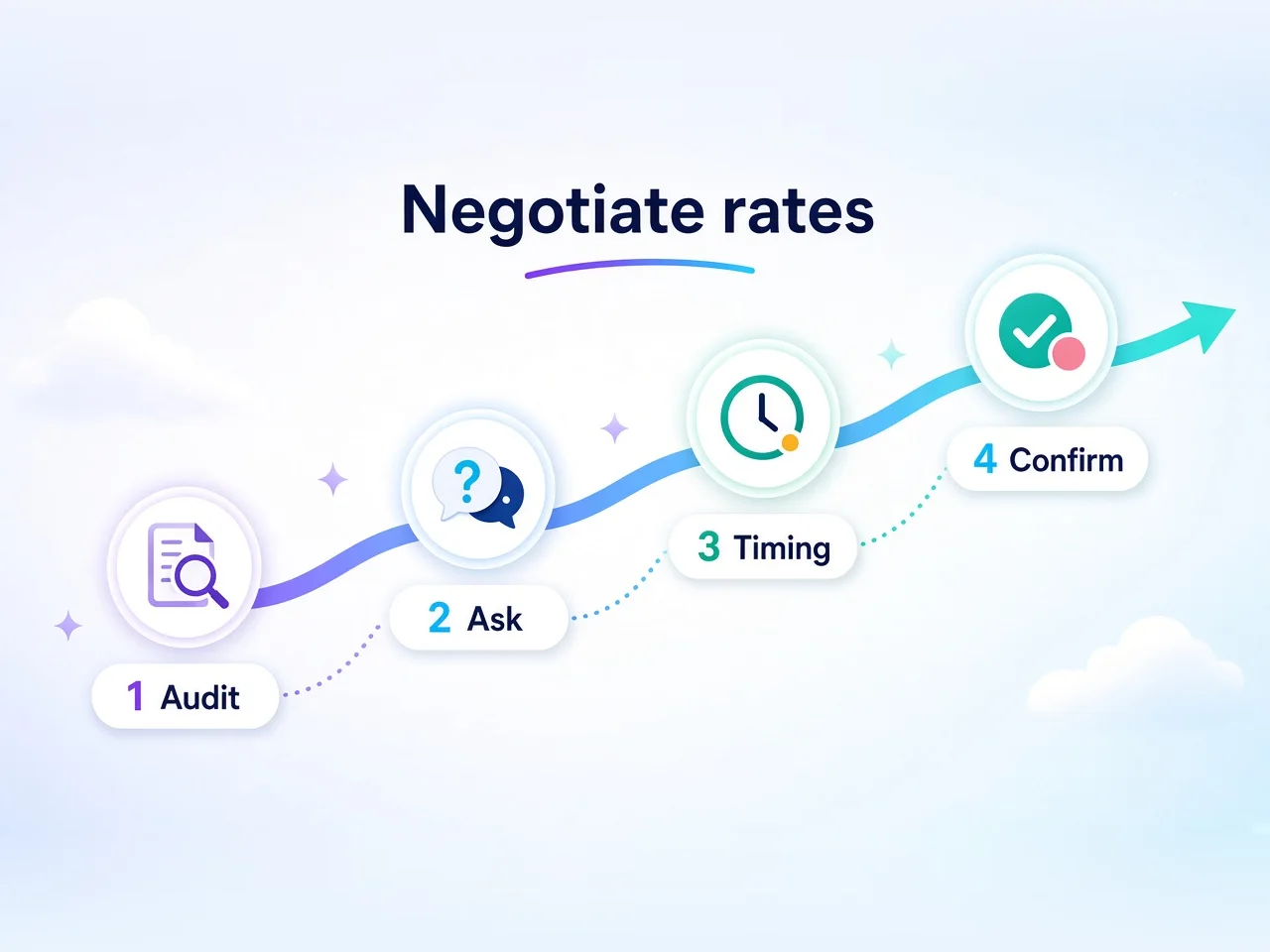
A practical negotiation sequence
1. Audit your last 90 days
Export clicks, sales, EPC, refunds and top landing pages. Note cookie misses you can prove (readers who returned after expiry). Screenshot or CSV beats anecdotes.
2. Pick one primary ask
Example: “+5% rev-share” or “cookie from 30→45 days” or “$10 bonus CPA on plan X through date Y.” Multiple asks dilute focus; secondary asks belong in a follow-up.
3. Time the email
Best windows: after a strong month, before a campaign you will promote hard, or during the brand’s planning cycle — not the day after a refund spike or a compliance warning. Mid-week mornings in the manager’s timezone help.
4. Send a short, evidence-led note
Structure that works:
01Context — who you are, which program/PID, channels.
02Proof — 3–5 numbers from the last 60–90 days (volume, EPC, CR, refund rate).
03Plan — what you will do with better terms (specific URL, launch date, expected lift — framed as a plan, not a guarantee).
04Ask — one clear lever and a reply-by window.
05Fallback — you are open to creatives, cookie or a temporary test rate if base commission is locked.
Keep it under ~200 words. Attach a one-page PDF or sheet if numbers are dense; do not paste a novel into the CRM.
5. Confirm in writing
When they agree, reply with a summary: new rate, start date, SKUs/geos covered, and whether it is permanent or a test. Dashboard screenshots drift; email trails settle disputes.
Email skeleton you can adapt
Subject: Partnership review — [Your site] × [Program] (last 90 days) Hi [Name] — we have promoted [Program] via [channels] since [month]. Over the last 90 days: [X] clicks, [Y] qualified actions, EPC [Z], refund rate [R]%. Top URL: [link]. We are launching [asset] on [date] and expect to grow this placement. Would you consider [specific ask] from [date], or a 60-day test at that rate? Happy to jump on a quick call. If base commission is fixed, we are also interested in [cookie / exclusive creative / bonus CPA]. Thanks, [Name] · [site] · [PID]
Swap in real figures only. Invented stats burn trust faster than a low starting rate.
When not to ask (yet)
Fewer than ~30–60 days of post-approval performance (unless you bring a large external audience with proof).
You just received a compliance strike, creative rejection wave or payment hold.
You are threatening to leave without an alternative ready — empty ultimatums read as noise.
The program publishes a hard public rate card with no custom path; ask about bonuses and creatives instead.
Networks where custom rates are common
Direct-brand programs vary, but large affiliate networks routinely support situational commissioning, private terms and account-manager overrides once you prove out. Start conversations here when your advertisers live on these platforms:
Impact.com and CJ Affiliate both lean enterprise — CJ’s tooling historically includes Situational Commissioning and Content Certification for publishers who negotiate beyond sticker rates; Impact’s partnership platform is built for custom partner deals across affiliates and other partner types. See our deeper Impact vs CJ comparison. Awin Global and ShareASale (Awin group) are strong for mid-market catalogs where managers can still move cookies, exclusive codes and publisher-specific rates after consistent volume. Directory cookie defaults (~45 days Impact/CJ, ~30 days Awin/ShareASale) are baselines — negotiated windows are program-specific.
If you work mostly with in-house programs (SaaS on PartnerStack, fintech on Partnerize), the same proof pack applies; the inbox is just the brand’s partner team instead of a network AM.
Alternatives when the rate will not move
A “no” on base commission is not the end of the conversation:
Exclusive or early creatives — often easier for the brand to approve than a permanent rate hike.
Longer cookies for content and email — especially on considered purchases.
Time-boxed bonus CPA tied to a launch — lower risk for the advertiser.
Priority support and deep-link tooling that raise conversion without changing the headline %.
Track which alternative actually lifts revenue. Sometimes a creative and cookie package beats a noisy 2% bump.
Common mistakes
Leading with “competitors pay more” and no performance sheet.
Asking every month — you train the manager to ignore you.
Negotiating in a public Slack or social thread.
Accepting a verbal bump with no PID/term confirmation.
Optimising only for rate while approval rate or refund clawbacks erase the gain.
Quick checklist before you hit send
0190-day metrics exported and summarised.
02One primary ask + one fallback lever.
03Proof URLs and disclosure already live.
04Timing tied to performance or a real upcoming push.
05Written confirmation plan ready for when they say yes.
Commission negotiation is a performance conversation, not a favour. Bring numbers, propose a plan, ask for one clear lever — and be ready to win on cookie, creative or bonus CPA when the base rate is locked.
Frequently asked questions
When should I ask for a higher affiliate commission?
After you have consistent performance — typically 60–90 days of post-approval data — with solid EPC, conversion rate, clean content and brand-safe traffic. Asking right after approval or after a compliance strike usually fails.
What metrics do affiliate managers want before raising rates?
EPC versus program norms, conversion rate with enough sample size, recent volume, refund/chargeback quality, content URLs, and proof of disclosures and accepted traffic sources. A short performance snapshot beats a long pitch.
Can I negotiate cookie length instead of commission percentage?
Yes. Longer cookies, bonus CPA, exclusive creatives, early offer access and temporary test rates are common alternatives when the base rate is locked. Ask for the lever that fixes your real bottleneck.
Which affiliate networks allow custom commission rates?
Large networks such as Impact.com, CJ Affiliate, Awin Global and ShareASale commonly support manager-led or situational custom terms once you prove volume and quality. Direct in-house programs can negotiate too via their partner teams.
What should I include in a commission negotiation email?
Who you are and your PID, 3–5 proof metrics from the last 60–90 days, a concrete upcoming promotion plan, one clear ask, and a polite fallback (cookie, creative or bonus CPA). Keep it short and confirm any agreement in writing.
Is it bad to mention a competitor’s higher rate?
Only if you have a real written alternative and strong performance of your own. Empty “they pay more” threats without data damage trust. Lead with your results; competitor offers are secondary context at most.
What if the brand says no to a rate increase?
Pivot to exclusive creatives, a longer cookie, a time-boxed bonus CPA, placement fees alongside links, or better deep-link tooling. Track whether the alternative lifts revenue — sometimes it beats a small permanent bump.