Guide
The software behind every commission does one job: match a conversion to the exact click that caused it. Here is the click-to-conversion lifecycle, the six components inside every tracker, and how to choose one.
Behind every affiliate commission is a piece of software quietly doing one job: matching a conversion back to the exact click that caused it. Affiliate tracking software assigns each partner a unique link, records every click, watches for the resulting sale or lead, and attributes it to the right affiliate — accurately enough that real money changes hands on the result. Get it wrong and affiliates go unpaid, advertisers bleed budget to fraud, and trust collapses.
This guide is for advertisers, affiliate managers and serious affiliates who want to understand the machinery — not just that tracking happens, but how the platform does it. We will walk the path a click takes through the software, break down the six components every tracker shares, compare building vs. buying, and give you a checklist for choosing one. (For the underlying mechanism — cookies, pixels, fingerprinting — see How Does Affiliate Tracking Work?; this piece is about the platform.)
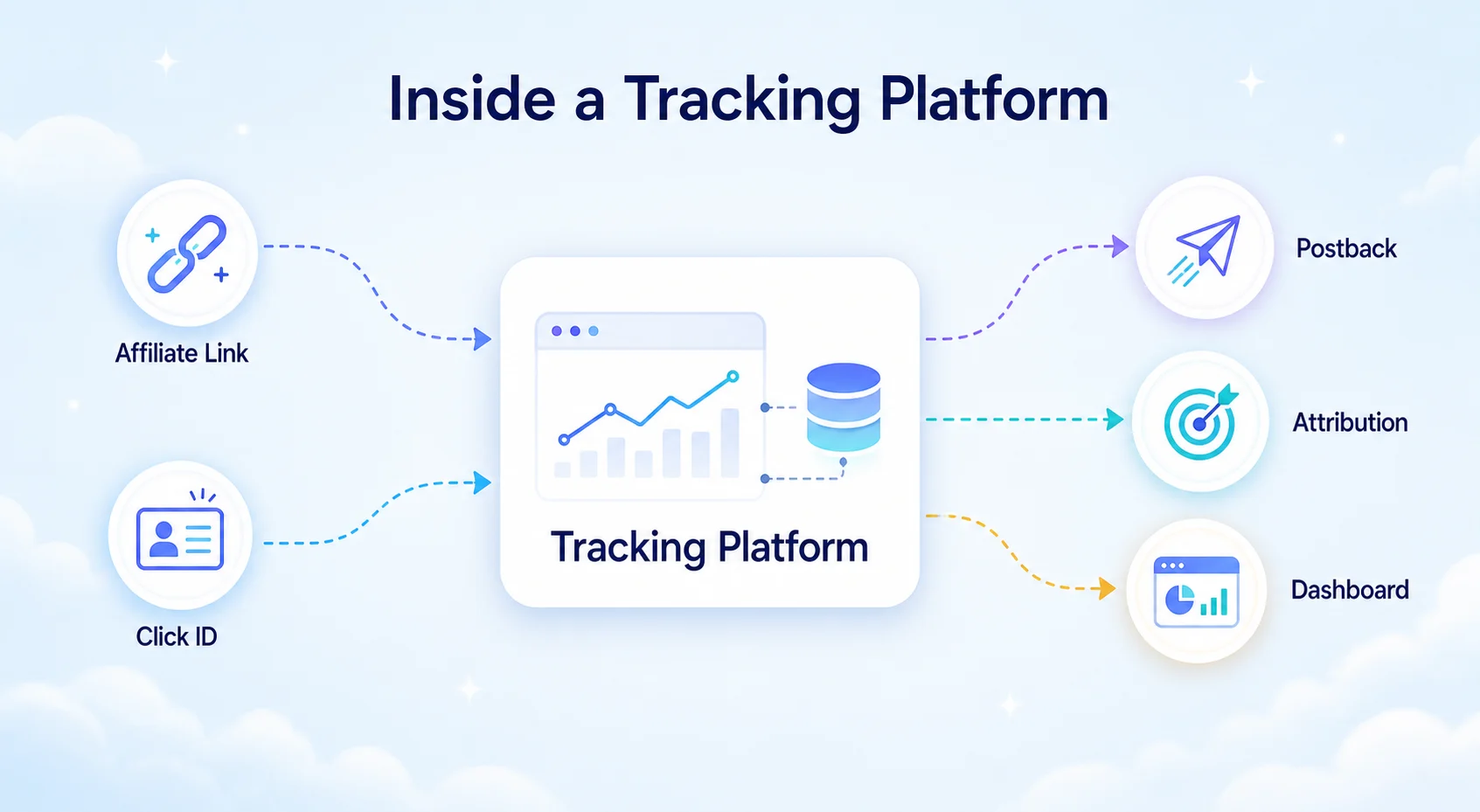
At its core, tracking software is a redirect engine plus a database plus a reporting layer. It sits between the three parties in any affiliate relationship — the advertiser (who has an offer), the affiliate/publisher (who has an audience), and often a network (who connects them) — and it is the single source of truth all three settle on.
Three things make it more than a link shortener:

Here is the full lifecycle inside the software, step by step:
Step 4 is where platforms differ most: browser pixels are easy to set up but lost to ad blockers and Safari's ITP, while postback / server-side tracking is far more resilient. See What Is Server-Side Tracking? for why serious programs default to it.

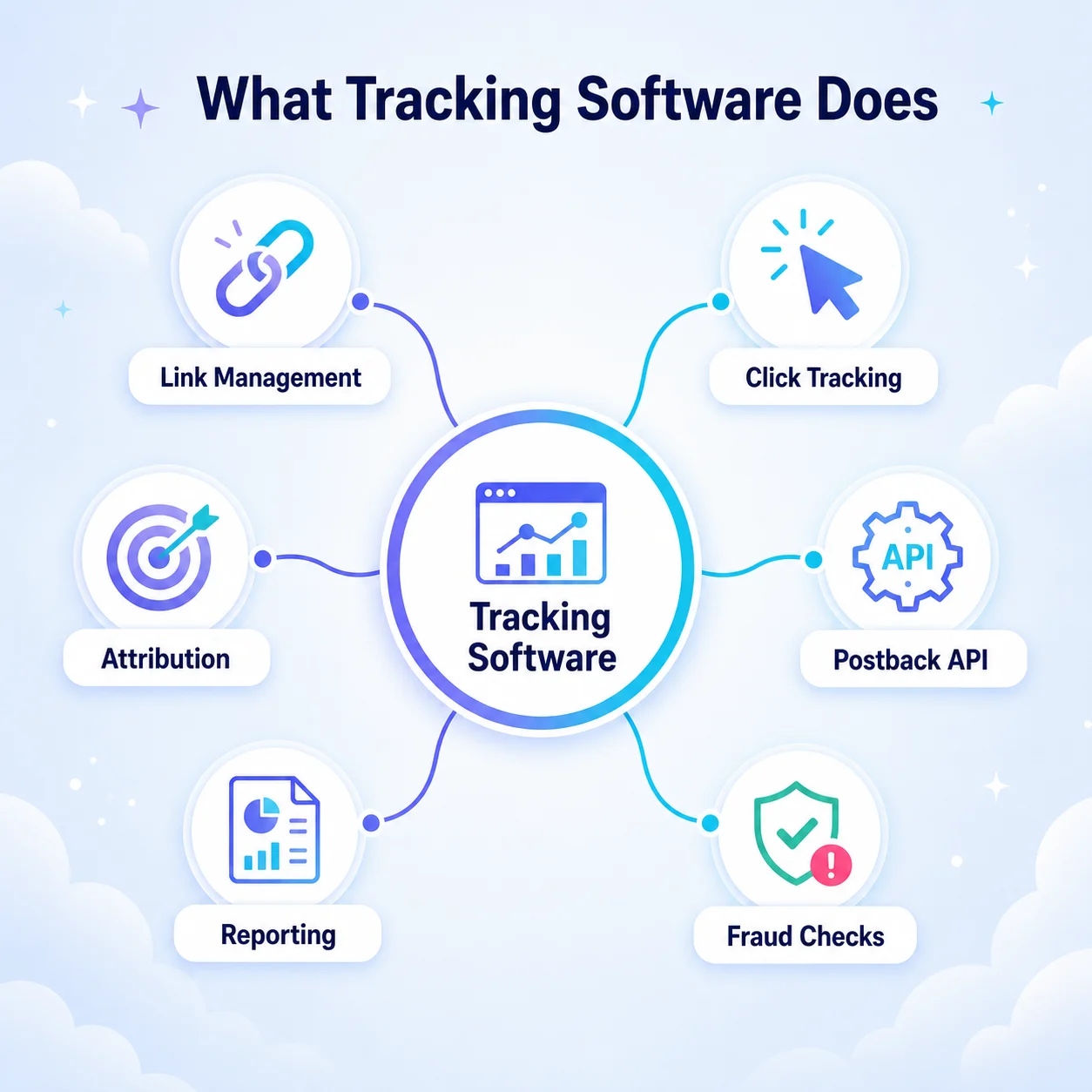
Strip any tracker down and you find the same six jobs:
| Component | Job |
|---|---|
| Link & creative management | Generate tracking links, deep links and sub-IDs; host banners and creatives |
| Click tracking | Log every click with click ID, timestamp, geo, device and referrer |
| Conversion attribution | Match conversions to clicks and apply the attribution model |
| Postback / pixel + API | Receive conversion signals (S2S postback, pixel) and integrate with carts/CRMs |
| Reporting & analytics | Real-time stats — clicks, conversions, EPC, revenue — sliced by any dimension |
| Fraud detection | Filter bot clicks, duplicate conversions and suspicious patterns |
Everything a platform markets — deep linking, coupon tracking, multi-touch attribution, partner portals — is a refinement of one of these six.
Tracking is not academic; measurable revenue leaks when it is weak:
| Reality | Why it matters for the software |
|---|---|
| Safari and iOS cap third-party cookies at ~24h (ITP) | Cookie-only tracking loses considered-purchase conversions; server-side is needed |
| A large share of web traffic is mobile | In-app and cross-device journeys break naive cookie tracking |
| Ad blockers strip many client-side pixels | Server-side postbacks fire regardless |
| Affiliate fraud drains a meaningful slice of spend | Built-in fraud filtering protects the payout budget |
Figures above are widely cited industry ranges, not guarantees — the point is directional: client-side-only tracking under-counts, so modern platforms lean server-side.
You rarely build a tracker from scratch. The real choice is how you source one:
| Option | What it is | Best for |
|---|---|---|
| Network's built-in platform | Tracking baked into a network (Impact, ClickBank and the like) | Most advertisers and affiliates — zero setup, trusted ledger |
| Standalone SaaS tracker | A hosted tracker you point campaigns at (RedTrack, Voluum-style) | Media buyers running many offers/sources who need one dashboard |
| Self-hosted software | Software you install and own (Post Affiliate Pro, Scaleo-style) | Brands wanting full data ownership and a custom in-house program |
For most people the decision is made for them: join a network and you inherit its tracking platform. Running your own program, or paid traffic across many sources, is when a standalone or self-hosted tracker earns its cost.
Score any option against the criteria that actually predict whether you will get paid correctly:
If you would rather inherit a proven tracking stack than run your own, these networks operate well-established platforms with server-side tracking, real-time reporting and fraud controls built in:
Joining one means the hardest part — accurate, trusted attribution — is handled for you. Browse the full directory to compare tracking, payouts and cookie windows across networks.
Affiliate tracking software is really three things done well: assign a unique identity, attribute the conversion to the right click, and report it honestly. The platforms that win do the unglamorous parts — server-side postbacks, fraud filtering, fast redirects — because that is where commissions are quietly won or lost. For most advertisers and affiliates, the smart move is to inherit a network's proven tracking rather than build your own.
It is the system that assigns each affiliate a unique link, logs every click, attributes the resulting conversions, and reports them for payout. It acts as the single source of truth between the advertiser, the affiliate and the network.
When a conversion fires, the advertiser's site sends back the click ID via a pixel or server-to-server postback. The tracker matches that click ID to the original logged click and applies its attribution model — most commonly last-click — to credit the right affiliate.
A postback is a server-to-server call the advertiser fires on conversion that passes the click ID and sale value back to the tracker. Because it runs server-side, it is far more reliable than a browser pixel, which ad blockers and Safari's ITP can strip.
Usually not. Joining an affiliate network gives you its built-in tracking platform for free. A standalone or self-hosted tracker is worth it mainly if you run your own in-house program or buy paid traffic across many offers and sources.
Less so for client-side cookies — Safari's ITP, mobile and ad blockers all erode them. Server-side and postback tracking are now the reliable default, which is why modern platforms lean on them.
A network is the marketplace that connects advertisers and affiliates; a tracking platform is the software that records clicks and conversions. Networks bundle a tracking platform, whereas a standalone tracker records data but does not include a marketplace of offers.
It filters bot and duplicate clicks, rejects impossibly fast or repeated conversions, and flags mismatched geos, devices and abnormal patterns before they reach the payout ledger.
8 minAd networks are the machinery that connects advertiser budgets to publisher ad space at scale. Here is what an ad network is, how it works, the main types and pricing models, and the benefits for both sides.
8 minClicks with no commissions isn't failure — it's usually a broken link in a six-step chain. Here's how to tell whether you even have a problem yet, and a diagnostic to find and fix the exact step that's leaking.
7 minDating is one of the largest, highest-paying CPA verticals — it converts on cheap free sign-ups yet sits on high-lifetime-value users. Here are the best high-paying dating affiliate networks — CrakRevenue, Advidi, AdsEmpire, ClickDealer, LosPollos and Trafee — plus the payout models (SOI, DOI, PPS, RevShare, smartlink) and how to choose.