HubSpot pays 30% recurring for a year; Semrush pays a flat $200 per sale. Here is how to tell which one earns more for your audience.
Oct 7, 2026 · 7 min read
HubSpot and Semrush run two of the most promoted affiliate programs in marketing software, and they pay in opposite ways. HubSpot pays 30% recurring commission for up to a year, so your payout scales with what the customer spends. Semrush pays a flat $200 bounty per new subscription plus $10 per trial, so your payout is the same whether the buyer is a freelancer or an agency.
That difference decides which one earns more for you, and it comes down to audience fit: who reads your content, what they're likely to buy, and how long they take to decide. This comparison is for bloggers, newsletter writers, YouTubers and agencies choosing where to put their marketing-software reviews and tutorials.
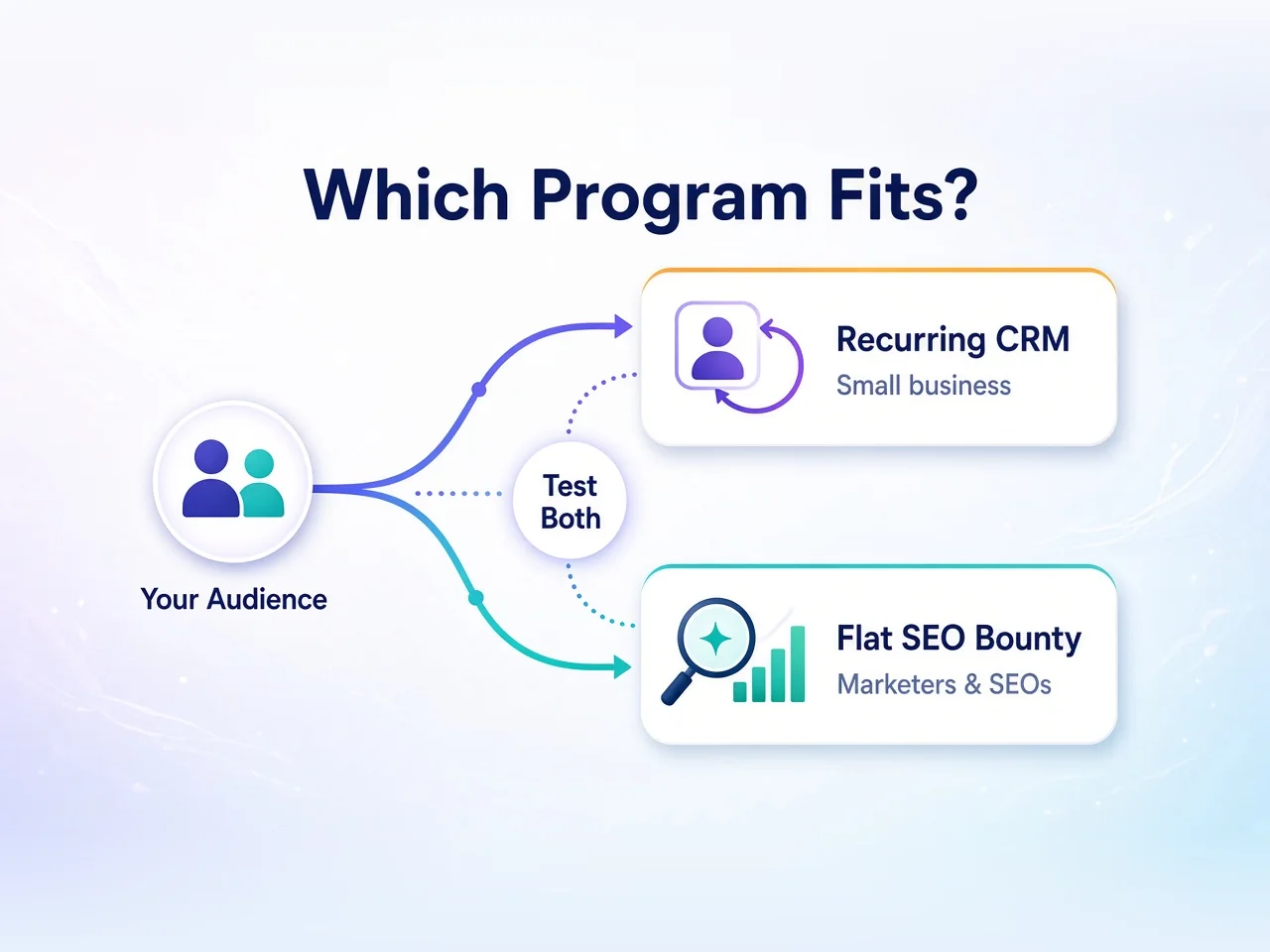
Same audience of marketers, two very different ways of getting paid
The two programs at a glance
Both are mature, well-run programs aimed at the same broad audience of marketers and business owners. The terms below come from each brand's public affiliate pages; both reserve the right to change them, so check the live terms before you build a content plan around a number.
$200 per new subscription; $10 per trial activation
Range by product or tier
Higher tiers add bonuses or custom commission
$100–$300 per sale by product, higher at top loyalty levels
Cookie window
180 days
120 days, last click
Platform
HubSpot's affiliate tool
Impact
Cost to join
Free, no minimum sales
Free; application reviewed in about 4 days
The headline difference is the model. If you want the mechanics behind each, our guide to CPA vs revenue share vs hybrid commission covers the trade-offs in general terms.
How HubSpot pays
HubSpot pays 30% of what a referred customer spends, every month, for up to 12 months. HubSpot's own page frames the upside as "up to $1,000+ per sale", which only happens when the customer buys a larger plan or adds seats and hubs.
A few terms shape real earnings:
First purchase by a new customer. You're credited for customers who weren't already in an active sales process with HubSpot when they clicked your link.
A locking period. The customer has to stay active for a set period before the commission locks, so very early cancellations don't pay.
Purchase or sign-up, not both. Commission is based on one or the other, and higher-volume tiers can unlock cost-per-sign-up or custom deals.
A 180-day cookie. HubSpot is a considered purchase, often involving a team decision, so a long window genuinely matters here. See what an affiliate cookie is for how windows interact with attribution.
The catch is that HubSpot's entry plans are inexpensive. A small business on a starter plan generates a small commission, and the recurring stream ends after a year or when the customer churns, whichever comes first.
How Semrush pays
Semrush pays a flat bounty when a referral makes its first purchase: $200 for a core Semrush subscription, with other products such as its local, social and content tools paying different amounts. It also pays $10 for every free-trial activation, which smooths income between sales.
The program moved to Impact after years in-house, replacing a famously long 10-year, first-click cookie with today's 120-day, last-click window. Its loyalty program places affiliates in four levels based on first purchases generated in the previous quarter; higher levels raise the per-sale bounty and unlock perks such as longer trials for your audience.
Because the bounty is fixed, Semrush pays you the same for a solo blogger on the cheapest plan as for an agency on a top plan. That makes earnings predictable and easy to forecast from traffic, which suits publishers who think in EPC terms.
The break-even rule
You can compare the two directly with simple arithmetic. Thirty percent of a customer's first-year spend beats a $200 bounty once that spend passes roughly $667. The examples below are hypothetical and ignore taxes, refunds and churn.
Referred customer's first-year spend
HubSpot (30% for up to 12 months)
Semrush (flat bounty)
$300
$90
$200
$667
about $200
$200
$2,400
$720
$200
$9,600
$2,880
$200
So the question isn't which program has the better rate. It's what your typical referral will actually spend in year one, and whether they'll still be paying after a few months. An audience of solo founders trying a free CRM tends to land on the left side of the table. An audience of growing sales teams and agencies tends to land on the right.
Timing matters too. HubSpot spreads earnings over a year, which helps cash flow later but slows payback on content you're paying to produce. Semrush's bounty arrives in one go after its locking period.
Audience fit: which program matches your readers
Start from who reads you, not from the headline rate
HubSpot fits content about running a business: CRM selection, sales pipelines, inbound marketing, customer service tooling, marketing automation and operations. Readers are business owners, sales leaders and marketing managers who buy for a team. Comparison posts against other CRMs, implementation guides and "how we set up our sales process" case studies convert best because the reader is already shopping.
Semrush fits content about getting found: keyword research, technical SEO, content strategy, competitor analysis, PPC research and local SEO. Readers are SEOs, content marketers, freelancers and agencies, many of whom buy for themselves. Tutorials that use the tool inside the workflow, such as "how to find keyword gaps", convert well because the free trial lets readers repeat your steps immediately.
There's real overlap. A general digital-marketing blog serves both audiences, and most such sites promote both programs on different pages rather than choosing one. The mistake is putting the same link everywhere; match each program to the article's intent.
Head-to-head on live data
The comparison below pulls current listing data from the Affground directory, including ratings and payout details as they're updated.
Head-to-headHubSpot Affiliate vs Semrush Affiliate
Neither program is better in the abstract. HubSpot wins when your readers buy for growing teams, because 30% of a sizeable subscription quickly outruns a flat bounty. Semrush wins when your readers are individual marketers and SEOs, because $200 per sale plus trial payouts beats a small slice of an entry plan. Most marketing publishers should run both, each on the content its buyers actually read.
Frequently asked questions
How much does the HubSpot affiliate program pay?
HubSpot pays 30% recurring commission for up to one year on referred customers' purchases, with higher tiers unlocking bonuses or custom commission. Check the live terms, as rates can change.
How much does the Semrush affiliate program pay?
Semrush pays a flat $200 per new core subscription and $10 per free-trial activation. Other Semrush products pay different amounts, and higher loyalty levels raise the per-sale bounty.
Which has the longer cookie, HubSpot or Semrush?
HubSpot lists a 180-day cookie window. Semrush uses a 120-day, last-click window.
Is HubSpot or Semrush better for affiliates?
It depends on what your referrals spend. Thirty percent of first-year spend beats a $200 bounty once that spend passes roughly $667, so HubSpot tends to win with growing teams and Semrush with individual marketers and SEOs.
Does HubSpot pay lifetime recurring commissions?
No. HubSpot's recurring commission runs for up to 12 months per customer, and it stops earlier if the customer cancels.
Which network runs the Semrush affiliate program?
The Semrush affiliate program is hosted on Impact, which provides links, tracking, reporting and payments.
Can I promote both HubSpot and Semrush?
Yes. Both programs are free to join, and many marketing publishers run both, matching HubSpot to business and sales content and Semrush to SEO and content workflows.
Does Semrush pay for free trials?
Yes. Semrush pays $10 for each free-trial activation from your referrals, in addition to the bounty when a referral makes its first purchase.
Oct 10, 2026 · 7 min read
Best Software Affiliate Programs for Bloggers
The tools that run your blog are the easiest to sell honestly. Compare hosting, page builder, SEO and email affiliate programs by commission, cookie and recurring pay.