What Is EPC in Affiliate Marketing? The Complete Guide
EPC — earnings per click — is the single most useful metric in affiliate marketing and the most misread. This is the complete publisher's guide: what EPC means, how to calculate it, network EPC vs your real EPC, benchmark figures, the levers that move it, and how to run your whole operation on it.
Jul 10, 2026 · 17 min read
Two publishers promote the same product, to roughly the same-sized audience, in the same month. One walks away with $90. The other makes $940. Same offer, same commission rate, same number of readers. The gap isn't luck — it's EPC, the single number that quietly explains why one affiliate business prints money and another spins its wheels.
EPC — earnings per click — is the most useful metric in affiliate marketing, and the most misunderstood. It's the number that lets you compare a flat-fee CPA offer against a lifetime revenue-share deal on one honest figure, spot which of your pages actually pays, and stop guessing about where to point your traffic. If you learn to read one affiliate metric well, make it this one.
This is the complete, publisher's-eye guide to EPC: what it means, exactly how to calculate it, the difference between the EPC a network shows you and the EPC you'll actually earn, real benchmark figures, the levers that move it, and a framework for using it to run your whole affiliate operation. Written for publishers, reviewers and comparison sites who want to earn more from the traffic they already have.
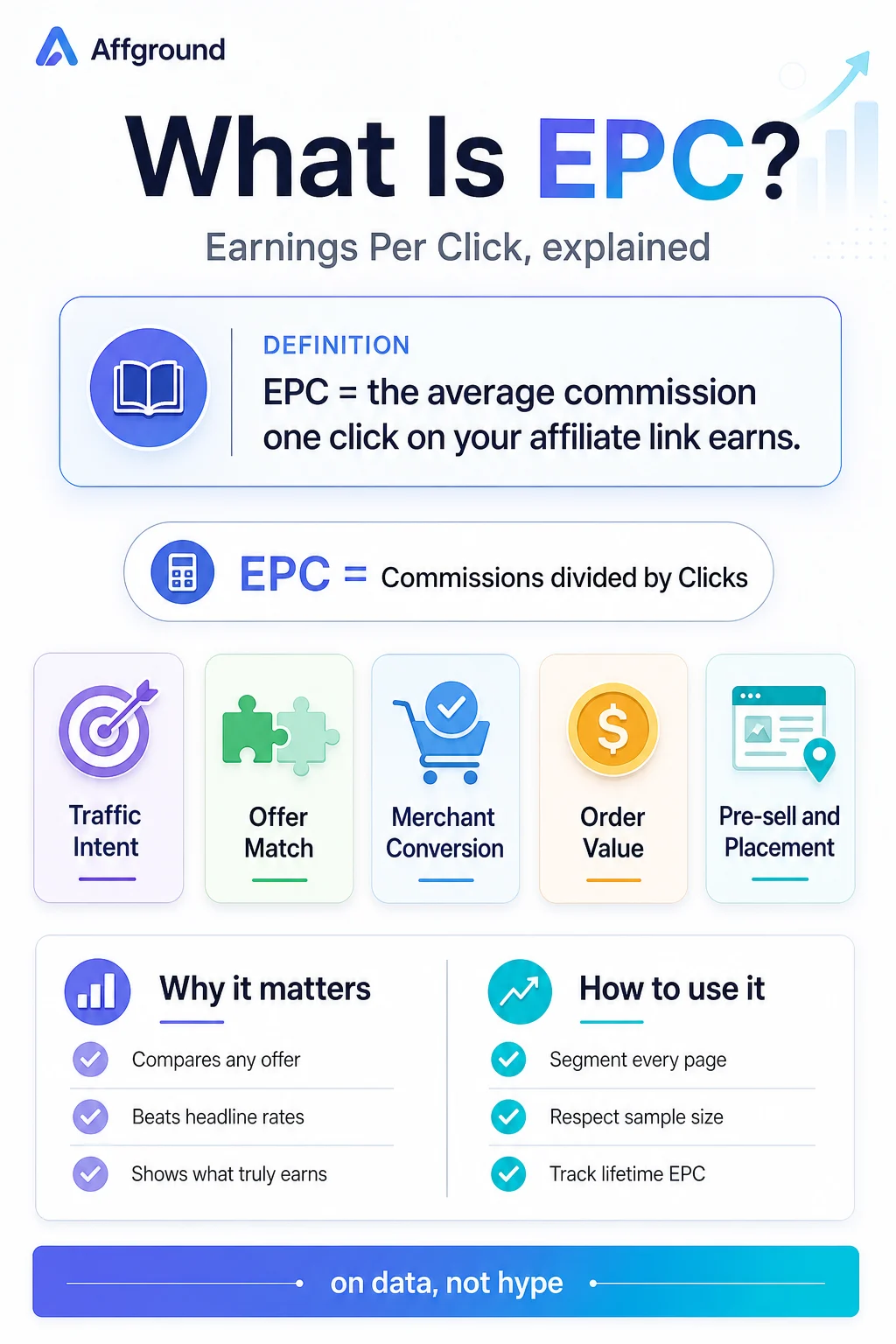
EPC at a glance — the formula, why it beats headline commission rates, and the five levers that decide the number.
What is EPC, really?
EPC stands for earnings per click. It answers one deceptively simple question: on average, how much money does a single click on your affiliate link earn you?
The formula is as plain as it looks:
EPC = total commissions ÷ total clicks
Send 1,000 clicks to an offer, earn $650 in commission, and your EPC is $0.65. That's it. One number that folds together everything that happens after the click — whether the merchant's page converts, how big the average order is, what percentage you're paid, and how many sales get reversed — into a single figure you can actually compare across wildly different offers.
That's the quiet genius of EPC. A 40% commission on a $19 ebook and a 25% recurring cut of a $99/month SaaS tool are impossible to compare by rate alone. Convert them both to EPC and the comparison becomes trivial: whichever earns more per click wins, full stop. EPC is the great equalizer — it doesn't care how an offer is structured, only what it delivers.
Affground's take: headline commission rates are marketing; EPC is truth. A program screaming "up to 50% commission!" is telling you its ceiling, not your reality. EPC is the only number that has already survived contact with real conversion rates, real order values and real reversals. When an experienced affiliate sizes up an offer, the rate is a footnote — EPC is the headline.
A note on units: per click vs per 100 clicks
Here's the first place beginners trip. EPC is usually quoted per single click ($0.65), but many networks — ShareASale and CJ among them — historically display it per 100 clicks instead. So an offer showing "$65 EPC" on a network dashboard almost always means $65 per hundred clicks, i.e. an EPC of $0.65 per click. Same number, shifted two decimal places.
It sounds trivial until you misread it and think an offer pays 100× what it does. Always confirm whether an EPC figure is per click or per 100 clicks before you compare anything. Throughout this guide, EPC means per single click unless stated otherwise.
The one distinction that matters most: network EPC vs your EPC
If you remember nothing else from this article, remember this: the EPC a network shows you is not the EPC you will earn.
Networks publish an EPC figure next to most offers. It's tempting to read it as a promise — "join this and earn $2.40 a click!" It is nothing of the sort. Network EPC is a blended average across every affiliate promoting that offer, usually over a trailing window (often the last 7 days), lumping together the expert with a perfectly-matched audience and the spammer blasting untargeted pop traffic. It's a benchmark, not a forecast.
Network EPC
Your EPC
What it is
Blended average across all affiliates
What your specific traffic actually earns
Time window
Usually a trailing 7 days
Whatever period you measure
Who it describes
Everyone, mixed together
Only you
Use it to
Shortlist and compare offers
Decide what to keep, cut and scale
Trap
Reading it as a guarantee
Judging it on too few clicks
Your own EPC on the same offer can land far above or far below the network figure — and which is the whole game. Great pre-sell content aimed at high-intent buyers routinely beats network EPC by 2–3×. Mismatched or low-intent traffic can earn a fraction of it. The network number tells you an offer can convert; only your number tells you whether it converts for you.
Affground's rule: treat network EPC as a starting shortlist, never a promise. Use it to decide what's worth testing, then let your EPC — measured on your own traffic — decide what's worth keeping. The affiliates who confuse the two either chase inflated numbers they never hit, or dismiss great offers a small tweak would have fixed.
What counts as a "good" EPC? Real benchmarks
There's no universal "good" EPC, because it swings enormously by vertical, offer type and traffic quality. A $0.30 EPC can be excellent in a high-volume, low-ticket niche and dismal in premium SaaS. Context is everything.
That said, real numbers beat hand-waving. Below are EPC figures published in the Affground directory across a spread of well-known programs and networks — a grounded sense of where the number actually lands (blended, indicative figures; your mileage will vary):
Program / network
Type
Vertical
Reported EPC
Shopify Affiliate
Program
E-commerce platform
$3.20
Semrush Affiliate
Program
SEO / SaaS
$2.95
NordVPN Affiliate
Program
VPN / security
$2.80
HubSpot Affiliate
Program
B2B SaaS
$2.60
PartnerStack
Network
B2B SaaS
$2.40
Coinbase Affiliate
Program
Crypto
$2.10
Impact.com
Network
Multi-vertical
$1.55
Bluehost Affiliate
Program
Web hosting
$1.40
ShareASale
Network
Multi-vertical
$1.12
ClickBank
Network
Digital products
$1.00
Awin Global
Network
Multi-vertical
$0.94
CJ Affiliate
Network
Multi-vertical
$0.90
A few patterns worth internalizing. High-ticket and recurring verticals — SaaS, security, hosting, crypto, e-commerce platforms — sit at the top, because a single conversion is worth a lot (and RevShare deals keep paying). Broad multi-vertical networks blend down to roughly $0.90–$1.55, because they average across everything from premium software to low-margin retail. As a rough field guide for your pages: under $0.20 is usually weak, $0.20–$0.50 is workable in high-volume niches, $0.50–$1.50 is solid, and consistently north of $1.50 means you've matched a strong offer to genuinely high-intent traffic.
Affground's take: don't chase the top of that table. A $3.20 EPC offer you can barely get anyone to click is worth less than a $0.40 offer perfectly matched to a hungry audience you already own. EPC only matters multiplied by the clicks you can actually send. Relevance first, EPC second — in that order, always.
EPC vs the other metrics it gets confused with
EPC lives in an alphabet soup of affiliate and ad-tech acronyms. Knowing exactly how it differs from its neighbours is what lets you read a dashboard without fooling yourself.
Metric
Full name
Whose number
What it measures
EPC
Earnings per click
The affiliate's
Commission earned per click you send
RPC
Revenue per click
The affiliate's
Effectively a synonym for EPC; same math
CPC
Cost per click
The advertiser's
What a buyer pays per click on paid ads
CPA
Cost per action
Both
A payout model (flat fee per action), not a per-click metric
AOV
Average order value
The merchant's
Average size of each purchase — a driver of EPC
CR
Conversion rate
Both
Share of clicks that convert — the other driver of EPC
EPMV
Earnings per 1,000 visitors
The publisher's
Blends all monetization, not just affiliate clicks
The one that catches people out is CPC vs EPC. They sound like mirror images, and in a way they are: CPC is what you pay to buy a click; EPC is what you earn from a click. For a paid-traffic affiliate, the entire business is one inequality — EPC must exceed CPC, or every click loses money. For an organic publisher, CPC is irrelevant (your clicks are "free"), and EPC is close to pure profit signal.
The other key relationship is that EPC isn't independent — it's built from two other metrics:
EPC ≈ conversion rate × commission per conversion
Which means there are only ever two ways to raise it: get more clicks to convert, or make each conversion worth more. Every optimization you'll ever do rolls up into one of those two levers. Hold that equation in your head and EPC stops being a mystery number and becomes a dial you know how to turn.
The five levers that actually move your EPC
Since EPC = conversion rate × value per conversion, everything that moves it works through one of those two. Here are the five levers that matter most, roughly in order of impact:
Traffic intent. The biggest lever by far. A reader who searched "best VPN for streaming" is worlds more likely to buy than someone who wandered in from a viral listicle. Intent decides conversion rate, and conversion rate is half the EPC equation. High-intent traffic can lift EPC by an order of magnitude over casual traffic on the identical offer.
Offer–audience match. The right offer for your people. Promoting premium B2B software to a hobbyist audience tanks EPC no matter how good the program's benchmark looks. Match the offer to what your readers actually buy.
The merchant's conversion machine. You send the click; the merchant's landing page, pricing, checkout and trust signals close (or lose) the sale. A program with a superb page will out-earn a stingier competitor with a leaky one — which is exactly why network EPC is worth checking before you commit.
Commission structure and order value. Higher rates, bigger average orders and recurring RevShare all raise the value per conversion. One loyal SaaS subscriber on lifetime RevShare can quietly out-earn dozens of one-off sales.
Pre-sell and placement. How well your content frames the decision, and where the link sits relative to the moment of choice. A recommendation placed right after you've made the case converts far better than one bolted on at the end. This is the lever you control most directly.
Notice the pattern: the two biggest levers — intent and match — are about who you send and to what, not about squeezing the offer. Beginners obsess over finding a higher-paying program. Professionals obsess over sending better-matched, higher-intent traffic to a merchant that already converts. The second game pays far better.
EPC turns a wall of offers into a ranked list: keep and scale the top earners per click, quietly retire the rest.
A worked example: reading EPC like a pro
Numbers make it concrete. Say you run a page reviewing SEO tools and you split its traffic across two programs for a month:
Program A pays a flat $100 CPA. You send 900 clicks, it converts at 1.2% → ~11 sales → $1,100. EPC = 1,100 ÷ 900 = $1.22.
Program B pays 30% recurring on a $120/month plan (~$36 first-month commission). You send 900 clicks, it converts at 2.5% → ~22 sales → ~$800 first month. EPC = 800 ÷ 900 = $0.89 — and it recurs.
On raw first-month EPC, Program A wins ($1.22 vs $0.89). But Program B's commission recurs every month. By month three, B's blended EPC has sailed past A's, and by month twelve it isn't close. This is the trap of judging EPC on a single window: for recurring offers, always look at lifetime EPC, not first-touch EPC. A snapshot flatters flat-fee offers and hides the compounding of RevShare.
Affground's rule of thumb: for one-off (CPA) offers, current EPC tells you almost everything. For recurring (RevShare) offers, current EPC tells you almost nothing — project it over the customer's expected lifetime, or you'll systematically underrate your best long-term earners.
How to calculate and track your own EPC
Computing EPC is arithmetic; the discipline is in segmenting it. A single blended EPC across your whole site is nearly useless — it averages your best page with your worst and hides both. The value comes from breaking it down.
Track EPC by every dimension that you can act on:
By program/offer — which merchants earn the most per click? Your first pruning list.
By page/post — which content sends clicks that actually convert? Your first scaling list.
By traffic source — search vs social vs email vs referral; intent varies wildly by channel.
By placement — in-content links vs comparison tables vs end-of-post CTAs.
By device and geo — mobile and desktop, and different countries, can convert very differently.
Then apply a simple rule: compare within a segment, not across the whole site. A newsletter click and a cold-social click aren't the same asset; averaging them together buries the signal you're paying to collect.
One warning that saves a lot of bad decisions: respect sample size. EPC on 40 clicks is noise — a single lucky sale can quadruple it, a single reversal can zero it. Wait for a few hundred clicks (ideally 1,000+) before you trust an offer's EPC enough to make a keep-or-cut call. And always compute EPC on confirmed, post-reversal commissions, not pending ones — chargebacks, returns and rejected leads are real, and an EPC built on pending numbers is fiction.
Turning EPC into a decision engine
Here's where EPC stops being trivia and starts running your business. Once you're tracking it per segment, it becomes an allocation engine — a simple, ruthless way to decide where every click and every hour of writing should go.
01Rank every offer by your own EPC. Not the network's — yours, on a real sample. This is your leaderboard.
02Scale the winners. Give your highest-EPC offers the best real estate: the top of your comparison tables, your most-trafficked pages, your primary recommendation.
03Fix or cut the losers. For a low-EPC offer, diagnose which lever is broken — is it low conversion (bad offer match or weak pre-sell) or low value (poor rate)? Fix what you can; retire what you can't.
04A/B test one lever at a time. Swap a program on a page and watch EPC. Move a link higher. Rewrite a pre-sell. Change one thing, measure, keep what wins.
05Reallocate traffic toward proven EPC. Internal links, featured placements and email sends are finite — point them at the pages and offers your data has already proven convert.
Affground predicts: as first-party tracking replaces third-party cookies and attribution gets messier, EPC becomes more valuable, not less. It's one of the few metrics that stays honest when the underlying tracking gets noisy — because it's measured on outcomes you can see (clicks in, commission out), not on a fragile cross-site cookie. The publishers who run on EPC will navigate the privacy shake-up far better than those still counting raw impressions.
Where to start: high-EPC programs and networks worth testing
The fastest way to raise your blended EPC is to test offers that already earn well per click. Two of the highest-EPC SaaS programs in our directory make a clean head-to-head — both premium, both with long cookie windows, but with different payout shapes worth weighing:
Head-to-headSemrush Affiliate vs HubSpot Affiliate
And here's a starter shortlist of consistently high-EPC programs spanning e-commerce, SEO and security — a good first test set for publishers with buyer-intent traffic:
Prefer to browse and filter yourself? The full affiliate networks directory lets you sort by EPC, commission type and payout terms, and every program listing shows its reported EPC up front — so you can build a shortlist matched to your exact vertical and traffic.
Common EPC mistakes that cost real money
Treating network EPC as a promise. It's a blended average across all affiliates, not what you'll earn. Test before you trust it.
Judging EPC on tiny samples. Forty clicks tell you nothing. One fluke sale or one reversal swings the number wildly. Wait for real volume.
Comparing across payout models on first-touch EPC. A flat CPA and a recurring RevShare look comparable on day one and are worlds apart by month six. Use lifetime EPC for recurring offers.
Using pending, pre-reversal numbers. Returns and rejected leads are real. EPC on confirmed commissions is the only EPC that pays your rent.
Optimizing EPC into a corner. The highest-EPC offer is worthless if almost no one clicks it. EPC × clickable volume is what you actually bank — never optimize one to zero.
Confusing per-click and per-100-click figures. A "$65 EPC" on a network dashboard usually means $0.65 a click. Misread it and every comparison you make is off by 100×.
Blending everything into one number. A site-wide EPC hides your best and worst pages inside a meaningless average. Segment, or you're flying blind.
How to improve your EPC: a step-by-step
01Instrument first. Make sure your links are tracked and you can pull clicks and confirmed commissions per offer, page and source. No measurement, no optimization.
02Establish a baseline. Compute EPC per segment on a real sample (aim for 1,000+ clicks per offer before you judge it).
03Rank and triage. Sort offers and pages by EPC. Flag the top quartile to scale and the bottom quartile to fix or cut.
04Attack the biggest lever. For weak offers, start with intent and offer–audience match — they move EPC most. Swap in a better-matched program before you tinker with copy.
05Sharpen the pre-sell. For decent offers underperforming their network benchmark, rewrite the framing and reposition the link to the moment of decision.
06Test recurring and higher-AOV offers. Where it fits your audience, a RevShare or high-ticket offer can lift lifetime EPC dramatically. Project the lifetime number, don't judge month one.
07Re-measure and reallocate. Feed your best internal links, placements and email sends to proven high-EPC pages. Then repeat the loop — EPC optimization is never "done," it compounds.
Affground's verdict
EPC is the closest thing affiliate marketing has to a truth serum. It cuts through headline commission rates, cookie-window marketing and payout-model complexity to answer the only question that pays your bills: how much does a click actually earn? Learn to read it — and, crucially, to distinguish the network's blended average from your real, segmented, post-reversal number — and you stop guessing about your business and start running it on evidence.
The mechanics take an afternoon: divide confirmed commissions by clicks, segment everything, respect sample size, and always project recurring offers over their lifetime. The discipline takes longer, because it means retiring offers you're attached to and scaling ones the data — not your gut — says are winning. But that discipline is the entire edge. The publishers who compound their earnings aren't the ones chasing the biggest advertised rate; they're the ones quietly optimizing EPC, one segment at a time, while everyone else stares at the headline number. Affground is betting on the measurers.
Frequently asked questions
What does EPC mean in affiliate marketing?
EPC stands for earnings per click — the average commission a single click on your affiliate link generates. You calculate it by dividing your total commissions by your total clicks. It folds conversion rate, order value, commission rate and reversals into one number, which makes it the fairest way to compare very different offers.
How do you calculate EPC?
EPC = total commissions ÷ total clicks. If you earned $650 from 1,000 clicks, your EPC is $0.65. Note that some networks (like ShareASale and CJ) display EPC per 100 clicks, so a '$65 EPC' on those dashboards usually means $0.65 per single click. Always confirm the unit before comparing.
What is a good EPC in affiliate marketing?
There's no universal figure — it depends heavily on vertical, offer type and traffic quality. As a rough guide, under $0.20 is usually weak, $0.20–$0.50 is workable in high-volume niches, $0.50–$1.50 is solid, and consistently above $1.50 is strong. High-ticket and recurring verticals like SaaS, hosting and security tend to post the highest EPCs.
Is the network's EPC the same as what I will earn?
No. Network EPC is a blended average across every affiliate promoting an offer, usually over a trailing 7 days — it mixes experts with matched audiences and spammers with junk traffic. Your own EPC on the same offer can be far higher or lower. Treat network EPC as a shortlisting benchmark, then measure your real EPC on your own traffic before you commit.
What is the difference between EPC and CPC?
EPC (earnings per click) is what you earn from a click on your affiliate link; CPC (cost per click) is what you pay to buy a click on paid ads. For paid-traffic affiliates the whole game is keeping EPC above CPC. For organic publishers, clicks are effectively free, so CPC is irrelevant and EPC is close to pure profit signal.
What is the difference between EPC and RPC?
They're effectively synonyms — RPC (revenue per click) uses the same math as EPC (earnings per click): commissions divided by clicks. Some platforms prefer one term over the other, but for an affiliate they describe the same thing: what a click is worth.
How many clicks do I need before EPC is reliable?
EPC on a few dozen clicks is noise — one lucky sale or one reversal can swing it wildly. Wait for at least a few hundred clicks, and ideally 1,000+, before you trust an offer's EPC enough to keep, cut or scale it. Always base it on confirmed, post-reversal commissions, not pending ones.
Should I always pick the affiliate offer with the highest EPC?
Not blindly. EPC only pays you multiplied by the clicks you can actually send, so a lower-EPC offer perfectly matched to a large, high-intent audience can out-earn a higher-EPC offer almost no one clicks. Optimize for relevance and volume first, then EPC — and for recurring offers, judge lifetime EPC rather than the first-month snapshot.