Best Recurring Commission Affiliate Programs (2026 Guide)
Recurring commissions pay you every month a referral stays subscribed — income that compounds instead of resetting. Here are the best recurring commission affiliate programs across email, SaaS, hosting, courses and VPNs, plus the lifetime-vs-time-limited trap and how to actually earn from them.
Jul 10, 2026 · 12 min read
Most affiliate commissions are a one-night stand: a reader buys, you get paid once, and the relationship is over. Recurring-commission programs are the opposite — you get paid again next month, and the month after that, for as long as the customer you referred keeps paying. Refer one $99/month subscriber to a tool that pays 30% recurring, and you've just added roughly $356 a year to your income from a single sale — and it renews without you writing another word.
That is the quiet superpower of recurring commissions, and it's why the smartest affiliates in software, hosting and subscriptions build their entire businesses around them. Instead of restarting from zero every month, they stack a growing base of subscribers who pay them on repeat. A hundred referrals that each earn $30/month isn't $3,000 once — it's $3,000 every single month, before you've made a single new sale.
This is the definitive guide to the best recurring commission affiliate programs: what "recurring" really means (and the trap hidden in the word), why it beats one-off payouts, the categories that pay best, and a ranked shortlist of programs — every one live in the Affground directory — you can join today. Written for publishers, reviewers and creators who want income that compounds instead of resets.
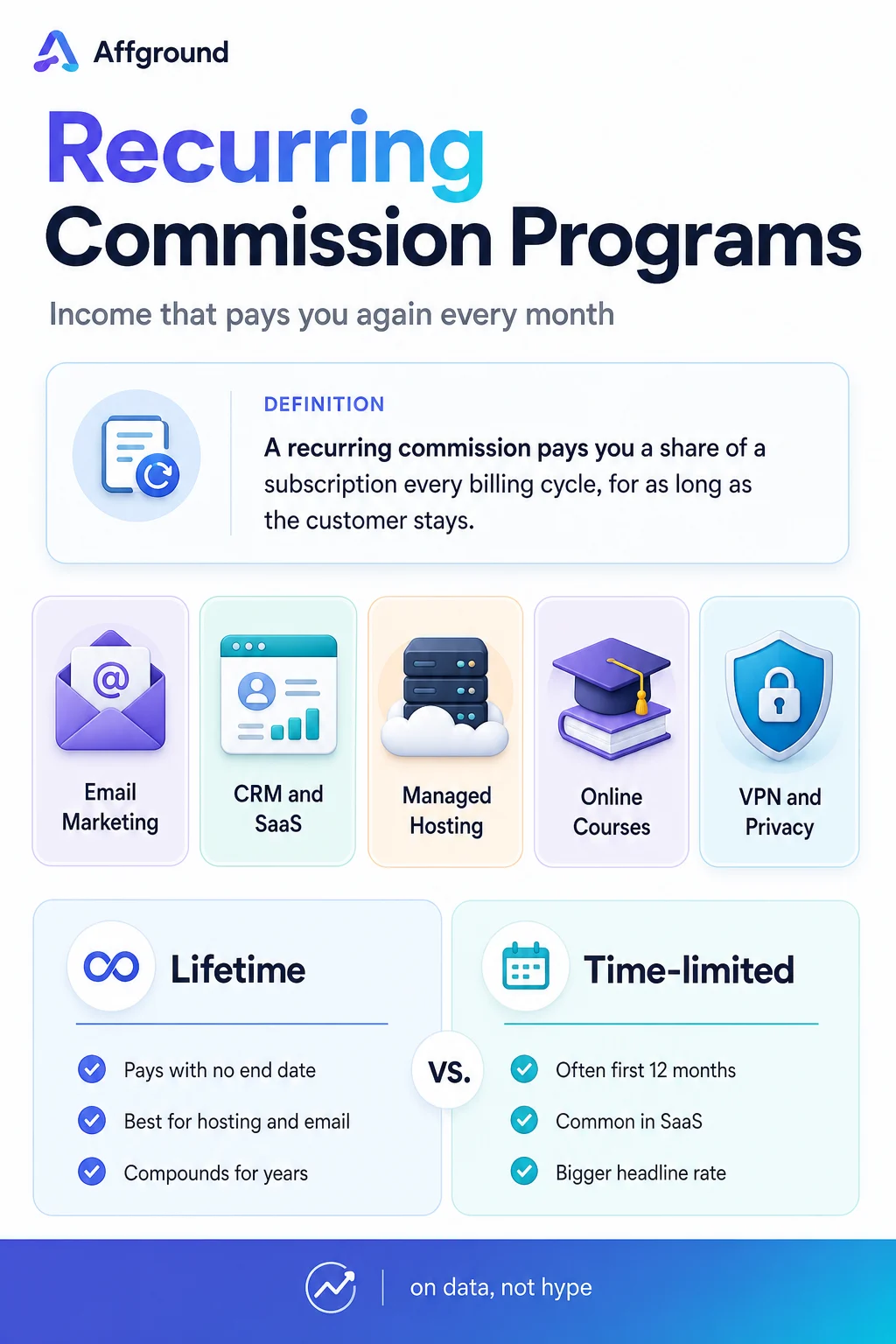
Recurring commissions at a glance — how one referral pays month after month, and the categories where the model pays best.
What "recurring commission" actually means
A recurring commission pays you a share of a customer's subscription every time they're billed, not just on the first purchase. The customer signs up through your link, and for as long as they keep their subscription active, you earn a percentage of each renewal — monthly or annually, automatically.
It's the affiliate version of the business model that made SaaS itself so valuable: recurring revenue. The merchant loves subscriptions because they turn one sale into predictable, compounding income. Recurring affiliate programs simply pass a slice of that predictability on to you. You do the acquisition work once; the payout repeats for months or years.
Contrast the two payout shapes with a single referral:
One-off (CPA) commission
Recurring commission
When you're paid
Once, on the first sale
Every billing cycle the customer stays
Income from 1 referral
Fixed, then zero
Grows the longer they subscribe
What you're building
A stream of one-time hits
A compounding subscriber base
Best for
High-volume, transactional niches
Subscription products with low churn
The risk
You're always hunting the next sale
Commission can be time-capped or churn away
Affground's take: recurring commissions turn affiliate marketing from a sales business into an asset business. With one-off payouts, your income is only ever as good as last month's traffic. With recurring, every referral you've ever made keeps paying — so your baseline rises even in a month you publish nothing. That shift, from hunting to owning, is the single biggest lever a subscription-niche publisher has.
Why recurring beats one-off: the compounding math
The case for recurring is arithmetic, not vibes. Picture a modest scenario: you refer 10 new subscribers a month to a tool that pays 30% recurring on a $100/month plan (a $30/month commission each), and assume a realistic 5% monthly churn.
Month 1: 10 subscribers → ~$300/month.
Month 6: your base has grown to ~52 active subscribers → ~$1,560/month.
Month 12: ~91 active subscribers → ~$2,730/month.
Month 24: the base plateaus near ~185 subscribers → ~$5,550/month — from the same 10 referrals a month.
A one-off program paying a generous $150 flat on the same 10 sales a month would earn a flat $1,500/month — and never grow. By month eight, recurring has overtaken it, and from there the gap only widens. The one-off affiliate is on a treadmill; the recurring affiliate is climbing a staircase. (Illustrative figures — churn and plan sizes vary — but the compounding shape is exactly how it plays out.)
One-off commissions are a treadmill you restart every month; recurring commissions are a staircase your income climbs.
Affground's rule of thumb: if a product is a subscription with reasonable retention, take the recurring deal over the bigger one-off almost every time. The only exceptions are very high one-off bounties on products people cancel quickly, or when you need cash flow now more than a bigger number later.
The trap in the word "recurring": lifetime vs time-limited
Here's the distinction that separates affiliates who understand these programs from those who just see the word "recurring" and sign up. Not all recurring commissions last forever. They come in two very different flavours:
Lifetime recurring — you earn for as long as the customer keeps paying, with no end date. This is the gold standard. GetResponse (33% for the customer's lifetime) and managed hosts like Kinsta and Cloudways (recurring for the life of the account) work this way. One good referral can pay for years.
Time-limited recurring — you earn recurring commission, but only for a fixed window: often the first 12 months. Many premium SaaS programs — Pipedrive, Zoho, Freshworks, monday.com, Keap — cap recurring at the first year. Still excellent, but a subscriber who stays five years only pays you for one.
Both are far better than a single one-off hit. But the difference between "33% for life" and "30% for 12 months" is enormous over a multi-year customer, and the headline "recurring!" badge hides it completely.
Affground's rule: before you promote any "recurring" program, find the duration. Read the terms for the exact phrase — "lifetime," "for the life of the subscription," or "for the first 12 months." That single line changes the true value of the deal more than the percentage does.
How we ranked these programs
Every program below is live in the Affground programs directory, and each was weighed on the factors that actually decide recurring income:
Commission rate and duration — the percentage, and crucially whether it's lifetime or time-capped.
Product retention — sticky, mission-critical tools (CRMs, hosting, email) churn less, so their recurring commissions last longer.
Cookie window — longer windows capture the slow, considered buying that subscription software invites.
Payout terms — realistic minimums and reliable monthly payments.
Audience fit — how easily a typical publisher can send genuinely interested, high-intent traffic.
The best recurring commission affiliate programs
Here's the ranked shortlist — a deliberate spread across the categories where recurring pays best, from email marketing to hosting to VPNs. Every card pulls live terms straight from our directory:
GetResponse — the poster child for lifetime recurring. 33% of every payment for the customer's entire lifetime, plus a 120-day cookie and a beginner-friendly product that converts on its free plan. Email marketing is the classic recurring niche because businesses rarely leave the tool their audience lives in.
HubSpot — a 30% recurring commission on one of the most trusted names in B2B software, and the highest EPC of the group in our data ($2.60). Enterprise-grade retention means those commissions stick.
monday.com — 25% of first-year customer revenue (up to 100% for top partner tiers), on a work-OS that spreads virally through teams. Time-limited to the first year, but the deal sizes are large.
Kinsta — managed WordPress hosting paying a $50–$500 signup bonus plus 10% monthly recurring for the life of the account. Hosting is famously sticky — people almost never migrate — so the lifetime slice compounds beautifully.
Pipedrive — a sales CRM paying 20–30% revenue share for the first 12 months, with a clean 90-day cookie. A natural fit for business, sales and productivity audiences.
Teachable — up to 30% recurring on a leading online-course platform. Perfectly positioned for the booming creator-economy and make-money-online niches, where your audience is already building a business.
Surfshark — 40% revenue share plus commission on renewals, representing the VPN category, where recurring privacy subscriptions and high consumer demand make for reliable volume.
Beyond this shortlist, the directory has plenty more worth a look — Zoho, Cloudways, Freshworks, Keap, NordVPN, Proton VPN, and data-infrastructure programs like Bright Data, SOAX and IPRoyal all run recurring or revenue-share deals. Browse them all in the programs directory and the affiliate networks directory.
Recurring commission ranges by category
Different niches pay recurring commissions very differently. Here's roughly where the model lands across the categories in our directory — useful for deciding which vertical to build in:
Category
Example programs
Typical recurring deal
Email marketing
GetResponse
~33%, often lifetime
CRM & marketing SaaS
HubSpot, Pipedrive, monday.com, Zoho
15–30%, frequently first 12 months
Managed hosting
Kinsta, Cloudways
7–10% lifetime + signup bonus
Online courses / creator
Teachable
up to 30% recurring
VPN & privacy
Surfshark, NordVPN, Proton
30–40% + renewal commissions
Proxies & data infrastructure
Bright Data, SOAX, IPRoyal
10–50% revenue share
Two patterns jump out. Hosting pays a smaller percentage but often for life, and its near-zero churn makes that 10% astonishingly durable. Marketing and CRM SaaS pay a bigger headline percentage but frequently cap it at 12 months — great money, but front-loaded. The best recurring portfolios usually mix both: sticky lifetime earners for the durable base, and higher-percentage time-limited programs for the bigger monthly numbers.
How to actually earn from recurring programs
Recurring programs reward a slightly different playbook than one-off affiliate content. Because the payoff compounds, the game is to acquire subscribers who stay.
01Target problem-aware, high-intent traffic. "Best CRM for small agencies," not "what is a CRM." People comparing tools are about to subscribe — and subscribers acquired at the decision stage churn less.
02Prioritise retention, not just the sale. A referral who cancels in month two is worthless in a recurring model. Recommend tools that genuinely fit the reader, and help them succeed with onboarding content — your commission literally depends on their staying.
03Go deep on a few sticky products. Recurring rewards expertise. A thorough, first-hand tutorial, migration guide or use-case library out-converts a shallow "top 10" every time, and positions you as the trusted source the reader returns to.
04Build an email list of your own. The highest-leverage move in recurring affiliate marketing: nurture an audience you own toward tools they'll subscribe to for years. Email sells subscriptions better than almost any other channel.
05Track lifetime value, not first-month EPC. A recurring program's true worth only shows up over the customer's lifetime. Judge programs on projected lifetime earnings per referral, or you'll undervalue your best long-term earners. (See our guide to EPC in affiliate marketing.)
Affground predicts: as more of the economy shifts to subscriptions, recurring affiliate programs will keep expanding out of software into everything — box subscriptions, memberships, fintech, even insurance. The publishers who plant their flag in a subscription niche now, and build a compounding base early, will own an income stream that quietly grows for the rest of the decade.
Common mistakes with recurring programs
Ignoring the duration. "Recurring" that ends after 12 months is worth far less than lifetime. Always check.
Chasing the rate over retention. A 40% recurring commission on a product people cancel in a month loses to a 15% commission on a tool they keep for years.
Promoting tools you haven't used. Recurring depends on referrals staying — recommend a bad fit and they churn, taking your commission with them.
Betting on one program. If a single advertiser cuts its recurring rate or caps its duration, an undiversified affiliate takes a permanent pay cut. Spread across a few.
Measuring on month one. Judge recurring programs on lifetime value; a first-month snapshot systematically hides their real payoff.
How to start: your first recurring portfolio
01Pick a subscription niche you can be credible in — SaaS, hosting, email, courses, VPNs. Interest first; the compounding rewards depth.
02Shortlist 3–4 programs from the directory, balancing lifetime earners (hosting, email) with higher-percentage time-limited ones (CRM, marketing SaaS).
03Apply and get approved — describe your traffic and methods honestly; SaaS programs vet applicants.
04Publish decision-stage content — comparisons, in-depth reviews, migration and setup guides that reach buyers about to subscribe.
05Disclose your links and help readers succeed — retention is your revenue, so onboarding help is in your direct interest.
06Track lifetime earnings per referral and reinvest in the programs and pages whose subscribers stick.
Affground's verdict
Recurring commission programs are the closest affiliate marketing gets to owning an asset. One-off payouts make you a salesperson who starts from zero every month; recurring makes you the owner of a subscriber base that pays you on repeat. The maths is decisive — beyond a break-even point that arrives within months, a compounding base of recurring commissions beats even generous one-off bounties, and keeps winning by more every year.
The craft is in the details the badge hides: favour lifetime over time-capped where you can, promote sticky products your readers will keep, target decision-stage traffic that actually subscribes, and judge everything on lifetime value, not the first month. Do that in a subscription niche you genuinely know, and you build the rarest thing in this business — income that grows while you sleep, and keeps growing long after the work is done. Affground's bet is simple: the publishers who own a compounding base will out-earn the ones still chasing the next one-off sale, every time.
Frequently asked questions
What is a recurring commission affiliate program?
It's an affiliate program that pays you a share of a customer's subscription every billing cycle — monthly or annually — for as long as they stay subscribed, rather than a single payment on the first sale. Because you earn on every renewal, one referral can pay you for months or years, and a growing base of subscribers compounds into predictable, repeating income.
Which affiliate programs pay the highest recurring commissions?
Among programs in the Affground directory, GetResponse pays 33% lifetime recurring (email marketing), HubSpot and Teachable pay up to 30% recurring, Surfshark pays 40% revenue share with renewal commissions, monday.com pays 25% of first-year revenue, and managed hosts like Kinsta and Cloudways pay ~7–10% recurring for the life of the account plus a signup bonus. The best choice depends on your niche and audience, not just the headline rate.
What is the difference between lifetime and time-limited recurring commissions?
Lifetime recurring pays for as long as the customer keeps their subscription, with no end date — the gold standard, common in email (GetResponse) and hosting (Kinsta, Cloudways). Time-limited recurring pays only for a fixed window, most often the first 12 months, which is typical of premium SaaS like Pipedrive, Zoho and monday.com. Over a multi-year customer, lifetime is worth far more, so always check the duration before promoting.
Are recurring commissions better than one-time (CPA) payouts?
For subscription products with reasonable retention, usually yes. A one-off commission is fixed and then stops; a recurring commission keeps paying and compounds as your subscriber base grows. Beyond a break-even point that typically arrives within several months, recurring out-earns even a generous one-off bounty. One-off payouts still win for high-volume transactional niches or when you need immediate cash flow.
Which niches have the best recurring affiliate programs?
The strongest recurring niches are subscription-heavy categories: email marketing (GetResponse), CRM and marketing SaaS (HubSpot, Pipedrive, monday.com, Zoho), managed hosting (Kinsta, Cloudways), online-course platforms (Teachable), VPN and privacy (Surfshark, NordVPN, Proton), and proxy/data-infrastructure tools (Bright Data, SOAX, IPRoyal). Sticky, mission-critical products churn less, so their recurring commissions last longer.
How much can you earn from recurring affiliate programs?
It depends on the plan price, commission rate, how many subscribers you refer and their churn. As an illustration, referring 10 subscribers a month to a tool paying $30/month recurring (with modest churn) can build to roughly $2,700/month by month 12 and over $5,000/month by month 24 — from the same 10 referrals a month, because the base compounds. The honest metric to track is projected lifetime value per referral.
Do recurring commissions really last forever?
Only if the program is lifetime recurring and the customer keeps paying. Many programs cap recurring commissions at the first 12 months, and any subscriber can churn, which ends their payments. Choosing sticky products with low churn and favouring lifetime programs is how you make recurring income last as long as possible.
How do I start with recurring commission affiliate programs?
Pick a subscription niche you can be credible in, shortlist three or four programs from the directory (mixing lifetime earners like hosting and email with higher-percentage time-limited SaaS), apply and get approved, then publish decision-stage content — comparisons, in-depth reviews and setup guides — that reaches buyers about to subscribe. Disclose your links, help referrals succeed so they don't churn, and track lifetime earnings per referral.