Amazon Associates vs ShareASale: 24-hour Amazon sessions and mega catalog versus merchant-set cookies and niche brand programs—when each wins.
Oct 2, 2026 · 8 min read
Choosing between Amazon Associates and ShareASale is less about which brand is "better" and more about what you need to win: a short cookie on a massive, high-intent catalog, or longer merchant-set windows across niche brands. This guide is for content publishers and creators who already know their niche and need a clear decision rule—not a hype shortlist.
What each platform actually is
is Amazon’s first-party affiliate program. One account gives you tagged links into Amazon’s marketplace catalog. Commission rates are fixed by on each Amazon marketplace (the figures below are for the public U.S. schedule). You do not negotiate a custom rate with Amazon the way you might with a DTC brand.
Amazon Associates
product category
amazon.com
ShareASale is a multi-merchant affiliate network—historically a U.S. specialty-retail powerhouse, now part of the wider Awin family. You join the network, then apply to individual advertiser programs. Each merchant sets its own commission model, cookie window, creatives, and approval rules. For how ShareASale and Awin relate day to day, see ShareASale vs Awin.
That structural difference drives almost every practical trade-off below.
Cookie length vs catalog depth
Cookie duration is the window after a click during which a conversion can still be credited to you. For a plain-English walkthrough of sessions, last-click, and browser privacy, read What is an affiliate cookie?.
On Amazon Associates (U.S. program terms), the attribution session is 24 hours after a customer clicks your Special Link (it can end earlier if they place a non-digital order or click another Associate’s link). Separately, products added to cart during that session can still qualify if the order completes within 89 days of the original click—so cart-stacking matters, but a browse-and-leave visitor who never carts still sits on a short clock.
On ShareASale / Awin-family programs, cookie duration is set per merchant. Awin’s public help docs describe a common industry default around 30 days, with program-level variation. Affground’s directory snapshot for ShareASale lists a ~30-day network-level default—live offers still override that. Many specialty and SaaS-style merchants run windows measured in weeks, not hours.
Catalog flips the other way. Amazon’s single storefront is unmatched for SKU breadth and checkout familiarity. ShareASale’s value is a searchable graph of independent brands (Affground’s directory snapshot lists on the order of ~16,500 offers—counts move over time). You trade one mega-catalog for many smaller catalogs with different economics.
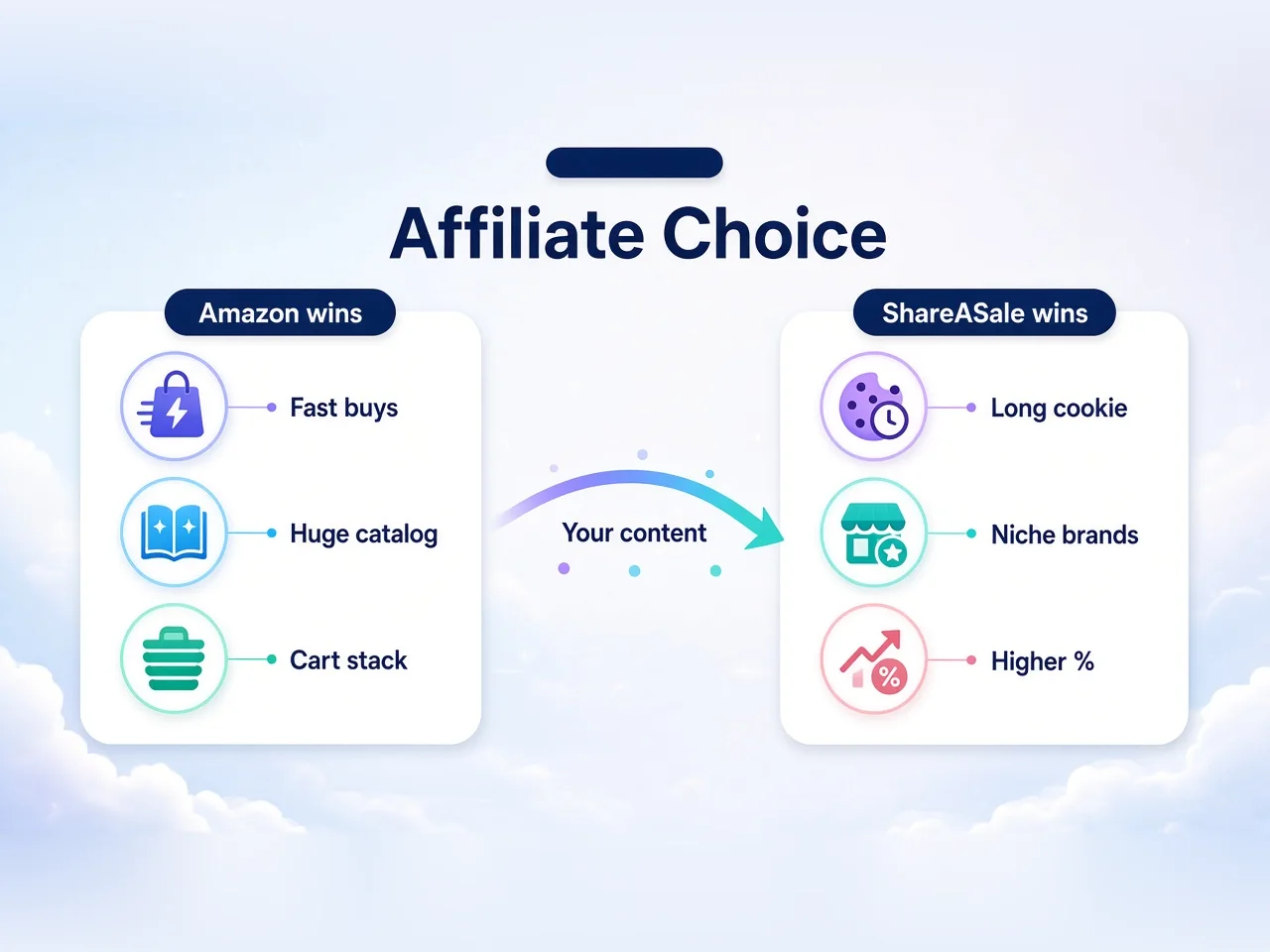
Cookie vs catalog — pick the lever that matches your content
The numbers (public terms snapshot)
Use this as a decision table, not a guarantee of your EPC. Amazon rates below are from Amazon’s public U.S. Standard Commission Income Statement; ShareASale cells are network norms / Affground directory snapshots and always vary by merchant.
Dimension
Amazon Associates (U.S.)
ShareASale (Awin family)
Model
Single-merchant marketplace program
Multi-merchant network
Cookie / session
24-hour session; cart adds can qualify up to 89 days
Merchant-set; often ~30 days default (verify each program)
Commission shape
Fixed % of qualifying revenue by category (roughly 0–10%; many everyday categories 1–4.5%; “All Other” 4%)
% of sale, CPA, or hybrid — set per advertiser
Catalog
Amazon’s full marketplace SKU set
Thousands of merchant programs (directory counts change)
Approval
Apply + 3 qualifying sales in 180 days before Amazon evaluates
Exact category rates, bounties, and payment charts change; always re-check Amazon Associates Central and each ShareASale/Awin program page before you publish a rate claim.
When Amazon Associates wins
Amazon wins when intent is already Amazon-shaped.
Review and roundup sites that send readers to a familiar checkout with Prime shipping expectations.
High SKU density niches (home, kitchen, gadgets, books, baby) where you need dozens of ASINs without juggling merchant applications.
Impulse or short-cycle purchases where a same-day or next-day decision is realistic—tools, consumables, accessories under a modest AOV.
Cart stacking: a reader who clicks for one item and adds others during the session can still pay out under Amazon’s cart rules even if they complete later (within the cart window).
Operational simplicity: one reporting surface, one disclosure pattern (“As an Amazon Associate…”), one payout pipeline.
The trade-off is structural: modest category percentages and a short session punish slow research journeys. If your average reader compares for a week before buying a $400 appliance, Amazon is a weak sole monetization layer unless they cart early.
When ShareASale wins
ShareASale (and the merchant programs that live in that Awin-family graph) wins when cookie length and brand economics beat SKU breadth.
Longer consideration cycles—furniture, specialized gear, software trials, premium fashion—where a multi-week cookie matches how people actually buy.
Higher headline economics on the right merchant: software and specialty DTC often pay more than Amazon’s mid-single-digit categories (still verify EPC, not just %).
Brand storytelling: exclusive creatives, coupons, deep links, and co-branded landing pages that Amazon’s generic ASIN links cannot match.
Niche catalogs Amazon under-serves—direct brand programs for tools, hobbies, B2B supplies, or regional merchants.
Relationship upside: once approved, you can ask managers about bumps, exclusive codes, or creative tests—something Amazon’s fixed schedule does not offer.
The trade-off is ops load: more applications, more declined programs, more creative versions, and payout timing that depends on merchant validation plus network settlement. Beginners sometimes under-estimate how much time merchant selection takes.
A practical decision framework
Use this sequence instead of picking a “winner” forever:
01Map the buyer clock. If most conversions happen inside a day of the click, Amazon’s session is livable. If research spans weeks, prioritize merchants with longer cookies.
02Score the offer economics. Compare expected commission on a realistic AOV (Amazon category % × AOV vs merchant %/CPA × AOV), then discount for approval odds and cookie fit.
03Match content type. ASIN-heavy roundups → Amazon-first. Brand deep-dives and “best X for Y” with one hero product → ShareASale/merchant-first.
04Check traffic policy. Paid search on trademarks, incentive traffic, and certain link cloaking patterns can void commissions on either side—read the live program rules.
05Run both when justified. Many mature publishers keep Amazon for long-tail SKUs and ShareASale for hero brands. Start where your next ten articles naturally point.
Browse live network and program cards on Affground Networks before you apply so cookie defaults and payout snapshots are in front of you.
Optimizing only for headline %. A 20% merchant offer with a bad cookie and soft conversion can lose to Amazon’s 4% on high-intent traffic.
Ignoring the cart rule on Amazon. Teaching readers to “add to cart while researching” (ethically, without dark patterns) matters more than obsessing over the 24-hour slogan alone.
Applying to every ShareASale merchant. Scattershot applications burn reputation; lead with sites that clearly match the brand’s audience.
Assuming ShareASale ≡ Awin everywhere. Related platforms, different day-to-day catalogs and payout mechanics—see the dedicated comparison linked above.
Skipping disclosures. Amazon requires its Associate wording; FTC rules still require clear material-connection disclosures on every placement.
Step-by-step: pick and launch this week
01List your next 10 planned URLs and tag each “Amazon-shaped,” “brand-shaped,” or “hybrid.”
02For Amazon-shaped URLs, create the Associates links and note the category rate for the hero ASINs.
03For brand-shaped URLs, search ShareASale/Awin for those merchants; record cookie, commission, and EPC (if shown) before applying.
04Apply with honest traffic descriptions and 2–3 sample URLs that already match the brand.
05Ship one hybrid article that uses Amazon for accessories and a merchant program for the hero SKU—then compare revenue per 1,000 sessions for 30 days.
06Keep or cut based on earned commission and approval friction, not vibes.
Hybrid setups that actually work
A clean hybrid looks like this: Amazon covers commodity accessories and long-tail ASINs where no specialty merchant exists, while ShareASale hosts the hero brand with the longer cookie and better creative. Keep the primary CTA on the offer that matches the reader’s decision clock. Secondary Amazon links can sit in a “also available” block without competing for the same click. Review the split after a month of tagged traffic—not after a single viral post.
Affground's verdict
Amazon Associates wins on catalog and checkout intent; ShareASale wins on cookie length and merchant-level economics. Use Amazon when readers already shop Amazon and decide fast; use ShareASale when a specific brand and a multi-week cookie are the real levers. Most serious niche sites eventually run both—with clear rules for which link type each page deserves.
Frequently asked questions
How long is the Amazon Associates cookie?
On the U.S. program, the attribution session is typically 24 hours after a Special Link click (it can end earlier if the customer orders a non-digital product or clicks another Associate’s link). Products added to cart during that session can still qualify if the order completes within 89 days of the original click. Always confirm the live Associates terms for your marketplace.
Does ShareASale have a longer cookie than Amazon?
Usually yes at the merchant level. ShareASale/Awin-family programs set cookies per advertiser; network defaults often sit around 30 days, and many merchants run multi-week windows. That is still longer than Amazon’s standard 24-hour session for non-carted browsing—verify each program page.
What are typical Amazon Associates commission rates?
On amazon.com, Amazon publishes fixed category rates roughly from 0% to 10% of qualifying revenue, with many everyday categories in the low-to-mid single digits and “All Other Categories” at 4%. Grocery and health categories can be as low as 1%. Rates differ by marketplace and change over time.
Is ShareASale the same as Awin?
ShareASale is part of the wider Awin family after platform consolidation, but publishers still experience distinct merchant graphs and ops details. Treat them as related, not identical—see Affground’s ShareASale vs Awin comparison for day-to-day differences.
Which is better for beginners: Amazon or ShareASale?
Amazon is simpler operationally—one catalog, familiar checkout, low payout floor—but the short session and modest category rates punish slow buyers. ShareASale can pay better on the right niche brands but needs per-merchant applications. Many beginners start with Amazon for coverage, then add ShareASale for hero products.
What is the Amazon Associates payout minimum?
For the U.S. program, public payment minimums are commonly $10 for direct deposit or Amazon gift card and $100 for check (check processing fees may apply). Confirm the current Payment Minimum Chart in Associates Central.
Can I use Amazon Associates and ShareASale together?
Yes. A common pattern is Amazon for long-tail SKUs and accessories, plus ShareASale/Awin merchants for hero brands with stronger cookies or commissions. Assign link types per page so readers are not flooded with mismatched CTAs.
When should I choose ShareASale over Amazon?
Choose ShareASale when your content sells a specific brand, the purchase cycle spans days or weeks, or merchant economics (rate + cookie + creatives) beat Amazon’s category percentage on that SKU. Choose Amazon when SKU breadth and Amazon-shaped intent matter more than cookie length.