What Is Server-Side Tracking? A Plain-English Guide
Cookies are crumbling and ad blockers are everywhere — and server-side tracking is how marketers and publishers reclaim accurate, durable, privacy-first data. Here is what it is, how it works, the trade-offs, and whether you actually need it.
Jun 26, 2026 · 16 min read
Here is an uncomfortable truth for anyone who makes decisions based on analytics: a large chunk of the data in your dashboard is quietly wrong. Conversions go uncounted. Sessions vanish. That "20% drop" might be a reporting gap, not a real decline. The culprit is the slow death of the cookie — and the fix that serious marketers and publishers are racing toward is server-side tracking.
If you have ever heard the phrase and nodded along while having no real idea what it means, this guide is for you. We will explain server-side tracking in plain English — what it is, how it differs from the browser-based tracking you grew up with, why everyone from advertisers to affiliates is moving to it, and what it actually costs to set up. No tag-manager jargon avalanche. Just the mental model and the trade-offs.
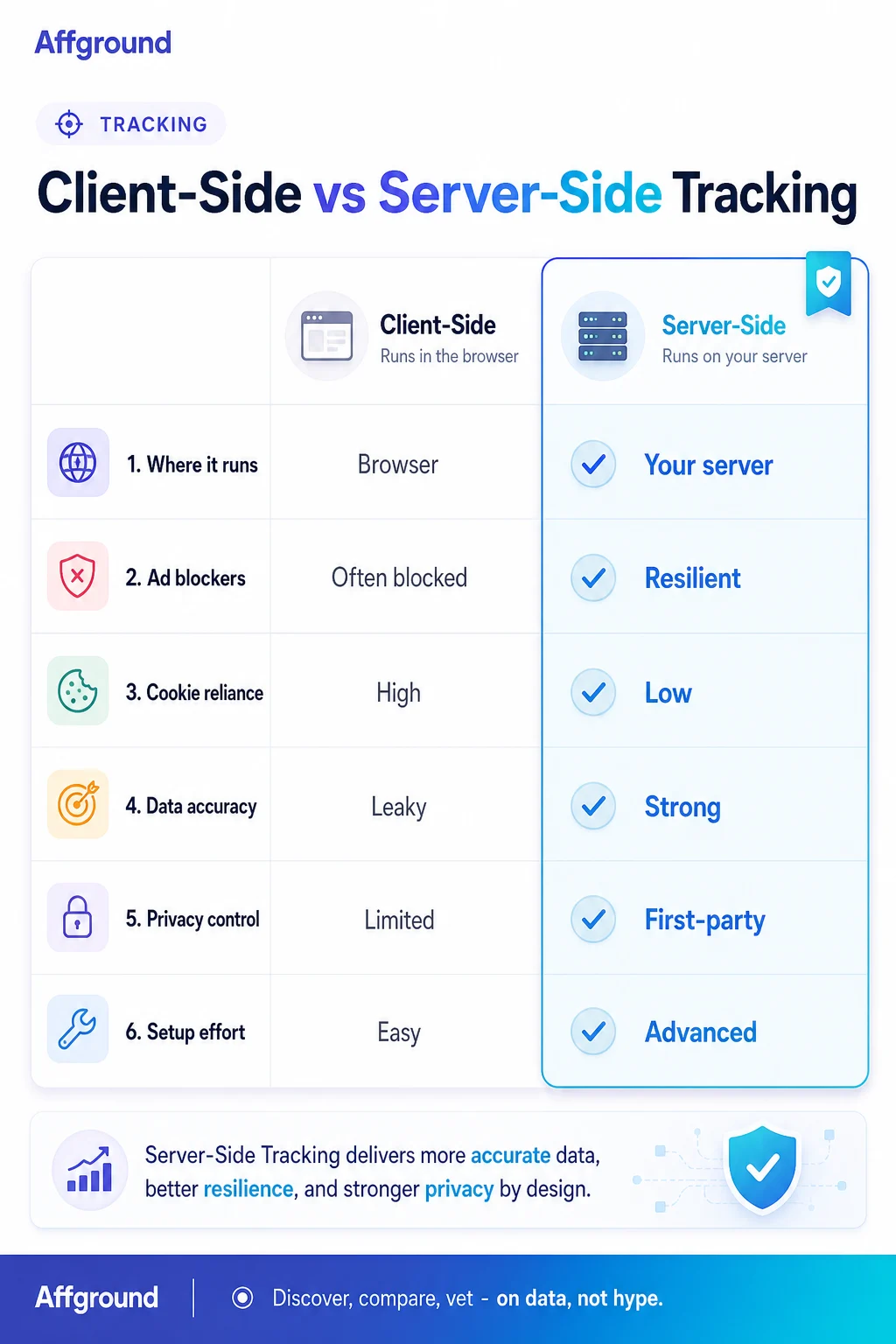
Client-side vs server-side tracking, at a glance — server-side wins on accuracy, resilience and privacy control.
What is server-side tracking, really?
Server-side tracking means collecting and sending your analytics and marketing data from your own server, instead of directly from the user's browser. That is the whole idea. Everything else is detail.
For two decades, tracking worked like this: a user lands on your page, a pile of JavaScript tags (Google Analytics, the Meta pixel, your affiliate network's script, a dozen others) fire inside their browser, and each one ships data straight to its vendor. The browser is the middleman, doing all the work out in the open.
Server-side tracking moves that work behind the curtain. The browser sends one clean signal to a server you control — your own domain, or a server-side container — and that server decides what to forward, to whom, and how. Think of it as the difference between every guest at a party shouting their order across the room to a dozen different bartenders, versus everyone quietly telling one trusted waiter who relays the right orders to the right place.
Affground's take: server-side tracking is not a "growth hack" — it is data hygiene. As the browser becomes a hostile environment for measurement, the brands that own their data pipeline will simply know things their competitors are guessing at. In a privacy-first web, accurate measurement becomes a competitive moat.
First, the old way: client-side tracking (and why it's breaking)
To appreciate server-side, you need to see why the old model is cracking.
Client-side tracking runs in the user's browser. Pixels, cookies and JavaScript snippets collect events — page views, clicks, purchases — and send them directly to platforms like Google, Meta or your ad network. It is dead easy to set up: paste a tag, done. That is exactly why it became the default.
The problem is that the browser is no longer a neutral place. Three forces are steadily breaking client-side tracking:
Ad blockers. Widely cited estimates put ad-blocker usage at roughly a third of internet users. Most blockers do not just hide ads — they kill analytics and pixel scripts outright. Every blocked script is a customer you never counted.
Browser privacy crackdowns. Safari (via Intelligent Tracking Prevention) and Firefox block third-party cookies by default, and Safari caps many client-side cookies to as little as 7 days — or 24 hours for link-decorated visits. Chrome has spent years dismantling third-party cookie support through its Privacy Sandbox. The third-party cookie, the backbone of old-school tracking, is effectively a dead man walking.
Privacy regulation and OS controls. GDPR, CCPA and Apple's App Tracking Transparency reshaped what you can collect and how. ATT opt-in rates have been widely reported in the low double digits — meaning most users simply say no.
Stack these up and the result is brutal: platform reporting and independent studies routinely show double-digit percentages of conversions going uncounted on client-side setups. You are not just losing data — you are making budget decisions on a sample silently biased toward people who do not block, do not opt out, and do not use Safari.
Server-side tracking keeps your data flowing on your own terms — even as third-party cookies and trackers get blocked.
A quick reality check: what the data gap looks like
Picture a store running ads. The ad platform proudly reports 100 conversions this month. The actual order count in the back end? 130. Where did the other 30 go? They were real sales — but the buyers used Safari, ran an ad blocker, or declined tracking, so the browser pixel never fired. The platform then optimized its bidding against a picture missing nearly a quarter of reality, and the marketer made budget calls on numbers that were quietly, confidently wrong.
Now flip to the publisher's side. You send a network 500 clicks and your dashboard credits you for 12 sales. The merchant's own records show 16. Those four uncredited conversions are commissions you earned and never got paid for — pure leakage, every single month, invisible unless you go looking.
This is the real cost of client-side-only tracking: not a dramatic outage, but a slow, silent tax on everything you measure and earn. Server-side tracking exists to close that gap — to make the dashboard and reality agree again.
So what changes with server-side tracking?
Server-side flips the data flow. Instead of the browser firing twelve scripts at twelve vendors, it sends a single, first-party request to your endpoint — usually a subdomain on your own domain (say, data.yoursite.com). From there, your server forwards the events wherever they need to go: analytics, ad platforms, your affiliate network, your CRM.
Two things make this powerful:
First-party context. Because collection happens on your own domain, it looks like — and is — first-party traffic, which browsers treat far more kindly than third-party scripts. Cookies set server-side from your own domain survive longer and dodge much of the third-party blocking.
You control the pipeline. Your server becomes the single gatekeeper. You decide what is collected, what gets forwarded, what gets stripped or anonymized, and which vendors ever see it. That is a privacy win and a data-quality win at the same time.
The most common real-world flavors you will meet are server-side Google Tag Manager (a container that runs on a server instead of the page), platform Conversions APIs (like Meta's CAPI, which sends conversions server-to-server), and, in affiliate marketing, server-to-server postbacks (more on those shortly).
How server-side tracking actually works, step by step
Let us walk one conversion through the pipeline:
01The event happens. A user buys something, fills a form, or clicks an affiliate link. The browser captures a minimal signal — what happened, plus a first-party identifier.
02It goes to your endpoint. Instead of broadcasting to every vendor, the browser sends that one event to your server-side container on your own domain.
03Your server enriches and decides. The server can add context (order value, currency, hashed identifiers), strip anything sensitive, apply consent rules, and decide which destinations should receive it.
04It forwards server-to-server. The server sends the cleaned event directly to each platform's API — Google, Meta, your affiliate network — machine to machine, with no browser script for an ad blocker to intercept.
05Attribution closes the loop. Each platform matches the event to the original click or campaign and credits the conversion. In affiliate setups, this is the postback that tells the network "this sale belongs to publisher X."
The beauty is that steps 3 to 5 happen out of the browser's reach. There is no fragile tag for a blocker to strip, no third-party cookie to expire, and far less data leaking to vendors you never intended to feed.
Client-side vs server-side: the honest comparison
Neither approach is "good" or "bad" — they are tools with different trade-offs.
Client-side
Server-side
Where it runs
The user's browser
A server you control
Setup effort
Paste a tag — minutes
Infrastructure + config — hours to days
Ad-blocker resilience
Low — often blocked
High — first-party, server-to-server
Cookie lifespan
Short, capped by browsers
Longer, first-party
Data accuracy
Leaky, biased sample
Strong, more complete
Privacy control
Limited — vendors see raw data
High — you filter before forwarding
Cost & maintenance
Cheap, low upkeep
Hosting + ongoing upkeep
The pattern is clear: client-side wins on simplicity and cost; server-side wins on accuracy, resilience and control. For a hobby blog, client-side is fine. For anyone making real money or real decisions on the data, server-side is fast becoming table stakes.
Why marketers and publishers are switching
Beyond "the cookie is dying," there are concrete reasons teams make the move:
Accuracy you can budget on. Recovering the conversions that ad blockers and cookie limits were eating — often a double-digit percentage — directly improves ROAS reporting and the optimization ad platforms do on top of it.
Resilience. Your measurement no longer depends on whether a user runs an ad blocker or uses Safari. The signal gets through.
Privacy and trust by design. You decide what leaves your server, so you can honor consent, hash personal data, and stop over-sharing with third parties — exactly what regulators (and users) increasingly demand.
Speed. Moving heavy tags off the page means less JavaScript in the browser, which can improve load times and Core Web Vitals — a quiet SEO and UX bonus.
Security. Fewer third-party scripts on your page means a smaller attack surface and less risk of a rogue tag skimming data.
Affground predicts: within a few years, "do you track server-side?" will be a standard question advertisers ask before they trust a publisher's numbers — the same way "are you HTTPS?" became non-negotiable. The publishers and networks that adopt early will quote cleaner data, win better deals, and look more professional doing it.
Server-side tracking and the cookieless future
Zoom out, and server-side is part of a much bigger shift: the move from borrowed third-party data to owned first-party data. For twenty years, marketing ran on cookies that followed users across the web. That era is closing — not because of one company, but because users, browsers, operating systems and regulators all decided, more or less at once, that it had to.
What replaces it is a first-party data strategy: collecting information directly from your own audience, on your own properties, with their consent, and managing it through infrastructure you control. Server-side tracking is the technical backbone of that strategy. It is how first-party data actually gets collected, cleaned and routed once the third-party pipes are gone.
The brands treating this as a deadline-driven scramble will bolt on a fix and move on. The ones treating it as a strategic shift — owning the relationship and the data with their audience — will build a durable advantage. Server-side tracking is not the destination; it is the on-ramp to owning your data future instead of renting it from platforms that can change the rules whenever they like.
The trade-offs (because nothing is free)
Server-side tracking is powerful, not magic. Be honest about the costs:
Complexity. You are now running infrastructure — a server container, endpoints, configuration. It is a real engineering project, not a copy-paste.
Cost. Server hosting and processing are not free, and they scale with your traffic. Modest for most, but a line item nonetheless.
Maintenance. APIs change, consent rules evolve, things break silently. Someone has to own it.
You become the data controller. With great pipeline comes great responsibility: routing data on your own server makes you more clearly accountable under privacy law. Server-side is a privacy tool, not a privacy exemption — you still need consent and compliance.
Affground's rule: do not go server-side because it is trendy. Go server-side when the data you are losing is worth more than the engineering you will spend — and the moment money or major decisions ride on your numbers, that math usually tips fast.
Server-side tracking and affiliate marketing
If you read our guide on what affiliate marketing is, you already know the punchline: bad tracking means working for free. Affiliate marketing lives and dies on attribution, and that is exactly where server-side shines.
The affiliate world's version of server-side is the server-to-server (S2S) postback. Instead of relying on a cookie in the buyer's browser to remember which publisher sent them, the merchant's server fires a postback directly to the network's server when a sale completes, passing a click ID that ties the conversion back to the right affiliate. No cookie required — which means conversions still get credited even on Safari, in in-app browsers, and in ad-blocked sessions where cookie-based tracking quietly fails.
For publishers, that means fewer missed commissions and more trustworthy reporting. For advertisers, it means cleaner data and less affiliate fraud. It is no accident that the most respected performance platforms put S2S tracking front and center.
When you are deciding where to send your traffic, the quality of a program's tracking matters as much as its commission rate. Browse the affiliate networks directory and the tracking software we list, and treat robust server-side and S2S support as a non-negotiable.
Do you actually need server-side tracking?
Be honest about where you sit. Not everyone needs to re-architect their measurement tomorrow:
Hobby or early-stage blog? Probably not yet. Client-side is fine until you have meaningful traffic and money on the line. Spend your energy on content.
Growing publisher or affiliate? Start paying attention. The moment commissions are being lost to broken cookie tracking, S2S postbacks and server-side conversions pay for themselves quickly.
Serious advertiser or performance marketer? Yes — and you probably needed it yesterday. If you are spending real budget and optimizing against platform data, the conversions you are missing are distorting every decision you make.
A simple test: if a 10–20% swing in your reported conversions would change how you spend money or what you tell a client, you cannot afford to keep guessing. That is the threshold where server-side stops being a nice-to-have and becomes the responsible choice.
How to get started without breaking things
You do not flip a switch and go fully server-side overnight. A sane path:
01Audit what you are losing. Compare your platform-reported conversions against your back-end source of truth — actual orders, actual signups. The gap is your business case.
02Pick your method. Server-side Google Tag Manager for general analytics, a Conversions API for ad platforms, and S2S postbacks for affiliate and performance campaigns. Most teams use a combination.
03Set up a first-party endpoint. A subdomain on your own domain (e.g. data.yoursite.com) is what gives you the first-party advantage.
04Run it in parallel first. Keep client-side running alongside server-side and compare. Do not rip out the old system until the new one is proven.
05Bake in consent. Wire your consent management into the server logic so you only collect and forward what users allowed. Build compliance in; do not bolt it on.
06Monitor relentlessly. Server-side fails silently — there is no broken pixel in the console to warn you. Set up alerts and check your numbers regularly.
Affground's take: start with the one event that actually matters — usually the purchase or the qualified lead — and get that flowing server-side cleanly before you migrate everything else. One reliable conversion signal beats a hundred half-broken ones.
Common mistakes to avoid
Treating it as a privacy loophole. Server-side does not exempt you from consent — if anything, it raises your responsibility. Collect lawfully.
No parallel testing. Cutting over cold and discovering a week later that nothing tracked is a genuinely expensive mistake.
Forgetting maintenance. A server-side setup is a living system. Left unowned, it rots.
Over-collecting "because you can." The point is control, which includes the discipline to forward less, not more.
Ignoring documentation. When the person who built it leaves, an undocumented pipeline becomes a black box nobody dares touch.
The server-side vocabulary you'll actually hear
The space is thick with jargon. Here is the plain-English decoder for the terms that matter:
First-party data — information you collect directly from your own audience on your own domain, with consent. The currency of the post-cookie web.
Server container — a server-side environment (such as server-side Google Tag Manager) that receives events and forwards them, replacing on-page tags.
Conversions API (CAPI) — a platform endpoint (Meta, Google and others) that accepts conversions sent server-to-server instead of via a browser pixel.
Postback / S2S postback — a server-to-server ping that reports a conversion, widely used in affiliate and performance marketing to credit the right partner.
Attribution window — the period after a click during which a resulting conversion is still credited to the source.
Keep a fuller reference handy in our affiliate marketing glossary — speaking the language fluently is half of sounding like you know what you are doing in a vendor call.
Affground's verdict
Server-side tracking is the web growing up. The era of pasting a dozen pixels into your page and trusting the numbers is ending — killed by ad blockers, browser privacy, and regulation that is not going anywhere. Moving measurement to a server you control is how forward-looking marketers and publishers reclaim accurate, durable, privacy-respecting data.
Is it more work? Yes. Is it worth it the moment real money rides on your numbers? Almost always. You do not need to boil the ocean — start with your most important conversion, prove the gap it closes, and expand from there. In a web that is actively hostile to lazy measurement, owning your data pipeline is not paranoia. It is just good business — and, as ever, Affground's bet is on the people who build on data, not hype.
Frequently asked questions
Is server-side tracking legal and GDPR-compliant?
Yes, it is legal — but it is not a way around privacy law. Because you collect and route data on infrastructure you control, you are clearly a data controller and still need a lawful basis and user consent where required. Done right it actually makes compliance easier, because you can filter, hash and withhold data before it ever reaches a third party.
Does server-side tracking get around ad blockers?
Largely, yes. Because events are sent from your own first-party domain server-to-server rather than via third-party browser scripts, most ad and tracking blockers no longer intercept them. It is not a magic bullet — a user can still refuse consent — but it recovers a large share of the data that client-side setups lose.
Is server-side tracking the same as server-side Google Tag Manager?
Not exactly. Server-side GTM is one popular way to do server-side tracking — a container that runs on a server instead of the page. But server-side tracking also includes platform Conversions APIs (like Meta's CAPI) and affiliate server-to-server postbacks. GTM server-side is a tool; server-side tracking is the broader approach.
Do I still need client-side tracking?
Often, yes — many teams run a hybrid. Some signals are easiest to capture in the browser, and running client- and server-side in parallel lets you compare and validate. Over time you can shift the critical, money-related events fully server-side while keeping lighter analytics client-side.
What is a server-to-server (S2S) postback in affiliate marketing?
It is the affiliate world's version of server-side tracking. When a sale completes, the merchant's server fires a postback directly to the network's server with a click ID, crediting the right publisher — without relying on a browser cookie. That keeps conversions accurate even where cookie tracking fails, such as on Safari or in ad-blocked sessions.
Is server-side tracking worth it for a small site?
If you are a hobby blogger, client-side is usually fine — the setup and hosting overhead is not worth it. The calculus changes the moment real money or real decisions ride on your data: lost conversions, skewed ROAS and missed commissions quickly cost more than a server-side setup does.
Does server-side tracking improve site speed?
It can. Moving heavy third-party tags off the page means less JavaScript executing in the browser, which can improve load times and Core Web Vitals — a side benefit for both user experience and SEO. The size of the gain depends on how many tags you move server-side.