Pixel tracking fires from the customer's browser; postback (server-to-server) tracking fires from a server. That one difference decides reliability, ad-blocker resistance, cross-device accuracy and setup effort. This guide explains how each works, the head-to-head differences, when to use which, and why the smartest programs run both — deduplicated.
Jul 13, 2026 12 min read
When a sale happens, something has to tell the affiliate network "that one counts." There are two fundamentally different ways to send that message — and the one you pick quietly decides how many of your conversions actually get recorded, how resistant you are to ad blockers, and how much money leaks out of your program without anyone noticing.
The two methods are pixel tracking and postback tracking. A pixel fires from the customer's browser; a postback fires from a server. That one distinction — where the conversion signal originates — cascades into everything: reliability, ad-blocker resistance, cross-device accuracy, setup effort and security. Get it wrong and you're either losing conversions you earned or trusting data you shouldn't.
This is the complete, plain-English breakdown for advertisers, affiliates and performance marketers: what each method actually is, how each works step by step, the head-to-head differences that matter, when each one is the right call, and why serious performance programs increasingly lean on postback. If you've read our guide to how affiliate tracking works, this is the deep dive on the two ways the conversion actually gets reported.
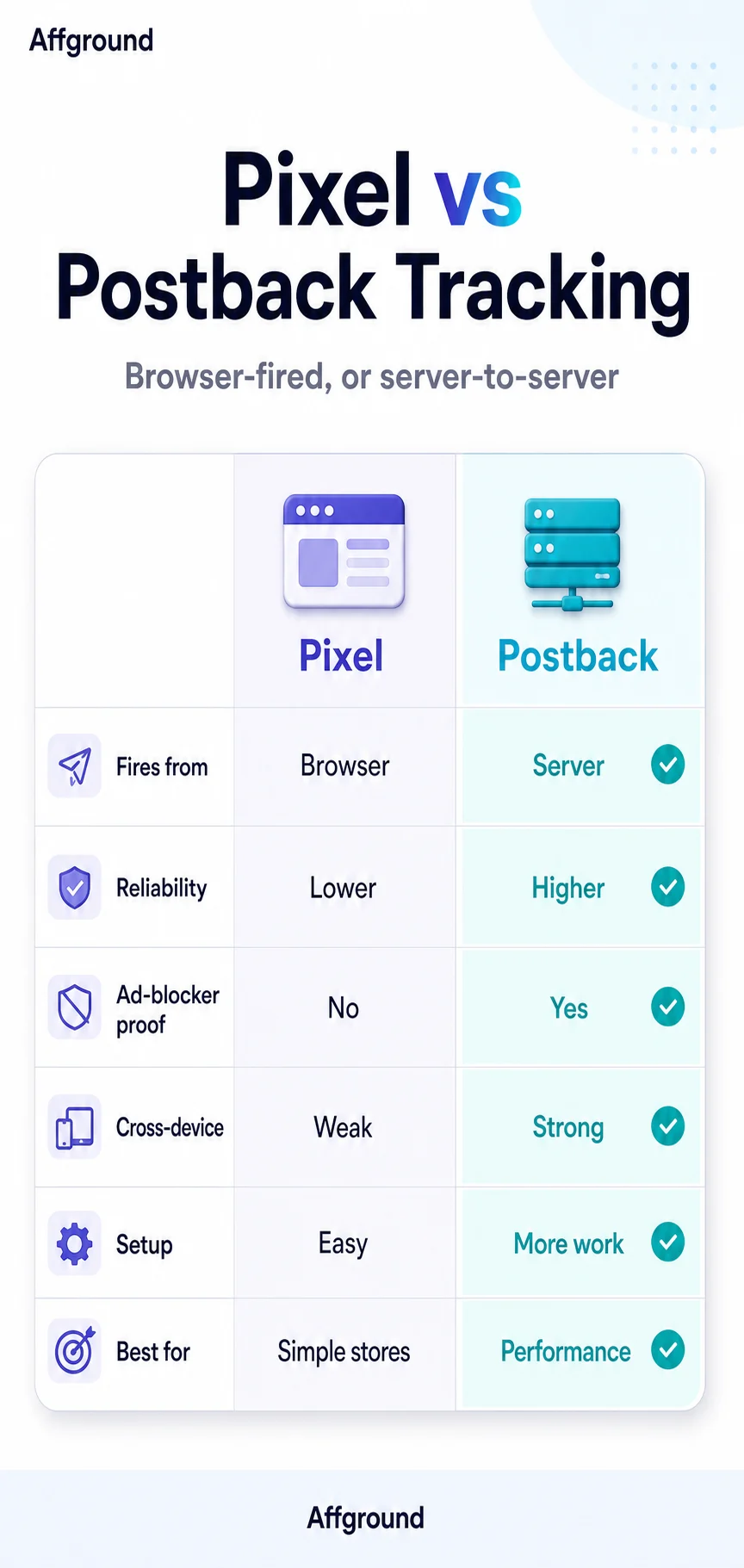
Pixel vs postback at a glance — where each fires from, and how they compare on reliability, ad-blocker resistance and setup.
The quick answer
Both methods do the same job — report a conversion to the network — but from opposite places:
Pixel tracking
Postback tracking
Fires from
The customer's browser (client-side)
A server (server-to-server)
Also called
Conversion pixel, tag, image pixel
S2S, postback URL, server-side
Relies on
The browser loading & running it
A click ID passed between servers
Ad-blocker resistant
No
Yes
Cross-device
Weak
Strong
Setup effort
Low (paste a tag)
Higher (pass and store a click ID)
Best for
Quick setup, rich on-page data
Reliability, performance/CPA, mobile
Everything below explains why those rows are what they are.
What is pixel tracking?
Pixel tracking records a conversion using a small piece of code — historically a 1×1 invisible image (the "pixel"), today usually a JavaScript tag — placed on the merchant's confirmation / thank-you page. When a customer completes a purchase and that page loads, the pixel fires, sending a request from the customer's browser to the network to say "a conversion happened here."
Because it lives in the browser, a pixel can easily read information that's already on the page — the order value, the order ID, the products bought — and pass it along. That's its native advantage: rich, on-page conversion data with almost no engineering. You paste a snippet onto the success page and you're tracking.
The catch is right there in "from the browser." A pixel only fires if the browser loads the page and runs the code — which means anything that interferes with the browser interferes with the pixel: ad blockers, privacy extensions, disabled JavaScript, a customer closing the tab before the page fully loads, or browser cookie restrictions. Every one of those is a conversion the pixel silently misses.
Affground's take: pixel tracking is the easy option, and that's exactly why so many programs over-rely on it. Pasting a tag onto a thank-you page feels like "done." But easy-to-install and reliable-in-the-wild are different things — and the gap between them is measured in ad-blocked, JavaScript-disabled, tab-closed conversions you never see. Pixels are fine; pixels alone are a slow leak.
What is postback tracking?
Postback tracking — also called server-to-server (S2S) tracking — records a conversion without involving the customer's browser at all. Instead of a tag firing on a page, the advertiser's server sends a postback: a direct call to the network's server, carrying the click ID that was generated when the customer first clicked the affiliate link.
Here's the mechanism. When the reader clicks the tracking link, the network generates a unique click ID and passes it to the advertiser, who stores it (against the session, the user, or the eventual order). When the conversion happens, the advertiser's server fires a URL — the postback — back to the network, appending that stored click ID (and often the sale amount). The network matches the click ID to the original click and credits the affiliate. No browser, no cookie, no page-load required.
Because the whole handshake happens server-to-server, postback is immune to the things that break pixels. Ad blockers can't block a call they never see. A closed browser tab doesn't matter. Cross-device journeys survive, because the click ID — not a browser cookie — is the thread. That resilience is why performance and CPA networks, where every conversion is real money, standardised on postback.
Affground's rule: if conversions are worth real money to you — CPA offers, high-ticket sales, performance campaigns — postback should be your primary tracking, not your backup. The whole point of server-side is that it keeps working when the browser doesn't, and in 2026 the browser increasingly doesn't. Treat pixel as the convenience layer and postback as the source of truth.
How each one works, step by step
Seeing the two flows side by side makes the difference obvious.
Pixel tracking flow:
1Customer clicks the affiliate link and lands on the merchant's site.
2Customer completes a purchase; the confirmation page loads.
3A pixel/tag on that page fires from the browser, reading order data from the page.
4The request reaches the network, which records the conversion — if the browser cooperated.
Postback tracking flow:
1Customer clicks the affiliate link; the network generates a click ID and passes it to the advertiser.
2The advertiser stores that click ID against the session or order.
3Customer completes a purchase.
4The advertiser's server fires a postback URL to the network, carrying the stored click ID (and sale amount).
5The network matches the click ID and records the conversion — no browser involvement at all.
The pixel's fate is decided in the customer's browser; the postback's is decided between two servers. That's the whole ballgame.
Two ways to report a conversion: a pixel fires from the browser on the thank-you page; a postback fires server-to-server with a click ID — no browser required.
Head-to-head: the differences that matter
Factor
Pixel (client-side)
Postback (server-side)
Reliability
Lower — depends on the browser
Higher — server-to-server
Ad-blocker resistance
Weak — often blocked
Strong — invisible to blockers
Cross-device tracking
Poor — browser/cookie bound
Good — keyed to a click ID
Setup complexity
Low — paste a tag
Higher — pass & store the click ID
On-page data (order value, items)
Easy — reads it from the page
Needs the advertiser to pass it
Cookie dependence
High
Low / none
Fraud surface
Exposes data in the browser
Cleaner, but URLs must be secured
Best fit
E-commerce, quick installs
CPA, performance, mobile, high-value
The pattern is clear: postback wins on reliability and resilience; pixel wins on simplicity and effortless on-page data. Neither is universally "better" — they're optimised for different constraints. But as browsers keep tightening the screws on client-side tracking, the reliability column matters more every year, which is why the industry's centre of gravity keeps sliding toward postback.
Where reliable tracking lives
The tracking method a platform supports directly affects how many conversions you record. These established networks and platforms are built around robust tracking — with server-side/postback support alongside pixels, and transparent reporting:
Postback's reliability doesn't make pixels obsolete. Pixel tracking is genuinely the better choice when:
You need rich on-page data with minimal effort. A pixel reads the order value, items and IDs straight off the confirmation page — no server work to pass them.
You don't control the server. On many hosted store platforms you can add a tag but can't easily fire server-side calls.
You want a fast, simple setup. Paste-and-go is a real advantage for smaller programs and quick tests.
The conversion is a simple, single-device web purchase. Where browser cooperation is likely, pixels do the job.
For a lot of straightforward e-commerce, a well-placed pixel is perfectly adequate — and its ease is a feature, not a flaw.
When postback is the right call
Reach for postback (ideally as your primary method) when:
Conversions are high-value or performance-based — CPA, lead-gen, high-ticket — where every lost conversion is real money.
Ad-blocker and privacy loss is significant — audiences that skew technical or mobile.
Journeys are cross-device or delayed — click on mobile today, buy on desktop next week.
You need tracking that survives the post-cookie web — server-side doesn't ask the browser's permission.
You control the backend and can pass and store the click ID properly.
This is precisely the profile of performance marketing, which is why CPA networks treat postback as the default and pixels as the extra. (It's the same reasoning behind the broader move to server-side tracking.)
Why not both? The hybrid approach
Here's the pragmatic answer most sophisticated programs land on: use both. Fire a postback as the reliable source of truth and a pixel to capture rich on-page data — then deduplicate so a single conversion isn't counted twice. You get postback's resilience and the pixel's easy access to order details, with belt-and-braces coverage if one method misses.
The one non-negotiable in a hybrid setup is deduplication. If both a pixel and a postback fire for the same sale and nothing reconciles them, you'll double-count conversions and overpay commissions — a different failure mode, but a costly one. Match on a shared order ID or click ID so each conversion is recorded exactly once.
Affground predicts: the pixel-vs-postback debate ends in "both, deduplicated" for anyone serious. As client-side tracking keeps degrading, postback becomes the backbone; but the pixel's effortless on-page data keeps it useful as an enrichment layer. The programs that win won't choose a side — they'll run a reconciled hybrid and quietly out-measure the ones still arguing about which single method to use.
A quick security note
Neither method is automatically "secure." A pixel runs in the browser, where its parameters are visible and can be inspected or tampered with — so never trust unsigned client-side values for anything that sets a payout. A postback is cleaner because it's server-to-server, but a naive postback URL can be spoofed if someone learns its format; protect it with secret keys, hashed/signed parameters, or IP allow-listing so only your real server can fire valid conversions. Server-side is more secure by default, but only if you actually secure it.
Common mistakes
Relying on a pixel alone for high-value conversions. You're leaving ad-blocked and JavaScript-disabled sales on the table.
Not passing the sale amount in the postback. A postback that fires but omits the order value can't credit percentage commissions correctly.
Forgetting to store the click ID. Postback breaks entirely if the advertiser doesn't capture and keep the click ID at click time.
Running both without deduplication. The fast route to double-counted conversions and overpaid commissions.
Leaving the postback URL unsecured. An open, unsigned postback endpoint is an invitation to conversion fraud.
Assuming the tag fired. Pixels fail silently — test that the conversion actually records, don't just paste and hope.
How to choose
1Default to postback for anything performance-based or high-value. Reliability is worth the extra setup.
2Use a pixel where you can't run server-side, or need quick, rich on-page data.
3Run both when you can, and deduplicate on a shared order/click ID — the best-coverage option.
4Always pass the essentials — click ID and sale amount — so conversions credit correctly.
5Secure your postback with keys or signatures, and test end-to-end before you trust the numbers.
Affground's verdict
Pixel and postback tracking are two answers to the same question — "how does the network learn a conversion happened?" — and the difference between them is simply where the message comes from. A pixel speaks from the customer's browser, which makes it easy to install and great at reading on-page data, but hostage to ad blockers, disabled scripts and the slow death of client-side tracking. A postback speaks server-to-server, which makes it resilient, cross-device and privacy-proof — at the cost of a bit more setup.
For simple e-commerce, a pixel is often enough. For performance marketing, high-value conversions and a post-cookie web, postback is the source of truth and pixel is the enrichment — and the smartest programs run both, deduplicated, so nothing leaks and nothing double-counts. Affground's bet is the same one the performance industry already made: as the browser gets less trustworthy every year, the tracking that doesn't depend on it wins. Build on the server, enrich from the browser, and you'll measure — and pay — for exactly the conversions you earned.
Frequently asked questions
What is the difference between pixel tracking and postback tracking?
The core difference is where the conversion signal comes from. Pixel tracking fires from the customer's browser — a tag on the confirmation page reports the sale — so it's easy to install and can read on-page order data, but it's vulnerable to ad blockers, disabled JavaScript and cookie restrictions. Postback tracking (server-to-server) fires from the advertiser's server, sending a click ID directly to the network with no browser involved, which makes it far more reliable and cross-device resistant.
What is pixel tracking?
Pixel tracking records a conversion using a small piece of code — historically a 1x1 invisible image, today usually a JavaScript tag — placed on the merchant's thank-you/confirmation page. When that page loads after a purchase, the pixel fires from the customer's browser and tells the network a conversion happened, often passing on-page data like the order value and items. Its strength is easy setup and rich data; its weakness is that anything blocking the browser (ad blockers, disabled JS, a closed tab) makes it silently miss the sale.
What is postback tracking (S2S)?
Postback tracking, also called server-to-server (S2S), records a conversion without the customer's browser. When the reader clicks the affiliate link, the network generates a unique click ID and passes it to the advertiser, who stores it. When the sale completes, the advertiser's server fires a postback URL back to the network carrying that click ID (and usually the sale amount), and the network matches it to the original click. Because the handshake is server-to-server, it's immune to ad blockers and survives cross-device journeys.
Which is more accurate, pixel or postback tracking?
Postback is generally more accurate and reliable because it doesn't depend on the customer's browser cooperating — ad blockers, privacy extensions, disabled JavaScript and closed tabs can't stop a server-to-server call the way they stop a pixel. Pixel tracking is adequate for simple, single-device web purchases where the browser is likely to cooperate, but for high-value or performance conversions, postback records more of what you actually earned.
Can you use both pixel and postback tracking together?
Yes, and sophisticated programs often do. You fire a postback as the reliable source of truth and a pixel to capture rich on-page data, getting the resilience of server-side plus the easy order details of client-side. The essential requirement is deduplication: match both signals on a shared order ID or click ID so a single sale isn't counted twice, which would otherwise double-count conversions and overpay commissions.
Is postback tracking more secure than pixel tracking?
By default, yes — a postback is server-to-server, so its data isn't exposed in the browser where a pixel's parameters can be inspected or tampered with. But postback isn't automatically safe: a naive postback URL can be spoofed if someone learns its format, so it must be protected with secret keys, hashed or signed parameters, or IP allow-listing. Server-side is more secure only if you actually secure it.
When should you use pixel tracking instead of postback?
Use a pixel when you need rich on-page data (order value, items, IDs) with minimal engineering, when you can't run server-side calls (as on many hosted store platforms), when you want a fast paste-and-go setup, or when the conversion is a simple single-device web purchase where the browser is likely to cooperate. For straightforward e-commerce, a well-placed pixel is often perfectly adequate.