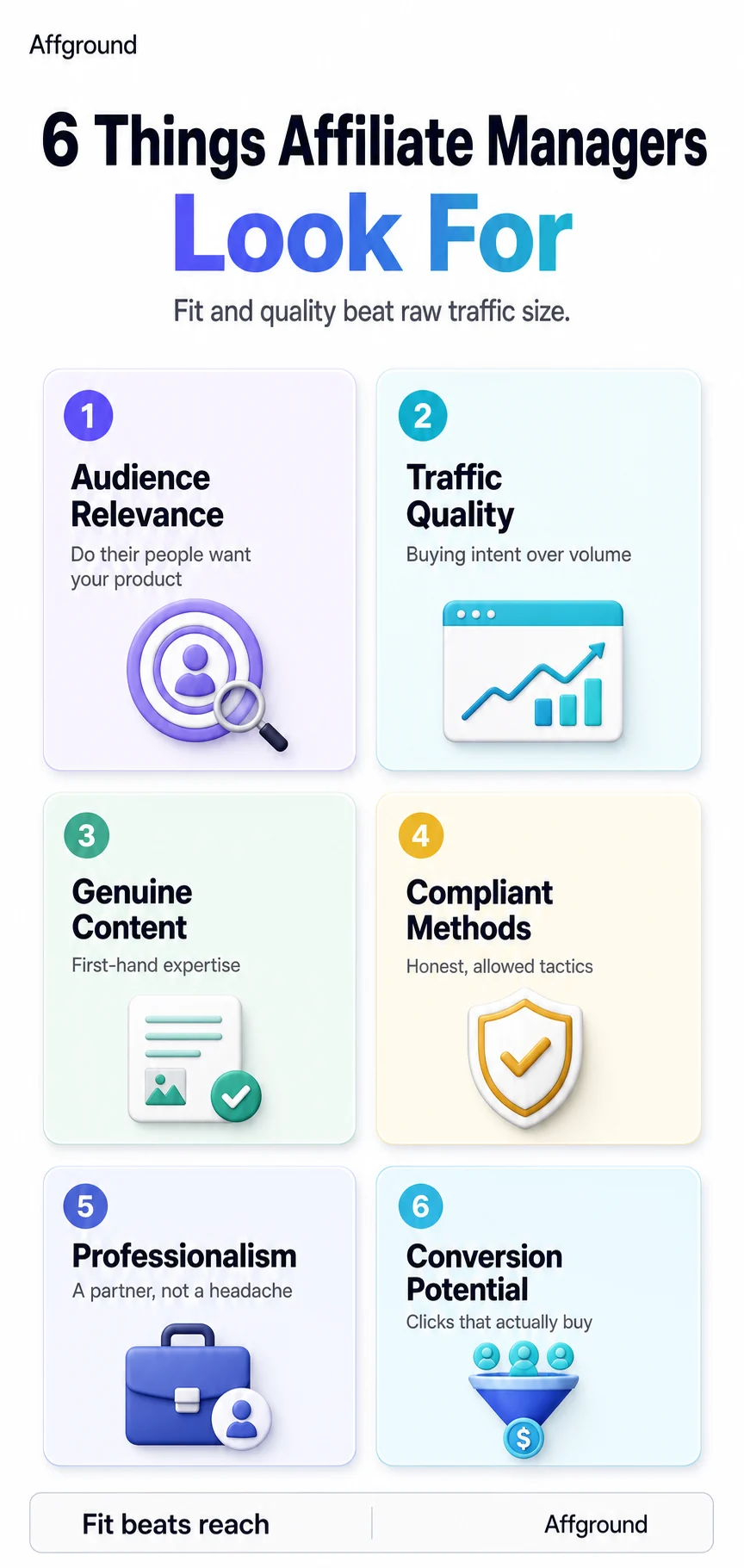
Affiliate managers aren't hunting for big traffic — they're screening for fit: the right audience, promoted the right way, by someone who looks like a professional partner. Here's the inside view of the scorecard managers actually use, the red flags that trigger instant rejections, and how to position yourself to get approved and recruited.
Jul 13, 2026 12 min read
You hit "apply" on an affiliate program and then wait, wondering what's happening on the other side. Somewhere, an affiliate manager is looking at your application — your site, your traffic, your promotional methods — and making a fast judgment: Understanding what runs through their head in that moment is the difference between getting a template rejection and getting a personal email with a bumped commission rate.
approve, reject, or recruit and prioritise.
Here's the surprise most publishers get wrong: affiliate managers are not, primarily, hunting for big traffic. A manager who's been burned before knows that a huge audience of the wrong people converts worse than a tiny audience of the right ones — and can actively cost them money in fraud, refunds and brand damage. What they're really screening for is quality of fit: the right audience, promoted the right way, by someone who looks like a professional partner rather than a liability.
This is the inside view — what affiliate managers actually look for when they evaluate a publisher, why each factor matters to them, the red flags that trigger an instant rejection, and exactly how to position yourself to get approved, recruited and prioritised. Written for publishers who want to stop guessing what's on the other side of that application.
What affiliate managers actually screen for — fit and quality over raw traffic size.
The mental model: managers buy fit, not size
Before the specific criteria, understand the frame. An affiliate manager's job is to grow profitable, low-risk revenue through partners. Every publisher they approve is a small bet: will this partner send buyers who stick, promote us in ways we're proud of, and not create problems? Traffic size is only interesting after the answer to those is yes.
That's why a niche reviewer with 5,000 monthly readers who all trust their verdict can be far more attractive than a generic coupon site with a million sessions. The reviewer sends warm, relevant buyers; the coupon site often just skims credit for sales that would have happened anyway. Managers have learned this distinction the expensive way, and it colours everything they evaluate.
Affground's take: publishers pitch their reach; managers buy their relevance. If your application leads with a big traffic number and nothing about who those people are or why they'd buy this specific product, you've answered a question the manager isn't asking. Lead with fit — the audience, the intent, the match — and reach becomes the multiplier on top, not the pitch itself.
What affiliate managers actually evaluate
When a manager reviews you, they're running a mental scorecard. The big rows:
What they check
The real question
What wins
Audience relevance
"Do their people want our product?"
Tight niche–offer fit
Traffic quality
"Is this buying-intent traffic or noise?"
Search & intent-rich sources
Content & expertise
"Is this genuine, or thin and copied?"
First-hand, credible content
Promotional methods
"How exactly will they drive sales?"
Compliant, transparent tactics
Professionalism
"Are they a partner or a headache?"
A real site, real application
Conversion potential
"Will their clicks actually buy?"
Evidence of converting audience
Brand safety
"Will we be embarrassed to appear here?"
Clean, on-brand content
Growth & consistency
"Are they building or dabbling?"
Active, growing presence
None of these is about raw size. They're all about whether you're the right, safe, effective kind of partner. Let's take the ones that decide most approvals.
1. Audience relevance — the factor that beats everything
This is the first thing a good manager checks and the one that most often decides the answer. Do the people who follow you actually want the thing this brand sells? A finance blog applying to a SaaS accounting tool is an instant yes; the same blog applying to a fashion program is a hard no, no matter how much traffic it has.
Relevance is what turns clicks into conversions, and conversions are the only thing the manager ultimately cares about. A perfectly matched audience means the manager can picture the sales before you've made one. A mismatched audience — however large — means wasted clicks, poor EPC and a partner they'll quietly deprioritise.
Affground's rule: apply to programs your audience would thank you for recommending, not the ones with the biggest payout. Managers can smell a mismatch instantly, and even if you sneak through, irrelevant traffic converts so poorly that you both lose. Fit first — it's the one factor you can't fake and the one they weight highest.
2. Traffic quality over quantity
Once fit is established, managers look at how good your traffic is — and quality trounces quantity every time. Ten thousand visitors who arrived from a "best X for Y" search carry more value than a million who bounced in from a viral meme. Managers are reading the signals of intent:
Source — search and email (high intent) versus cold social or pop traffic (low intent).
Geography — do your visitors sit in the countries the brand actually sells to?
Engagement — time on page, return visits, an email list you own.
Behaviour — do these people research and buy, or just browse?
A manager who sees intent-rich, on-geo, engaged traffic can forecast conversions. One who sees huge but junk traffic sees refunds, chargebacks and support tickets. Size impresses nobody who's been doing this a while.
Managers weigh relevance and intent over raw size — a small, matched, buying audience outweighs a huge, mismatched one.
3. Genuine content and real expertise
Managers look at your actual content, and they can tell the difference between first-hand expertise and thin, spun, copy-paste pages in seconds. They favour publishers who demonstrably know the space — who've used the products, can explain trade-offs, and write things a generic aggregator couldn't. That credibility is what makes your recommendations convert, and it's increasingly what search engines reward too.
Thin affiliate sites — the ones that are clearly just a stack of "top 10" pages built for a commission — are exactly what managers have learned to filter out. They convert badly, they attract penalties, and they signal a partner who'll churn the moment the rate drops. Substance is a competitive advantage precisely because so many applicants don't have it.
4. Compliant, transparent promotional methods
Managers want to know exactly how you'll drive sales — and the wrong answer here gets you rejected or later terminated even with great traffic. They're screening for methods that are honest and won't create legal or brand problems:
Clear FTC-style disclosure of affiliate relationships.
No trademark bidding on the brand's name in paid search (a classic instant-ban).
No coupon or cashback abuse that steals last-click credit without adding value.
No misleading claims, spam, or incentivised clicks.
Traffic sources the program actually permits (some ban paid, email, or certain geos).
Being upfront and specific about your promotion methods — and matching what the program allows — signals a professional who won't blow up their program. Vagueness or a hint of shady tactics is a fast no.
5. Professionalism and communication
A lot of approval comes down to a simple gut check: does this person look like a partner or a problem? A complete, thoughtful application; a real website with an about page and contact details; a professional email; a prompt, clear reply when the manager reaches out — these quietly signal that you'll be easy and safe to work with. Blank applications, dead sites and one-word answers signal the opposite.
This matters more than publishers think, because managers manage people, not just URLs. The partners who communicate well get the manager's time, the early heads-up on promotions, and the negotiated rate. (It's the mirror image of what publishers should expect from a good program — see how to build trust with publishers.)
6. Conversion potential — do your clicks actually buy?
Ultimately, managers are trying to predict one thing: will your traffic convert? Everything else is a proxy for this. A publisher who can show — or credibly suggest — that their audience buys is gold. Evidence helps: existing affiliate results, an engaged email list, content built around buying decisions (reviews, comparisons, "best X") rather than top-of-funnel curiosity.
This is why managers love bottom-of-funnel publishers. Someone whose content catches people at the moment of decision sends clicks with a wallet already half-open — which shows up as strong earnings per click, the number managers watch to decide who to scale. Show you understand conversion, not just traffic, and you speak their language.
The red flags that get publishers rejected
Managers say no fast when they see these — often before reading anything else:
No real website or content — an empty or placeholder site.
Irrelevant audience — a fundamental mismatch with the product.
Thin, spammy or copied content — clearly built only to grab commissions.
Vague or shady promotional methods — "I'll drive traffic" with no specifics.
Trademark bidding or coupon abuse signals — the classic instant bans.
Poor-quality traffic sources — bot-prone or non-permitted channels.
Unprofessional application — blank fields, no contact info, no site.
Brand-unsafe content — anything the brand won't want to be associated with.
Notice the theme: nearly every rejection is about risk and fit, not size. Remove the red flags and you're most of the way to a yes.
How to position yourself for a yes
You can't manufacture a perfect audience overnight, but you can present what you have like a professional:
Build a real, credible site with genuine content, an about page and clear contact details.
Apply to relevant programs where your audience obviously fits — and say why in the application.
Be specific about your methods — name your channels (SEO, email, reviews) and confirm they're compliant.
Show your fit and results — audience description, key stats, any existing affiliate performance, a simple media kit.
Disclose properly and look trustworthy — visible disclosures and a professional presence do quiet, heavy lifting.
Communicate like a partner — respond promptly and clearly when a manager reaches out.
Do this and you flip from "risk to screen out" to "partner to recruit." The best publishers don't just get approved — they get pursued.
Where managers find and vet publishers
Affiliate managers discover, review and approve partners largely through networks and platforms — which is also where publishers make themselves findable and credible. A complete, professional profile on an established network puts you in front of the managers actively recruiting:
Browse the full affiliate networks directory to find networks that serve your niche, then build a profile and applications that show managers exactly the fit they're looking for.
Recruiting vs approving: how top publishers get pursued
There are two ways a manager engages a publisher, and they're worth distinguishing. Approving is reactive — you apply, they screen you against the scorecard above. Recruiting is proactive — the manager spots a publisher who ranks for the right terms, has a trusted audience and obvious fit, and reaches out first, often with better terms than the public program.
The publishers who get recruited are simply the ones who visibly nail the scorecard in public: relevant, credible, converting, professional. You don't get there by gaming applications; you get there by being the partner managers are hunting for — and then being easy to find. Rank for your niche, build genuine authority, keep a clean and professional presence, and recruitment starts coming to you.
Affground predicts: as programs get more selective and data-rich, manager recruiting will increasingly target demonstrated conversion quality over follower counts and vanity reach. The publishers who document real results and genuine expertise will be pursued with premium terms, while big-but-generic sites get commoditised. Provable fit is becoming the scarcest, most valuable thing a publisher can offer.
Affground's verdict
What affiliate managers look for in publishers is, at heart, one thing wearing many hats: fit. Not the size of your audience, but its relevance; not the volume of your traffic, but its intent; not how you describe your methods, but whether they're honest and allowed; not your promises, but whether your clicks actually convert. Every criterion on the manager's scorecard is a different angle on the same question — is this a partner who will send us profitable, low-risk sales?
The good news for publishers is that this is a game you win with substance, not scale. You don't need a million visitors; you need the right audience, genuine content, clean methods and a professional presence — the things a small, serious publisher can absolutely build. Nail those and you stop being an application to screen and become a partner to pursue. Affground's bet: in an industry drowning in thin sites and inflated numbers, the publisher who is demonstrably the right fit will always have managers competing to work with them.
Frequently asked questions
What do affiliate managers look for in publishers?
Managers screen for quality of fit rather than raw traffic. The main things they evaluate are audience relevance (do your people want this product?), traffic quality and intent, genuine first-hand content and expertise, compliant and transparent promotional methods, professionalism, brand safety, and conversion potential (will your clicks actually buy?). Every one of these is a different angle on the same question: are you a partner who will send profitable, low-risk sales?
Do you need a lot of traffic to get accepted into affiliate programs?
No. A large audience helps only after fit is established — and a small, tightly matched, high-intent audience is often more attractive than a huge irrelevant one. Managers have learned that mismatched traffic converts poorly and can cost them money in refunds and support, so a niche reviewer with a few thousand engaged, relevant readers can out-appeal a generic site with a million sessions. Relevance and intent beat size.
Why do affiliate programs reject applications?
The most common reasons are all about risk and fit, not size: no real website or content, an audience that doesn't match the product, thin or copied content built only for commissions, vague or shady promotional methods, signals of trademark bidding or coupon abuse, poor-quality or non-permitted traffic sources, an unprofessional application with blank fields and no contact info, and brand-unsafe content. Remove those red flags and most of the objection disappears.
How do I get approved for an affiliate program?
Build a real, credible site with genuine content, an about page and contact details; apply to programs your audience clearly fits and explain why in the application; be specific about your promotional channels and confirm they comply with the program's rules; show your fit and any results with a simple media kit; disclose your affiliate relationships visibly; and respond promptly and professionally when a manager reaches out. Together these turn you from a risk to screen out into a partner to approve.
What makes an affiliate manager recruit a publisher proactively?
Recruiting happens when a manager spots a publisher who visibly nails the scorecard in public — ranks for the right terms, has a trusted and relevant audience, produces genuine content, and looks professional. Rather than waiting for an application, the manager reaches out first, often with better-than-public terms. You earn this not by gaming applications but by being the obvious right fit and being easy to find in your niche.
Does audience relevance matter more than audience size to affiliate managers?
Yes. Relevance is usually the single most important factor and the one managers weight highest, because it's what turns clicks into conversions. A perfectly matched audience lets a manager picture the sales before you've made one; a mismatched audience — however large — means wasted clicks and poor EPC. Size is a multiplier that only matters once relevance is established.
What promotional methods do affiliate managers not allow?
Common prohibitions include bidding on the brand's trademark in paid search (often an instant ban), coupon or cashback tactics that steal last-click credit without adding value, misleading claims, spam, incentivised or bot clicks, and using traffic sources the program doesn't permit (some ban paid ads, email, or certain geographies). Managers want honest, disclosed methods that match the program's rules — being specific and compliant about how you drive sales is itself a strong positive signal.