Exchange rev-share vs CPA vs hardware wallet commissions: real terms for Binance, Bybit, OKX, Kraken, Coinbase, Ledger and Trezor, plus geo and compliance caveats.
Oct 15, 2026 · 7 min read
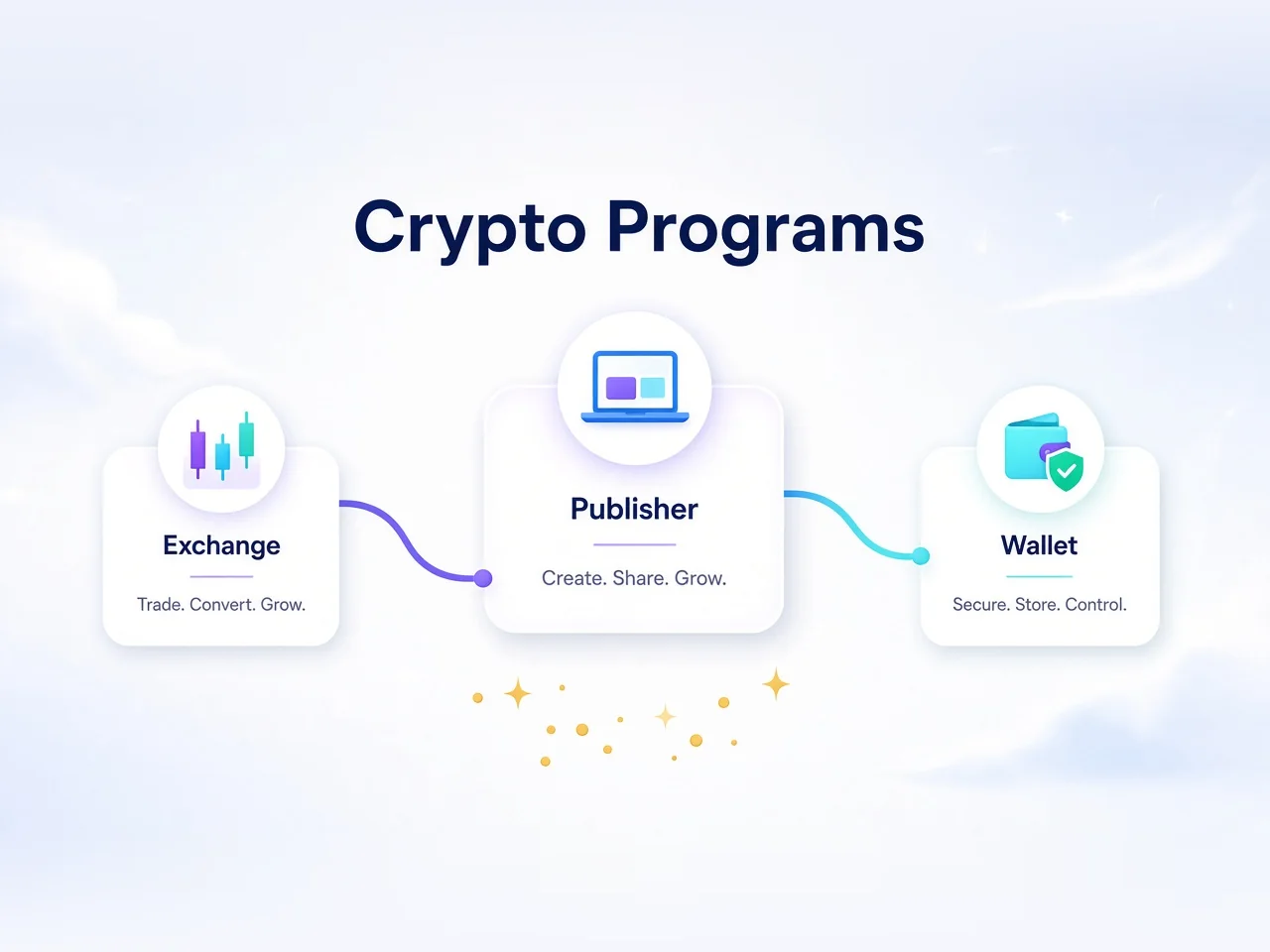
Crypto affiliate programs pay in a way almost nothing else in affiliate marketing does. The big exchanges don't pay you per sale: they pay a revenue share of the trading fees your referred users generate, often for the lifetime of the account, with headline rates up to 50% at Binance, Bybit, OKX and Kraken. Hardware wallet makers like Ledger and Trezor sit on the other side, paying a classic percentage of each order. Mixing the two is how serious crypto publishers smooth out a notoriously cyclical income.
This guide is for crypto content sites, finance and security publishers, YouTubers and newsletter operators who want a shortlist built on real program terms, not banner-ad hype. Every figure below comes from Affground's listing data for each program; terms in crypto change often and vary by region, so treat them as current snapshots and confirm in the program dashboard before you build a page around them.
How crypto affiliate programs actually pay
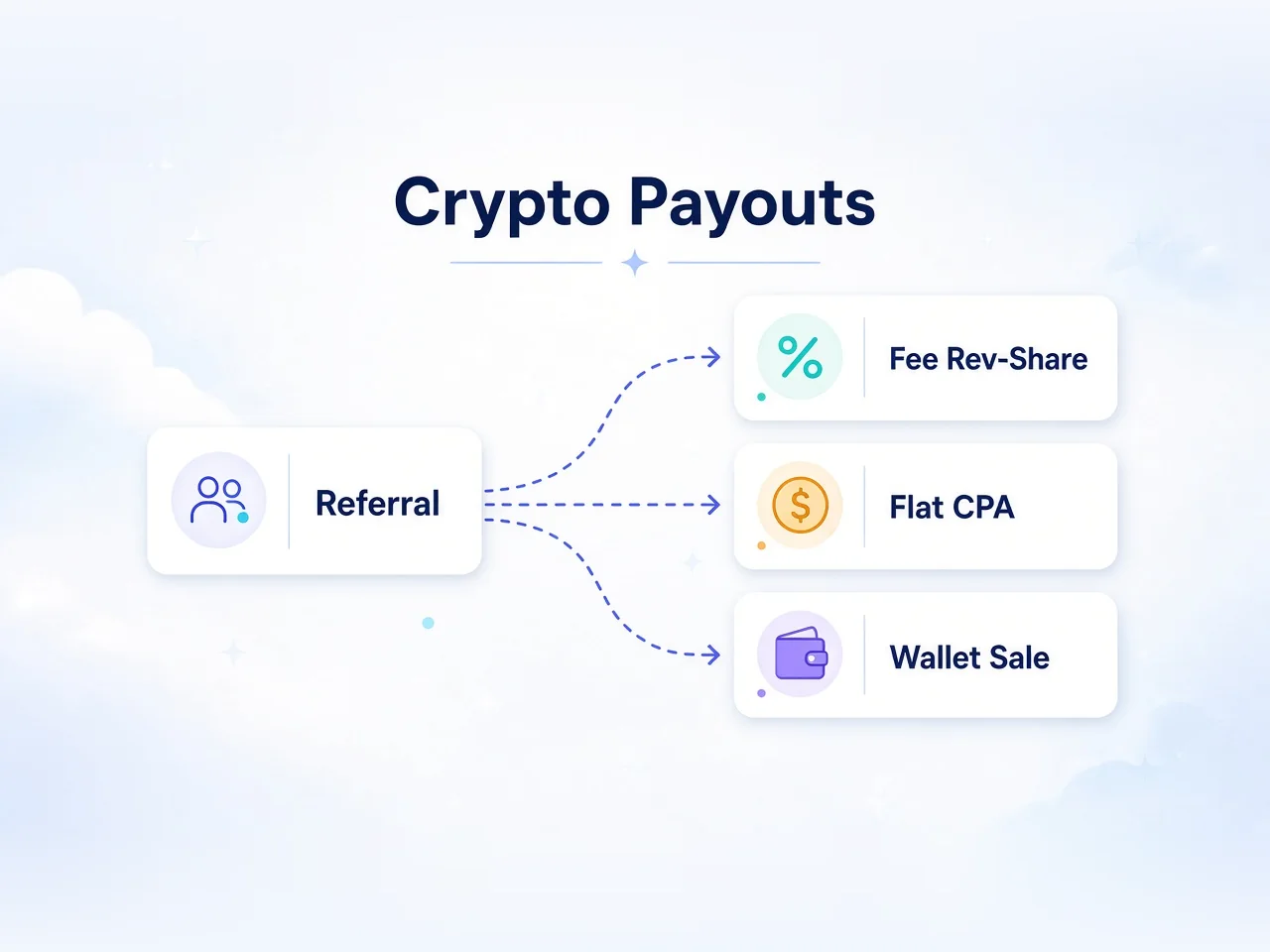
There are three payout shapes in this vertical, and they behave very differently over a market cycle.
Exchange rev-share compounds with trading activity; CPA and wallet commissions pay once, whatever the market does next.
Trading-fee revenue share. You earn a cut of the fees your referrals pay every time they trade. Volume rises in bull markets and collapses in quiet ones, so this income swings hard, but a handful of active traders can pay for years.
CPA per new user. A fixed bounty when a referred user signs up and meets the qualifying action. Predictable and front-loaded, with no upside if that user becomes a whale.
Percentage of sale. Hardware wallets are physical products, so they pay like ecommerce: a commission on the net order value, once, when the device ships.
Spot up to 50% (41% base); futures 30% for 12 months
90 days
No fixed minimum
Monthly, in crypto
Bybit
Trading-fee rev-share
~30% rising to 50%, plus 10% from sub-affiliates
Lifetime attribution
Effectively none
Daily, in USDT and other crypto
OKX
Trading-fee rev-share
30% default, tiered up to 50%
Lifetime attribution
Not listed
Frequent, in USDT (USDC in the EEA)
Kraken
Trading-fee rev-share
Commonly 20% up to about $1,000 per client; up to 50% on negotiated terms
180 days
$50
Monthly, bank wire
Coinbase
CPA
Roughly $10–50 per qualified user
30 days
$50
Monthly
Ledger
% of sale
10% base on net order value
30 days
€50
Weekly, in bitcoin
Trezor
% of sale
Up to 15% of net order value (tiered)
30 days
~€100 (BTC) / ~€200 (wire)
Monthly, EUR or bitcoin
Two things jump out. First, the exchange headline of "up to 50%" is a ceiling, not a starting point: Binance's 50% spot rate applies to affiliates who bring in more than 500 traders, OKX tiers are reassessed monthly on volume and active-trader counts, and OKX requires 10 valid new users before you unlock full eligibility. Second, the hardware wallet programs have proper thresholds and normal cookies, so their maths looks like any ecommerce program. Commission rates are only part of the story; why affiliate clicks but no sales is a useful sanity check once traffic starts flowing.
The shortlist
These seven cover the three payout shapes and the two big jobs a crypto audience has: getting onto an exchange and securing what they bought.
Binance is the deepest rev-share in the group if you can reach the volume tiers, and the futures commission (30% for 12 months) rewards derivatives-focused content. Rates and eligibility are reviewed quarterly and differ by region, which matters more here than anywhere else on the list.
Bybit pays the fastest: commissions are calculated and settled daily in crypto with effectively no minimum, and the 10% sub-affiliate layer suits publishers who recruit other creators. Bybit also runs a separate consumer referral scheme with different terms, so make sure you apply to the affiliate program.
OKX has the clearest tier structure (30% default, up to 50%) and pays across spot, futures, options and its CeDeFi products, with a dedicated manager once you qualify.
Kraken is the most "traditional affiliate" of the exchanges. It runs through the Impact platform, uses a 180-day cookie with same-device attribution, pays monthly by wire, and offers CPA, flat placement and hybrid deals to larger media partners. The commonly cited 20% base with a per-client cap of about $1,000 makes its income more bounded than the offshore exchanges.
Coinbase is the CPA option: a fixed bounty per qualified new user rather than a fee share. It's the easiest to forecast and a natural fit for beginner "how to buy bitcoin" content aimed at US, UK and EU readers, where the program focuses its geo coverage.
Ledger pays a 10% base on net sales (excluding VAT and shipping), weekly in bitcoin once you pass €50. Trezor pays up to 15% tiered by volume, monthly in euros or bitcoin. Both fit security, self-custody and "how to store crypto" content, and both convert well beside exchange tutorials because the reader's next question after buying is where to keep it.
Geo and compliance: the part that kills crypto pages
No other vertical punishes careless geo targeting like crypto. Product availability for Binance, Kraken and the other exchanges varies by jurisdiction, and a referral who can't open an account, or can only use a restricted version of the platform, earns you nothing.
Match the exchange to the reader's country. Segment pages by region, or at least state availability clearly. Sending US readers to an exchange that doesn't serve them wastes the click and damages trust.
Read the promotion rules. Exchange programs commonly restrict paid search on brand terms and specific claims about returns. Breaking those rules is the fastest route to clawed-back commissions.
Don't promise returns. Many regulators treat crypto marketing as financial promotion. Write about features, fees and security, not price predictions.
A simple framework for building a crypto program mix
01Pick one primary exchange per region your audience comes from. Depth beats breadth: one well-tracked exchange with detailed tutorials outperforms seven thin banners.
02Add one CPA program as a hedge. Coinbase-style bounties keep revenue flowing when trading volume, and therefore fee rev-share, dries up in a quiet market.
03Add one hardware wallet. Ledger or Trezor content (setup guides, comparisons, "exchange vs self-custody") converts on its own and doesn't depend on trading activity at all.
05Review quarterly. Exchange tiers and regional terms change often; put a recurring check on the calendar and update your pages when they do.
Common mistakes
Treating "up to 50%" as the rate you'll get. Most new affiliates start on the base tier. Model your earnings on the base, and treat the top tier as upside.
Ignoring the cycle. Rev-share income can fall sharply in a bear market. Without a CPA or hardware component, a crypto site's revenue tracks the market.
Confusing referral and affiliate programs. Several exchanges run both, with very different terms. Apply to the affiliate track.
Forgetting payout logistics. Crypto-denominated commissions bring their own tax and accounting questions; know how you'll record them before the first payment lands.
Thin content. Exchange managers approve and upgrade affiliates who drive active traders. That comes from genuinely useful tutorials and comparisons, not a page of referral links.
Affground's verdict
For most crypto publishers the strongest setup is one exchange rev-share matched to your audience's region, one CPA hedge, and one hardware wallet program. The rev-share builds long-term value, the CPA keeps revenue steady when markets go quiet, and the wallet commission pays whatever the price does. Choose on geo availability and payout mechanics first, headline percentage second.
Frequently asked questions
Which crypto affiliate program pays the most?
On headline rate, Binance, Bybit and OKX all advertise up to 50% of referred users' trading fees, with Kraken reaching up to 50% on negotiated terms. In practice the top tiers need volume: Binance's 50% spot rate applies to affiliates with more than 500 referred traders, so most new affiliates earn the base rate first.
Do crypto exchange affiliate programs pay for life?
Several do. Binance, Bybit and OKX pay a share of referred users' trading fees for the lifetime of the account, which is why a few active traders can be worth more than many one-time signups. Binance's futures commission is the exception, at 30% for 12 months.
Is a CPA or a revenue share better for crypto?
Revenue share builds long-term value but swings with trading volume, so it falls in quiet markets. A CPA program like Coinbase pays a fixed bounty per qualified user and is easier to forecast. Many publishers run one of each so income doesn't depend entirely on the market cycle.
How do hardware wallet affiliate programs work?
They pay like ecommerce programs: a percentage of the net order value when a referred reader buys a device. In Affground's data Ledger pays a 10% base, weekly in bitcoin once you pass 50 euros, and Trezor pays up to 15% tiered by volume, monthly in euros or bitcoin, both with 30-day cookies.
How are crypto affiliate commissions paid?
Exchanges usually pay in crypto: Bybit settles daily in USDT and other coins, OKX pays frequently in USDT (USDC in the EEA), and Binance pays monthly in crypto. Kraken is the exception among exchanges, paying monthly by bank wire with a 50 dollar minimum.
Can I promote crypto exchanges to readers in any country?
No. Exchange products and availability vary by jurisdiction, and a referral who can't open an account earns nothing. Match each exchange to the countries your audience comes from, follow each program's promotion rules, and avoid promising returns.
What is the difference between an exchange referral program and an affiliate program?
Referral programs are aimed at everyday users and usually pay smaller rewards on different terms. Affiliate programs are for publishers and creators, with higher rev-share tiers, dashboards and account managers. Bybit, for example, runs both, so make sure you apply to the affiliate track.