What Is Revenue Share? RevShare Explained for Publishers
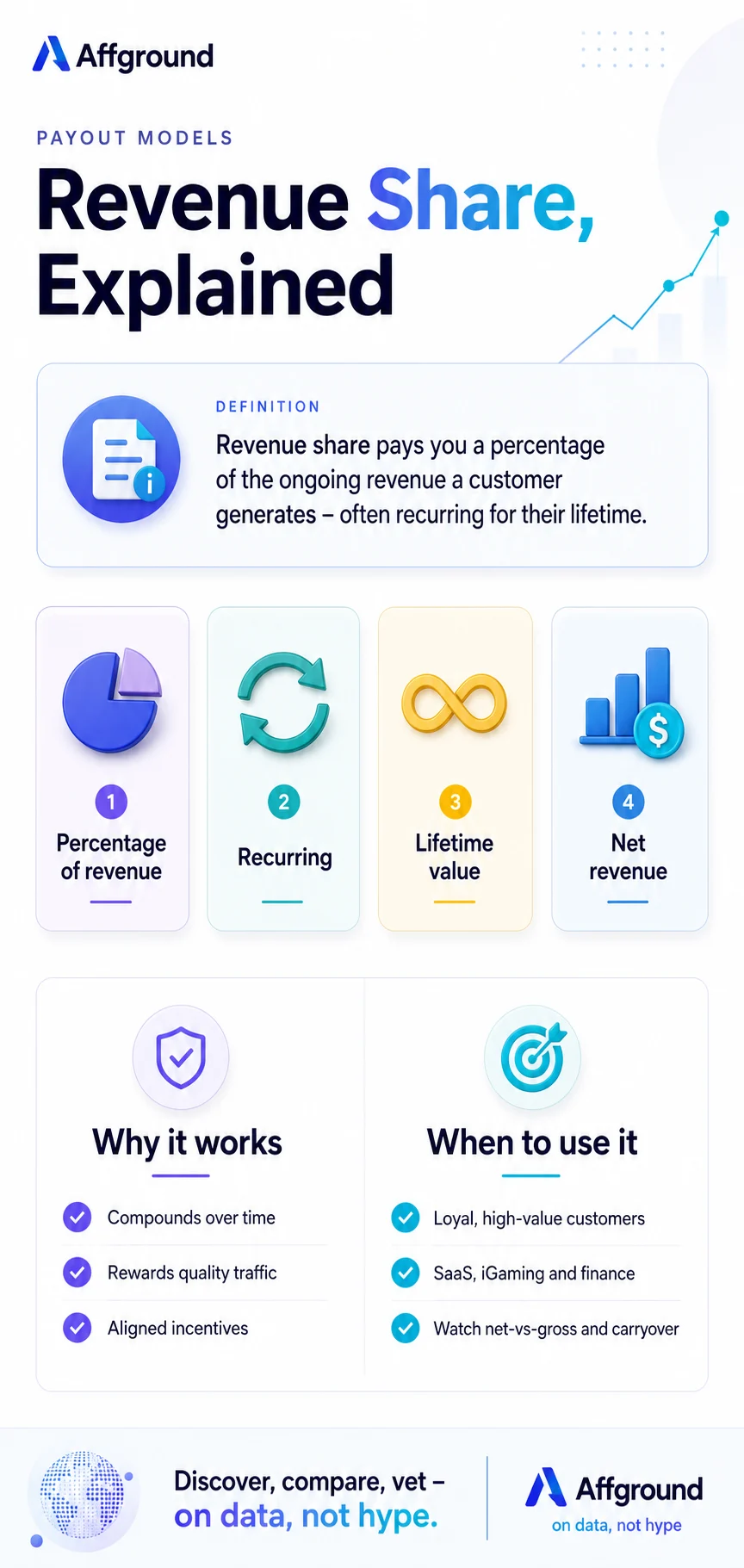
Revenue share pays you a percentage of the ongoing revenue a customer generates — often recurring, for life. Here is how RevShare works, how it beats (and loses to) CPA, and the fine print that quietly decides what you actually earn.
Jun 27, 2026 · 16 min read
There is a particular kind of joy in waking up to money you earned months ago. Not a one-time payout for a sale you made and forgot — but a steady, recurring cut of revenue from a customer who is still happily paying, long after you introduced them. That is the quiet superpower of revenue share (or RevShare, if you want to sound like you belong), and it is one of the most misunderstood ways to get paid in marketing.
Most people meet revenue share and immediately ask the wrong question — "what's the percentage?" — when the percentage is often the least important part. This guide fixes that. We will cover what revenue share actually is, how it works, how it stacks up against the flat-fee models you already know, the fine print that secretly decides your income, and exactly when it is (and is not) the right deal to chase. Plain English, real math, no fluff.
Revenue share, explained — a recurring percentage of the revenue a customer generates, often for their lifetime.
What is revenue share, really?
Revenue share is a payment model where you earn a percentage of the ongoing revenue a customer generates, rather than a one-time fee for referring them. Refer a customer who pays $50 a month, sign a 30% RevShare deal, and you earn $15 every month — for as long as they stay.
Compare that to the model most people picture when they think "affiliate commission": CPA (cost per action), where you get a single fixed payout — say $40 — the moment someone signs up, and then nothing. The relationship is over. CPA pays you for the introduction. Revenue share pays you for the ongoing value of what you introduced.
That shift — from a one-time bounty to a continuing slice — changes everything about how you should think, who you should send, and what a "good deal" even means. A RevShare partner is not being paid to drive a transaction; they are being paid to drive a relationship.
Affground's take: revenue share is the model that rewards you for being right, not just for being loud. Anyone can generate a click. RevShare only pays when the customer you sent actually sticks around and keeps paying — which quietly filters out the spammers and rewards the publishers who genuinely match the right people to the right product. It is the most honest payout model there is.
How revenue share actually works
The mechanics are simple once you see them. Four things define any RevShare deal:
01The rate — the percentage you earn, commonly anywhere from 5% to 50% depending on the industry and the product's margins.
02The base — what the percentage is calculated on. This is the part people skip, and it is the part that matters most (more on "net vs gross" shortly).
03The duration — how long you keep earning: a fixed window (say 12 months), or for the customer's entire lifetime with the brand.
04The attribution — how the brand knows the customer is yours, and keeps crediting you month after month, via reliable tracking.
Here is the flow: you refer a customer, they sign up and start paying, and the brand pays you your percentage of their payments on a recurring schedule. As long as that customer keeps spending, you keep earning. Stop sending new customers and your existing ones keep paying out — which is why a mature RevShare portfolio can feel a lot like a dividend.
The catch, and the thing that makes RevShare riskier than a flat fee, is that your income depends on what happens after the sale — whether the customer stays, upgrades, churns, or refunds. You are no longer just a marketer; you are a stakeholder in the customer's success.
The RevShare advantage: a customer who keeps paying means commission that compounds month after month.
A quick history: where revenue share came from
Revenue share is not new — it is one of the oldest deal structures in business, from authors earning royalties on book sales to musicians earning a cut of every record. But its modern affiliate form was forged in iGaming in the early 2000s, where online casinos needed partners to send players and realised that paying a share of what those players spent aligned everyone's incentives perfectly. Affiliates were suddenly motivated to send not just any player, but valuable, long-term ones.
From there it spread. The SaaS boom of the 2010s supercharged it: software sold by monthly subscription was a natural fit for recurring commission, and "lifetime recurring" became a headline perk used to recruit serious affiliates. Today, as more of the economy shifts to subscriptions, revenue share has quietly become one of the defining payout models of the performance-marketing era — a long way from its casino roots, but built on the same simple insight: when you share the upside, everyone works to grow it.
Revenue share vs CPA vs CPL: the honest comparison
Revenue share is one of three payout models you will be offered. None is "best" — they suit different traffic and different goals.
Revenue Share
CPA
CPL
You earn
% of ongoing revenue
Fixed fee per sale
Fixed fee per lead
Paid
Recurring, often for life
Once, upfront
Once, per lead
Upside
Compounds, uncapped
Predictable, immediate
Easy to convert
Risk
Depends on retention
None after the sale
Low value each
Best for
Loyal, high-value customers
High-volume traffic
Top-of-funnel content
CPA is the sprinter: instant, predictable cash, perfect for high-volume traffic where you want money now. CPL (cost per lead) is the easy on-ramp — low value each, but simple to convert. Revenue share is the marathon runner: slow to build, but it compounds into something far bigger if you send quality. Many of the smartest publishers run a hybrid — a small CPA upfront plus ongoing RevShare — to get paid today and tomorrow.
The two words that change everything: "recurring" and "lifetime"
If you remember one thing about revenue share, make it this: the duration matters more than the rate.
A 20% RevShare that pays for the customer's lifetime will, for any product people stick with, crush a 40% deal that stops after the first payment. Why? Because of lifetime value (LTV) — the total a customer spends before they leave. In subscription businesses, that number is often many multiples of the first payment.
Run the intuition: a customer paying $50/month who stays two years is worth $1,200. A 20% lifetime RevShare earns you $240 from that one person — drip-fed, but real. A flashy 40% deal that only pays on month one earns you a single $20 and then goes silent. The "smaller" percentage wins by 12x, purely because it kept paying.
This is why recurring is the magic word in SaaS, memberships and subscriptions, and why lifetime is the magic word everywhere. When you see them together — lifetime recurring revenue share — you are looking at the closest thing affiliate marketing has to passive income.
Affground's rule: never judge a RevShare offer by its headline percentage. Ask two questions first — "percentage of what?" and "for how long?" The answers decide your income far more than the rate on the banner.
A worked example: RevShare vs CPA, side by side
Numbers make it concrete. Imagine you can send a SaaS tool 100 paying customers over a year. The tool costs $40/month, and the average customer stays 18 months. You are offered two deals:
CPA: $50 per customer, paid once.
RevShare: 25% recurring, for the customer's lifetime.
The CPA math: 100 customers × $50 = $5,000, paid roughly as they sign up. Clean, fast, done.
The RevShare math: 25% of $40 is $10/month per customer. Over an 18-month average lifetime, each customer is worth $180 to you. 100 customers × $180 = $18,000 — but spread out over a couple of years, not paid upfront.
That is more than 3x the CPA total. The trade-off is obvious: CPA hands you $5,000 now; RevShare builds toward $18,000 later. If you need cash today, take the sprinter. If you can be patient and you trust the product's retention, the marathon pays dramatically more. (Illustrative figures — real retention and rates vary — but the shape holds: RevShare rewards patience and quality.)
Where you'll meet revenue share
Revenue share shows up wherever customers stick around and keep paying:
iGaming (casino & sportsbook) — the spiritual home of RevShare, with deals commonly in the 25%–45% range on net gaming revenue, often for the player's lifetime. High upside, but watch the fine print (negative carryover is a real thing here).
SaaS & software — the modern darling. Recurring subscriptions make 20%–30% lifetime RevShare genuinely lucrative, and the customers are sticky.
Finance & crypto — exchanges and fintech often share a cut of the trading fees or spreads a referred user generates, sometimes for life.
Hosting & infrastructure — long contracts and renewals make recurring share attractive.
Memberships & subscription boxes — anywhere there is a monthly charge, there is a case for revenue share.
The common thread: recurring revenue on the merchant's side makes recurring commission on yours. One-off purchases — a single gadget, a one-time course — almost never run on RevShare, because there is no ongoing revenue to share.
The fine print that quietly decides your earnings
This is the section that separates pros from beginners. Two RevShare deals with the identical headline rate can pay wildly differently depending on these clauses:
Net vs gross revenue. Are you paid on the gross the customer pays, or net after fees, taxes, refunds and chargebacks are stripped out? "Net" can be meaningfully smaller. Always ask what the percentage applies to.
Negative carryover (mostly iGaming). If a player wins big one month and the operator loses money, does that negative balance roll into your next month, eating future earnings? A deal that resets monthly is far safer than one that carries losses forward.
Chargebacks & clawbacks. If a customer refunds or charges back, your commission is usually reversed. Heavy-refund products quietly erode RevShare income.
The "lifetime" definition. "Lifetime" sometimes means the customer's lifetime, and sometimes a capped window (12 or 24 months). Read which one you are actually getting.
Attribution & tracking reliability. RevShare only works if the brand keeps recognizing your customer month after month. Weak tracking means your "recurring" revenue quietly stops getting credited — which is exactly why server-side and S2S tracking matter so much here.
Affground's rule: the contract, not the rate, is the product. Before you celebrate a 40% deal, find the words "net," "carryover," "chargeback" and "lifetime" in the terms. If you cannot find them, ask — and if they will not answer clearly, that is your answer.
Revenue share beyond affiliate marketing
Revenue share is bigger than affiliate links — it is one of the fundamental ways modern businesses split value:
SaaS partner programs. Software companies pay partners and agencies a recurring cut for bringing and keeping customers — basically RevShare with a B2B suit on.
Creator platforms & marketplaces. YouTube, app stores, Substack, Twitch and countless marketplaces keep a percentage of what creators earn — that is revenue share, just pointing the other direction.
Joint ventures & licensing. Two businesses team up and split the revenue a partnership generates, instead of one paying the other a flat fee.
Embedded fintech & platforms. Companies that process payments or power transactions often take a small share of the revenue flowing through them.
Seeing the pattern matters: revenue share is what you reach for when incentives need to stay aligned over time. A flat fee says "thanks, goodbye." A revenue share says "we both win only if this keeps working" — which is why it underpins so many of the web's most durable partnerships.
The honest pros and cons
The upside:
Compounding income that can far exceed flat fees over time.
Aligned incentives — you and the brand both want the customer to thrive.
Passive-feeling earnings from customers you referred long ago.
No income cap — a few loyal, high-value customers can pay out for years.
The catch:
Slow to start — early months can feel discouragingly thin.
Income depends on retention, refunds and churn you do not control.
Fine-print risk — net calculations and carryover can gut a "good" rate.
Reliant on accurate long-term tracking to keep getting credited.
Is revenue share right for you?
It depends almost entirely on your traffic and your patience:
You drive high-intent, loyal buyers (in-depth reviews, trusted recommendations, a niche audience)? RevShare is likely your best long-term money — your customers stay, so your commissions compound.
You drive high-volume, lower-commitment traffic (broad, casual, one-and-done)? CPA usually serves you better — bank the fixed fee before the customer churns.
You need cash flow now (you are starting out, or reinvesting fast)? Lean CPA or hybrid until you can afford to play the long game.
You are building a durable, content-led brand? Revenue share is how that content turns into an appreciating asset.
Affground predicts: as the subscription economy keeps swallowing the internet — software, media, commerce, even cars and razors sold "as a service" — revenue share will quietly become the default serious-publisher payout model, and one-time CPA will look increasingly like a beginner's deal. The publishers who learn to value LTV now will be the ones negotiating from strength later.
How to evaluate a revenue share offer
Before you sign, run the checklist:
01Percentage of what? Net or gross — get it in writing.
02For how long? True lifetime, or a capped window?
03What is the product's retention like? Sticky subscriptions make RevShare sing; high-churn products do not.
04How are refunds and chargebacks handled? And is there negative carryover?
05How reliable is the tracking? Recurring credit depends on it — favor programs with strong server-side and S2S attribution.
06What is the realistic LTV? Multiply it by your rate to get the number that actually matters — not the headline percentage.
How to negotiate a better revenue share deal
Revenue share rates are rarely as fixed as the signup page implies — especially once you can prove you send quality. A few levers:
Bring data, not vibes. Nothing moves a rate like showing a manager your conversion quality, retention or volume from comparable programs. Numbers earn percentage points.
Ask about tiers. Many programs quietly bump your rate once you pass volume thresholds. If they do not advertise tiers, ask what hitting them would unlock.
Negotiate the base, not just the rate. Shifting from a stingy "net" definition to a fairer one, or removing negative carryover, can be worth more than a few extra percent.
Trade exclusivity or placement for rate. Offering a brand a dedicated review, a top spot, or first-look content is real value you can exchange for better terms.
Get a manager. Direct programs and bigger networks often assign affiliate managers who can approve custom deals a self-serve signup never will.
Affground's take: the published rate is the floor, not the ceiling — for publishers who can prove their traffic is worth it. The affiliates earning the most are rarely on the standard deal; they asked, brought receipts, and negotiated. The worst a clear, evidenced ask gets you is a polite no.
Where to find solid revenue share programs
Recurring and lifetime RevShare lives mostly in SaaS, finance and subscription niches. A practical starting shortlist spanning a SaaS partnership platform, a recurring software program and a major network:
Browse the full affiliate networks directory, filter by commission type, and shortlist programs whose products people genuinely keep paying for — because in revenue share, retention is your salary. New to all of this? Start with our guide to what affiliate marketing is for the bigger picture.
Three revenue share myths, debunked
"Revenue share is passive income." Sort of. The earnings feel passive once they are flowing, but building the portfolio of referred customers is anything but. The passivity is the reward for front-loaded work, not a shortcut around it.
"A higher percentage is always better." The single most expensive mistake in this whole article. A 40% deal on month-one-only, calculated on net after heavy refunds, can earn a fraction of a 20% lifetime gross deal. Duration and base beat rate almost every time.
"Revenue share is only for iGaming." Outdated. While it was born in gambling, SaaS, finance, hosting, memberships and the entire subscription economy now run on it. If a product charges customers repeatedly, revenue share is on the table.
Affground's verdict
Revenue share is the payout model for people who think in years, not transactions. It starts slow and demands patience, but for publishers who send genuinely good customers to genuinely good products, it compounds into something a flat fee never can: income that grows while you sleep and rewards you for being right.
Just remember the two lessons that separate the pros from the disappointed. First, the duration and the base matter more than the rate — chase lifetime and net-vs-gross before you chase the big percentage. Second, your commission is only as good as the product's retention and the program's tracking. Get those right and revenue share becomes the closest thing to an asset an affiliate can own — and, as always, Affground's bet is on the patient publishers who build on data, not hype.
Frequently asked questions
What is revenue share in simple terms?
Revenue share means you earn a percentage of the ongoing revenue a customer generates, instead of a one-time fee for referring them. Refer someone who pays $50 a month on a 30% deal and you earn $15 every month for as long as they keep paying — often for their entire lifetime with the brand.
What is the difference between revenue share and CPA?
CPA (cost per action) pays a single fixed fee when someone signs up, then stops. Revenue share pays a recurring percentage of what that customer spends over time. CPA is faster and more predictable; revenue share starts slower but can earn far more from loyal, high-value customers. Many publishers combine both in a hybrid deal.
Is revenue share better than a flat commission?
Not always — it depends on your traffic and patience. For sticky products and loyal audiences, lifetime revenue share usually out-earns a flat fee by a wide margin because it compounds. For high-volume, one-and-done traffic, or when you need cash now, a flat CPA can be the smarter choice.
What does net vs gross mean in a revenue share deal?
It defines what your percentage is calculated on. Gross is the full amount the customer pays; net is what is left after fees, taxes, refunds and chargebacks. A net-revenue deal can pay noticeably less than a gross one at the same headline rate, so always confirm which base applies before you sign.
What is negative carryover?
It is a clause, common in iGaming revenue share, where a month in which referred players win more than they lose creates a negative balance that rolls into your next month, reducing future earnings. A program that resets the balance monthly is much safer for an affiliate than one that carries losses forward.
What does lifetime revenue share mean?
It usually means you keep earning your percentage for as long as the customer stays with the brand — potentially years. Be careful, though: some programs define lifetime as a capped window, such as 12 or 24 months. Always check exactly how long the recurring payments actually last.
Which industries use revenue share most?
Anywhere customers pay on an ongoing basis: iGaming (casino and sportsbook), SaaS and software subscriptions, finance and crypto, web hosting, and memberships or subscription boxes. The common thread is recurring revenue on the merchant's side, which is what makes recurring commission possible on yours.