Guide
Ad networks are the machinery that connects advertiser budgets to publisher ad space at scale. Here is what an ad network is, how it works, the main types and pricing models, and the benefits for both sides.

The open web runs on advertising, and ad networks are the machinery that makes it work at scale. An ad network is a company that aggregates unsold advertising space — inventory — from thousands of publishers and sells it to advertisers, matching the right ad to the right page, serving it, and counting every impression and click. Without them, every advertiser would have to negotiate with every website one at a time.
This guide is for advertisers, publishers and affiliate marketers who want a clear, practical map of the ad-network landscape. We will define exactly what an ad network is, show how it works step by step, break down the main types and pricing models, and weigh the benefits for both sides of the marketplace — so you can decide where an ad network fits your strategy. (For where ad networks sit next to affiliate networks, see Ad Network vs Affiliate Network.)
An ad network is the middle layer between advertisers who want to buy attention and publishers who have attention to sell. Publishers — websites, apps, channels — have ad slots they cannot always fill directly; advertisers have budgets but no time to strike deals site by site. The network pools that inventory, categorises it, and gives advertisers a single place to buy across many properties at once.
Historically this meant a network literally bought inventory in bulk and resold it. Today most run on programmatic rails — automated auctions that match ads to impressions in milliseconds — but the core promise is unchanged: aggregate supply, connect demand, handle the serving and measurement.
A quick distinction people often blur:

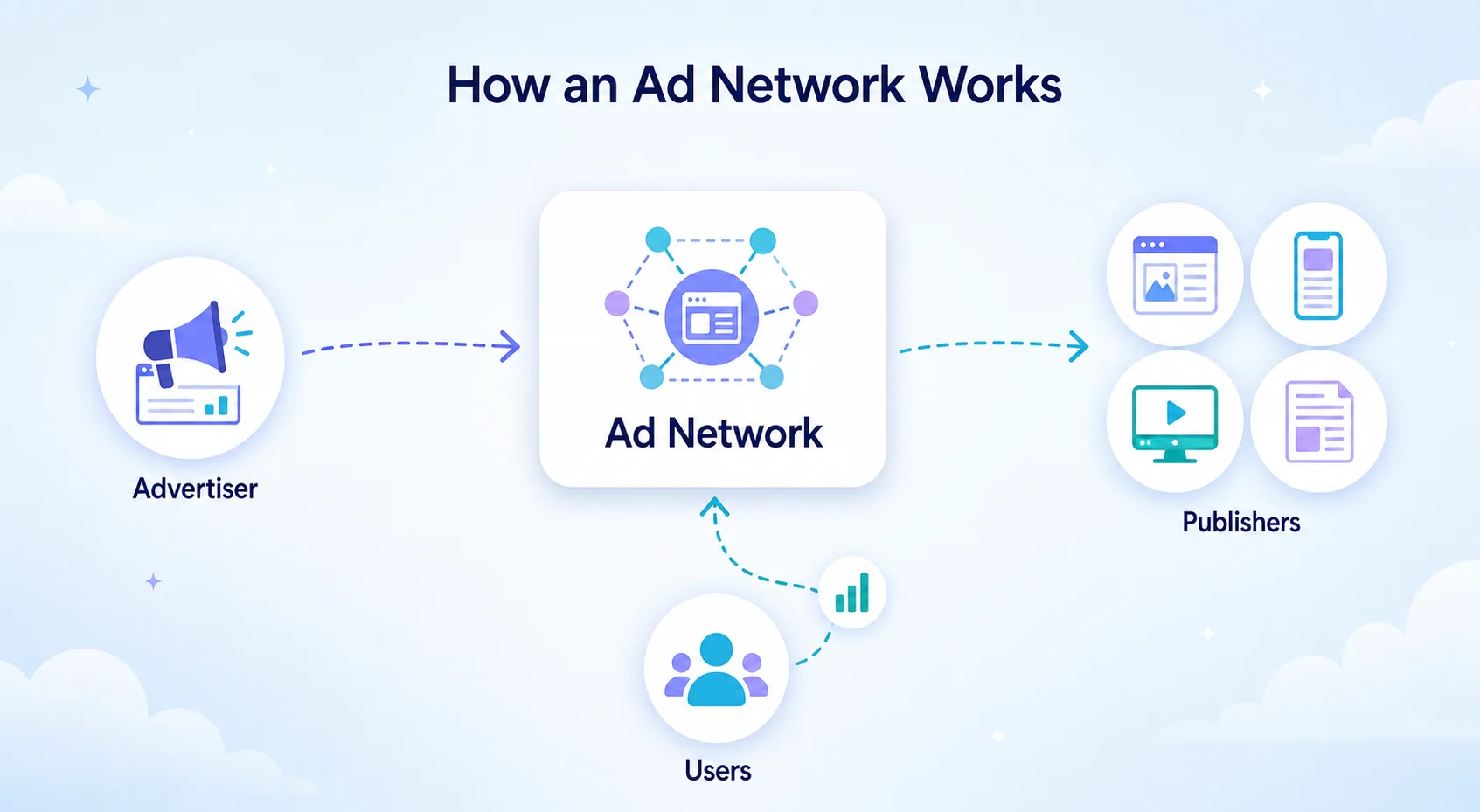
The mechanism is a loop between four players:
The network keeps the difference between what advertisers pay and what publishers earn (its margin) and reports performance to both sides. Everything else — sharper targeting, fraud filtering, richer formats — is refinement on this loop.

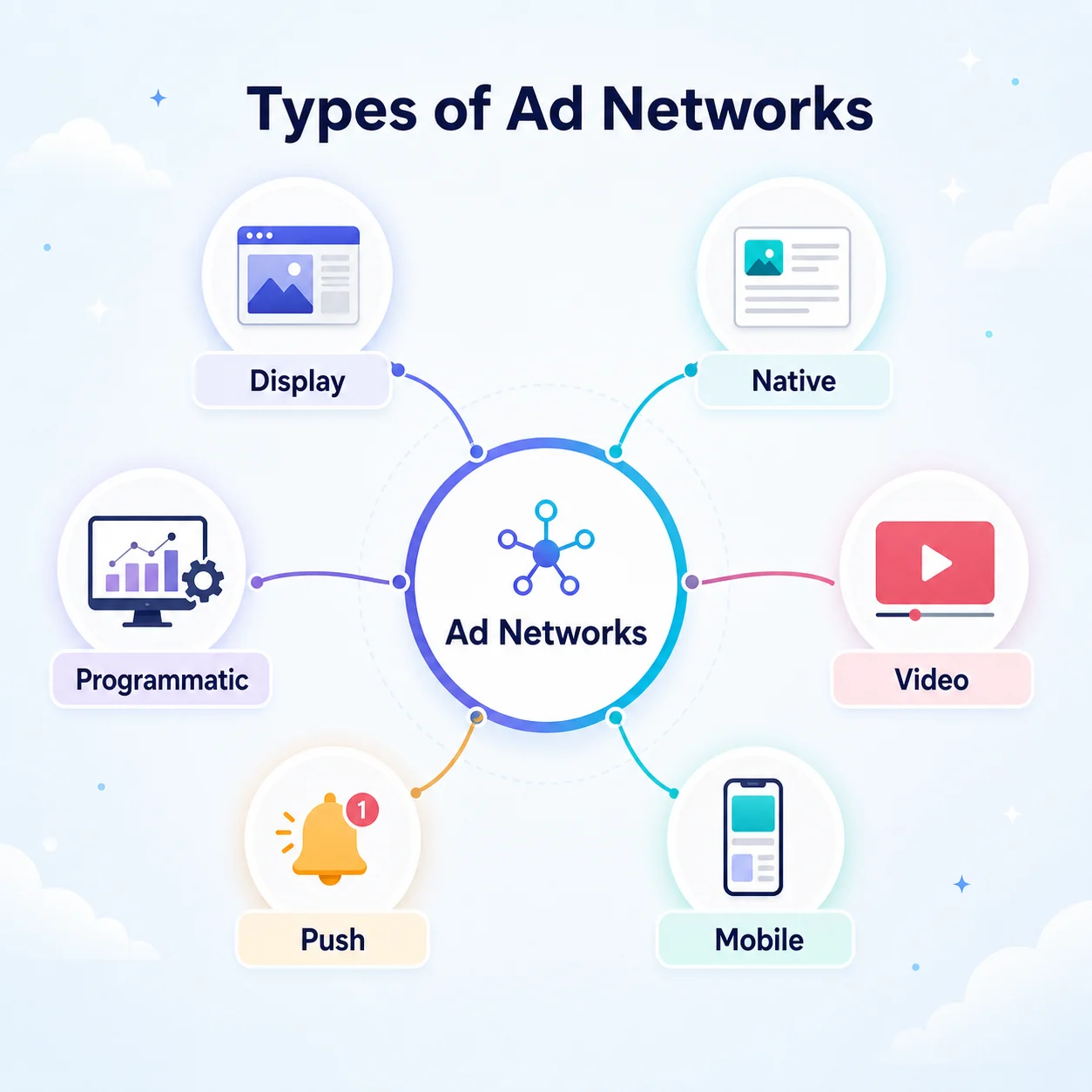
"Ad network" is an umbrella term. The main kinds you will meet:
| Type | What it offers | Typical use |
|---|---|---|
| Display | Banner and image ads across the web | Broad reach, retargeting |
| Native | Ads that match the look of the host content (feeds, "recommended") | Content discovery, soft-sell |
| Video | In-stream and out-stream video ads | Brand awareness, high engagement |
| Mobile / in-app | Formats built for apps (interstitials, rewarded) | App installs, mobile games |
| Push / pop | Push notifications and pop-under formats | High-volume performance traffic |
| Programmatic / exchange | Automated, auction-based buying across sources | Efficient, data-driven scale |
Networks are also grouped by breadth: horizontal (broad, general inventory), vertical (one niche — finance, gaming, health) and premium (a curated set of high-quality publishers). Many specialise by format and pricing model at once.
The pricing model decides who carries the risk:
| Model | You pay per | Best for |
|---|---|---|
| CPM | 1,000 impressions | Awareness, reach |
| CPC | Click | Traffic, response |
| CPA | Action (sale or lead) | Performance, low risk |
| CPV | Video view | Video campaigns |
| CPI | App install | Mobile apps |
CPM gives publishers certainty; CPA shifts the risk onto the network and publisher. Performance advertisers push toward CPC and CPA, while brand campaigns live on CPM and CPV.
For advertisers:
For publishers:
The catch for both sides is margin and transparency: the network takes a cut, and inventory quality and fraud vary widely — which is exactly why choosing the right one matters.
The right network depends on your format, vertical, geos and pricing model. Start with well-established, verified networks that span the major formats — native, display and push/pop:
Match the network to your goal: native (Taboola, Outbrain, MGID) for content discovery; display and push/pop (Adsterra, PropellerAds) for high-volume performance traffic. For a full decision framework read How to Choose an Ad Network, and compare the formats themselves in our guides to display advertising and native advertising. Browse every option in the directory.
An ad network is simply the aggregator that connects advertiser demand to publisher supply — then serves, measures and settles the whole exchange. The concept is singular; the execution splits along three axes: format (display, native, video, push), breadth (horizontal, vertical, premium) and pricing model (CPM through CPA). Match those three to your goal and you have chosen the right network — everything after that is optimisation.
An ad network is a company that gathers unsold ad space from many publishers and sells it to advertisers in one place, handling the ad serving, targeting and measurement. It is the middle layer connecting advertiser demand to publisher supply.
Mainly on margin — the difference between what advertisers pay for inventory and what the network pays publishers for it. Some also charge platform or management fees on top.
An ad network aggregates and packages publisher inventory to sell to advertisers, often at negotiated or fixed terms. An ad exchange is an open, real-time auction marketplace where impressions are bid on programmatically. Networks frequently buy and sell through exchanges.
By format: display, native, video, mobile/in-app, push/pop and programmatic. By breadth: horizontal (broad inventory), vertical (a single niche) and premium (curated high-quality publishers). Many networks combine a format specialty with a pricing model.
Ad networks sell attention — you pay per impression or click for ads. Affiliate networks pay for performance — partners earn a commission only when a sale or lead happens. See our full comparison for details.
A publisher adds the network's ad code to its site or app, the network fills those slots with the best-paying eligible ads, and the publisher receives a revenue share for each impression, click or action delivered.
It depends on your format and goal. Native networks like Taboola, Outbrain and MGID suit content discovery, while Adsterra and PropellerAds are popular for high-volume display and push/pop traffic. Match the network to your format, vertical and pricing model rather than chasing size.
The software behind every commission does one job: match a conversion to the exact click that caused it. Here is the click-to-conversion lifecycle, the six components inside every tracker, and how to choose one.
8 minClicks with no commissions isn't failure — it's usually a broken link in a six-step chain. Here's how to tell whether you even have a problem yet, and a diagnostic to find and fix the exact step that's leaking.
7 minDating is one of the largest, highest-paying CPA verticals — it converts on cheap free sign-ups yet sits on high-lifetime-value users. Here are the best high-paying dating affiliate networks — CrakRevenue, Advidi, AdsEmpire, ClickDealer, LosPollos and Trafee — plus the payout models (SOI, DOI, PPS, RevShare, smartlink) and how to choose.