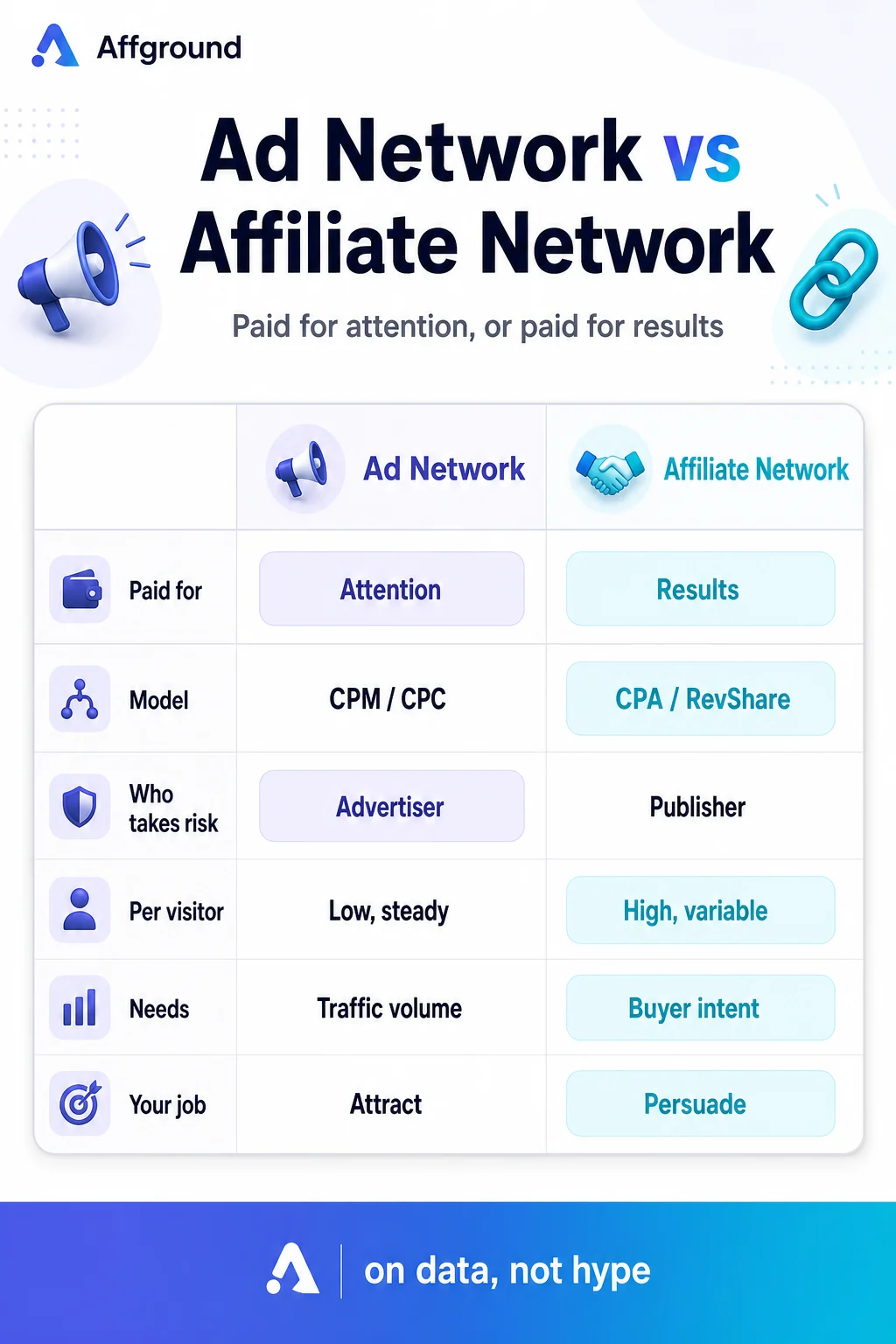
They both have "network" in the name and both turn traffic into income — but ad networks and affiliate networks are opposite sides of the same marketplace. One pays for attention (impressions and clicks); the other pays for results (sales and sign-ups). Here's the full breakdown, which pays more, and how to choose.
Jul 11, 2026 · 12 min read
They both have "network" in the name, they both promise to turn your website traffic into income, and they're constantly mentioned in the same breath — so it's no surprise that ad networks and affiliate networks get mixed up all the time. But they are not two flavours of the same thing. They are opposite sides of the same marketplace, and confusing them is one of the most expensive mistakes a publisher can make.
Here's the one-sentence answer: *an ad network pays you for attention — impressions and clicks on ads — while an affiliate network pays you for results — the sales and sign-ups your recommendations produce.* One monetizes eyeballs; the other monetizes outcomes. That single distinction cascades into everything: how much you earn, who carries the risk, how much traffic you need, and what your content has to do.
This guide breaks the whole thing down for publishers: what each network actually is, how the money flows, which pays more (and when), whether you can run both, and how to choose. Written for anyone deciding how to monetize a site, newsletter or channel — and tired of the two terms being used interchangeably.
Ad networks pay for attention; affiliate networks pay for results — the one distinction that drives every other difference.
The quick answer
If you only take one thing away, take this table:
Ad network
Affiliate network
You get paid for
Impressions & clicks (attention)
Sales & sign-ups (results)
Typical model
CPM, CPC
CPA, CPS / RevShare, CPL
Who carries the risk
The advertiser
The publisher (you)
Revenue per visitor
Low, but reliable
High, but variable
Traffic you need
High volume
High intent
Your content's job
Attract visitors
Persuade buyers
Setup effort
Paste one code snippet
Pick offers, write, place links
Example players
Taboola, Outbrain, Adsterra
Awin, CJ, Impact
Everything below is just this table, explained.
What is an ad network?
An ad network is a middleman that connects publishers who have ad space to advertisers who want to buy it. You paste a snippet of code on your site, the network fills that space with ads, and you get paid based on how many people see (impressions) or click (clicks) them. Google AdSense is the one everyone knows; Taboola and Outbrain dominate native "recommended for you" ads; Adsterra, PropellerAds and AdMaven specialise in pop, push and display formats.
The defining trait: you're paid for attention, not outcomes. It doesn't matter whether the person who saw or clicked the ad ever buys anything. The advertiser is buying exposure and takes on the risk that it converts. Your job ends at delivering the impression or the click.
How you're paid: mostly CPM (cost per mille — a rate per 1,000 impressions) or CPC (a rate per click).
What you provide: ad inventory — the space on your pages.
What it demands:volume. Because each impression is worth a fraction of a cent to a few dollars per thousand, ad networks reward big, steady traffic.
Effort to run: minimal. Approve, paste the tag, and revenue starts flowing automatically as people visit.
Affground's take: ad networks are the utilities of monetization — plug in, and the meter runs whether you're paying attention or not. That passivity is their whole appeal and their whole ceiling: you'll never earn much per visitor, so the only lever is more visitors. For a high-traffic content site, that's a feature. For a small, engaged audience, it's a rounding error.
What is an affiliate network?
An affiliate network is a marketplace that connects publishers to the affiliate programs of thousands of merchants, behind a single login, dashboard and payout. You browse offers, grab a tracked link, recommend the product in your content, and earn a commission when a reader takes a specific action — usually a purchase, sometimes a lead or sign-up. Awin, CJ, Impact, ShareASale and ClickBank are among the biggest.
The defining trait: you're paid for results, not attention. A million people can read your review; if nobody clicks through and converts, you earn nothing. In exchange for carrying that risk, you keep a real slice of every sale — often far more per buyer than an ad ever pays.
How you're paid:CPA (flat fee per action), CPS / RevShare (a percentage of the sale, sometimes recurring), or CPL (per lead).
What you provide: a recommendation — trusted, contextual, persuasive.
What it demands:intent. A reader who searched "best CRM for agencies" is worth a hundred casual browsers, because they arrived ready to buy.
Effort to run: real. You choose offers, write content that converts, place links well, and track what works.
Affground's take: an affiliate network turns your credibility into revenue, not your pageviews. That's why it scales with trust rather than traffic — and why a niche newsletter with 5,000 loyal readers can out-earn a content farm with a million bored ones. The work is heavier than pasting an ad tag, but the ceiling is in a different universe.
The core difference: attention vs results
Strip everything else away and the divide is about what you're selling and who takes the risk.
With an ad network, you sell attention. The advertiser pays for the chance to be seen and bets that some viewers convert. If the campaign flops, that's the advertiser's problem — you still got paid for the impressions. Risk sits with the buyer of the ad.
With an affiliate network, you sell outcomes. The merchant only pays when a real sale happens, so the risk of "did this actually work?" shifts onto you. No conversion, no commission. You're rewarded for carrying that risk with a much larger cut when it pays off.
Same traffic, two monetization paths: ad networks bank the click; affiliate networks bank the conversion that follows it.
That risk transfer explains every downstream difference. Ad revenue is low but dependable — a small, predictable amount per visitor, largely regardless of what you write. Affiliate revenue is high but variable — potentially many dollars per buyer, but only if your content actually persuades. One is a steady trickle indexed to traffic; the other is a series of larger, lumpier wins indexed to trust and intent.
Head-to-head: an ad network vs an affiliate network
To make it concrete, here's a native ad network (Taboola) placed directly against a classic affiliate network (CJ Affiliate). Notice how the affiliate side carries a cookie window — because it tracks conversions over time — while the ad network doesn't need one at all:
The contrast in that table is the difference: the ad network's model is built around impressions and clicks that settle instantly, so there's no cookie and no conversion to attribute. The affiliate network's whole machinery — cookies, attribution windows, commissions — exists precisely because it pays on an action that happens later, after the click.
How the money works: the payout models side by side
The payment acronyms are where the two worlds physically diverge. Ad networks live in the top half of this table; affiliate networks in the bottom:
Model
Full name
You're paid when…
Used by
CPM
Cost per mille
Ads are shown (per 1,000 impressions)
Ad networks
CPC
Cost per click
Someone clicks an ad
Ad networks
CPA
Cost per action
A referred user completes an action/sale
Affiliate networks
CPS / RevShare
Cost per sale / revenue share
A sale completes (flat or % of order)
Affiliate networks
CPL
Cost per lead
A referred user submits a lead/sign-up
Affiliate networks
Read top to bottom and you can watch the risk migrate from advertiser to publisher. CPM pays just for showing an ad — zero performance risk for you. By the time you reach CPS/RevShare, you're only paid if a real purchase happens — all the performance risk, but all the upside too. CPC and CPL sit in between. The further down the table you earn, the more you're paid per success and the more your content has to actually work.
Which one earns more?
The honest answer: it depends entirely on your traffic — and the best sites use both. But here's the rule that cuts through it.
*Affiliate almost always wins on revenue per engaged visitor; ad networks win on revenue per casual visitor at scale.* If your audience arrives with buying intent — searching for reviews, comparisons, "best X for Y" — affiliate will out-earn ads many times over, because one converted buyer is worth thousands of ad impressions. If your traffic is broad, casual and high-volume — viral content, news, entertainment — most visitors will never buy anything, so ad impressions monetize them far better than affiliate links they'll ignore.
Affground's rule of thumb: monetize intent with affiliate and attention with ads. A single "best email marketing tools" buyer's guide can out-earn a year of display ads on the same page — but a viral listicle that nobody shops from is pure ad inventory. Match the model to why the visitor showed up.
Affground predicts: as attention gets cheaper and trust gets scarcer, the revenue mix will keep tilting toward affiliate for anyone with genuine expertise. Ad rates are squeezed by ad blockers, privacy changes and infinite supply; affiliate commissions are anchored to real sales and real credibility — which AI-generated content can't fake. The publishers who lean into results-based income will compound faster than those renting out eyeballs.
When to use which
Neither is "better" — they fit different situations. Use this as a decision guide:
Reach for an ad network when:
You have high traffic volume but low commercial intent (news, entertainment, viral content).
You want passive, hands-off income with near-zero ongoing effort.
Your content isn't naturally about products you could recommend.
You want a predictable revenue floor that scales smoothly with pageviews.
Reach for an affiliate network when:
Your audience is researching purchases (reviews, comparisons, buyer's guides).
You have topical authority and trust in a niche.
You'd rather earn a lot per buyer than a little per visitor.
You're willing to invest in content that persuades, not just attracts.
Can you run both at once? (Yes — and most pros do)
These are not mutually exclusive — they're complementary layers on the same traffic. A well-run content site typically does both: affiliate links inside the high-intent, product-focused articles where readers are ready to buy, and ad units filling the rest of the site — the informational posts, the archives, the visitors who were never going to purchase anything.
The trick is not letting them cannibalise each other. Plastering aggressive display ads over a careful product comparison can tank the conversions — and the affiliate commissions — that page was built for. The smart pattern: let affiliate own your money pages, and let ads mop up the attention everywhere else. Layered well, the two don't compete; they cover different visitors on the same site.
Leading ad networks worth knowing
If attention monetization fits your traffic, these are established, publisher-friendly ad networks spanning native and high-yield formats:
And if you're monetizing intent, these are three of the most established affiliate networks — each bundling thousands of merchant programs behind one dashboard:
"They're basically the same thing." They're opposites: attention vs results, advertiser-risk vs publisher-risk. Everything else follows from that.
"Affiliate always pays more." Only for intent-rich traffic. For casual, high-volume audiences that never buy, ad impressions usually win.
"Ad networks are free money." The revenue per visitor is so low that without serious traffic, it barely registers.
"You have to pick one." You don't. The best sites layer both, matching each to the right kind of visitor.
"An ad network and an affiliate network are interchangeable partners." No — one supplies ads to display, the other supplies offers to recommend. Different inventory, different work, different payout.
How to choose: a simple decision rule
01Look at your traffic's intent, not just its size. Are visitors researching purchases, or passing through? Intent points to affiliate; casual volume points to ads.
02Match the model to the visitor. Money pages and buyer's guides → affiliate. Informational and archive traffic → ads.
03Start with one, master it, then layer the other. Pick the model that fits your dominant traffic type first; add the second once the first is working.
04Protect your conversions. If a page earns real affiliate income, don't smother it in ads that cost you sales.
05Measure per-visitor value on each. Track what a thousand visitors earn via ads vs affiliate on comparable pages, and let the data decide the mix.
Affground's verdict
Ad networks and affiliate networks aren't rivals to choose between so much as two different machines for two different jobs. An ad network is a volume business: it converts raw attention into a small, dependable trickle, and it rewards scale above all. An affiliate network is a trust business: it converts credibility and intent into larger, lumpier wins, and it rewards expertise above all. Get the labels straight and the strategy writes itself — sell attention where that's all you have, and sell results wherever your audience actually trusts your recommendation.
For most serious publishers, the endgame isn't ad networks or affiliate networks — it's both, deployed deliberately: affiliate on the pages where readers are ready to act, ads on everything else. But if you're building for the long term, weight your effort toward the results side. Attention is getting cheaper every year; trusted recommendations only get more valuable. Affground's bet is that the publishers who monetize what they've earned — credibility — will outlast the ones renting out what they merely rent: eyeballs.
Frequently asked questions
What is the difference between an ad network and an affiliate network?
An ad network pays you for attention — impressions and clicks on ads placed on your site — using models like CPM and CPC, with the advertiser carrying the risk of whether those ads convert. An affiliate network pays you for results — the sales, leads or sign-ups your recommendations produce — using models like CPA and CPS/RevShare, with the publisher carrying the performance risk. In short: ad networks monetize eyeballs, affiliate networks monetize outcomes.
What is an ad network?
An ad network is a middleman that connects publishers who have ad space with advertisers who want to buy it. You add a code snippet to your site, the network fills that space with ads, and you earn based on impressions (CPM) or clicks (CPC) — regardless of whether anyone buys. Examples include Google AdSense, Taboola and Outbrain (native), and Adsterra, PropellerAds and AdMaven (pop/push/display). It rewards high traffic volume and needs almost no ongoing effort.
What is an affiliate network?
An affiliate network is a marketplace that connects publishers to the affiliate programs of thousands of merchants behind a single dashboard and payout. You grab a tracked link, recommend a product in your content, and earn a commission when a reader completes an action — usually a purchase (CPA or CPS/RevShare), sometimes a lead (CPL). Examples include Awin, CJ, Impact, ShareASale and ClickBank. It rewards buyer intent and trust rather than raw traffic.
Which pays more, ad networks or affiliate networks?
It depends on your traffic. Affiliate almost always earns more per engaged, high-intent visitor, because one converted buyer is worth thousands of ad impressions — so review, comparison and buyer's-guide content monetizes far better with affiliate. Ad networks earn more from casual, high-volume traffic that will never buy anything, like viral, news or entertainment content. The best publishers use both, matching each model to the right kind of visitor.
Can you use an ad network and an affiliate network at the same time?
Yes, and most professional publishers do. They're complementary layers on the same traffic: affiliate links on high-intent money pages where readers are ready to buy, and ad units on informational posts, archives and casual visitors who were never going to purchase. The key is not letting aggressive ads cannibalise the conversions on your affiliate pages — let affiliate own your money pages and ads cover everything else.
Is Google AdSense an ad network or an affiliate network?
Google AdSense is an ad network. It pays publishers for displaying ads and for clicks on them (impression- and click-based revenue), not for driving sales. An affiliate network, by contrast, would pay you a commission only when a referred visitor actually buys or signs up. So AdSense monetizes attention, whereas affiliate networks like Awin or CJ monetize conversions.
Do ad networks use cookies and attribution windows like affiliate networks?
Not in the same way. Affiliate networks rely on cookies and attribution windows (often 30–90 days) because they pay for a conversion that usually happens later, after the click, and must credit it back to the right publisher. Ad networks are paid on impressions and clicks that settle instantly, so they don't need a conversion-tracking cookie window to pay you — which is one of the clearest structural differences between the two.