Display advertising is the visual ad layer of the open web — banners, native units and video served across sites and apps, mostly bought programmatically in milliseconds. This complete guide covers how it works, the formats and pricing models, targeting and retargeting, how it compares to search, and how to approach it as an advertiser or a publisher.
Jul 11, 2026 · 13 min read
Every banner ad you scrolled past today, every "recommended for you" box at the bottom of an article, every product that seemed to follow you around the internet after you looked at it once — that's display advertising. It is the visual wallpaper of the open web, and it moves a staggering amount of money: widely cited industry figures put global display ad spending in the hundreds of billions of dollars a year, the large majority of it now bought and sold automatically in the time it takes a page to load.
Display advertising is how brands buy attention at scale and how millions of publishers turn their traffic into revenue. But "display" is a deceptively broad word — it spans tiny banners, full-screen takeovers, native recommendation widgets and autoplay video, priced and targeted in half a dozen different ways. Understand how the machine actually works and you can either buy it far more efficiently or sell it for far more.
This is the complete guide: what display advertising is, how the programmatic plumbing moves an ad from advertiser to your screen in milliseconds, the formats and pricing models, how targeting works, how it compares to search and social, and how to approach it from both sides — as an advertiser buying it and a publisher monetizing it.
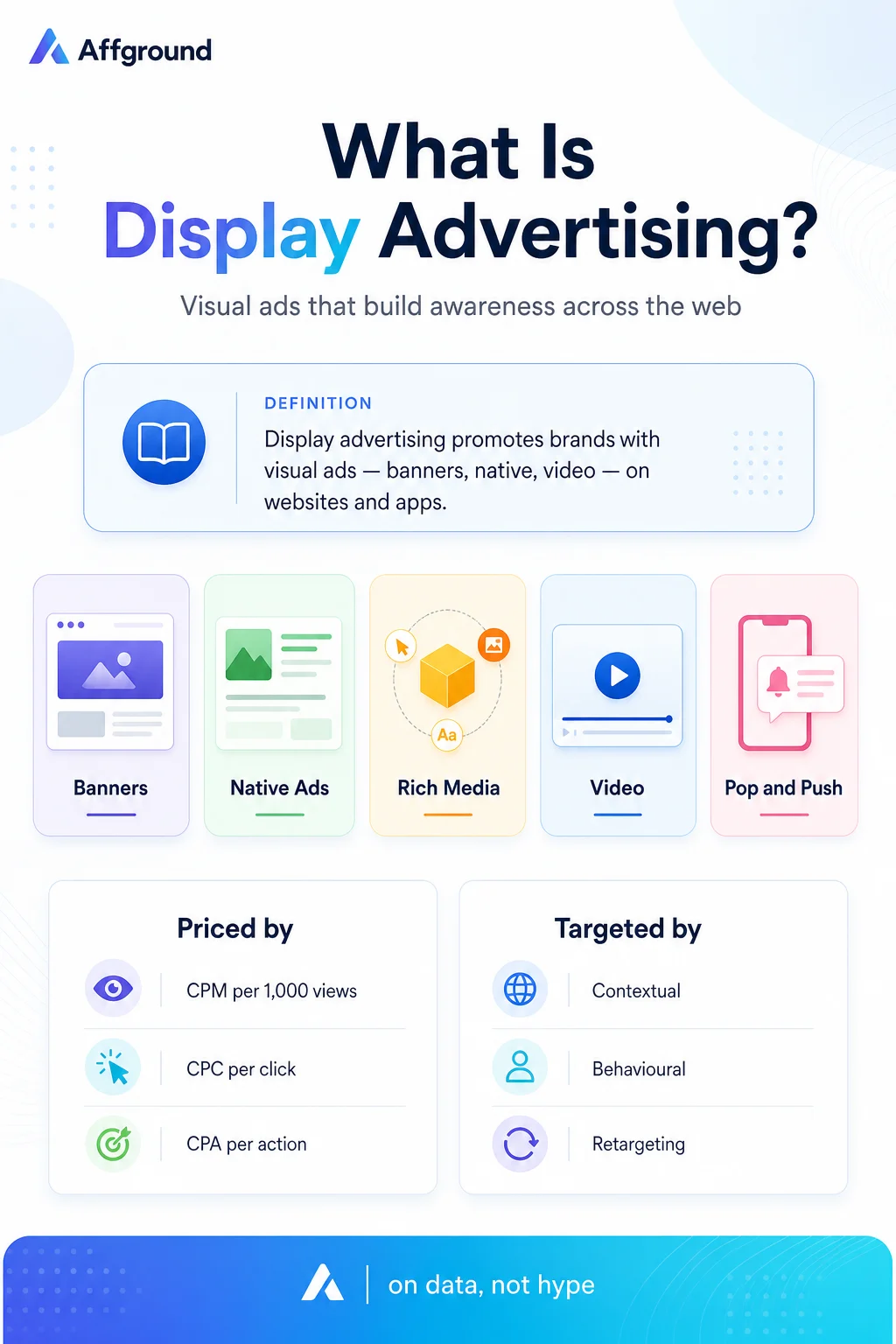
Display advertising at a glance — the main formats, how they're priced, and how they're targeted.
What is display advertising?
Display advertising is the practice of promoting a brand, product or offer using visual ads — images, graphics, video or interactive media — placed on websites, apps and social platforms across the internet. Those banner, native and video units you see wrapped around content are display ads, and the money behind them is what funds most of the free web.
The clearest way to understand display is by contrast with search advertising. A search ad is text, and it's shown because you asked — you typed "running shoes," so an ad for running shoes appears. Display is visual, and it's shown while you're doing something else — reading an article, watching a video, scrolling an app. Search advertising captures existing demand; display advertising creates and sustains it, putting a brand in front of people who weren't actively looking.
That single difference shapes everything about how display is used: it's the channel of awareness, reach and retargeting — building recognition, staying top-of-mind, and nudging people who already showed interest — rather than catching red-hot purchase intent the moment it appears.
Affground's take: the biggest mistake people make with display is judging it by search's yardstick. Display click-through rates look tiny next to search — often a fraction of a percent — but that's because you're measuring an awareness channel with a demand-capture ruler. Display's job is usually to plant and water the intent that search later harvests. Measure it on reach, assisted conversions and brand lift, not on last-click glory.
How display advertising actually works
Behind every ad impression is an invisible, millisecond-fast auction. The old world of manually negotiating ad placements is mostly gone; today the vast majority of display is programmatic — bought and sold automatically by software. Here's the cast of characters:
The advertiser — the brand that wants to show an ad, working through a DSP (demand-side platform) that buys impressions on its behalf.
The publisher — the site or app with ad space to sell, working through an SSP (supply-side platform) or an ad network that packages and sells that inventory.
The ad exchange — the marketplace where DSPs and SSPs meet and impressions are auctioned in real time.
The ad network — an aggregator that bundles inventory from many publishers into buyable packages (Taboola, Outbrain, Adsterra, MGID and others sit here).
When you load a page, a real-time bidding (RTB) auction fires: in the ~100 milliseconds before the ad slot renders, advertisers' DSPs evaluate who you are and bid for the right to show you an ad. The highest bid wins, its creative loads, and an impression is recorded — all before you've consciously noticed the space existed. Multiply that by billions of impressions a day and you have the programmatic display economy.
For a publisher, the practical upshot is simpler: you join an ad network or SSP, place a tag on your site, and that machinery fills your ad slots and pays you — most commonly per thousand impressions. For an advertiser, it means you can reach precise audiences across millions of sites without negotiating a single deal directly.
The programmatic chain: an advertiser's bid flows through platforms and an exchange to fill a publisher's ad slot — in about the time a page takes to load.
The main types of display ads
"Display" is an umbrella over several very different formats. The big ones:
Format
What it is
Best for
Banners
Classic image ads in standard sizes (leaderboard, skyscraper, rectangle)
Broad awareness, cheap reach
Native ads
Ads styled to match the surrounding content ("recommended for you")
Engagement, content discovery
Rich media
Interactive units with video, animation or expandable elements
Higher engagement, brand storytelling
Video display
Short in-stream or out-stream video ads
Emotional impact, brand lift
Interstitial
Full-screen ads between content or app screens
High visibility (used sparingly)
Pop & push
Pop-unders and browser push notifications
High-yield performance/affiliate traffic
Native has been the fastest-growing slice for years because it sidesteps "banner blindness" — readers engage with ads that look like content far more than with obvious banners. Video commands the highest attention (and prices). Banners remain the cheap, ubiquitous workhorse. Pop and push sit at the aggressive, high-yield end favoured by performance and affiliate advertisers.
How display ads are priced
Display is bought on a few core pricing models, and which one you're on decides who carries the performance risk:
Model
You pay / earn per
Risk sits with
Typical use
CPM
1,000 impressions
Advertiser
The default for awareness & reach
CPC
Click
Shared
Traffic-focused campaigns
CPA / CPL
Action or lead
Publisher/network
Performance & affiliate campaigns
vCPM
1,000 viewable impressions
Advertiser
When viewability is the priority
CPM is the native currency of display — you're buying (or selling) attention, so you pay per thousand impressions whether or not anyone clicks. Performance-minded advertisers push toward CPC or CPA to only pay for outcomes, but they'll usually pay a premium per result in exchange for shifting the risk. For a publisher, CPM is the reliable baseline; CPC/CPA can pay more per visitor but only when the traffic actually performs.
Affground's rule: if your goal is awareness, buy on CPM and judge success by reach and viewability. If your goal is a measurable action, buy on CPC or CPA and judge by cost per result. Mixing the two — buying on CPM but grading on last-click conversions — is how good display campaigns get killed for the wrong reasons.
How display targeting works
The reason a product you viewed once seems to chase you around the web is display targeting, and it comes in several flavours:
Contextual — ads matched to the content of the page (a running-shoe ad on a marathon-training article). Privacy-friendly and resurgent as third-party cookies fade.
Behavioural — ads based on a user's past browsing behaviour and interests.
Retargeting (remarketing) — ads shown to people who already visited a site or viewed a product but didn't convert. The highest-performing display tactic by far.
Demographic & geographic — targeting by age, gender, location, language and device.
Lookalike / audience — reaching new people who resemble a brand's existing customers.
Retargeting is display's killer application: someone who already visited your product page is dramatically more likely to convert than a cold viewer, which is why those "come back" ads follow shoppers so persistently. As third-party cookies wind down, the industry is shifting weight back toward contextual targeting and first-party data — a change every advertiser and publisher should be planning around now.
Display vs search vs social vs native
Display doesn't exist in isolation. Here's how it sits against the other big digital channels:
Channel
Intent level
Strength
Weakness
Display
Low (interrupts)
Cheap reach, retargeting, awareness
Low CTR, banner blindness
Search
High (you asked)
Captures demand, high intent
Limited to existing demand, competitive
Social
Medium
Rich targeting, engagement
Rising costs, platform dependence
Native
Low–medium
Blends in, beats banner blindness
Can under-disclose, needs good creative
The takeaway isn't that one wins — it's that they do different jobs. Search harvests demand that already exists. Display and social create it and keep brands visible. The strongest strategies use display and social to build awareness and retarget, then let search catch the intent those channels generated.
Two sides of the same coin: advertiser vs publisher
Display advertising has two customers, and it's worth being clear which one you are.
As an advertiser, display is how you build reach and stay in front of an audience affordably. The wins come from tight targeting (especially retargeting), disciplined creative testing, frequency caps so you don't annoy people into ad-blocking you, and — crucially — measuring the channel on its real job (awareness and assisted conversions), not just last click.
As a publisher, display is how you monetize the traffic that isn't ready to buy anything. You join an ad network or SSP, place your tags, and earn primarily on CPM. The levers are traffic volume, viewability (ads that are actually seen pay more), ad placement, and choosing networks that fill your inventory at strong rates without wrecking the user experience.
Affground's take: for a content publisher, display is the floor, not the ceiling. It reliably monetizes every visitor, including the ones who'll never convert — which is exactly why it pairs so well with affiliate. Let display bank the casual attention across your whole site, and let affiliate capture the buyers on your money pages. (We break the two apart in ad network vs affiliate network.)
Where display advertising is bought and sold
Publishers and advertisers meet display inventory through ad networks — aggregators that package inventory, handle targeting and payment, and specialise in particular formats. Here are established networks spanning native discovery and high-yield display:
Beyond native, networks like Adsterra, PropellerAds and AdMaven specialise in pop, push and high-yield display formats favoured by performance advertisers. Browse the full ad networks directory to compare formats, minimums and payout terms, and shortlist the ones that fit your traffic or campaign.
The metrics that actually matter
Display is measured differently from demand-capture channels. The numbers to watch:
Impressions & reach — how many times the ad was served, and to how many unique people.
Viewability — the share of ads actually seen (in view long enough to count). A served ad nobody saw is worthless; strong campaigns track this closely.
CTR (click-through rate) — clicks ÷ impressions. Useful, but expect display CTRs to be a fraction of a percent — that's normal, not failure.
CPM / eCPM — cost (or effective earnings) per thousand impressions; the core efficiency metric.
Conversions & assisted conversions — actions driven, including the ones display influenced even when another channel got the last click.
Affground's rule of thumb: if you only ever look at click-through rate, you'll conclude display doesn't work — and you'll be wrong. Weight viewability and assisted conversions alongside CTR. Display's value hides in the conversions it set up for other channels to close.
Common display advertising mistakes
Judging it by last-click only. Display mostly assists conversions; grading it on last click buries its real contribution.
Ignoring viewability. Paying for impressions that were never actually on screen is pouring budget into a void.
No frequency caps. Show the same ad 40 times and you don't build a brand — you train people to hate it and install an ad blocker.
Weak creative. Display is a visual medium; a boring banner fails no matter how good the targeting.
Over-stuffing a site with ad units (publishers). Aggressive ads tank user experience, page speed and the very affiliate conversions that pay better.
Betting everything on third-party cookies. They're going away; start shifting toward contextual and first-party targeting now.
How to get started
If you're an advertiser:
01Define the job — awareness, retargeting, or direct response — because it dictates your format, pricing model and metrics.
02Pick your route — a self-serve DSP or an ad network that fits your format and budget.
03Start with retargeting — the fastest, highest-ROI display win; re-engage people who already know you.
04Test creative relentlessly and set frequency caps.
05Measure on the right metric — reach and assisted conversions for awareness; cost-per-action for direct response.
If you're a publisher:
01Choose an ad network or SSP that serves your vertical and traffic type.
02Place tags thoughtfully — balance revenue against user experience and page speed.
03Optimise for viewability — above-the-fold, in-view placements earn more.
04Track eCPM by placement and cut what underperforms.
05Layer with affiliate on your high-intent pages so you monetize both attention and intent.
Affground's verdict
Display advertising is the connective tissue of the open web: the awareness engine that keeps brands visible and the monetization layer that funds the free content everyone reads. Its reputation suffers because people keep measuring it wrong — holding an awareness-and-retargeting channel to search's demand-capture standard and declaring it broken when the click-through rate is small. Understood on its own terms, display is one of the most cost-effective ways to build reach, re-engage interested buyers, and turn ordinary traffic into steady revenue.
The winners on both sides do the same thing: they match the tool to the job. Advertisers use display to plant and nurture demand — especially through retargeting — and measure it on reach and assisted conversions. Publishers use it as a dependable revenue floor across all their traffic, then layer affiliate on top where intent is high. Get the framing right, respect viewability and frequency, and plan for a post-cookie, contextual future — and display remains exactly what it has always been: the quiet, enormous machine that pays for the internet.
Frequently asked questions
What is display advertising?
Display advertising is the practice of promoting a brand or product using visual ads — banners, native units, rich media and video — placed on websites, apps and platforms across the internet. Unlike text search ads that appear because someone searched for something, display ads are shown while people are doing something else, which makes display primarily a channel for awareness, reach and retargeting rather than capturing active purchase intent.
What is the difference between display and search advertising?
Search advertising is text-based and shown because a user actively searched for a keyword, so it captures existing demand at high intent. Display advertising is visual and shown while users browse other content, so it creates and sustains demand by building awareness and retargeting interested users. Search harvests intent; display plants and nurtures it. Most strong strategies use both together.
How does display advertising work?
Most display is programmatic — bought and sold automatically. When you load a page, a real-time bidding (RTB) auction fires in about 100 milliseconds: advertisers' demand-side platforms (DSPs) bid for the impression, publishers offer inventory through supply-side platforms (SSPs) or ad networks, and an ad exchange matches them. The highest bid wins and its ad loads before you notice the slot. Publishers simply place a tag and get paid, usually per thousand impressions.
What are the main types of display ads?
The main formats are banners (standard image ads like leaderboards and rectangles), native ads (styled to match surrounding content), rich media (interactive or expandable units), video display (in-stream and out-stream), interstitials (full-screen ads), and pop & push formats favoured by performance advertisers. Native has grown fastest because it beats banner blindness, while banners remain the cheap, ubiquitous workhorse.
How is display advertising priced?
The core models are CPM (cost per 1,000 impressions), CPC (cost per click), CPA/CPL (cost per action or lead), and vCPM (cost per 1,000 viewable impressions). CPM is the default currency of display because you're buying attention. Advertisers who want to pay only for outcomes shift to CPC or CPA, usually at a premium per result. For publishers, CPM is the reliable baseline income.
What is retargeting in display advertising?
Retargeting (or remarketing) shows display ads to people who already visited a site or viewed a product but didn't convert — the reason a product you looked at once seems to follow you around the web. It's display's highest-performing tactic, because a warm visitor who already showed interest converts far more readily than a cold viewer. As third-party cookies fade, retargeting is increasingly complemented by contextual and first-party targeting.
Is display advertising effective?
Yes, when it's measured on the right job. Display click-through rates are typically a fraction of a percent, so judging it purely on last-click clicks makes it look weak. Its real value is in reach, brand awareness, retargeting and assisted conversions — the sales it sets up for other channels to close. Weighted on viewability and assisted conversions rather than last click, display is one of the most cost-effective digital channels.