The ad network you pick sets your RPM, fill rate, payment reliability and reader experience — yet most publishers just default to AdSense. This guide covers the types of ad networks, the criteria that actually matter (RPM x fill, payment, ad quality), how to match a network to your traffic and niche, the red flags to avoid, and a step-by-step to choose.
Jul 26, 2026 10 min read
Most publishers "choose" an ad network the same way: they slap on AdSense because it's the default, and never think about it again. That single unexamined decision quietly caps their ad revenue for years — because the ad network you pick sets your Get it right and the same traffic earns materially more; get it wrong and you're leaving money (and reader trust) on the table.
RPM, your fill rate, your payment reliability, the quality of the ads your readers see, and how much your site's experience suffers.
Choosing an ad network isn't about finding "the best" one — there's no such thing. It's about matching the right network to your traffic, niche, content type and goals. A high-traffic lifestyle blog, a niche B2B site, and a mobile game each want a completely different network. The skill is knowing what to evaluate and how to weigh it.
This is the publisher's decision guide: the types of ad networks, the criteria that actually matter, how to match a network to your specific situation, the red flags to avoid, and a step-by-step to make the call. Written for site owners choosing (or switching) an ad network — and tired of settling for the default. (If you're weighing ads against other monetization, start with how to monetize a blog without AdSense.)
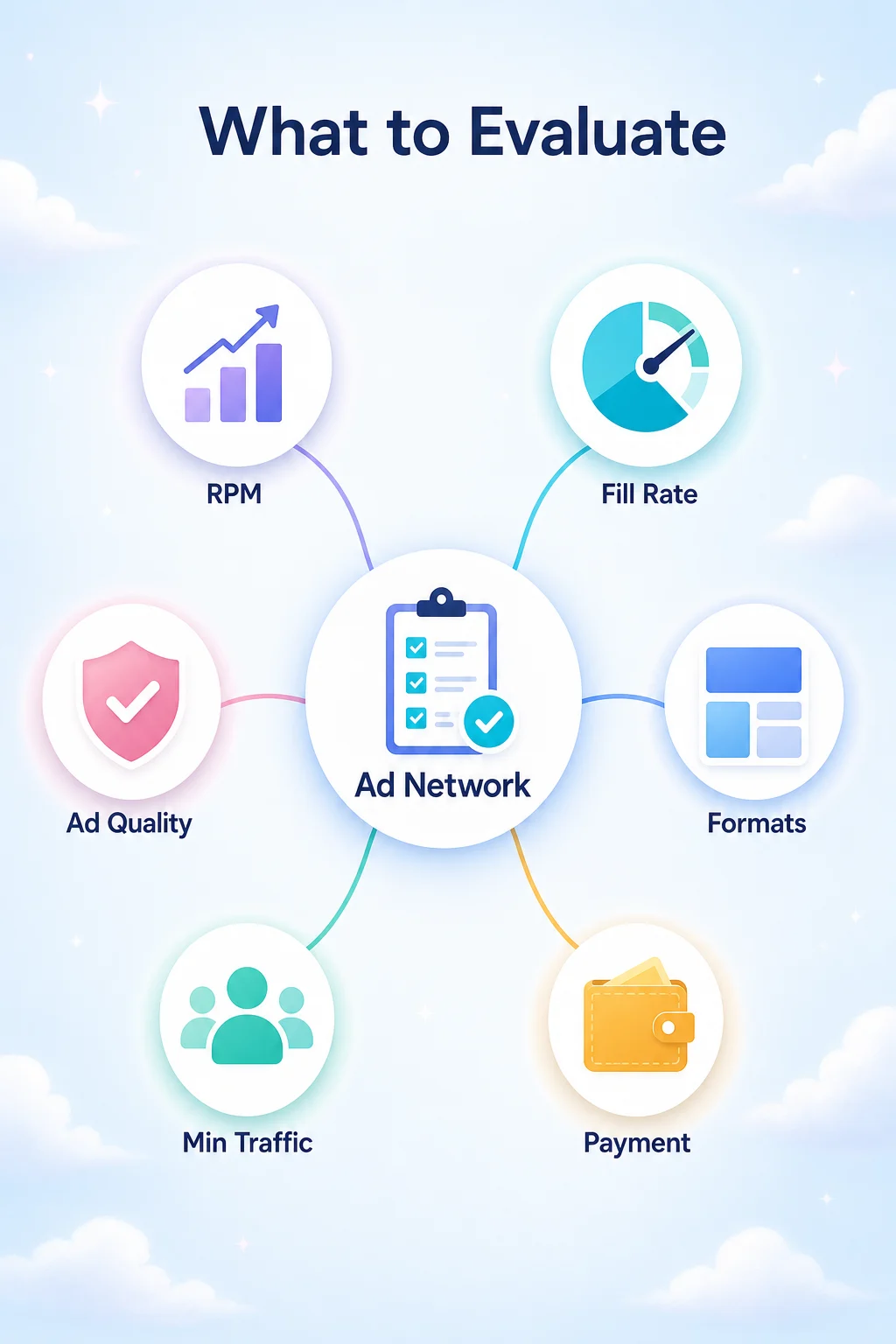
Judge an ad network on six things — RPM, fill rate, formats, payment terms, traffic minimums and ad quality — not just the headline rate.
Why the choice matters
An ad network isn't a commodity you can swap without consequence — it's the partner that decides how much your attention is worth and how your site feels to use. The wrong pick shows up as low RPMs, unsold inventory (poor fill), ugly or intrusive ads that erode trust, or payments that arrive late (or not at all). The right pick does the opposite: it fills your inventory at strong rates with ads that don't wreck the experience, and it pays reliably.
Because switching later means re-integrating and often re-qualifying, the decision compounds. It's worth an hour of real evaluation up front rather than defaulting into whatever's easiest — the difference between networks on the same traffic can be substantial.
Affground's take: there is no single "best ad network" — only the best fit for your traffic. Publishers waste months chasing the network a bigger site raves about, not realising that network's RPM was built on that site's geography, niche and volume. Evaluate against your own numbers, not someone else's screenshots. Fit beats reputation every time.
Know your options: the types of ad networks
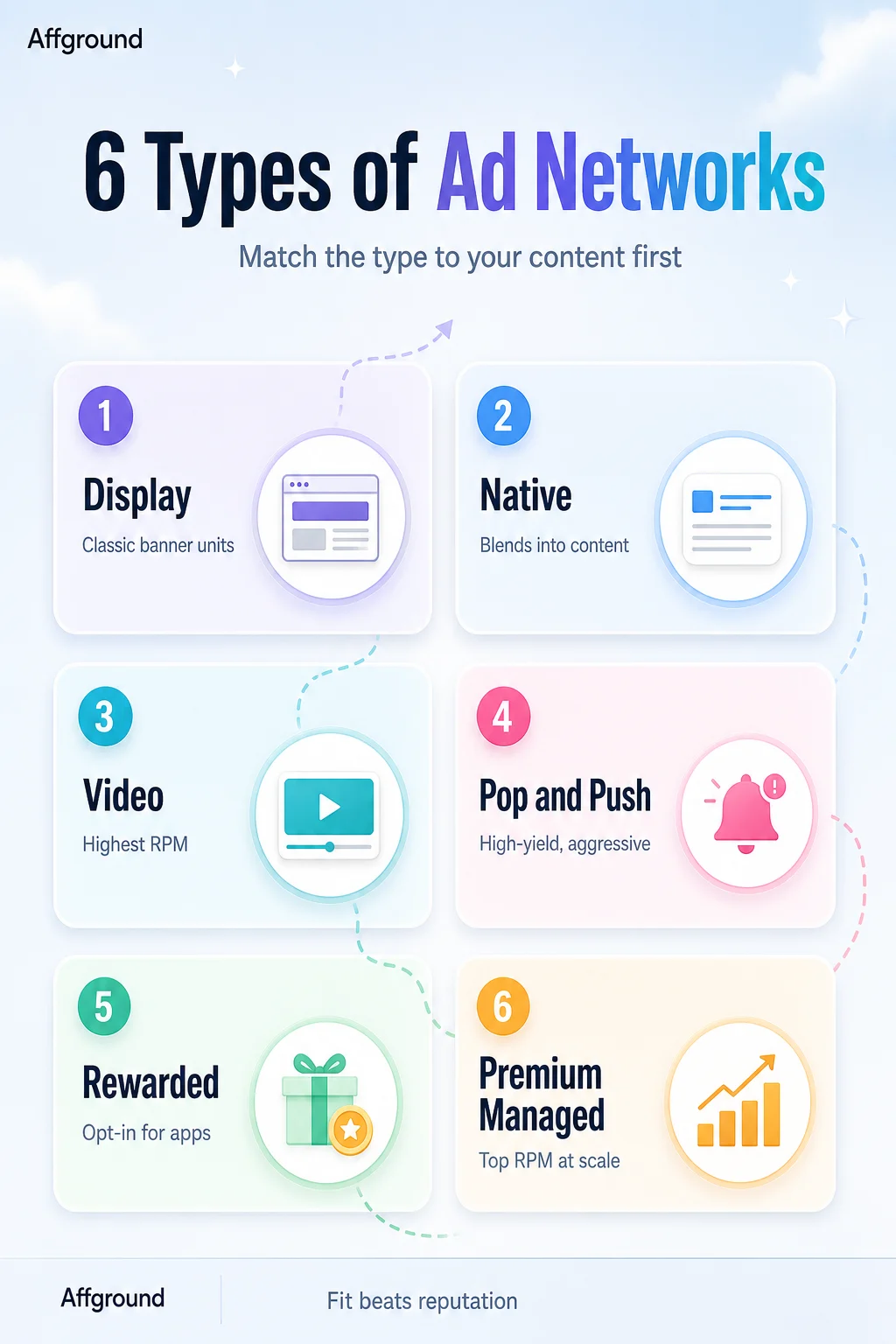
Before you can choose, you need to know what's on the menu. Ad networks specialise, and the type matters as much as the brand:
Ad networks specialise — display, native, video, pop and push, rewarded, and premium managed — so match the type to your content before comparing brands.
Display networks — the classic banner ad units. Ubiquitous, easy, lower RPM. The AdSense category.
Native networks — ads styled to match your content ("recommended for you" widgets). Higher engagement, less banner blindness. (More in native advertising.)
Video networks — in-stream and out-stream video ads. High RPM, best for video or high-engagement content.
Pop & push networks — pop-unders and push notifications. High-yield and accessible with low minimums, but aggressive — best for certain performance verticals, not premium brands.
Rewarded / in-app networks — users opt in to an ad for a reward. The mobile-app and game standard.
Premium managed networks — the Mediavine / Raptive / Ezoic tier that optimises and sells your inventory for materially higher RPMs, once you meet their traffic thresholds.
The single biggest sorting step is matching the type to your content and audience. A native or premium-managed network suits a content blog; a rewarded network suits a game; a pop/push network suits high-volume performance traffic. Pick the wrong type and no amount of tuning saves the RPM.
What to evaluate: the criteria that matter
Once you've narrowed to the right type, judge specific networks against these:
Criterion
The question
Why it matters
RPM / earnings
What will 1,000 views actually earn?
The headline number — but only in your geo/niche
Fill rate
What share of your inventory gets sold?
High RPM on 40% fill loses to modest RPM on 95%
Ad formats
Do they offer formats that fit your site?
Format-to-content fit drives both RPM and UX
Payment terms
Threshold, frequency, methods, reliability
You can't spend revenue you can't withdraw
Traffic minimums
Do you qualify?
Premium networks gate on volume
Ad quality & UX
Are the ads clean, safe, non-intrusive?
Bad ads cost you the trust that funds everything
Targeting & relevance
Can it serve relevant, on-geo ads?
Relevance lifts RPM and reader tolerance
Support & transparency
Real reporting, a reachable human?
Opacity hides underpayment and problems
Two of these quietly decide more than the headline RPM. Fill rate — a network boasting a high RPM but only filling half your slots earns less than a steady network filling nearly all of them. And payment reliability — a great rate from a network that pays late or disputes your earnings is worthless. Weight both heavily.
Affground's rule: never choose an ad network on advertised RPM alone. Multiply realistic RPM × fill rate, then sanity-check payment reliability and ad quality before you believe the number. A network that fills 95% of your inventory with clean ads and pays on time beats a flashy "high RPM" network that fills half your slots and pays late — every time.
Match the network to your situation
The right network is a function of your specifics. Use these as decision rules:
Low traffic / just starting? Premium networks will reject you — start with an accessible network (open display, or a pop/push network with low minimums) and graduate later.
Established content blog with real traffic? Aim for a premium managed network (Mediavine/Raptive/Ezoic tier) — the RPM jump over AdSense is the whole point.
Content-heavy, editorial site? Native networks blend in and beat banner blindness.
Video or high-engagement content? A video network unlocks the highest RPMs.
Mobile app or game? Rewarded / in-app networks are built for you.
High-volume performance traffic? Pop/push and high-yield networks monetise it where premium networks won't.
Specific geographies? Check the network's strength in your audience's countries — RPMs vary enormously by geo.
Most publishers land on two networks: a premium/native one for the bulk of value, plus a backfill network to fill unsold inventory. That combination lifts total fill and RPM beyond what either does alone.
A note for advertisers
If you're on the buying side, the criteria flip but the discipline is the same: evaluate a network on reach (does it have your audience?), targeting (can you reach them precisely?), formats (does it support your creative?), transparency and fraud protection (are impressions real and viewable?), and pricing model (CPM/CPC/CPA fit for your goal). The parallel to publishers is exact — match the network to your objective, and judge it on delivered results, not the pitch. (See ad network vs affiliate network for which channel even fits your goal.)
Where to compare ad networks
The directory lets you compare networks on formats, minimums and payout terms in one place. These three span the main types — premium native, high-yield multi-format, and native performance:
Browse the full ad networks directory to filter by format, vertical, minimum payout and payment terms, and shortlist the ones that fit your traffic.
Red flags in an ad network
Some signs should make you walk away regardless of the promised rate:
Chronically low fill rate — lots of empty or house ads means the RPM is theoretical.
Late or disputed payments — the cardinal sin; check reviews for payment complaints.
High payout thresholds — a $100+ minimum can strand a smaller site's earnings.
Intrusive or unsafe ads — malvertising, auto-redirects and deceptive units torch reader trust.
Opaque reporting — no real-time, verifiable data means you can't tell if you're being underpaid.
No support — no reachable human when fill drops or payment stalls.
How to choose: a step-by-step
1Define your situation — traffic level, niche, content type (blog/video/app), and main geographies.
2*Pick the right network type*** for that content before comparing brands.
3Shortlist 2–3 networks you qualify for that fit the type.
4Evaluate on realistic RPM × fill, then payment terms, ad quality and support.
5Check reputation — search each network's name with "payment" and "review."
6Test, don't marry — run a network on part of your inventory and measure real RPM and UX before committing.
7Consider a primary + backfill pairing to maximise fill and total revenue.
8Re-evaluate periodically — RPMs and networks change; the best choice isn't permanent.
Affground's verdict
Choosing an ad network is a real decision, not a default — it sets how much your audience's attention is worth and how your site feels to use. There's no universally "best" network; there's the one that fits your traffic, niche, content type and geography, judged on the metrics that actually matter — realistic RPM multiplied by fill rate, payment reliability, ad quality, and whether you even qualify. The publishers who evaluate deliberately, test before committing, and often run a primary-plus-backfill pairing consistently out-earn the ones who paste on the default and forget it.
So match the type to your content, weigh fill and payment as heavily as RPM, test on real traffic, and revisit the choice as you grow. And remember display ads are usually the floor of a monetization stack, not the ceiling — the biggest gains often come from pairing the right ad network with higher-value streams like affiliate. Affground's bet: the publisher who chooses an ad network on fit and evidence, not reputation and habit, earns more from the exact same traffic.
Frequently asked questions
How do you choose an ad network?
Start by defining your situation — traffic level, niche, content type (blog, video, app) and main geographies — then pick the right network *type* before comparing brands. Shortlist two or three networks you qualify for, and evaluate them on realistic RPM multiplied by fill rate, plus payment terms, ad quality and support. Check each network's reputation for payment reliability, test one on part of your inventory before committing, and consider running a primary network plus a backfill to maximise fill.
What is the best ad network for a small blog or beginners?
There's no single best — it depends on your traffic and niche — but small or new sites usually can't qualify for premium managed networks (Mediavine, Raptive, Ezoic) yet, so they start with more accessible options: open display networks or high-yield pop/push networks with low payout minimums. The goal is to earn and grow until you meet a premium network's traffic threshold, where the RPM jump becomes worth switching.
What should you look for in an ad network?
Judge a network on RPM/earnings potential (in your own geo and niche), fill rate, the ad formats it supports, payment terms (threshold, frequency, methods and reliability), traffic minimums you must meet, ad quality and UX impact, targeting and relevance, and support/transparency. Two matter more than the headline rate: fill rate (a high RPM on half-filled inventory earns less than a modest RPM on nearly full inventory) and payment reliability (a great rate you can't actually withdraw is worthless).
Does RPM alone tell you how much an ad network will pay?
No — RPM alone is misleading. A network can advertise a high RPM but fill only a fraction of your ad slots, so your real earnings are realistic RPM multiplied by fill rate. Advertised RPMs are also built on other sites' geography, niche and volume, which may not match yours. Always combine RPM with fill rate and sanity-check payment reliability and ad quality before believing a number.
What are the main types of ad networks?
Display networks (classic banner units, like AdSense), native networks (ads styled to match content), video networks (in-stream/out-stream, highest RPM), pop & push networks (high-yield and accessible but aggressive), rewarded/in-app networks (opt-in ads for apps and games), and premium managed networks (the Mediavine/Raptive/Ezoic tier that optimises inventory for the highest RPMs at scale). Matching the type to your content is the biggest single step in choosing well.
Is AdSense the best ad network?
AdSense is the default, not the best. It's an easy, accessible display network, but its RPMs are among the lowest, so most established sites earn materially more by switching to a premium managed network (Mediavine, Raptive, Ezoic) once they qualify, or by using native/video networks that fit their content better. AdSense is a reasonable starting floor, but it's rarely the highest-earning choice.
Can you use more than one ad network at the same time?
Yes, and many publishers do. The common setup is a primary network (often a premium managed or native network) for the bulk of the value, plus a backfill network that fills the inventory the primary doesn't sell. Running a primary-plus-backfill pairing lifts your total fill rate and overall revenue beyond what either network achieves alone — just make sure the combination doesn't harm page speed or user experience.