Media.net vs Google AdSense: Contextual Ads Compared
AdSense is an open, self-serve network with published revenue share and payouts; Media.net is now a managed SSP you reach through sales. We compare entry, revenue share, payouts, formats and running both.
Nov 26, 2026 · 7 min read
Media.net and Google AdSense are compared as if they were the same kind of product, two ad networks you sign up for and paste code from. In 2026 that is no longer true. AdSense is still an open, self-serve network: any site owner aged 18 or over with original, policy-compliant content can apply. Media.net now calls itself a sell-side platform (SSP), and it takes new publishers through its sales team, not a sign-up form.
This guide is for bloggers and content-site owners choosing their first or second ad partner. It compares how you get in, what each one sells, how revenue share and payouts work, and when running both makes sense. Every term comes from Google's AdSense Help Center or from Media.net's own publisher and policy pages. Where Media.net does not publish a figure, we say so.
Same page, two very different demand paths: Google's open auction and Media.net's managed SSP.
The short answer
Start with AdSense if you have a new or mid-sized site and want ads running this month. It has no published traffic floor, a fixed monthly payment cycle and documented revenue share. Approach Media.net once your site has real scale and you want a managed partner: header bidding, direct-deal inventory and an account team. Media.net does not publish an entry threshold, so that conversation starts with an email, not an application.
What each platform actually is
Google AdSense connects your pages to Google's advertiser demand, mainly Google Ads buyers plus third-party platforms. You place an ad code or turn on Auto ads, and Google runs the auction, picks the ad and handles billing. Since its revenue-share update, AdSense for Content pays publishers per impression.
Media.net built its name on contextual ads. Under the Yahoo! Bing Network Contextual Ads program, Media.net ran the publisher side and Yahoo ran the advertiser side. Its publisher pitch today is broader:
A fully managed Prebid header bidding platform in its "Accelerate" suite, with AI-driven yield optimisation and a unified control panel
Demand across display, native and video from agencies, brands and DSPs, plus what it calls exclusive performance budgets for cookieless environments
An AI vertical video format for the open web and support for direct-deal inventory
Partner-management and engineering teams that build custom solutions
Founder Div Turakhia reacquired Media.net in 2023. The publishers it shows off are large media brands such as TIME, U.S. News and Kobe Shimbun. That tells you who the current product is built for.
Getting in: open application vs sales conversation
This is the biggest practical difference.
Google AdSense
Media.net
How to join
Self-serve application at adsense.google.com
"Let's Talk" form or pubsales@media.net
Published traffic minimum
None listed in eligibility rules
None published
Who can apply
Site owners 18+ with original, policy-compliant content and access to the site's HTML
Publishers who own the site or have a direct contract with its owner
Technical must-haves
Ad code or Auto ads on your pages
An authorised ads.txt / app-ads.txt file before any inventory is sent
Content bar
AdSense Program policies
Inventory Policies: original content, navigation-friendly design, no excessive ads, Better Ads Standards
Right to reject
Policy review
"Sole discretion", even for reasons not listed
AdSense reviews your site against its program policies. Media.net's inventory policy turns down sites that lack original content, are built mainly for ads, are parked or under construction, redirect traffic, or monetise URLs that normal navigation can't reach. It also bans resold inventory from intermediaries it hasn't approved.
The practical upshot is that AdSense is the default first ad partner, and Media.net is a partner you pitch. If your site is small, no published rule rules you out at Media.net, but its offer (managed header bidding, direct deals, an account team) only pays for itself with meaningful volume.
Revenue share and how you are paid
Google is unusually open about its cut. Media.net is not.
Google AdSense
Media.net
Revenue share
80% of revenue to the publisher on AdSense for Content, after the advertiser platform's fee
Not published
Effective share via Google Ads
About 68%
—
Pricing basis
Per impression (eCPM) for content ads
Set by your agreement and the auction
Payment cycle
Monthly: earnings finalised by the 3rd, paid 21st–26th
Not published; set in the publisher agreement
Payment threshold
$100 for a USD account
Not published
The 80% figure is the share left after the buy-side platform takes its fee. When the buyer is Google Ads, Google's own example says publishers keep about 68% of what the advertiser spent. The update applies to AdSense for Content, not AdSense for Search.
Before the first AdSense payment you also need to clear its verification steps. Identity verification can now be required before ads show. At $10 in earnings Google mails a PIN to your payment address. It can take two to three weeks to arrive, and you have four months to enter it. Payment details must be fixed by the 20th to apply to that month's payout.
For Media.net, ask in writing for your revenue share, minimum payout, payment schedule and payment methods before you sign. None of them appears on its public site, so the contract is the only source that counts.
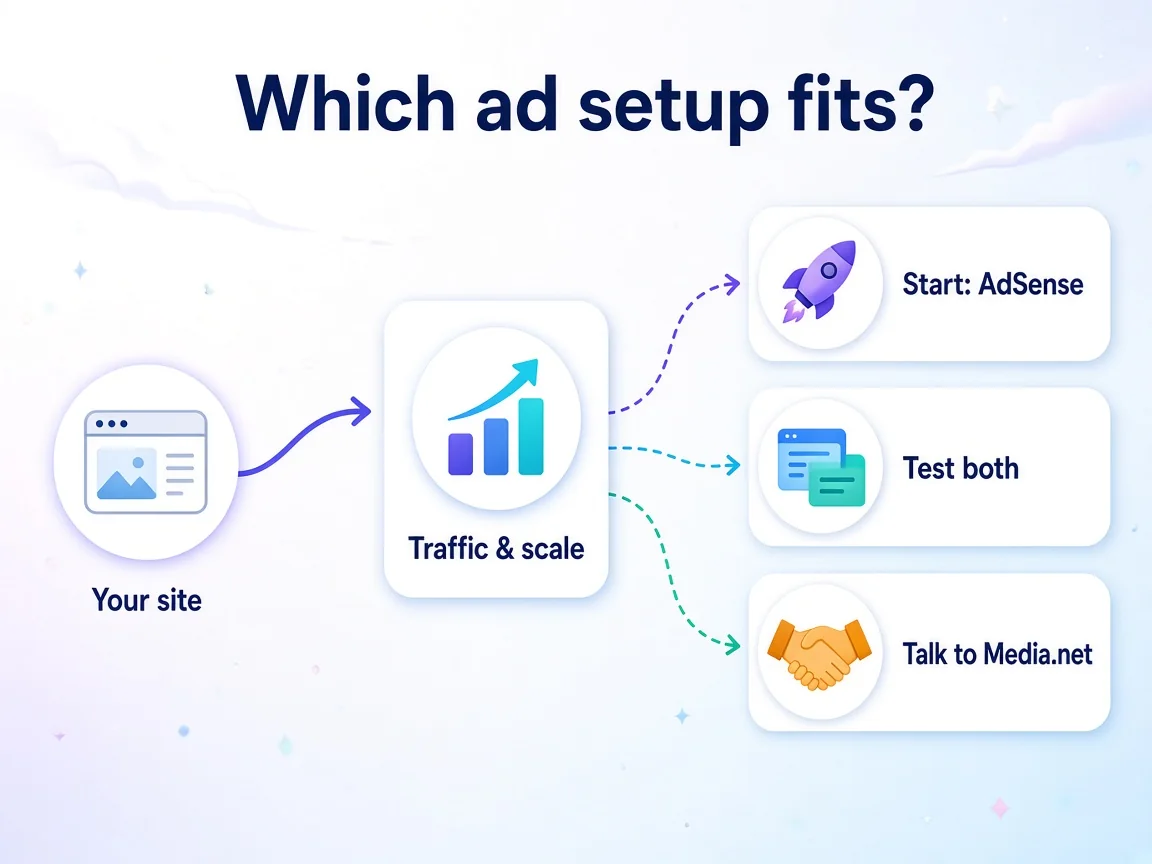
Traffic and scale decide the route: open auction first, managed SSP once you have volume to negotiate with.
Ad formats and control
AdSense offers display, in-feed, in-article, multiplex and anchor or vignette formats, through manual units or Auto ads. You trade fine control for convenience: Auto ads decides where ads go, and you can switch formats off or exclude pages.
Media.net sells across display, native and video, and puts control and customisation front and centre. Its managed Prebid setup lets several demand sources compete for each impression. It also offers vertical video and content recommendations. That suits a publisher with an ad-ops person or a partner who will run the setup. It is more than a solo blogger needs.
Running both on the same site
You don't always have to choose. Google's help page says you may place non-Google ads on the same site or page as Google ads. Two conditions apply: you must follow the Google Publisher Policies and ad placement rules, and you may not have more ads than content on a page. Google also makes you responsible for any contract conflict with your other network.
So the real constraint is on Media.net's side. Read your Media.net agreement for exclusivity or placement clauses before you add AdSense units next to theirs. Then:
01Keep total ad density below your content, and well within the Better Ads Standards Media.net requires.
02Give each partner clearly separate placements so you can see which units earn.
03Add both partners' lines to ads.txt. Media.net won't accept inventory without an authorised entry.
04Compare revenue per thousand sessions over a full month, not a single week.
Treating Media.net as a self-serve AdSense clone. Most older reviews describe a sign-up flow that its publisher site no longer offers.
Quoting a Media.net payout minimum from a blog post. The official site publishes no threshold or schedule. Use your contract.
Comparing headline revenue shares. AdSense's 80% is after the buy-side fee, so compare what reaches your account, not percentages.
Forgetting ads.txt. A missing or wrong entry costs revenue with both partners.
Stacking units to "test" both. More ads than content breaks AdSense's inventory value rule and hurts readers.
How to decide
01Under real scale, apply to AdSense. Fix originality, navigation and policy issues first. Our Ezoic vs Google AdSense guide covers other entry-level options.
02Once traffic is steady, email Media.net's publisher team with your monthly sessions, geo mix, niche and current setup. Ask for revenue share, payout terms and exclusivity in writing.
03If both accept you, run a clean test in separate placements for at least a full payment cycle.
AdSense is the easy door in. It is open, documented and predictable: 80% after buy-side fees, a $100 threshold and a payment window from the 21st to the 26th. Media.net is now a managed SSP partner, not a quick AdSense swap, and its terms live in the contract rather than on its website. Start with AdSense, build volume, and bring Media.net in when you have enough traffic to negotiate.
Frequently asked questions
Is Media.net better than Google AdSense?
They suit different stages. AdSense is an open, self-serve network with a published 80% revenue share on content ads and a $100 payment threshold. Media.net is now a managed sell-side platform that takes new publishers through its sales team, so it fits larger sites that want header bidding, direct deals and an account team.
How do I apply to Media.net as a publisher?
Media.net's site has no self-serve sign-up. Publishers use the Let's Talk contact form or email pubsales@media.net. Existing partners reach support at pubsupport@media.net.
What is the Media.net minimum payout?
Media.net does not publish a minimum payout, payment schedule or revenue share on its website. These terms are set in your publisher agreement, so ask for them in writing before you sign.
What revenue share does Google AdSense pay?
For AdSense for Content, publishers receive 80% of revenue after the advertiser platform takes its fee. When advertisers buy through Google Ads, Google says publishers keep about 68% of the spend.
When does AdSense pay?
Earnings for a month are finalised by about the 3rd of the next month. If your balance is above the threshold ($100 for a USD account) and there are no holds, payment is issued between the 21st and the 26th.
Can I run Media.net and AdSense on the same page?
Google allows non-Google ads on the same site or page as AdSense, as long as you follow its publisher and ad placement policies and don't show more ads than content. Check your Media.net agreement for exclusivity or placement clauses first.
Does Media.net have a traffic requirement?
It publishes no traffic minimum. Its inventory policy requires original content, navigation-friendly design, no excessive advertising, compliance with the Better Ads Standards and an authorised ads.txt file, and it can reject any site at its discretion.