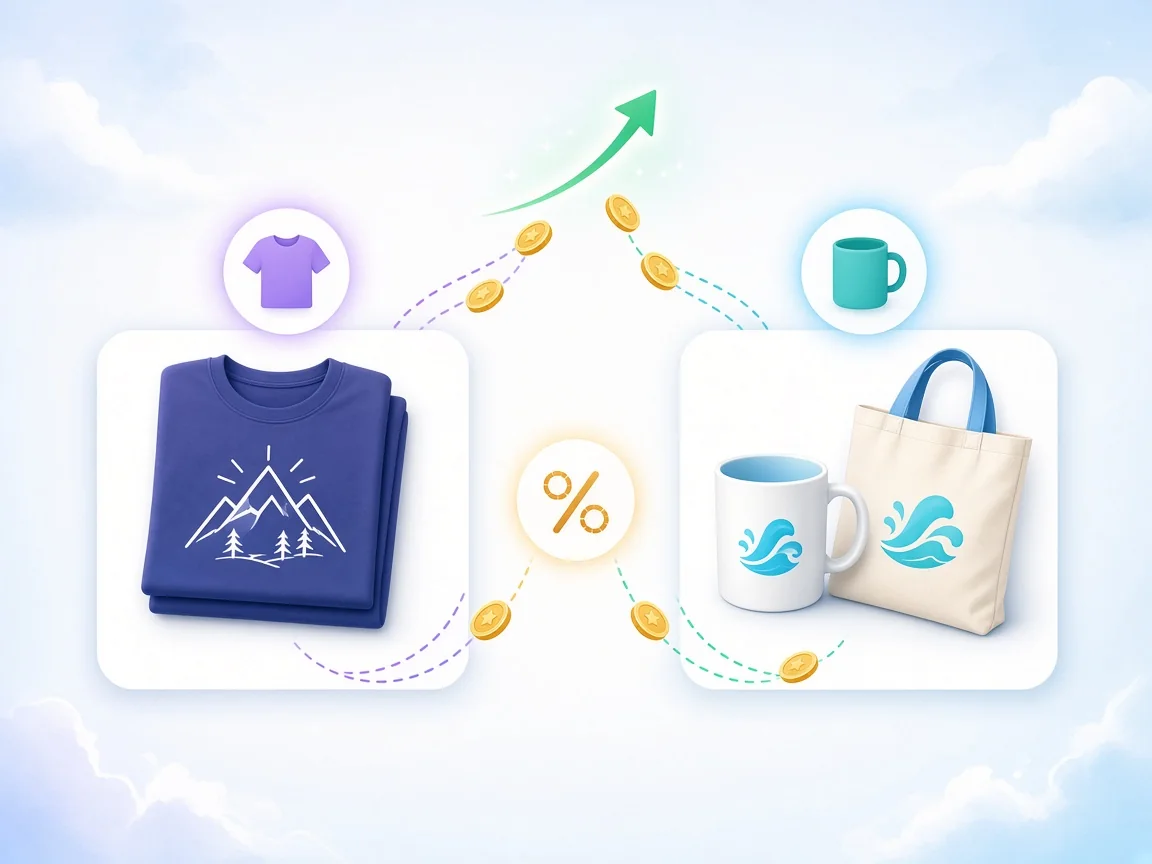
Printful pays 10% on a 30-day cookie; Printify pays 5% on a 90-day cookie. We compare commission base, payouts, promotion rules and which audience fits each, from official terms.
Nov 27, 2026 · 8 min read
Printful and Printify sell the same idea, print-on-demand with no inventory, and both run in-house affiliate programs that pay for 12 months on each customer you refer. The headline terms pull in opposite directions, though. Printful pays 10% on a 30-day cookie. Printify pays 5% on a 90-day cookie. Neither number tells you on its own which program will earn more from your audience.
This comparison is for bloggers, YouTubers and course creators in the e-commerce and merch niche deciding which program to lead with, or whether to run both. Every term below comes from Printful's and Printify's own affiliate pages, help articles and affiliate agreements. Where a program doesn't publish a figure, we say so.
Same business model, two commission structures: a higher rate versus a longer cookie.
The short answer
Lead with Printful if your readers are close to buying, for example tutorial viewers who set up a store the same week, and you want the higher rate, on-demand payouts and a bonus for subscription referrals. Lead with Printify if your readers research for weeks before they commit, because its 90-day cookie catches late sign-ups that a 30-day window misses. Coupon sites should note that Printify's agreement lists coupon websites as unsuitable for its program.
Product price after discounts; taxes and shipping excluded
Product cost only; refunded or returned orders excluded
Earning window
12 months per referred customer
12 consecutive months per referral
Cookie
30 days
90 days
Extra rewards
$25 for each first-time Growth plan subscription
Custom promo codes on request
Minimum payout
$25
None published
Payout method
PayPal, in USD
PayPal
Payout timing
On request, processed in 1–3 business days
Monthly, at the start of each month
Application review
Usually 2–5 business days
Within two working days
Referral cap
None stated
None ("no referral cap")
How commission is calculated
Both programs pay a percentage of what your referral spends on products, not on what that customer later charges their own buyers. Printful spells out its formula: 10% of the product price minus any product discount. Its own example is a $15 product with a $2 discount, which pays you $1.30. Taxes and shipping are left out.
Printify's agreement says commission is calculated "only on the product cost" and only on orders that are not refunded or returned. On the same $13 of product spend, 5% would be $0.65. That is simple arithmetic, not a published Printify example, but it shows the scale of the gap: at equal spend, Printful pays twice as much per order.
Printful also lists what doesn't count. Sample orders, free-trial upgrades and repeat Growth subscriptions earn nothing. Product commissions are paid only when the order comes through Printful-approved e-commerce platforms and integrations, and a customer who already has, or once had, a Printful account doesn't qualify.
Cookie length and the 12-month window
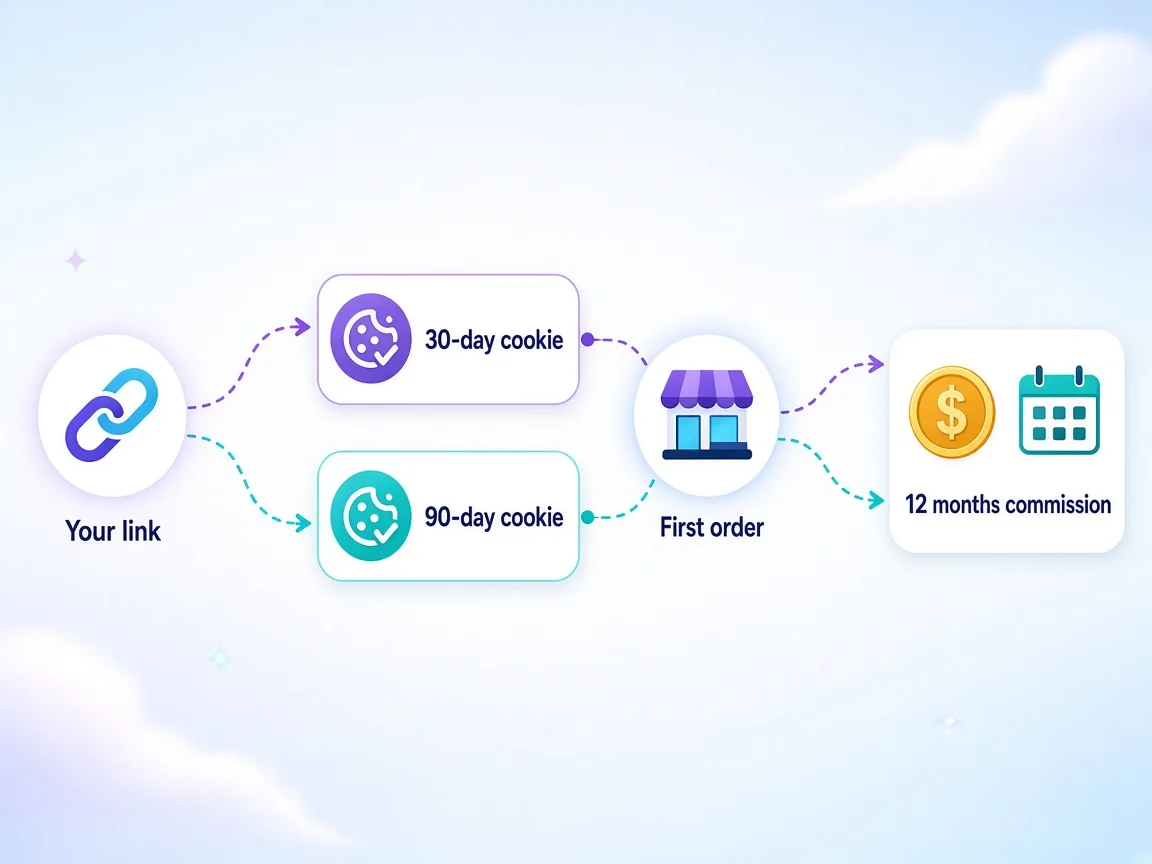
The cookie decides whether you get the customer at all. The 12-month window decides how long you earn from them.
The cookie only has to catch the sign-up; after that, both programs pay on the customer for a year.
With Printful, the cookie sits in the browser for 30 days, and the visitor must sign up or place an order in that time to be linked to you. The affiliate page adds that each customer's 12-month period starts only when their first order has been printed and shipped. That matters for sellers who sign up and then take weeks to launch: your clock doesn't start until they actually fulfil an order.
Printify's cookie lasts 90 days, three times longer. For audiences that watch a tutorial, compare platforms and only open a store a month or two later, that longer window is worth more than the lower rate suggests. Printify's earning period is 12 consecutive months on each sale your referrals make.
The practical read: the higher your audience's purchase intent, the more Printful's rate wins; the longer their research cycle, the more Printify's cookie closes the gap.
Payouts and cash flow
This is where the two programs differ most in day-to-day use.
Printful
Printify
How you get paid
Request a withdrawal from your Affiliate Dashboard
Paid automatically each month
Threshold
$25 minimum withdrawal
Not published on the affiliate page or agreement
Speed
1–3 business days after the request
Start of each month
Unclaimed balance
May be voided if not withdrawn within one year
—
Refunds after payout
Deducted from your balance and future payments
Commission excludes refunded or returned orders
Printful lets you withdraw monthly or any time you hold at least $25. That flexibility comes with one catch: balances left untouched for a year can be removed at Printful's discretion, so set a reminder. Printful's agreement also says it will withhold taxes if you don't supply the relevant documents, such as a W-8BEN.
Printify pays to the PayPal address of your choice at the start of each month. Its public pages don't list a minimum, so confirm in your affiliate dashboard before you plan around small balances.
Promotion rules that can get you banned
Both programs restrict brand-keyword advertising, and the details are worth reading before you buy a single click.
Brand keywords: Printful bans "Printful," "printful.com" and similar variations as keywords in SEO or PPC ads. Printify bans PPC campaigns on its brand terms unless that traffic lands on your own website before it is redirected.
Direct linking from paid traffic: Printful requires paid traffic, such as PPC or media buys, to go to your own landing page first. You also must not knowingly run ads that rank above Printful-managed ads.
Site types: Printify's agreement can cancel applications from coupon websites and from sites with "Printify" or a misspelling of it in the domain. It also prohibits groups or pages in social communities set up to publicise Printify offers.
Self-referrals: neither program pays you for referring your own store. Printify explicitly allows you to sell as a merchant and be an affiliate at the same time.
Disclosure: Printful requires a clear affiliate disclosure under FTC guidelines, and both agreements ban spam and unsolicited commercial email.
Head-to-head: live listing data
Head-to-headPrintful Affiliate Program vs Printify Affiliate Program
Printful fits creators whose audience wants a done-for-you, brand-forward store: in-house fulfilment, custom branding options such as neck labels and packing inserts, and a large catalog (Printful says 611 products and more than 1 million items fulfilled each month). Tutorials that walk viewers through launching a store tend to convert inside the 30-day window, and the $25 Growth plan bonus adds a second revenue line on top of the 10%.
Printify fits creators whose audience is price-sensitive and comparison-minded. Printify positions itself on low production costs and a network of print providers, and its 90-day cookie gives slower deciders time to come back. Custom promo codes, available on request, are useful for YouTubers who prefer reading out a code to pointing at a link.
Running both works for general print-on-demand content, as long as each recommendation is honest about the trade-off. Comparison posts, platform reviews and "how to start a POD store" guides can carry both links. For a broader shortlist, see our guide to the best print-on-demand affiliate programs.
Common mistakes
Comparing rates without the cookie. A 10% program on a 30-day cookie can lose to a 5% program on a 90-day cookie if your readers take two months to start.
Forgetting the commission base. Neither program pays on shipping or tax, and Printify pays on product cost only. Estimate earnings from product spend, not order totals.
Bidding on brand terms. Both agreements treat this as grounds for removal, and Printify says it can ban on the first occurrence.
Letting Printful balances sit. Unwithdrawn commission can be voided after a year.
Building a coupon page for Printify. Its agreement lists coupon websites as unsuitable.
How to get started
01Decide which program matches your audience's buying cycle, using the cookie section above.
02Apply on the official page: Printful reviews applications in about 2–5 business days, and Printify within two working days.
03Set up PayPal in the account you'll be paid in. Printful pays in USD.
04Add a clear affiliate disclosure near every link.
05Send any paid traffic to your own landing page, never straight to the brand.
06Track referrals in each dashboard and, for Printful, withdraw regularly.
On paper, Printful is the stronger program per order: double the rate, a $25 subscription bonus and payouts within days of a request. Printify's 90-day cookie is the real counterweight, and for research-heavy audiences it can matter more than the rate. Most POD creators should lead with the program that fits their audience's buying speed and keep the other as an honest alternative.
Frequently asked questions
Which pays more, the Printful or Printify affiliate program?
Per order, Printful does: it pays 10% of the product price after discounts, while Printify pays 5% of product cost. Both pay for 12 months per referred customer. Printify's 90-day cookie, against Printful's 30 days, can close the gap for audiences that take longer to sign up.
How long is the Printful affiliate cookie?
30 days. The visitor must sign up or place an order within that window to be linked to your affiliate account.
How long is the Printify affiliate cookie?
90 days in the visitor's browser, according to Printify's affiliate page.
What is the minimum payout for each program?
Printful's minimum withdrawal is $25, paid via PayPal in USD within 1–3 business days of your request. Printify pays monthly via PayPal and does not publish a minimum on its affiliate page or agreement.
Do Printful and Printify pay commission on shipping?
No. Printful excludes taxes and shipping from its calculation, and Printify calculates commission only on product cost for orders that are not refunded or returned.
Can I bid on Printful or Printify brand keywords?
Printful bans its brand name and variations as SEO or PPC keywords and requires paid traffic to land on your own page first. Printify bans brand-term PPC unless the traffic goes to your own website before redirecting, and can remove violators on the first occurrence.
Can I join both programs at the same time?
Yes. Neither program's terms requires exclusivity. Both prohibit self-referrals, and Printify's agreement lists coupon websites as unsuitable, so check your site type before applying.
Nov 25, 2026 · 8 min read
Impact.com vs PartnerStack: Which Partner Platform Fits?
Impact.com is a brand-and-retail partnership marketplace; PartnerStack is a B2B SaaS partner ecosystem. We compare catalog, approval, contracts, cookies and payouts from each platform's official docs.