Kadam Launches Smart Mediation to Increase Publisher Revenue From Existing Traffic
Kadam's new Smart Mediation ranks a publisher's existing ad networks by revenue per 1,000 impressions sent rather than dashboard CPM, routes each traffic segment to the best earner, and charges no mediation fee.
Oct 2, 2026 · 7 min read
Partner announcement. This article covers a product launch by Kadam and is based on information Kadam provided, checked against its published offer page. Links to Kadam are tracked.
Ad network Kadam has launched Smart Mediation, a tool that ranks a publisher's existing ad networks by the revenue they actually generate rather than the CPM their dashboards report — then routes each slice of traffic to whichever source earns most. It sits on top of a publisher's current setup instead of replacing it, adds Kadam's own advertiser demand to the competition, and charges no mediation fee on the revenue other networks pay.
The launch is aimed at publishers monetising popunder, banner and video traffic across several networks, and comes with a time-limited offer for anyone who connects by October 5, 2026. Below: how it works, why the metric it uses is the right one, what setup involves, and what to confirm before switching it on. (For background on how networks fill and price inventory, see What is an Ad Network? and How Mobile Ad Networks Work.)
At a glance
Detail
Kadam Smart Mediation
What it is
A revenue-based mediation layer over your existing ad networks
Fee
0% of the revenue your other networks pay you
Formats
Popunder, banner and video (direct links: mediation only)
How sources are compared
Revenue per 1,000 impressions sent, segment by segment
Payouts
Your networks pay you directly; Kadam earnings go to your Kadam balance
Test share for new sources
Up to 50% while performance data builds
Commitment
No exclusivity, no contract; disconnect at any time
Launch offer
Connect by October 5, 2026 for a 14-day test
Why dashboard CPM can mislead
A CPM tells you what a network paid for the impressions it accepted. It says nothing about the impressions it turned away — and those still came out of your traffic.
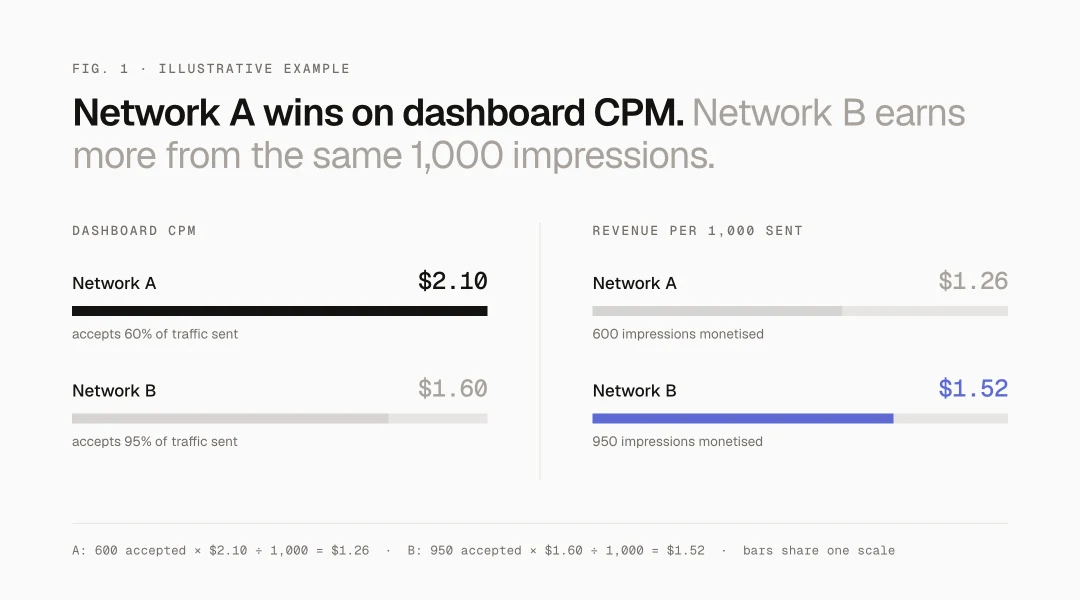
Take two networks, each sent the same 1,000 impressions. Network A reports a $2.10 CPM but accepts only 60% of the traffic. Network B reports a lower $1.60 CPM but accepts 95%.
Network A looks better in its own dashboard. Network B earns more from the traffic you actually send it.
Network A
Network B
Dashboard CPM
$2.10
$1.60
Share of traffic accepted
60%
95%
Impressions monetised (of 1,000 sent)
600
950
Revenue per 1,000 sent
$1.26
$1.52
Ranked by CPM, Network A wins. Ranked by what it earns from your traffic, Network B wins by about 20%. Kadam's own example covers the first case — a $2.10 CPM on 60% acceptance returns $1.26 per 1,000 impressions sent; Network B is an illustration we have added to show how easily the ranking flips.
One basis for every network: revenue per 1,000 sent
Comparing networks is harder than it looks because each one reports differently: different time zones, different impression counting, and different GEO classification for the same visitor. Kadam's answer is to put every source on a single denominator — actual revenue per 1,000 impressions sent.
The word sent is doing the work. Traffic a network rejects or fails to monetise is a real cost, so it has to be part of the comparison. This is a test you can apply yourself, with or without Kadam: divide each network's revenue by the impressions you sent it, not the ones it reports.
Segment-level routing, not one winner
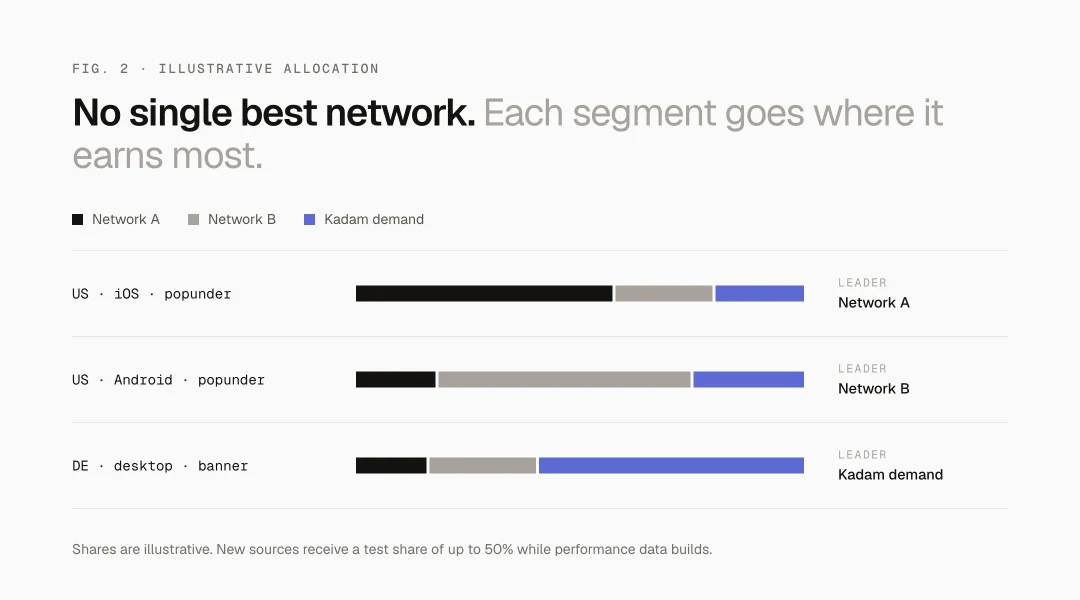
Average CPM hides a second problem: networks do not perform evenly. A network that is strongest on US iOS traffic may be mediocre on Android or in Germany. Smart Mediation compares sources segment by segment — by country, operating system, proxy traffic and impression number — so different sources can win different slices of the same supply.
There does not have to be one best network for the whole supply — each segment can have its own leader.
Allocation then follows performance. If a source starts earning more in a segment, it receives more of that traffic; if another overtakes it, traffic moves again. New sources begin with a test share of up to 50% so the system can gather data before reallocating. The practical gain is less time spent reading dashboards and adjusting traffic splits by hand.
Kadam's own demand — and how Kadam earns
Smart Mediation does not only arbitrate between your existing networks. It adds Kadam's own advertiser demand — including retargeting and direct campaigns — as another competitor. According to Kadam, roughly 1.2% of popunder clicks and 0.5% of banner impressions are worth 6–20× the average rate for their segment, and that demand is exclusive to Kadam.
Kadam only receives a segment when its demand pays more than the alternatives; if another network performs better, the traffic goes there instead. That is also how the tool is funded. Kadam takes 0% of the revenue your other networks pay you and earns from its own advertisers when its demand wins. Your networks keep paying you directly, earnings from Kadam demand accrue to your Kadam balance, and both appear in Kadam's reporting. Kadam contrasts this with third-party mediation platforms, which by its figures typically charge 5–20% of traffic or revenue.
How setup works
Setup is self-serve and designed to start small:
01Add a site and a Kadam ad unit. The Kadam unit acts as the mediation container.
02Connect your networks and zones by granting read-only statistics access via API. Several zones of the same format from one network are connected separately and compared as separate sources.
03Set a test share for new sources — up to 50% while performance data builds.
04Install one script, which enables both mediation and Kadam's retargeting demand. Direct links can be mediated but do not get retargeting.
There is no exclusivity requirement and no contract. You can begin with a single site rather than your whole portfolio, and if you disconnect, your existing ad units keep working.
The launch offer: connect by October 5, 2026
Kadam is backing the launch with a 14-day test aimed at a +10% revenue uplift over your current setup — whether that is another mediation platform or your own waterfall. The process, per Kadam's offer page:
01Connect your site and networks by October 5, 2026.
02Send your statistics to a Kadam manager and agree your pre-test earnings as the starting point.
03Run the 14-day test and review the results together.
One detail is worth confirming before you start. Kadam's announcement describes the offer as a guarantee of at least 10% more revenue, with Kadam topping up any shortfall to the full +10%. Its offer page frames the protection more conservatively: if you earn less than the agreed starting point during the test, Kadam pays the difference. Ask your manager which applies — and agree in writing how the baseline is measured — before the test begins.
What to check before you connect
Whether your networks are supported. Kadam lists six networks with one-click setup; confirm yours are among them and what read-only access each needs.
Your formats. Popunder, banner and video are covered. Retargeting demand needs the script, not a direct link.
The baseline period. A 14-day test against a pre-test period can be skewed by seasonality or a one-off traffic spike, so agree a representative window.
Which numbers settle disputes. Your networks pay on their own reporting; decide up front how differences from Kadam's normalised view will be treated.
Your own benchmark. Work out revenue per 1,000 impressions sent for your current setup before you start, so you can judge the result independently.
The bottom line
The idea underneath Smart Mediation holds whether or not you use it: rank networks by revenue per 1,000 impressions sent, segment by segment — not by dashboard CPM. What Kadam adds is the automation, its own demand in the competition, and no fee on your existing revenue. Because it runs alongside your current networks and can start on a single site, it is straightforward to test against your own numbers. Compare other monetisation options in our ad network directory, and see How to Choose an Ad Network for the wider decision.
It is a revenue-based mediation layer from the ad network Kadam. It compares a publisher's existing ad networks on actual revenue per 1,000 impressions sent, routes each traffic segment to the source that earns most, and adds Kadam's own advertiser demand to the competition.
Does Kadam charge a fee for Smart Mediation?
Kadam says there is no mediation fee: it takes 0% of the revenue your other networks pay you. It earns from its own advertisers when Kadam demand wins a traffic segment, and those earnings are credited to your Kadam balance.
Do I have to stop using my current ad networks?
No. Your existing networks stay connected and keep paying you directly. Smart Mediation works as an optimisation layer on top, with no exclusivity or contract, and your existing ad units keep working if you disconnect.
Why compare ad networks on revenue per 1,000 impressions sent instead of CPM?
CPM only reflects the impressions a network accepted. A network that rejects part of your traffic can show a high CPM while earning less from your traffic overall. Revenue per 1,000 impressions sent counts the rejected traffic too, so every network is compared on the same basis.
Which ad formats does Kadam Smart Mediation support?
Popunder, banner and video. Direct links can be mediated, but Kadam's retargeting demand requires installing its script.
How does the Kadam launch offer work?
Publishers who connect by October 5, 2026 run a 14-day test against a pre-test earnings baseline agreed with a Kadam manager, with Kadam targeting a +10% uplift. Kadam's announcement describes topping up any shortfall to the full +10%, while its offer page describes paying the difference if earnings fall below the agreed starting point, so confirm the exact terms before you start.
How quickly does traffic allocation change?
According to Kadam, allocation adjusts as revenue performance changes within each segment rather than on a fixed schedule. New sources start with a test share of up to 50% while performance data builds.