Mobile advertising runs on SDKs, sub-second auctions and privacy-preserving attribution. Here is the full mechanism — the ad request lifecycle, waterfall vs in-app bidding, what each format pays, and how installs get credited in 2026.
Sep 4, 2026 10 min read
Most digital advertising now happens on a phone, and almost none of it works the way web advertising does. A mobile ad network does not drop a tag on a page — it ships an SDK inside an app, competes in an auction that resolves in a few hundred milliseconds, and then has to prove an install happened without ever seeing who the user is. That last constraint is the one that rewrote the industry.
This guide is for publishers monetising apps and media buyers running mobile campaigns who want the actual mechanism rather than a glossary entry. We will follow one ad request end to end, unpack waterfall versus in-app bidding, compare what each format really pays, and explain how attribution works in 2026 — after ATT, SKAdNetwork and Android's Privacy Sandbox changed the rules. (For the general concept first, read What is an Ad Network?.)
What makes a mobile ad network different
Three structural differences separate mobile from the web, and almost everything else follows from them.
SDKs, not tags. In-app inventory is reached through code compiled into the app itself. A publisher cannot swap demand by editing a template — it often means an SDK update and an app-store release, which is why mobile stacks change slowly and why SDK bloat is a real cost.
No shared cookie jar. Apps do not share browser storage. Identity came from device advertising IDs — IDFA on iOS, GAID on Android — and both are now restricted by platform policy.
The conversion is an install. On the web you can pixel a purchase on a site you control. In mobile user acquisition the conversion is an install, followed by behaviour inside a different app you do not control. Measurement has to cross an app boundary and an app-store boundary.
Worth separating two things often lumped together: mobile web inventory behaves much like desktop web (browser, tags, cookies, and the same privacy erosion), while in-app inventory is the SDK-and-device-ID world described here. When a network says "mobile," ask which one it means.
How a mobile ad request actually works
The whole cycle is budgeted in a few hundred milliseconds — anything slower is an unfilled impression.
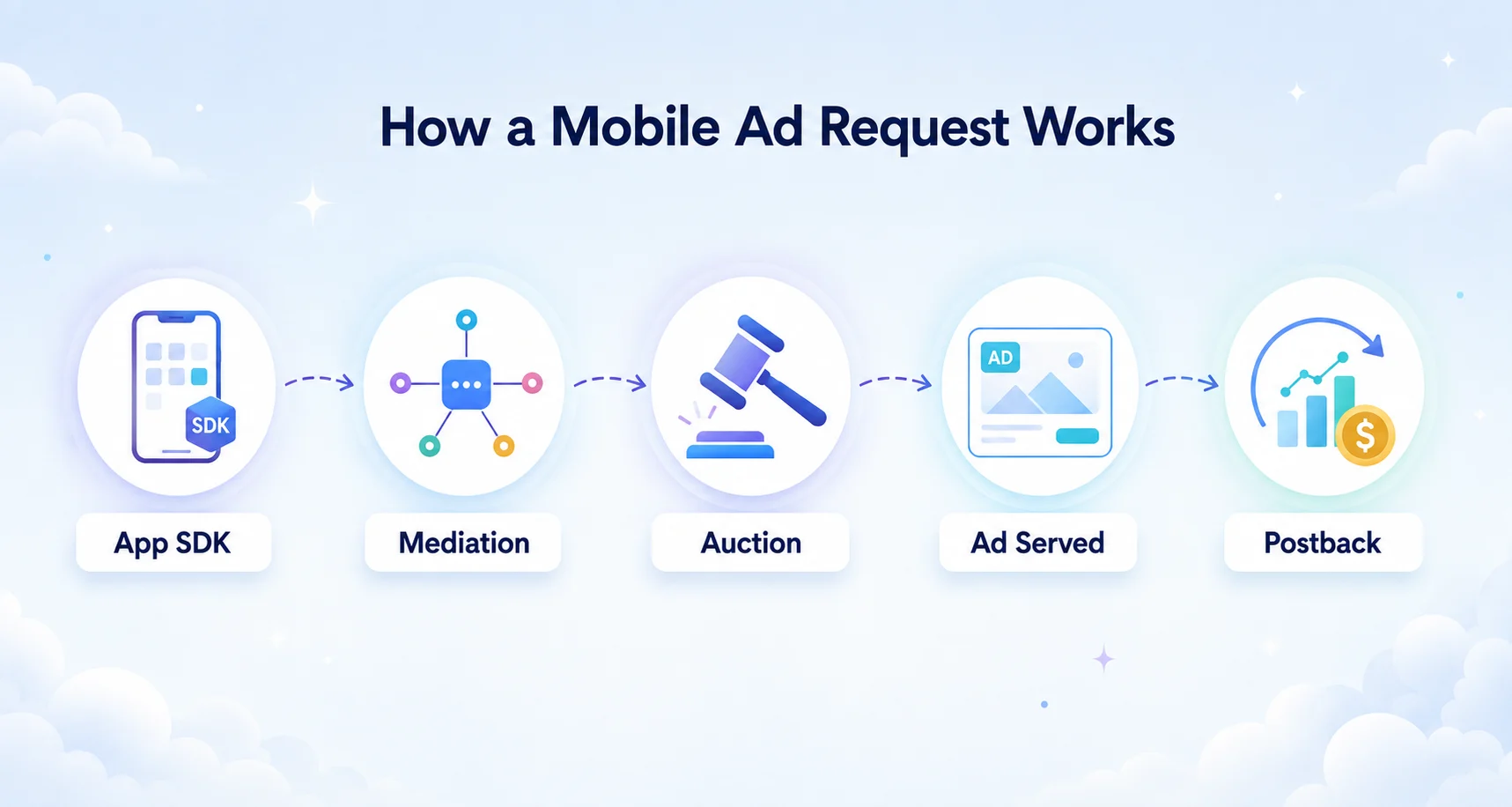
The full path, from a moment in an app to money in a publisher's account:
1An ad opportunity opens. The user hits a natural break — a level ends, a feed scrolls, a session starts.
2The SDK requests a fill. The publisher's SDK asks the mediation layer for an ad, attaching context: app and placement, format, geo, device and OS, connection type, and whatever identifiers are permitted.
3The auction runs. Mediation either walks a waterfall or runs a unified auction. Networks and DSPs return bids with creatives attached.
4A winner renders. The highest eligible bid wins; the creative is cached and displayed. Video and playable formats usually pre-cache so playback is instant.
5Billing events fire. The SDK reports impression, viewability and — for video — completion. These events, not the request, are what gets paid on.
6The click leaves for the store. A tap opens the App Store or Play Store rather than a landing page, which is precisely where web-style tracking breaks.
7Install and postback. Attribution is resolved through the platform's framework or an MMP, a postback confirms it to the network, and the publisher is credited.
The entire sequence is budgeted in the low hundreds of milliseconds. Every extra network in the chain adds latency, and a request that times out is an unfilled impression — revenue that simply never existed.
Waterfall versus in-app bidding
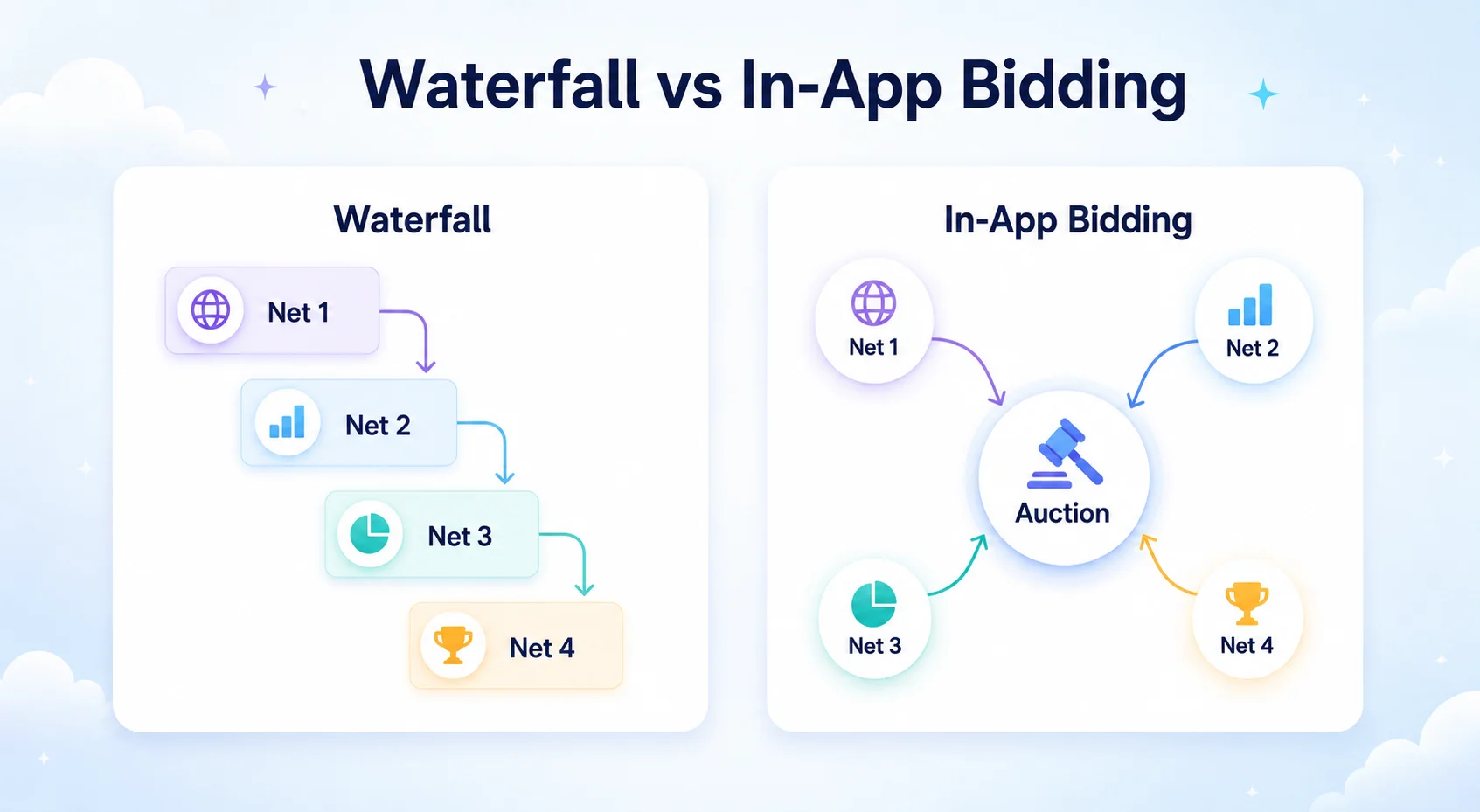
A waterfall asks networks one at a time in a fixed order; in-app bidding asks them all at once and lets price decide.
For years mobile monetisation ran on a waterfall: networks ranked by their historical average eCPM and called one after another until one filled the slot. It works, but it has three structural flaws — it prices impressions on yesterday's average rather than what this impression is worth, it stacks latency with every network that passes, and a network placed low in the order never gets to bid high even when the user is unusually valuable to it.
In-app bidding (the app-side equivalent of header bidding) fixes the mechanism: every demand source bids on the same impression simultaneously, and the highest actual bid wins.
Waterfall
In-app bidding
Order
Fixed, by historical eCPM
Simultaneous, by live bid
Pricing
Estimated from past averages
Real price per impression
Latency
Adds up with each passback
One parallel auction
Ops effort
Constant manual re-ranking
Largely self-tuning
Yield
Leaves money on the table
Generally higher
Most real stacks in 2026 are hybrid — a bidding auction for the sources that support it, with a short waterfall beneath for those that do not. If you are a publisher still running a pure manual waterfall, moving the top of your stack to bidding is usually the single highest-return change available to you.
The formats — and what each is actually for
Format
What it is
Relative eCPM
UX cost
Best for
Rewarded video
Opt-in: watch, get something
Highest
Lowest — the user chose it
Games, utility apps
Playable
Interactive mini-demo
High
Medium
Game user acquisition
Interstitial
Full-screen at a break
High
High if mistimed
Between levels or sessions
App open
Shown on launch
Medium
Medium
Session start
Native
Styled to match the app
Medium
Low
Feeds and content apps
Banner
Small, persistent
Lowest
Low
Steady baseline revenue
Relative eCPM is directional — actual rates vary enormously by geo, vertical, app quality and season. The ordering holds for a reason worth understanding: rewarded video pays most because the user opted in, which makes attention genuine and completion rates high. Interstitials pay well but spend user goodwill, and a badly timed one is one of the fastest ways to raise churn. Banners pay least but cost almost nothing in experience, which is why they persist.
Attribution in 2026: the part that genuinely changed
This is where mobile stopped resembling the web. Since App Tracking Transparency arrived in iOS 14.5, apps must ask permission before accessing the IDFA, and a large share of users decline. Without that identifier there is no deterministic, user-level join between an ad impression and an install.
Apple's replacement is SKAdNetwork — and, more recently, AdAttributionKit, which extends the same privacy-preserving model to re-engagement and alternative app marketplaces. Both work on the same principle, and it is a genuine paradigm shift:
Attribution is reported in aggregate, not per user.
Postbacks are deliberately delayed and arrive in conversion windows rather than in real time.
Conversion detail is coarse — a limited conversion value, not an event stream.
Below a privacy threshold, data is withheld or made even coarser, so small campaigns can report almost nothing.
Android has kept the GAID usable for longer, but Privacy Sandbox on Android and its Attribution Reporting API move in the same aggregated direction. The trajectory across both platforms is identical: campaign-level, delayed, modelled measurement replacing user-level certainty.
Sitting above all of this are mobile measurement partners — AppsFlyer, Adjust, Branch, Singular, Kochava. An MMP deduplicates claims across every network you run, blends platform postbacks with deterministic and modelled signals, and acts as the neutral referee. In practice the MMP, not the network dashboard, is the number both sides agree to settle on.
Two networks will each claim the same install, and both are reporting honestly — they simply cannot see each other. Agreeing the MMP as the single source of truth before the first dollar is spent prevents the argument entirely.
Practically, this means optimising cohorts rather than individuals, expecting reporting delay as normal rather than as a bug, and budgeting campaigns large enough to clear privacy thresholds — a fragmented spend across many tiny campaigns can produce almost no usable data at all.
The metrics that decide everything
Metric
What it measures
Matters most to
eCPM
Revenue per 1,000 impressions
Publisher
Fill rate
Share of ad requests actually filled
Publisher
ARPDAU
Average revenue per daily active user
Publisher
IPM
Installs per 1,000 impressions
Advertiser — creative quality
CPI
Cost per install
Advertiser
ROAS (D7 / D30)
Revenue returned against spend
Advertiser
The single most common publisher error is judging a network on eCPM alone. Revenue is eCPM × fill rate, so a network quoting a spectacular eCPM that fills a fraction of your requests can easily earn you less than a duller one that fills nearly all of them. On the buy side, IPM is the clearest read on whether a creative is working, because it isolates creative performance from bid strategy.
Fraud: where mobile budgets leak
Mobile attribution's reliance on postbacks and clicks creates specific, well-documented attack patterns:
Click injection — malware on Android detects an install starting and fires a click at the last moment to claim credit for an organic install.
Click spamming — mass fake clicks fired in the hope that some users install anyway, letting the fraudster claim attribution on last click.
SDK spoofing — fabricated install and event signals sent without any real device or user behind them.
Device farms and emulators — real-looking installs at scale from racks of devices or virtual ones.
The defences are unglamorous and effective: run an MMP with fraud protection enabled, validate installs and in-app receipts, watch for implausible click-to-install times, and check cohort quality rather than install volume. Traffic that installs perfectly and then never opens the app again is the clearest signal you have bought something worthless.
Where to start
If you are monetising an app or buying mobile traffic, start with one established network and one format rather than bolting five SDKs into your build at once. These networks are verified listings in our directory with meaningful mobile inventory across pop, push, native and display:
Match the network to the format you actually need — native discovery (MGID, Taboola) behaves very differently from pop and push monetisation (Adsterra, PropellerAds, AdMaven), and the two suit different apps and audiences. Compare the full set in the ad network directory, and use How to Choose an Ad Network as the decision framework.
Common mistakes
Judging on eCPM alone. Revenue is eCPM × fill rate; a high quoted rate that rarely fills is worth less than a modest one that always does.
Stacking too many SDKs. Each one adds latency, app size, crash surface and a privacy review burden.
Mistiming interstitials. A full-screen ad mid-task is the fastest route to uninstalls, and churn costs more than the impression earned.
Expecting user-level iOS reporting. It is not coming back; build your reporting around cohorts and conversion windows.
Not agreeing a source of truth. Settle on the MMP before spending, not during the first invoice dispute.
Running campaigns too small to measure. Under privacy thresholds, tiny campaigns return coarse data or none at all.
Affground's verdict
Mobile ad networks are the same three-sided marketplace as any other — supply, demand, and a matching engine — but two constraints make them their own discipline: the ad lives inside an SDK, and the conversion has to be proven without identifying anyone. Get the mechanism right and the decisions follow naturally: move the top of your stack to in-app bidding, pick formats by the experience you can afford rather than the eCPM headline, judge revenue as eCPM × fill rate, and treat your MMP as the number that settles arguments.
Frequently asked questions
What is a mobile ad network?
A mobile ad network aggregates advertising inventory inside apps and mobile websites and sells it to advertisers. In-app inventory is reached through an SDK compiled into the publisher's app rather than a tag on a page, which is the main structural difference from web advertising.
What is the difference between a waterfall and in-app bidding?
A waterfall calls ad networks one at a time in a fixed order based on their historical average eCPM until one fills the request. In-app bidding asks every demand source to bid on the same impression simultaneously, so the price reflects what that specific impression is actually worth. Bidding generally yields more and adds less latency.
Which mobile ad format pays the most?
Rewarded video typically commands the highest eCPM because the user opts in to watch it in exchange for something, which makes attention genuine and completion rates high. Playables and interstitials follow, with banners lowest. Actual rates vary widely by geo, vertical and app.
How does mobile ad attribution work after ATT?
Since iOS 14.5, apps must request permission to access the IDFA and many users decline, so user-level attribution is largely unavailable. Apple's SKAdNetwork and the newer AdAttributionKit report installs in aggregate, with delayed postbacks, coarse conversion values and privacy thresholds below which data is withheld.
What is an MMP and do I need one?
A mobile measurement partner — AppsFlyer, Adjust, Branch, Singular or Kochava — deduplicates attribution claims across every network you run and blends platform postbacks with other signals. If you buy from more than one network, you need one, because networks cannot see each other and will each claim the same install.
What is a good eCPM for a mobile app?
There is no single benchmark — eCPM swings enormously by country, format, vertical and season. The more useful measure is eCPM multiplied by fill rate, since that is what actually determines revenue. Compare networks on that combined figure over the same traffic rather than on a quoted eCPM.
How do you spot mobile ad fraud?
Watch for implausible click-to-install times (click injection and spamming), installs with no subsequent in-app activity, and traffic concentrated in a few suspicious publisher IDs. Enable your MMP's fraud protection, validate in-app purchase receipts, and judge sources on cohort retention rather than install volume.