Affiliate SEO means ranking a page whose job is to send visitors away, in the most contested queries online, against a search engine that has spent years demoting thin review content. Here is the structure that still works.
Sep 7, 2026 9 min read
Affiliate SEO is not ordinary SEO with links bolted on. You are trying to rank a page whose entire job is to send the visitor somewhere else, in the most commercially contested queries on the internet, against a search engine that has spent the last three years explicitly demoting thin, second-hand review content. The bar is genuinely higher here than in almost any other niche.
This guide is for affiliate site owners and content publishers who want a durable ranking strategy rather than a list of tips. We will map search intent to page types, build the cluster model that funnels authority into money pages, cover the E-E-A-T signals that separate surviving affiliate sites from demoted ones, work through the technical essentials specific to affiliate sites, and finish on the measurement loop that ties rankings to actual revenue. (For the tracking layer underneath all of this, see How to Track Affiliate Links in WordPress.)
Why affiliate SEO is its own discipline
Three things make it harder than standard content SEO.
The queries are the most competitive that exist. "Best web hosting" is contested by companies with seven-figure content budgets. Commercial intent attracts commercial competition.
Google has repeatedly targeted this exact content type. The helpful content system — folded into core ranking in March 2024 — was aimed squarely at content written for search engines rather than people, and mass-produced review content was its most visible casualty. Separately, Google's scaled content abuse and site reputation abuse policies closed two of the shortcuts affiliates relied on: publishing at volume with no original value, and renting authority from a big domain's subfolder.
Your page has to earn a click it then gives away. A reader who trusts you enough to leave for a merchant is a reader you have genuinely convinced. That is a much higher standard than "ranked and got a pageview."
None of this makes affiliate SEO unviable. It makes first-hand experience the moat — the one thing a competitor with a bigger budget cannot copy from your page.
Start with intent, not keywords
The single most common mistake is chasing volume. A keyword with 40,000 monthly searches and no buying intent is worth less to an affiliate site than one with 400 searches from people holding a credit card.
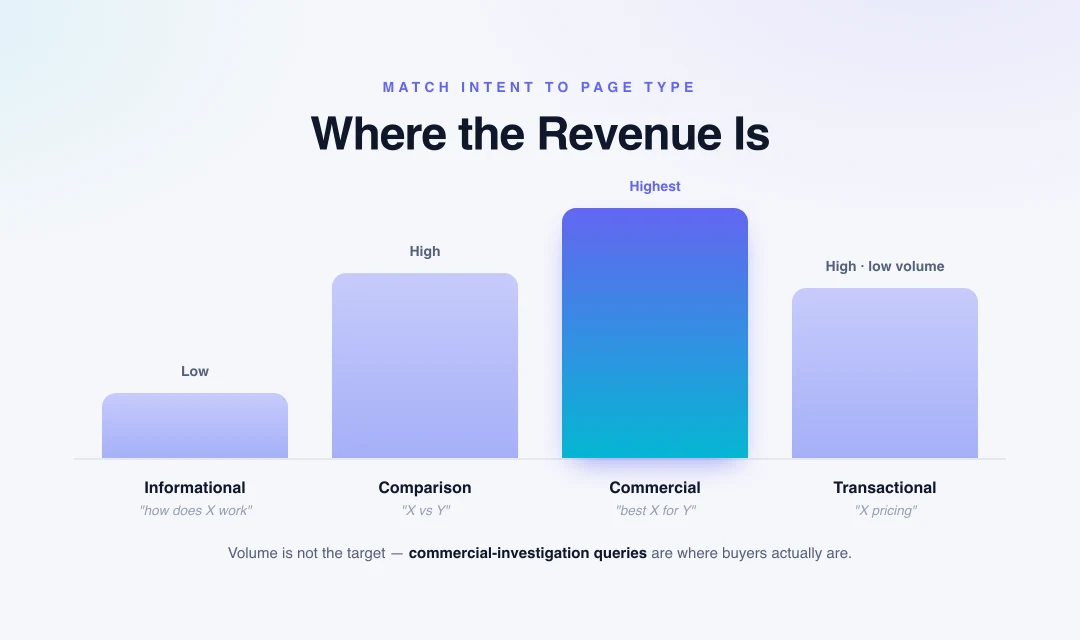
Revenue concentrates in commercial-investigation queries — the ones where someone is choosing, not learning.
Query shape
Intent
Page type
Revenue potential
"how does X work"
Informational
Guide, explainer
Low — but builds authority
"X vs Y"
Comparison
Head-to-head
High
"best X for Y"
Commercial investigation
Ranked listicle
Highest
"X review"
Commercial investigation
Hands-on review
High
"X pricing / discount"
Transactional
Deal or pricing page
High, low volume
The money sits in commercial investigation — "best", "vs", "review", "alternatives". Those are the pages that should get your best work, your original testing and your internal links. Informational content is not wasted, but it earns its place by supporting those pages rather than by converting directly.
The cluster model
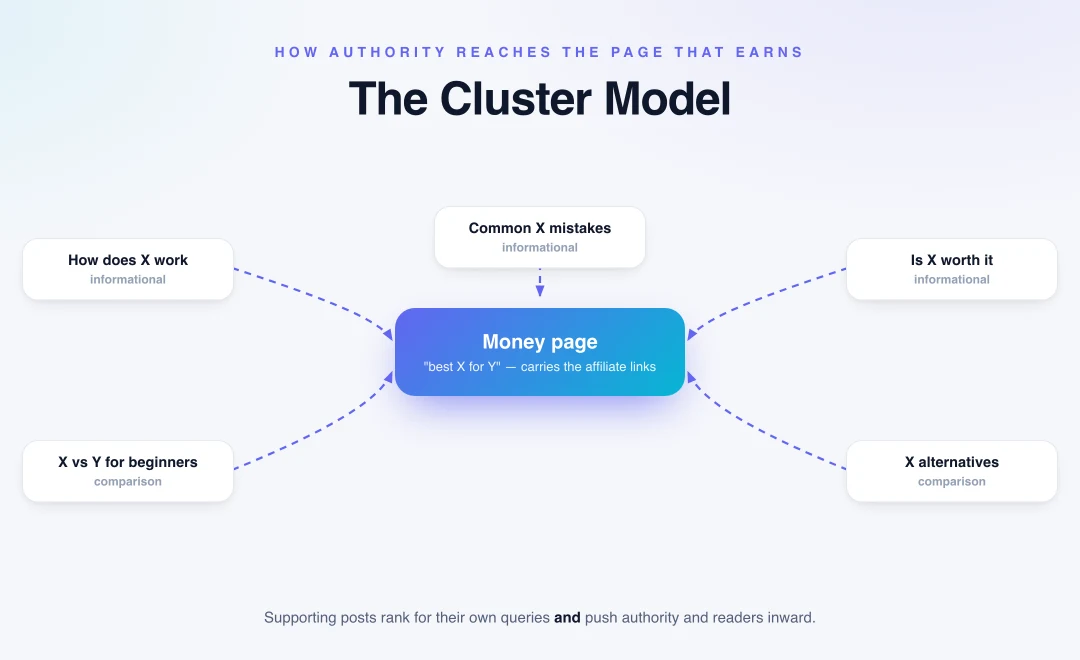
Informational posts do two jobs: they rank for their own queries, and they push authority and readers into the money page.
The structure that works is boringly consistent: one money page per commercial topic, surrounded by informational posts that link into it.
The money page targets the commercial query ("best X for Y") and carries the affiliate links.
The supporting posts target the informational questions around it ("how does X work", "is X worth it", "X vs Y for beginners") and link inward to the money page with descriptive anchor text.
The money page links back out to the supporting posts where it genuinely helps the reader.
This does three things at once: it captures the full topic rather than one query, it concentrates internal authority on the page that earns, and it gives you somewhere natural to send readers who are not ready to buy.
Two rules keep clusters healthy. One page per intent — if "best X" and "X review" both target the same query, you have cannibalisation, and Google will pick one, usually the weaker. And link with descriptive anchors, not "click here"; internal anchor text is one of the few ranking levers you fully control.
E-E-A-T: proving you actually used the thing
Google added Experience to E-A-T in late 2022, and for affiliate content it is the decisive letter. Its reviews guidance repeatedly asks the same question: does this content demonstrate first-hand use?
What that looks like in practice:
Original media. Your own screenshots, photos and video of the product in use. Stock images and manufacturer renders signal the opposite.
A stated methodology. How long you tested, what you compared, what you measured. A short "how we tested" block does more for credibility than another 500 words of description.
Specific, falsifiable detail. Real numbers, real friction, real quirks. "Setup took eleven minutes but the DNS step failed twice" cannot be paraphrased from a spec sheet.
Who it is not for. The single strongest trust signal available, and the one competitors copying your page never include.
A real author with a real bio, and a visible affiliate disclosure near the top.
If you genuinely cannot test something, say so and change the framing — a well-sourced comparison of published terms is honest; a fabricated hands-on review is the exact pattern Google's systems are built to find.
Technical essentials for affiliate sites
Most technical SEO advice applies unchanged. These are the parts specific to affiliate sites:
Mark up affiliate links with `rel="sponsored"`. Google has expected this since 2019. rel="nofollow" is still accepted, and many publishers use rel="sponsored nofollow" together.
Keep redirect paths out of the index. If you cloak links through /go/ or /recommends/, those URLs should not be crawled or indexed as pages.
Fix indexation bloat. Thin tag archives, paginated duplicates and empty category pages dilute the site. Index what deserves to rank; exclude the rest.
Watch Core Web Vitals — especially INP, which replaced FID as a Core Web Vital in March 2024. Affiliate pages are often heavy with comparison tables, images and scripts.
Use schema accurately. Product and FAQ markup can help, but Google restricts self-serving review markup, so do not expect star snippets on your own commercial roundups. Mark up what is genuinely there.
Never let a broken merchant link sit. Programs end and URLs change; a quarterly link audit protects both revenue and user trust.
What actually gets affiliate sites demoted
Worth naming plainly, because most recoveries start by removing one of these:
Content that exists only to rank. Restated specs, no testing, no point of view.
Scaled publishing with no original value — the pattern Google's scaled content abuse policy targets, regardless of whether a human or a model wrote it.
Renting someone else's authority. Coupon or review subfolders on unrelated high-authority domains fall under site reputation abuse.
Bought links. Still against Google's link spam policies, still detected, still not worth it.
Cannibalisation and thin variants. Twenty near-identical "best X" pages compete with each other, not with your rivals.
Measure revenue, not traffic
The last mistake is measuring affiliate SEO like a media site. Sessions are an input, not a result.
Track the chain end to end: impressions → clicks → affiliate clicks → conversions → revenue per session. A page with 800 monthly visits on "best X for Y" can out-earn one with 30,000 on "what is X", and if you optimise on traffic you will systematically invest in the wrong page.
Use EPC to compare offers, keep a sub-ID per placement so the network report tells you which page earned, and review money pages on revenue per session rather than rank alone. If clicks are healthy and sales are not, the problem is usually the offer or the tracking rather than the ranking — this diagnostic walks the chain.
Where to start
You cannot do this without data on what people actually search and what competitors already rank for. These four SEO platforms are verified listings in our directory — and, conveniently, they run some of the better recurring affiliate programs in the software space, so the tool you use can also become something you write about honestly:
Pick one and learn it properly rather than subscribing to three. Semrush and SE Ranking both carry a 120-day cookie, and SE Ranking and Mangools pay lifetime recurring — worth knowing if you plan to review the category you work in every day.
Common mistakes
Chasing volume over intent. Ranking for a question nobody buys after is a vanity result.
Publishing reviews of products you have not used. It is the exact signature Google's systems look for.
One page per keyword instead of one page per intent. That is how cannibalisation starts.
Forgetting `rel="sponsored"` and letting redirect URLs get indexed.
Treating internal links as decoration. They are your main lever for pushing authority into money pages.
Judging success by sessions. Revenue per session is the number that reflects the business.
Publishing and never revisiting. Commercial pages decay as products, prices and programs change; a refresh schedule beats a publishing schedule.
Affground's verdict
Affiliate SEO in 2026 rewards the thing that is hardest to fake: evidence you actually used the product. Structure still matters — map intent to page types, build clusters that funnel authority into money pages, and get the technical hygiene right — but structure alone no longer ranks. Test the products, show your work, say who each one is wrong for, then measure the result in revenue per session rather than traffic. That combination is durable in a way that no tactic is.
Frequently asked questions
Is SEO still worth it for affiliate websites?
Yes, but the bar is much higher than it was. Google's helpful content system and its scaled content abuse and site reputation abuse policies removed the shortcuts that thin affiliate sites relied on. What still works is genuine first-hand testing, tight topic clusters and content that demonstrates real experience — which is also the hardest thing for a better-funded competitor to copy.
What keywords should an affiliate website target?
Prioritise commercial-investigation queries — "best X for Y", "X vs Y", "X review", "X alternatives" — over high-volume informational terms. A keyword with 400 searches from people actively choosing a product is worth more than one with 40,000 searches from people who are only learning.
How many affiliate links should be on a page?
There is no fixed number, and Google has never published one. What matters is that every link is genuinely useful, marked with rel="sponsored", and placed where a reader would want it. A page stuffed with links to hit a quota reads as monetisation-first, which is exactly what the helpful content system targets.
Do affiliate links hurt SEO?
Not when handled correctly. Mark them with rel="sponsored" (or rel="sponsored nofollow"), keep cloaked redirect paths like /go/ out of the index, and make sure the content around them has real value. Affiliate links themselves are not a penalty; thin content built around them is.
What is E-E-A-T and why does it matter for affiliate sites?
E-E-A-T stands for Experience, Expertise, Authoritativeness and Trustworthiness. Experience was added in late 2022 and is the decisive one for affiliate content: Google's reviews guidance repeatedly asks whether the content shows first-hand use. Original screenshots, a stated testing methodology, specific detail and a clear statement of who a product is not for all demonstrate it.
How long does affiliate SEO take to work?
Realistically months, not weeks. New commercial pages face established competitors, and search engines need time to evaluate a site. Judge progress on six months of consistent publishing and refreshing, and track leading indicators — impressions and rankings for target queries — before revenue arrives.
Should I use AI to write affiliate content?
Google's position is about quality rather than method, so AI assistance is not itself a violation. But mass-produced content with no original value falls under the scaled content abuse policy whether a human or a model wrote it. AI is safe for outlining, editing and research; it cannot supply the first-hand testing that makes affiliate content rank.