A newsletter is the highest-converting affiliate channel you own — and the easiest to lose. Here are the two rulebooks to clear first, the deliverability traps, the bridge-page decision, and how to measure it now that opens are meaningless.
Sep 7, 2026 9 min read
Email is the highest-converting channel most affiliates own, and the easiest one to lose. A newsletter list is warm, permission-based and free to send to — but drop the wrong link into it and you can breach your email platform's terms, land your sending domain on a blocklist, or void the commission entirely.
The revenue is real; so is the downside.
This guide is for newsletter operators, bloggers and creators who want to monetise a list without damaging it. We will cover the two rulebooks that decide whether you can send affiliate links at all, why those links threaten deliverability, the direct-link versus bridge-page decision, how to track results when opens are no longer trustworthy, and what disclosure actually requires. (For the site-side setup, see How to Track Affiliate Links in WordPress.)
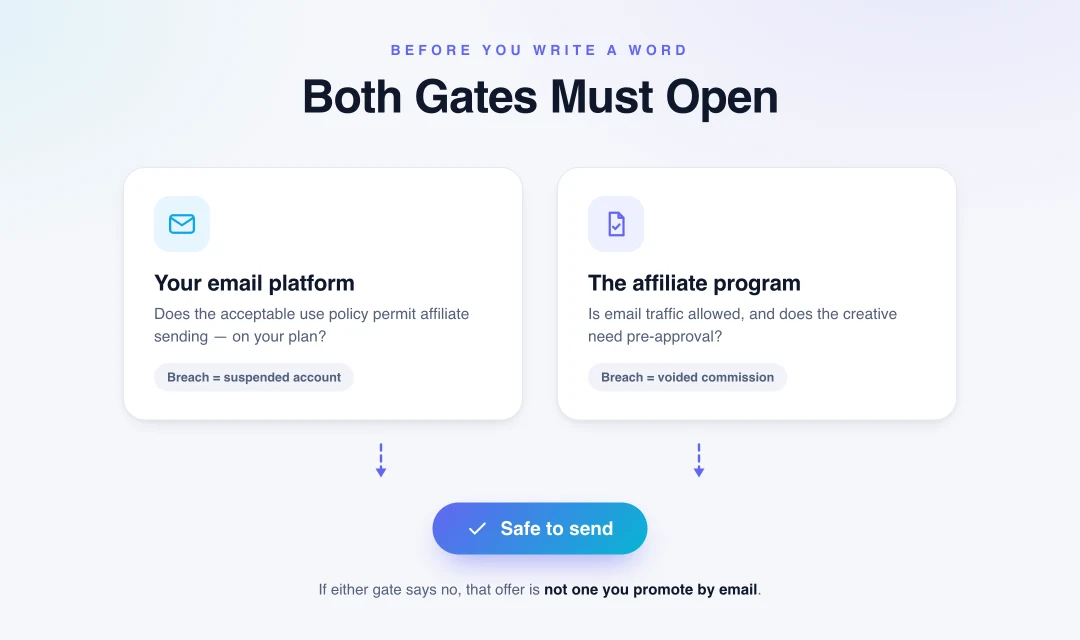
Two rulebooks decide whether you can do this at all
Before writing a single line, check both. Most people check neither, and find out the expensive way.
Both gates have to open. Either one can cost you the account or the commission.
Your email platform's terms. Email service providers carry the deliverability reputation of every sender on their shared infrastructure, so many restrict or prohibit affiliate-heavy sending. Mailchimp is the most frequently cited example of a platform with tight restrictions on affiliate marketing, and enforcement usually arrives as a suspended account rather than a warning. Creator-focused platforms — beehiiv, Kit, GetResponse, AWeber, MailerLite — are generally more accommodating, but policies change and vary by plan, so read the current acceptable use policy rather than a forum post from three years ago.
The affiliate program's terms. Plenty of programs restrict email traffic, and some prohibit it outright. Others allow it but require the email creative to be pre-approved, or forbid sending to purchased or co-registered lists. Breaching this rarely gets you banned from email — it just quietly voids your commissions, which you discover at payout.
The rule is simple: both gates must open. If either says no, that offer is not one you promote by email.
Why affiliate links threaten deliverability
An affiliate link is, structurally, exactly what a spam filter is trained to distrust: a redirect through a third-party domain you do not control, often shared with thousands of other senders.
Shared redirect domains carry other people's reputation. If a network's tracking domain is abused by someone else, your email inherits the suspicion.
Link shorteners are a strong spam signal.bit.ly and similar in an email body is one of the oldest filter heuristics there is. Never use them here.
Domain mismatch looks evasive. A message from your brand whose only links point somewhere unrelated reads as a phishing pattern.
Volume and repetition compound it. The same affiliate URL blasted to an entire list, repeatedly, is a recognisable footprint.
The mitigations are unglamorous: link to your own domain wherever possible, keep affiliate links to a small share of total links, send offers only to relevant segments rather than the whole list, and never send affiliate content to a cold or purchased list. Deliverability is earned slowly and lost quickly.
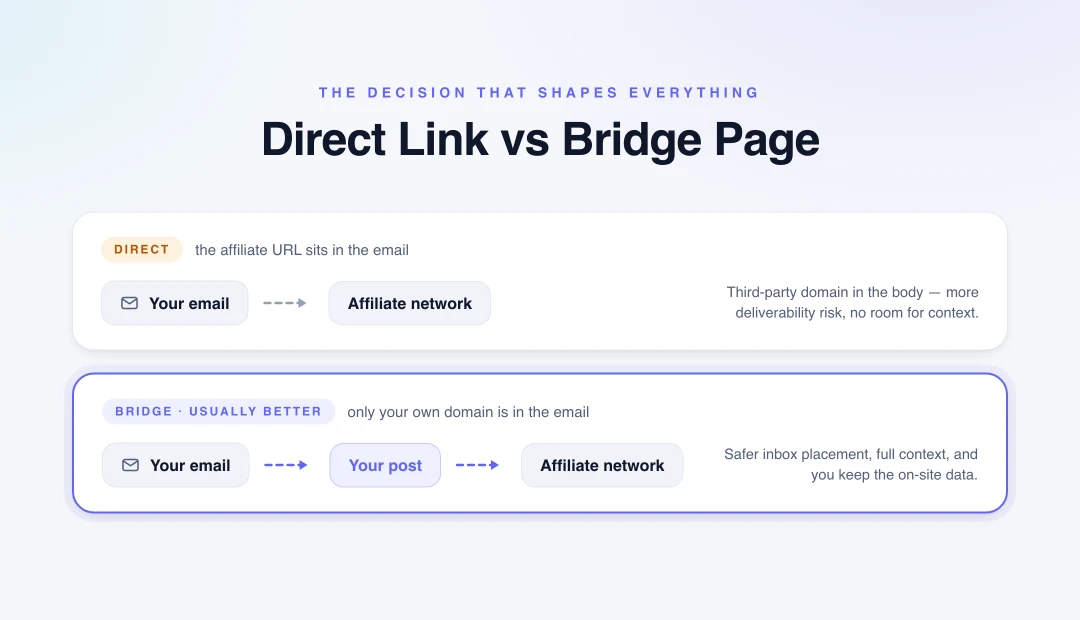
Direct link or bridge page?
This is the decision that shapes everything else.
A bridge page puts your own domain in the email and moves the affiliate link to a page you control.
A direct link puts the affiliate URL in the email itself. A bridge page links to a post on your own site, which carries the affiliate link.
Direct affiliate link
Bridge page
Deliverability risk
Higher — third-party domain in the body
Lower — only your own domain
Platform compliance
Depends entirely on ESP terms
Almost always acceptable
Context you can add
A sentence, at most
Full review, comparison, caveats
Drop-off
Shorter path
One extra step
Data you keep
ESP clicks plus network report
Also full on-site analytics
Best when
Warm list, permissive ESP, trusted offer
Most newsletters, most of the time
For most operators the bridge page wins, and not only for safety. The extra step filters for genuine interest, so the clicks that do reach the advertiser convert better — and you keep the reader on a page you own, where a single email can go on earning for months. The exception is a short, well-established list on a permissive platform promoting an offer readers already know, where the extra hop costs more than it protects.
Tracking what actually happened
Email measurement broke in 2021 and many publishers still optimise on numbers that no longer mean anything.
Opens are unreliable. Apple's Mail Privacy Protection pre-loads tracking pixels regardless of whether a human read the message, inflating open rates and masking location. Treat open rate as a rough trend at best; never use it to judge an offer.
Clicks are better, but not pure. Corporate security scanners follow links in emails to check them, which can register as clicks that no person made. If a campaign shows clicks with a wildly atypical click-to-conversion ratio, suspect scanning before you blame the offer.
So judge on conversions and revenue per send. The metrics worth tracking:
Metric
What it tells you
Clicks per send
Whether the pitch earned attention
Conversion rate
Whether the offer matched the audience
Revenue per send
The only number that compares campaigns fairly
[EPC](/blog/what-is-epc-in-affiliate-marketing)
What one click is actually worth
Unsubscribes per send
The cost you are paying for the revenue
That last one matters most and is watched least. Every affiliate send has a price in list health. If a campaign earns $180 and costs forty engaged subscribers, it was a bad trade.
Two practical notes. Use a sub-ID per send so the network report tells you which issue produced the sale — nl-042-hero and nl-042-ps beat one undifferentiated "newsletter" tag. And be aware that ESP click tracking rewrites your links through its own tracking domain; that extra hop occasionally mangles query parameters, so always send yourself a test and click the final link before the real send.
Disclosure and the law
Three obligations apply, and none is optional.
Disclose in the email itself. The FTC requires disclosure that is clear, conspicuous and near the link — not buried in a footer, and not only on the landing page. A plain line above the link ("I earn a commission if you buy through this link") is enough.
Meet CAN-SPAM basics. A working unsubscribe honoured promptly, a real physical postal address, and a subject line that does not mislead.
Respect consent rules. Under GDPR and equivalents, the list must have opted in for this kind of content, and permission does not transfer between lists or owners.
Disclosure costs almost nothing in conversions. Readers already assume a creator earns something; stating it plainly reads as confidence, and it is the same honesty that makes the recommendation worth acting on.
A newsletter that actually converts
1Earn the right first. Send genuinely useful issues before you send an offer. A list that only ever hears from you when you are selling stops opening.
2One offer per email. A single primary call to action beats five competing links, which look like a spam blast and convert like one.
3Segment before you send. Send the hosting offer to people who read hosting content. Relevance lifts conversion and protects deliverability at the same time.
4Lead with the problem, not the product. The email earns the click; the landing page makes the sale.
5Be specific about who it is not for. The caveat is what makes the recommendation credible.
6Place the link two or three times, naturally — early, in context, and once at the end. Not fifteen times.
7Measure revenue per send and unsubscribes together, then keep what passes both tests.
Where to start
If you are choosing a platform to build on — or looking for offers your list will genuinely want — email tools are among the best affiliate programs available, because they are recurring by nature and newsletter audiences already use them. All five below are verified listings with recurring commission:
Two things stand out in that list: AWeber's 365-day cookie, the longest here, and beehiiv's 50–60% tiered rate, the highest. Since email platforms are sticky and rarely switched, recurring commission on them compounds unusually well — see best recurring commission programs for the wider picture.
Common mistakes
Not reading the ESP's acceptable use policy. The cheapest ten minutes in this entire guide.
Assuming the program allows email traffic. Many restrict it; some require creative pre-approval.
Using link shorteners. A textbook spam signal, and you lose the tracking anyway.
Blasting the whole list. Segment, or pay for it in unsubscribes and inbox placement.
Judging campaigns on open rate. Mail Privacy Protection made that number decorative.
Burying the disclosure. It must be near the link, in the email, visible without scrolling to the footer.
Ignoring unsubscribes. Revenue that costs you subscribers is a loan against future sends, not profit.
Affground's verdict
Newsletters convert better than almost any other affiliate channel because the audience already trusts the sender — which is exactly why the channel punishes carelessness so hard. Clear both rulebooks before you write, default to a bridge page on your own domain, disclose plainly in the email, and judge every campaign on revenue per send against unsubscribes. Do that and the list keeps earning for years. Treat it as an inventory of clicks to be spent, and it will be gone in a quarter.
Frequently asked questions
Can you put affiliate links in email newsletters?
Usually yes, but two sets of terms decide it. Your email platform's acceptable use policy must permit affiliate sending — several restrict it, with Mailchimp the most commonly cited — and the affiliate program itself must allow email traffic, which many restrict or require pre-approval for. Check both before you send.
Which email platforms allow affiliate links?
Creator-focused platforms such as beehiiv, Kit (ConvertKit), GetResponse, AWeber and MailerLite are generally more accommodating of affiliate content than large general-purpose senders. Policies change and vary by plan, so always read the current acceptable use policy rather than relying on older advice.
Do affiliate links hurt email deliverability?
They can. Affiliate links are redirects through third-party domains you do not control, often shared with many other senders, which is a pattern spam filters distrust. Reduce the risk by linking to your own domain, avoiding link shorteners, keeping affiliate links to a small share of your content, and sending only to relevant segments.
Should I link directly or use a bridge page?
For most newsletters a bridge page is better: only your own domain appears in the email, which protects deliverability and platform compliance, and the page gives you room for real context plus full on-site analytics. Direct linking suits a warm list on a permissive platform promoting an offer readers already know.
How do I track affiliate sales from a newsletter?
Use a unique sub-ID per send — something like nl-042-hero — so the network report shows which issue and which placement produced the sale. Then judge campaigns on revenue per send rather than opens, and always send yourself a test to confirm your ESP's link rewriting has not mangled the tracking parameters.
Are email open rates still reliable?
No. Apple's Mail Privacy Protection pre-loads tracking pixels whether or not anyone read the message, which inflates open rates and hides location. Use opens only as a rough trend, and judge affiliate campaigns on clicks, conversions and revenue per send instead.
Do I need to disclose affiliate links in emails?
Yes. The FTC requires disclosure that is clear, conspicuous and near the link — inside the email itself, not only on the landing page and not buried in the footer. A single plain line above the link is enough, and you must also meet CAN-SPAM basics like a working unsubscribe and a physical address.