Pinterest is a visual search engine, not a social feed — which is why a single pin can send buyers for years. Here is what Pinterest permits, the blog-first decision, Pinterest SEO, and why cookie length matters more here than anywhere else.
Sep 8, 2026 9 min read
Pinterest is the most misunderstood channel in affiliate marketing. Treat it like Instagram and it will disappoint you; treat it like a visual search engine and it becomes one of the few places where a single piece of content keeps sending buyers for years. Pinterest users are not scrolling to be entertained — they are , often weeks or months before they make it.
planning a purchase
This guide is for bloggers, creators and ecommerce sellers who want traffic that compounds rather than spikes. We will cover what Pinterest actually permits for affiliate links, the direct-pin versus blog-first decision, Pinterest SEO and where keywords genuinely count, how to design pins that earn outbound clicks, and why cookie length matters more here than on any other channel. (Its closest cousin is search — see How to Do SEO for an Affiliate Website.)
Pinterest is a search engine, not a social feed
This single reframe fixes most Pinterest strategies.
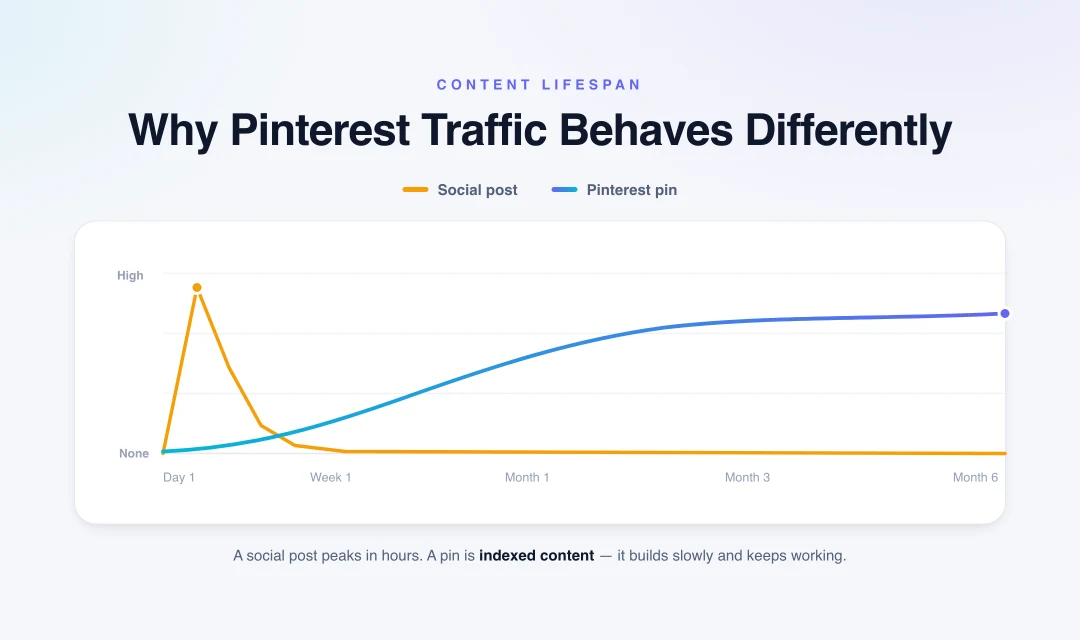
A social post peaks within hours and dies. A pin builds slowly and keeps working for months.
On a social network, a post peaks within hours and is effectively dead within two days. On Pinterest, a pin is indexed content: it surfaces in search results, in related-pin feeds and in recommendations for as long as it stays relevant. Traffic tends to start slowly and build, and a good pin can still be delivering clicks a year later.
Three consequences follow, and they shape everything else:
Keywords matter more than posting frequency. Discovery is driven by search, not by an algorithm rewarding recency alone.
Patience is required. Judge a pin over months, not days. Pinterest is the wrong channel if you need results this week.
Seasonality runs early. Pinterest's own guidance is that people plan well ahead — holiday, wedding and seasonal content should be published weeks before the season, not during it.
Are affiliate links allowed on Pinterest?
Yes. Pinterest banned affiliate links in 2015 and reinstated them in 2016, and they have been permitted since — with conditions that people routinely ignore.
Disclose clearly. Both the FTC and Pinterest's own guidelines require it. Put #ad or "affiliate link" in the pin description itself, not only on the destination page.
Be careful with cloaked and shortened links. Pinterest has a history of blocking redirect domains and URL shorteners associated with spam. A link that works today can be rejected tomorrow, and a blocked domain is painful to unwind.
Check the program's terms. Many affiliate programs restrict direct linking from social platforms, and some prohibit it outright.
That last point deserves a specific warning. Amazon Associates is a poor fit for direct Pinterest linking on two counts: its operating agreement places restrictions on where links may be posted, and its cookie window is only 24 hours — which is close to worthless on a channel whose entire advantage is that people discover things weeks before they buy.
Direct pin or blog-first?
You can point a pin straight at an affiliate link, or point it at your own content that contains the link.
Direct affiliate pin
Blog-first
Setup speed
Immediate
Slower — you need the post
Program compliance
Often restricted or banned
Almost always permitted
Risk of link rejection
Real, especially with cloakers
Minimal — your own domain
Context you can add
A description
A full review or comparison
Data you keep
Pinterest clicks only
Full on-site analytics
Rich Pins eligible
No
Yes
Best for
Simple product pins, permitted programs
Almost everyone else
Blog-first wins for most people. It sidesteps the compliance and link-blocking problems entirely, it lets one post absorb traffic from dozens of different pins, and it means a program change never invalidates the pins you have already published — you edit the post instead. The direct pin is worth it mainly for straightforward product recommendations in programs that explicitly permit it.
Pinterest SEO: where keywords actually count
Pinterest reads text in more places than most people optimise for.
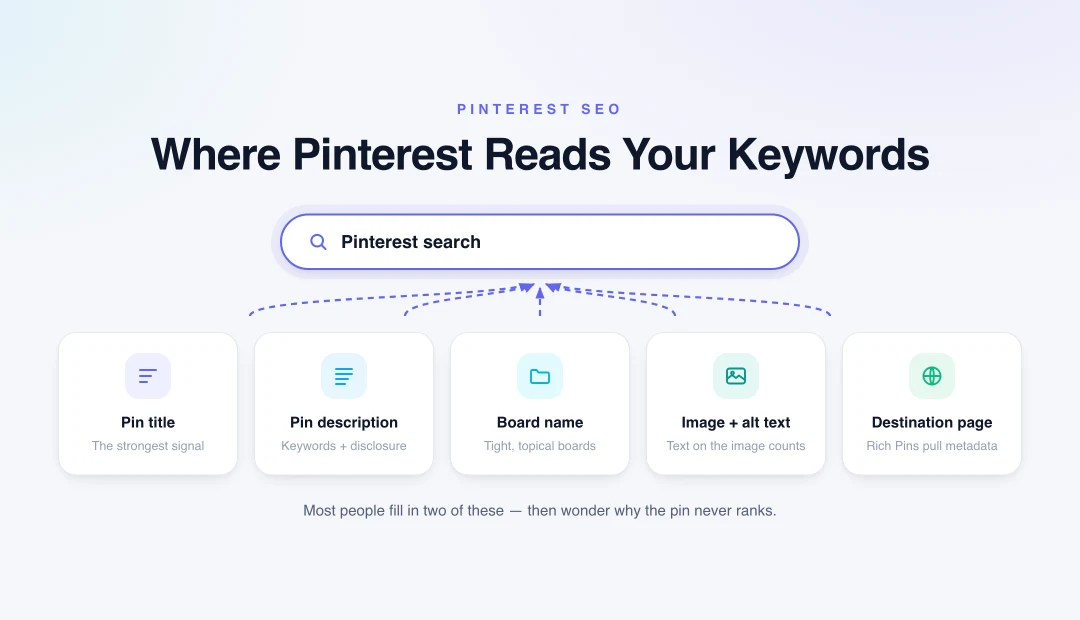
Five surfaces feed Pinterest's understanding of a pin. Most people fill in two and wonder why nothing ranks.
Pin title — the strongest signal. Lead with the phrase someone would actually search.
Pin description — natural sentences containing the keyword and its variants, plus the disclosure.
Board name and description — a pin on a well-named, topically tight board is easier to classify than one on "Stuff I Like".
Image text and alt text — Pinterest reads text rendered in the image, which is why text overlay is standard practice.
The destination page — its title and content confirm what the pin is about, and validated Rich Pins pull that metadata onto the pin itself.
Research keywords inside Pinterest rather than in a traditional SEO tool: type a seed term into the Pinterest search bar and read the suggestions and the coloured filter tiles beneath it. Those are Pinterest's own view of how its users phrase things, which frequently differs from Google.
Designing pins that earn clicks
Use 2:3 vertical, 1000 × 1500 px. Taller pins get truncated; square pins lose visual real estate in the feed.
Put readable text on the image. Most pins are scanned at thumbnail size on a phone, so the promise has to survive at that size.
Create fresh pins, don't recycle one image. Since around 2020 Pinterest has favoured new images over repeated repinning of the same one. Make several visually distinct pins per destination URL, published over time, rather than pinning one image repeatedly.
Make the image match the promise. A gorgeous pin that leads somewhere unrelated earns a hide, and hides are a negative signal.
Measure outbound clicks, not saves
Pinterest analytics report impressions, saves and outbound clicks. Only the last one can become revenue.
Saves feel like success and are genuinely a distribution signal — a saved pin gets shown to more people — but a pin with thousands of saves and few outbound clicks is a vanity result. Optimise for outbound clicks, then for what happens after them.
Track the chain properly: outbound clicks in Pinterest, sessions in your analytics, and a sub-ID per pin or per board so the affiliate network report tells you which pin produced the sale. The setup is the same one described in How to Track Affiliate Links in WordPress. If clicks look healthy but nothing converts, work the chain in this diagnostic before blaming Pinterest.
A workflow that scales
1Pick a niche Pinterest actually rewards — home, food, decor, style, weddings, DIY, crafts, parenting, beauty and personal finance are perennially strong.
2Set up a business account and claim your website, which unlocks analytics and Rich Pins.
3Build tightly themed boards with keyword-led names and real descriptions.
4Write the destination content first if you are going blog-first — the pin is the advert, the post is the sale.
5Design three to five distinct pins per URL, each with a different angle, image and title.
6Publish steadily rather than in bursts, and schedule seasonal content weeks ahead.
7Review outbound clicks monthly, then make more pins in the style of whatever earned them.
Where to start
Pinterest suits visual, aspirational and product-led offers — and because its traffic arrives slowly, cookie length matters more here than on any other channel. These five verified listings suit Pinterest audiences and creators:
Look at the spread in cookie windows and you can see the point immediately: Systeme.io's 365-day cookie gives a pin nearly a year to convert, while Amazon's 24-hour window expires long before a typical Pinterest planner is ready to buy. For a channel built on slow discovery, that difference matters more than the headline rate. Compare terms across the full directory before committing.
Common mistakes
Treating Pinterest like Instagram. It is a search engine; keywords beat posting cadence.
Quitting after three weeks. Pins build over months, and early data tells you very little.
Pinning one image over and over. Fresh images per URL outperform repetition.
Skipping the disclosure. Required by the FTC and by Pinterest, and it costs almost nothing in clicks.
Relying on cloaked or shortened links. They can be blocked, and a blocked domain is expensive to unpick.
Direct-linking to programs that forbid it — or to short-cookie programs that cannot survive the delay.
Celebrating saves. Saves aid distribution; outbound clicks pay.
Affground's verdict
Pinterest rewards the opposite instincts to social media: patience over frequency, keywords over captions, and evergreen content over the moment. Go blog-first unless a program explicitly permits direct links, treat every pin as an indexed search result rather than a post, make several fresh pins per URL, and measure outbound clicks rather than saves. Then pick offers with cookie windows long enough to survive how Pinterest users actually buy — which is slowly, deliberately, and often weeks after they first saw your pin.
Frequently asked questions
Are affiliate links allowed on Pinterest?
Yes. Pinterest banned them in 2015 but reinstated them in 2016, and they have been permitted since. You must disclose clearly in the pin description — the FTC and Pinterest both require it — and you should avoid cloaked or shortened links, which Pinterest has a history of blocking. Also check that your affiliate program permits direct social linking.
Should I link directly to an affiliate offer or to my blog?
Blog-first is better for most people. It avoids programs that restrict direct social linking, removes the risk of Pinterest blocking a redirect domain, lets one post absorb traffic from dozens of pins, and means a program change does not invalidate pins you already published. Direct pins suit simple product recommendations in programs that explicitly allow them.
How long does Pinterest take to drive affiliate traffic?
Months rather than days. A pin is indexed content that surfaces in search and related feeds, so traffic typically starts slow and builds, and a good pin can still deliver clicks a year later. Judge performance over months and treat early data as close to meaningless.
What is the best pin size for affiliate marketing?
A 2:3 vertical ratio at 1000 × 1500 pixels. Taller pins get truncated in the feed and square pins waste visual space. Add readable text overlay, because most pins are scanned at thumbnail size on a phone and the promise has to survive at that size.
What are fresh pins and why do they matter?
A fresh pin is a new image Pinterest has not seen before. Since around 2020 Pinterest has favoured fresh images over repeatedly repinning the same one, so the effective approach is to create several visually distinct pins for each destination URL and publish them over time rather than recycling one graphic.
Which niches work best on Pinterest?
Visual, planning-led categories perform strongest: home and decor, food and recipes, style, weddings, DIY and crafts, parenting, beauty and personal finance. These match how people use Pinterest, which is to plan a purchase or project rather than to browse for entertainment.
Can you use Amazon affiliate links on Pinterest?
It is a poor fit on two counts. Amazon's operating agreement places restrictions on where links may be posted, and its cookie window is only 24 hours — which rarely survives a channel where people discover things weeks before buying. If you want Amazon products on Pinterest, send traffic to your own post rather than linking directly.