Affiliate rejections are rarely personal, rarely permanent, and almost always traceable to a short list of fixable reasons. This guide explains the real causes behind the form-letter — no real site, thin content, irrelevant audience, incomplete application, prohibited methods — how to fix each, and how to reapply and get approved.
Jul 18, 2026 11 min read
You filled in the form, hit submit, and a day later got the email: "Thank you for your interest. Unfortunately, your application was not approved at this time." No reason, no feedback, just a door quietly closing. It stings — and it's confusing, because you're never told what you did wrong.
Here's the reassuring part: affiliate program rejections are rarely personal, rarely permanent, and almost always traceable to a short list of fixable reasons. Approval is a risk filter, not a judgment of your worth. The manager on the other side is asking one question — "is this a safe, relevant partner who will send real sales without creating problems?" — and a rejection just means your application didn't answer it convincingly. Fix what triggered the "no," and the same program will often say "yes."
This is the publisher's guide to why affiliate applications get rejected and exactly how to fix each cause: the real reasons behind the form-letter, how to diagnose which one hit you, how to reapply successfully, and how to stack the odds so you get approved the first time. Written for affiliates and publishers tired of unexplained rejections. (For the flip side — what managers are screening for — see what affiliate managers look for in publishers.)
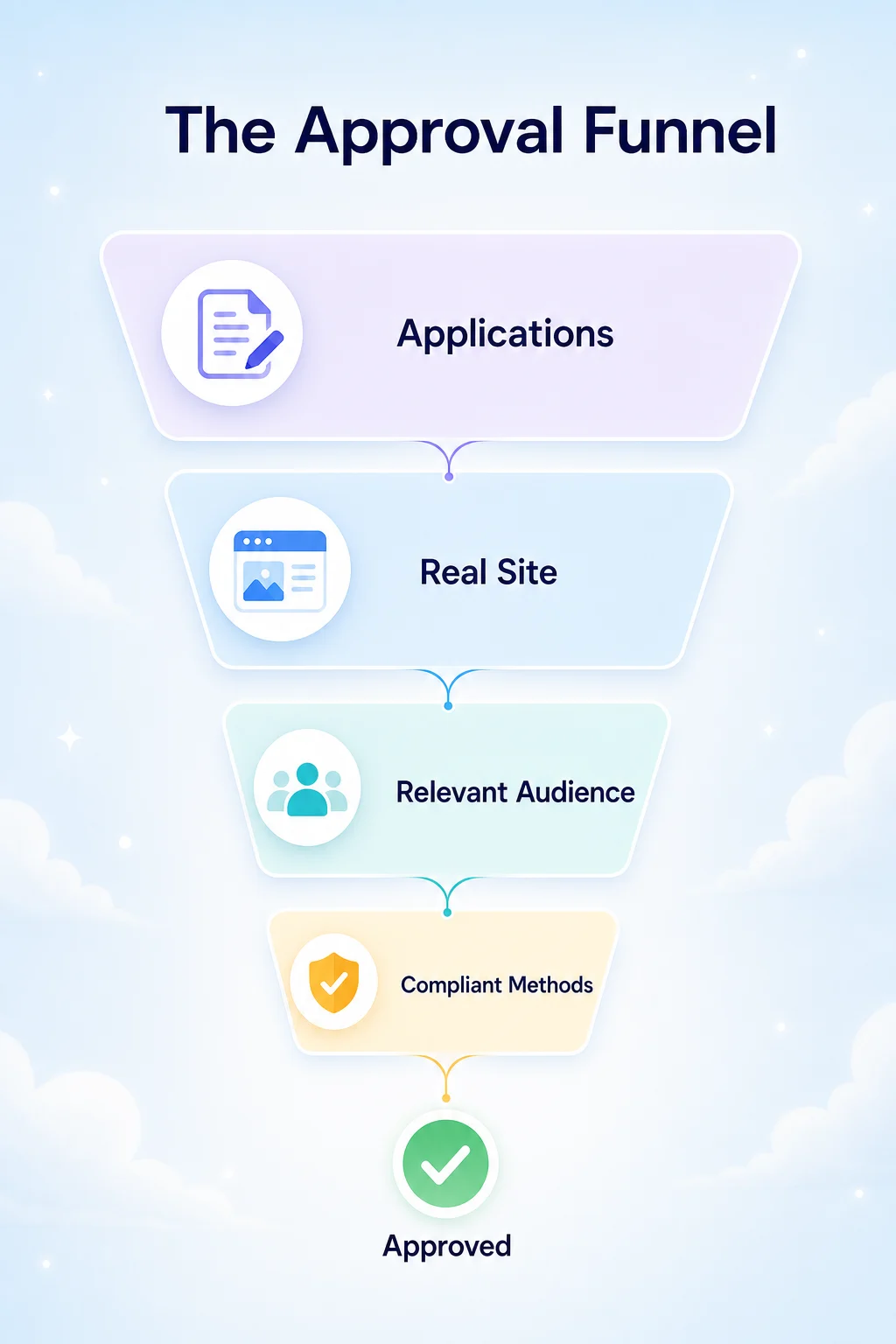
The approval funnel — applications drop out at a real-site check, a relevance check and a methods check; clear all three and you're approved.
Why programs reject applications at all
Approval isn't about whether you're a "good person" or even a talented creator — it's risk management. Every affiliate a program approves is a small bet that this partner will send profitable sales, promote them in ways they're proud of, and not create legal, brand or fraud headaches. When an application doesn't clearly signal "safe and relevant," the manager's rational default is to decline. Rejecting a questionable applicant costs them nothing; approving one can cost them money and reputation.
That's why rejections cluster around a handful of signals of risk — no real website, an irrelevant audience, thin content, vague promotional methods, an incomplete application. None of these are verdicts on your potential; they're gaps in the evidence you gave the reviewer. The whole game is closing those gaps.
Affground's take: stop reading a rejection as "you're not good enough" and start reading it as "you didn't give me enough to say yes." Managers approve on evidence, and most applicants simply don't provide it — blank fields, a half-built site, no explanation of fit. The rejection isn't the manager judging you harshly; it's the manager having nothing to judge you by. Give them the evidence and the answer usually flips.
The real reasons applications get rejected
Behind the polite form-letter, rejections almost always trace to one of these:
Reason
What the manager saw
Fixable?
No real website / thin content
An empty, broken or placeholder site
Yes — build genuine content
Incomplete application
Blank fields, no detail, no contact
Yes — fill it in properly
Irrelevant audience
A poor fit between your site and the product
Yes — apply to relevant programs
Not enough / unproven traffic
A brand-new site with no history
Yes — grow, or start beginner-friendly
Prohibited promotional methods
Traffic sources the program bans
Yes — use compliant channels
Brand-safety / policy conflict
Content the brand won't appear beside
Yes — clean it up or apply elsewhere
Missing account details
No tax, payment or verified contact info
Yes — complete your profile
Notice the last column: every common reason is fixable. A rejection is a to-do list in disguise.
Reason 1 — No real website or thin content
The most common cause by far. If your site is empty, half-built, broken, or a thin stack of "top 10" pages clearly assembled to grab commissions, a manager can't assess you and won't risk it. They're looking for a genuine, functional site with real content that serves an audience.
The fix: build first, apply second. Publish a handful of substantive, genuinely useful pages in your niche — real reviews, guides, comparisons — with an about page and contact details, before you apply. You don't need hundreds of posts; you need enough to prove you're a real publisher with a real audience, not a placeholder chasing links.
Reason 2 — An incomplete or lazy application
Managers read applications for signals of professionalism, and a blank or one-line application signals the opposite. Empty fields, no description of how you'll promote, no website URL, no contact info — these read as "low-effort, high-risk" and get declined on sight.
The fix: treat the application like a pitch. Fill in every field, add your real website, describe your audience and specifically how you'll promote the brand (SEO reviews, an email list, comparison content). A complete, thoughtful application is a surprisingly large share of the battle, because so many applicants don't bother.
Reason 3 — Your audience doesn't fit
A finance blog applying to a fashion program, or a general "deals" site applying to a specialist B2B tool, gets rejected because the fit isn't there. Managers approve partners whose audience obviously wants the product; a mismatch means wasted clicks and poor conversion, so they pass — no matter how good your site is.
The fix: apply to programs your audience would genuinely thank you for recommending, and say why in the application. Relevance is the single strongest approval signal, and it's entirely within your control — choose programs that fit, and spell out the fit rather than leaving the manager to guess.
Reason 4 — Not enough (or unproven) traffic
Some programs — especially premium or in-house ones — want to see established traffic before they approve you, and a brand-new site with no history can get an automatic "not yet." This one feels unfair when you're starting out, but it's really about the program's risk appetite, not your worth.
The fix: two moves. First, start with beginner-friendly networks and programs that approve newer publishers, build a track record, then apply to the pickier ones later. Second, grow and show it — even modest but real, engaged traffic, described honestly, beats an empty application. Rejection for traffic is usually a "come back later," not a "never."
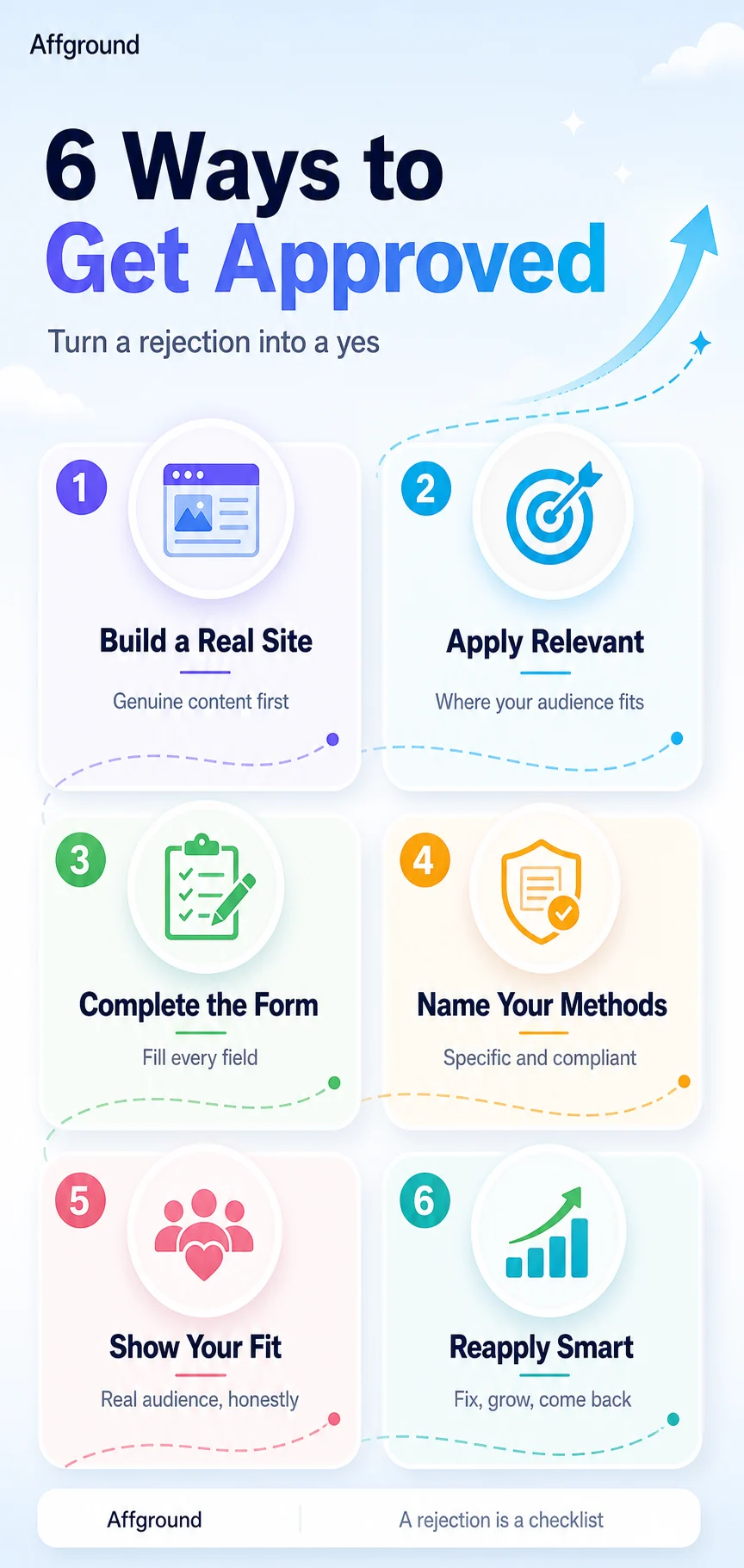
Six ways to flip a rejection into an approval — the fixes that answer the manager's one real question.
Reason 5 — Prohibited or vague promotional methods
Every program has rules about how you may drive traffic — and using (or hinting at) a banned method is a fast rejection. Common triggers: bidding on the brand's trademark in paid search, certain paid or email traffic the program doesn't allow, incentivised or coupon-abuse tactics, or simply being vague ("I'll drive traffic") in a way that reads as evasive.
The fix: read the program's terms before you apply, then name specific, compliant channels in your application. "I publish SEO-optimised reviews and comparisons and promote via my email newsletter" reassures a manager; "I'll send traffic" alarms one. Specificity that matches the program's rules is itself a strong approval signal.
Reason 6 — Brand-safety or policy conflicts
Brands won't appear next to content they consider unsafe or off-brand, and they screen for it. Content that's controversial, adult-adjacent, or simply mismatched with the brand's image can trigger a rejection on brand-safety grounds even if everything else is fine.
The fix: make sure your content is clean, professional and appropriate for the brands you're targeting — or, if your niche is genuinely edgy, apply to programs and networks that welcome it rather than mainstream brands that won't. Fit works both ways: match your content to programs whose brand-safety bar you actually clear.
Reason 7 — Missing account or contact details
Sometimes the rejection is purely administrative: an incomplete network profile, missing tax or payment information, or no verifiable contact details. Managers can't (and won't) approve a partner they can't actually pay or reach.
The fix: complete your network or platform profile fully before applying — payment method, tax details where required, a real contact, a finished bio. A tidy, complete profile removes an easy reason to say no.
How to reapply after a rejection
A rejection is rarely final. Here's how to come back and get the "yes":
1Diagnose the likely cause. Match your situation to the reasons above — usually it's site, fit, application quality or methods.
2Fix it visibly. Add real content, complete your profile, choose more relevant programs, clarify your methods.
3Wait until you've genuinely improved — don't reapply the next day with nothing changed; that just confirms the "no."
4Reapply (or email the manager). Many programs let you reapply once you've grown; a polite, specific note to the affiliate manager explaining what you've improved can reopen the door.
5Have alternatives running. Get approved on beginner-friendly networks meanwhile, so you're building income and a track record while the pickier programs come around.
How to maximise your approval odds
Do these before you apply and rejections become rare:
Build a real, credible site with genuine content, an about page and contact details.
Apply to relevant programs where your audience obviously fits — and explain the fit.
Complete every field of the application and your account profile.
Name specific, compliant promotional methods that match the program's rules.
Show your traffic and audience honestly — real and modest beats empty and vague.
Start with beginner-friendly networks to build approvals and a track record.
Where to start if you keep getting rejected
If premium programs keep declining a newer site, start where approval is more accessible: large, beginner-friendly networks that welcome growing publishers, then use that track record to unlock the pickier programs. These established networks are common, approachable starting points:
Browse the full affiliate networks directory to find networks that fit your niche and traffic — and remember that a program worth joining vets you precisely because it's the kind that won't waste your effort. (Spotting the ones that aren't worth joining is its own skill — see how to identify affiliate program red flags.)
Common myths about rejections
"You need huge traffic to get approved." Most programs care far more about relevance, real content and compliant methods than raw volume. A small, focused site gets approved constantly.
"A rejection is permanent." It almost never is. Fix the cause, grow, and reapply — programs approve improved applicants all the time.
"They rejected me personally." They rejected an application that didn't signal safety and fit. It's a filter, not a verdict on you.
"More applications = more approvals." Spraying applications at irrelevant programs just stacks up rejections. Targeted, relevant, well-made applications win.
Affground's verdict
Affiliate program applications get rejected for reasons that are almost boringly consistent — no real site, thin content, an irrelevant audience, a lazy application, prohibited methods, a policy conflict, missing details — and every one of them is fixable. A rejection isn't a wall; it's a checklist. The manager wasn't judging your worth; they were failing to find, in your application, the evidence that you're a safe, relevant partner who'll send real sales. Supply that evidence and the same door opens.
So treat rejection as feedback, not defeat. Build a genuine site, apply where you actually fit, fill in every field, name compliant methods, start on the networks that welcome newer publishers, and reapply once you've grown. Do that and approvals stop feeling like a lottery and start feeling like a formality. Affground's bet: the publishers who read rejection as a to-do list — not a verdict — get approved, build their track record, and end up with programs competing to work with them.
Frequently asked questions
Why do affiliate program applications get rejected?
Rejections almost always trace to a short, fixable list: no real website or thin content, an incomplete or lazy application, an audience that doesn't fit the product, not enough or unproven traffic, prohibited or vague promotional methods, brand-safety or policy conflicts, and missing account or contact details. Approval is risk management — the manager is checking whether you're a safe, relevant partner — so a rejection means your application didn't clearly signal that, not that you were judged personally.
How do I get approved for affiliate programs?
Build a real, credible site with genuine content, an about page and contact details before applying; apply to programs your audience obviously fits and explain the fit; complete every field of the application and your account profile; name specific, compliant promotional methods that match the program's rules; show your traffic and audience honestly; and start with beginner-friendly networks to build a track record. Together these answer the manager's one real question — are you a safe, relevant partner?
Can you reapply after being rejected from an affiliate program?
Yes, almost always. Diagnose the likely cause (usually your site, fit, application quality or promotional methods), fix it visibly, and wait until you've genuinely improved before reapplying — don't resubmit the next day with nothing changed. Many programs let you reapply once you've grown, and a polite, specific note to the affiliate manager explaining what you've improved can reopen the door. Keep beginner-friendly networks running meanwhile to build income and a track record.
Do you need a website to join affiliate programs?
Usually, yes — or at least a real, substantial presence on a platform you control. The most common rejection reason is no real website or thin, placeholder content, because a manager can't assess an empty site. You don't need hundreds of pages, but you do need enough genuine, useful content (reviews, guides, comparisons) plus an about page and contact details to prove you're a real publisher. Some programs accept established social or video channels in place of a site.
Do you need a lot of traffic to get approved for affiliate programs?
Not usually. Most programs weigh relevance, real content and compliant promotional methods far more heavily than raw traffic volume, so a small, focused, well-made site gets approved constantly. Some premium or in-house programs do want established traffic first — but that's typically a 'come back later,' not a 'never.' If traffic is your blocker, start with beginner-friendly networks, build a track record, then apply to the pickier programs.
Which affiliate networks are easiest to get approved for?
Large, beginner-friendly networks that welcome growing publishers — such as ShareASale, FlexOffers and CJ Affiliate — are common, approachable starting points because they bundle many programs and accept newer sites more readily than premium in-house programs. Getting approved and building a track record on one of these makes it far easier to unlock the pickier programs later. Approval requirements still vary by the individual merchant programs within each network.
Is an affiliate program rejection permanent?
Almost never. A rejection is a filter on a specific application at a specific moment, not a lifetime ban. Once you fix the cause — add real content, complete your profile, choose more relevant programs, clarify your methods, or grow your traffic — you can typically reapply, and programs approve improved applicants all the time. Treat the rejection as a to-do list rather than a verdict, and the same door usually opens.