In affiliate marketing you invest first and get paid later — so vetting a program before you commit is essential. This guide covers the red flags across payment, tracking, terms, transparency, reputation and product, the green flags that mark a program worth your traffic, and a pre-join checklist to screen out the duds.
Jul 15, 2026 12 min read
You found a program paying 50% commission in your exact niche. You spent three weeks writing the reviews, ranked the pages, sent hundreds of qualified clicks — and then the payout never came, or came months late, or got clawed back under a clause you never read. The program wasn't a scam exactly; it was just a bad partner, and every warning sign was there before you wrote a word.
Here's the thing about affiliate programs: you invest first and find out later. You spend the content, the traffic and a slice of your audience's trust before you learn whether the program tracks honestly, pays reliably, and plays fair. That asymmetry makes vetting a program up front not optional but essential — because the cost of a bad one isn't just the unpaid commission, it's the weeks of work and the credibility you spent promoting it.
This is the publisher's field guide to spotting a bad affiliate program before you commit: the red flags across payment, tracking, terms, transparency, reputation and product — what each one signals, why it should worry you, and the green flags that mark a program actually worth your traffic. Written for affiliates and publishers who'd rather screen out the duds than learn the expensive way.
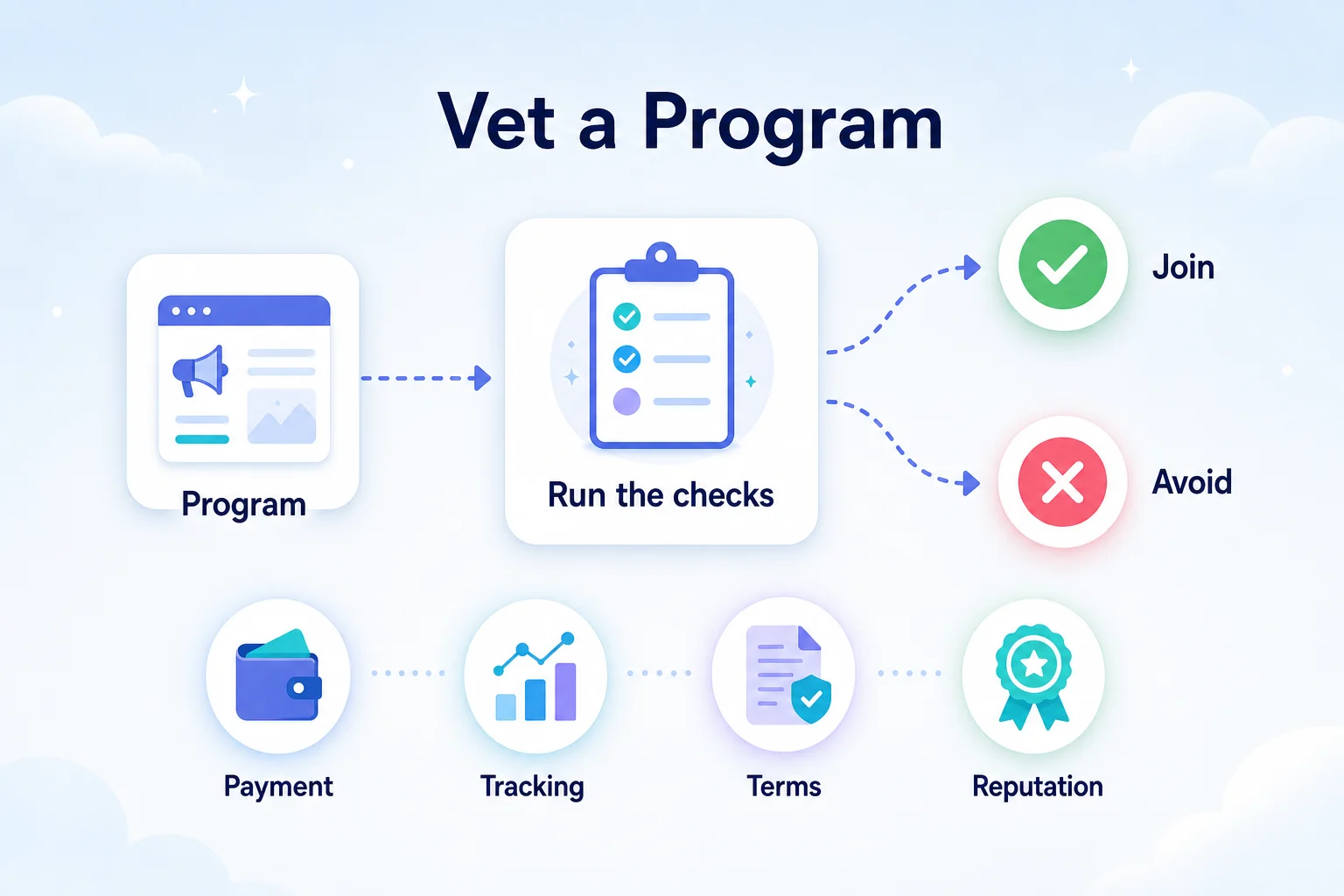
Vet before you commit: run any program through the core checks — and let the red flags decide join or avoid.
Why vetting a program up front matters
Affiliate marketing runs on a lopsided deal. The publisher does the work at the start — creating content, earning rankings, sending traffic — and only collects at the end, weeks or months later, if the program holds up its side. Between your effort and your payout sits a company you're trusting to count your sales, honour its terms and actually pay. Vet badly and you can pour a month of work into a program that was never going to pay you fairly.
The good news is that bad programs almost always announce themselves. High payout thresholds, vague payment terms, opaque tracking, one-sided clauses, a trail of affiliate complaints — these are visible before you join, if you know to look. Screening for them costs you an hour; skipping the screen can cost you a season of work.
Affground's take: treat joining an affiliate program like hiring, not shopping. You're not buying a commission rate — you're entering a working relationship where you deliver first and get paid on trust. A dazzling rate from a program flashing red flags is the affiliate equivalent of a too-good-to-be-true job offer: the number is bait, and the terms are where the truth is. Read the terms, not the headline.
The red-flag categories at a glance
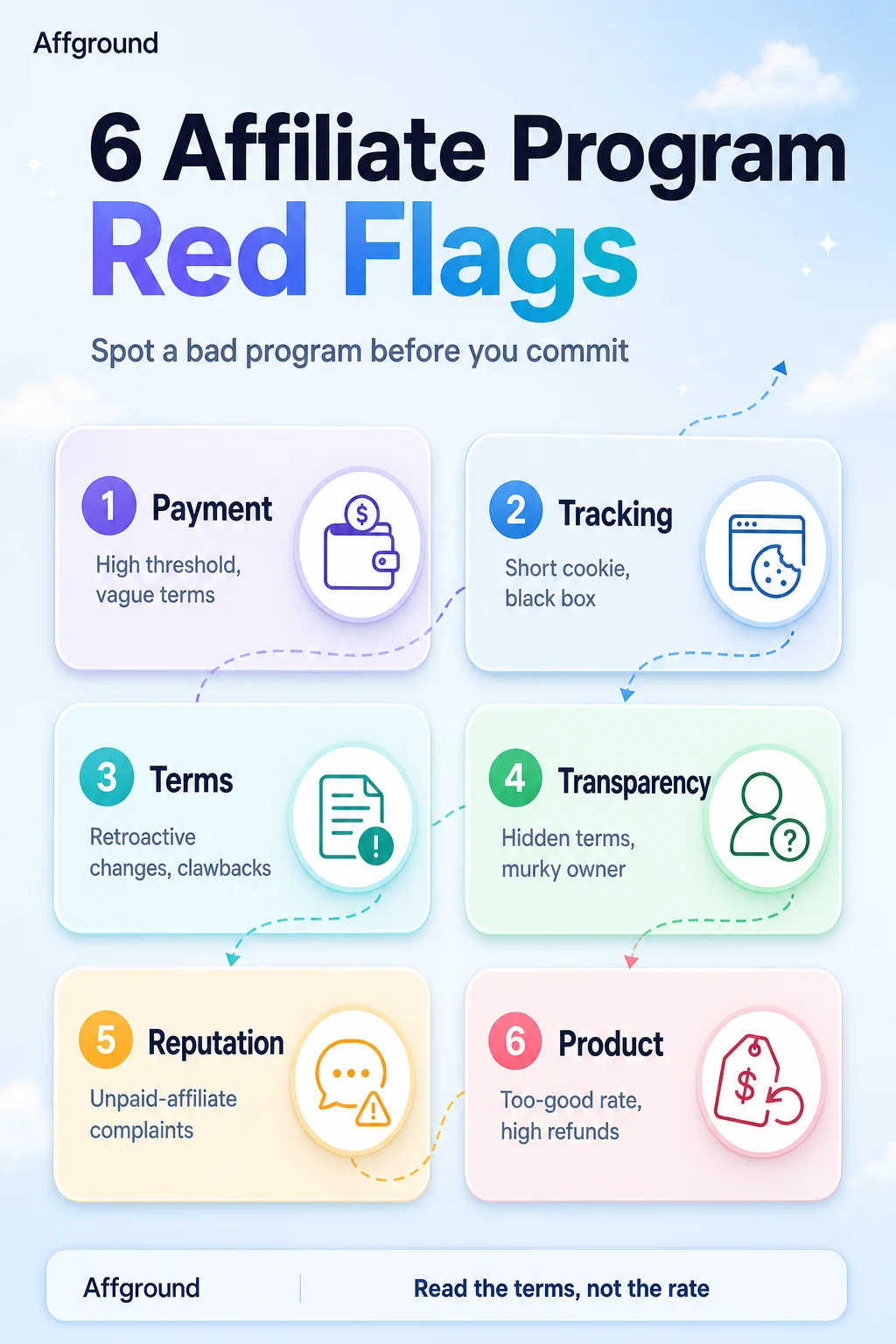
Bad programs leak warning signs across six areas. Here's the map before we go deep:
Category
The warning sign
What it really signals
Payment
High thresholds, vague/long terms
You may struggle to ever get paid
Tracking
Short cookie, no server-side, discrepancies
Your conversions won't get counted
Terms
Retroactive changes, harsh clawbacks
The deal can change under you
Transparency
Hidden terms, opaque reporting
They're hiding something
Reputation
Affiliate complaints, no track record
Others already got burned
Product
Too-good rates, high refunds, spammy offers
The offer won't convert or will reverse
Notice the theme: almost none of these are about the commission rate. A red-flag program with a huge rate is worth less than a clean program with a modest one — because a big percentage of nothing is nothing.
Payment red flags
Payment is where bad programs hurt you most directly, so scan it first. Watch for:
Unreasonably high payout thresholds — a $500+ minimum before you can withdraw can strand your earnings indefinitely, especially on a smaller program.
Vague or very long payment terms — "net-60," "net-90," or worse, no clear schedule at all. The longer and fuzzier the terms, the more room to delay.
A history of late or missing payments — the single biggest tell, and usually findable in affiliate forums and reviews.
Limited or awkward payout methods — no method you can actually use, or unusual conditions attached to getting paid.
Payment "review" clauses — broad rights to withhold or delay payouts at the program's sole discretion.
Affground's rule: before you promote anything, answer three payment questions — what's the threshold, what's the exact schedule, and do affiliates report actually getting paid on time? If you can't get a clear answer to all three, that ambiguity is the answer. Reliable programs make their payment terms easy to find because reliable payment is their selling point.
Tracking red flags
If the tracking leaks, you work for free — so a program's tracking setup is a core vetting item, not a technicality. Warning signs:
A very short cookie / attribution window — a 24-hour window quietly forfeits every sale that happens after a day's consideration.
No server-side / postback option — cookie-only tracking loses more conversions every year to ad blockers and browser restrictions.
No transparency about attribution — you can't find out whether it's last-click, the window length, or how reversals work.
Reported tracking discrepancies — other affiliates complaining that conversions "don't show up" is a five-alarm signal.
A black-box dashboard — lagging, vague reporting that gives you no way to verify what you actually drove.
Tracking quality is invisible until it fails, which is exactly why you check it before you invest. (Our guide to how affiliate tracking works covers what good tracking looks like.)
Terms & conditions red flags
The terms are where a program tells you, in writing, how badly it can treat you — if you read them. The clauses that should worry you:
Retroactive change rights — the ability to cut your rate or change attribution on work you've already done.
Vague or aggressive reversal/clawback policies — broad rights to reverse commissions with little explanation.
Termination-and-withhold clauses — the right to close your account and keep your earned but unpaid commissions.
Unreasonable exclusivity or restriction — terms that box in how you can promote or forbid competing partnerships unfairly.
"We can change these terms anytime" with no notice — predictability is what lets you invest; a program that can move the goalposts silently is one you can't safely build on.
Skipping the terms is the most expensive shortcut in affiliate marketing. Read them before you write the content, not after the clawback.
Transparency red flags
Reputable programs are clear by default; shady ones are murky by design. Distrust a program that hides the basics:
No clear commission structure — you can't tell what you'll actually earn, or "rates on request" with no detail.
Buried, hard-to-find, or missing terms — if the T&Cs are hidden, assume they're hidden for a reason.
Opaque reporting — no real-time, verifiable data on your clicks, conversions and reversals.
No real company information — anonymous ownership, no address, no verifiable business behind the offer.
Opacity is itself the red flag. A program that won't tell you clearly how it tracks, pays and reverses is telling you something — just not in words.
Six categories of affiliate program red flags — scan every one before you invest your content and traffic.
Reputation red flags
Someone has almost always tested a program before you. Their experience is free due diligence:
A pattern of negative affiliate reviews — especially about payment and tracking, on forums and review sites.
No track record at all — a brand-new program with no history isn't automatically bad, but it's unproven, so tread carefully and start small.
Complaints of account bans and withheld earnings — a recurring, serious signal.
Anonymous or evasive ownership — no named people, no findable company, no accountability.
Spend fifteen minutes searching the program's name alongside words like "payment," "scam," or "not paying." What other affiliates say — good or bad — is the most honest data you'll get.
Product & offer red flags
Even a well-run program is a bad bet if the thing you're promoting won't convert or won't stick. Watch the offer itself:
Commission rates that are too good to be true — a wildly above-market rate can signal desperation, a product that doesn't sell, or a plan not to pay in full.
High refund or chargeback rates — sales that reverse mean commissions clawed back; a returns-heavy product quietly erodes your earnings.
Spammy, misleading, or low-quality products — promoting these costs you the audience trust that makes you valuable in the first place.
Pushy, hype-driven program marketing — "get rich promoting us!" energy often masks a weak offer and a weaker payout intention.
Affground's take: the biggest red flag of all is a headline commission rate that doesn't match the program's quality. Trustworthy programs rarely need to dangle the largest number in the market — their reliability is the draw. When the rate is the only impressive thing, assume it's compensating for everything you can't see, and that the math ends at "0% actually paid."
Red flags vs green flags
The inverse of every warning sign is a mark of a program worth your traffic. A quick contrast:
Red flag
Green flag
Payment
High threshold, vague terms
Low threshold, clear schedule, paid on time
Tracking
Short cookie, cookie-only, black box
Fair window, server-side, transparent reporting
Terms
Retroactive changes, harsh clawbacks
Fair notice, no retroactive changes
Transparency
Hidden terms, murky ownership
Clear terms, real company, open reporting
Reputation
Payment complaints, anonymous
Positive affiliate reviews, track record
Support
No manager, ghosting
Responsive, reachable human contact
If you want to know what a trustworthy program looks like from the inside, it's the same list a good advertiser builds toward — see how to build trust with publishers.
The pre-join vetting checklist
Run any program through this before you write a single piece of content:
3Read the terms — look specifically for retroactive changes, clawbacks and termination-and-withhold clauses.
4Search the reputation — the program's name plus "payment," "not paying," "review." Read what affiliates say.
5Assess the offer — does the product actually convert, and is its refund rate sane?
6Test communication — is there a reachable manager, and do they respond like a partner?
7Start small — for anything unproven, send limited traffic first and confirm tracking and payment before you scale.
Do this and you convert vetting from a gut feeling into a repeatable screen — the difference between promoting on evidence and promoting on hope.
Lower your risk: start with reputable networks
The simplest way to avoid most red flags is to start inside established networks and platforms, where tracking is standardised, payments are handled by the network, and programs operate under enforced terms. The network's own credibility filters out much of the risk before you ever apply:
Browse the full affiliate networks directory to compare platforms on payout terms, tracking and reputation — and favour the ones whose standards do your vetting for you.
What to do if you spot red flags after joining
Sometimes the flags only appear once you're in. If they do:
Don't scale into it. Pause new content and hold your best real estate until you've confirmed it pays.
Test with limited traffic and watch tracking and payouts closely.
Document everything — screenshots of terms, reports and communications — in case of a dispute.
Raise discrepancies specifically and promptly, and judge the program by how it responds.
Cut your losses and diversify. If payment or tracking is genuinely broken, redirect your traffic to a program that has earned it. Never let one shaky advertiser hold your income hostage.
Affground's verdict
Identifying affiliate program red flags is really one skill: reading the terms and the track record instead of the headline rate. Bad programs broadcast their nature before you join — in high thresholds, vague payment terms, short cookies, one-sided clauses, hidden ownership and a trail of unpaid affiliates. None of it is hidden from a publisher who takes an hour to look. The commission rate is the loudest number and the least informative; the quiet details around payment, tracking and terms are where a program's real character lives.
So vet like your work depends on it — because it does. Screen every program against payment, tracking, terms, transparency, reputation and product; favour networks whose standards filter the risk for you; and start small on anything unproven. Do that, and you stop donating months of content to programs that were never going to pay you fairly, and start spending your traffic only where it's genuinely respected. Affground's bet: the affiliates who vet ruthlessly up front out-earn the ones chasing the biggest rate straight into the biggest red flag.
Frequently asked questions
What are affiliate program red flags?
Red flags are warning signs that a program may not pay you fairly or treat you well, and they cluster in six areas: payment (high thresholds, vague or very long terms, a history of late payments), tracking (short cookie windows, no server-side option, reported discrepancies), terms (retroactive changes, harsh clawbacks, termination-and-withhold clauses), transparency (hidden terms, opaque reporting, anonymous ownership), reputation (affiliate complaints, no track record), and product (too-good-to-be-true rates, high refund rates, spammy offers). Most of them are visible before you join if you look.
How do you know if an affiliate program is legit and trustworthy?
Check the green flags: a low, clear payout threshold and an exact payment schedule that affiliates confirm is honoured; a fair attribution window with server-side tracking and transparent reporting; terms with fair notice and no retroactive changes; clear commission info and a real, findable company behind it; positive affiliate reviews and a track record; and a responsive, reachable manager. A program that makes all of this easy to verify is signalling that it has nothing to hide.
What payment terms should make you avoid an affiliate program?
Be wary of unreasonably high payout thresholds (a $500+ minimum can strand your earnings), vague or very long payment terms with no clear schedule, limited or awkward payout methods, and broad clauses letting the program withhold or delay payment at its discretion. The biggest single tell is a documented history of late or missing payments, which you can usually find in affiliate forums and reviews. If you can't get a clear answer on threshold, schedule and payment reliability, treat that ambiguity as the answer.
Is a very high commission rate a red flag?
It can be. A commission rate far above the market norm can signal desperation, a product that doesn't actually sell, or a program that doesn't intend to pay in full — a big percentage of nothing is still nothing. Trustworthy programs rarely need to dangle the largest number in the market because their reliability is the draw. When the rate is the only impressive thing and the payment terms, tracking or reputation are murky, assume the rate is compensating for what you can't see.
How do you vet an affiliate program before joining?
Run it through a checklist: verify the payment terms (threshold, schedule, methods); check the tracking (attribution window, server-side support, reporting transparency); read the terms for retroactive changes, clawbacks and termination-and-withhold clauses; search the program's reputation by pairing its name with words like 'payment' and 'not paying'; assess whether the product actually converts and its refund rate is sane; test whether there's a responsive manager; and start with limited traffic on anything unproven before you scale.
What should you do if an affiliate program stops paying or shows red flags after you join?
Stop scaling into it immediately and hold your best content and placements. Test with limited traffic while watching tracking and payouts closely, and document everything — screenshots of terms, reports and communications — in case of a dispute. Raise any discrepancy specifically and promptly, and judge the program by how it responds. If payment or tracking is genuinely broken, cut your losses and redirect your traffic to a program that has earned it; never let one shaky advertiser hold your income hostage.
Are affiliate networks safer than joining programs directly?
Often, yes, especially when you're starting out. Established networks standardise tracking, handle payments centrally, and hold programs to enforced terms, which filters out a lot of the risk before you ever apply — the network's own credibility does part of your vetting for you. Direct programs can offer better rates and a dedicated manager, but they put the responsibility for verifying payment and tracking entirely on you, so they reward more careful due diligence.