How to Create Affiliate Creatives That Publishers Use
Most affiliate creatives brands make never get used — because they're built to decorate the brand, not to arm the publisher. This guide covers what creatives publishers actually deploy (and ignore), the principles that make an asset usable, and how to build a creative kit partners reach for first.
Jul 16, 2026 10 min read
Your design team spent a week on a gorgeous set of banners. They're on-brand, pixel-perfect, and sitting in your affiliate dashboard completely untouched. Meanwhile your best publisher is hand-writing their own text links because nothing you gave them actually fits their content. This is the quiet, expensive reality of most affiliate programs:
the majority of the creatives brands make never get used.
The reason is a simple misunderstanding of what an affiliate creative is for. A display ad decorates your brand; an affiliate creative arms a salesperson. Publishers don't deploy your assets to look pretty — they deploy the ones that earn them money without wrecking their user experience. Get that incentive right and your creatives get used, your program converts, and your best partners give you their best real estate. Get it wrong and you've decorated a dashboard nobody opens.
This is the practical guide for advertisers and affiliate managers: what creatives publishers actually use (and ignore), the principles that make an asset deployable, how to build a creative kit partners reach for first, and the mistakes that leave beautiful banners gathering dust. Written for brands who want their affiliate assets worked, not warehoused.
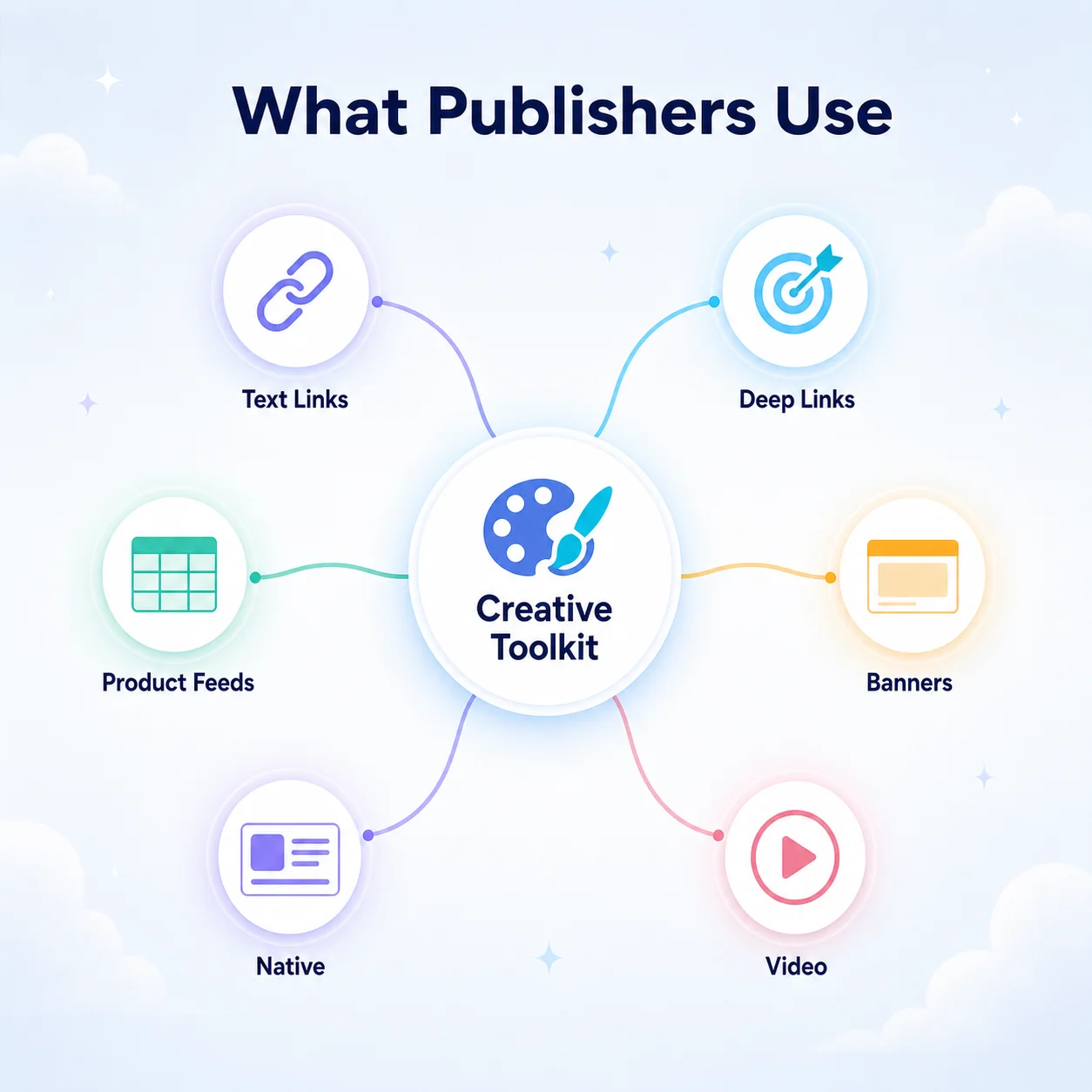
The affiliate creative toolkit — the formats publishers actually deploy, from flexible text and deep links to product feeds and refreshed banners.
Why most affiliate creatives fail
Brands design creatives for themselves — brand-first, campaign-led, built to look good in a pitch deck. Publishers need the opposite: assets built for their page, their audience, and their conversion. When those two purposes collide, the publisher wins, because they control what goes on their site — and what they choose is whatever helps them earn without annoying their readers.
That's why the prettiest banner often loses to a plain text link. The banner screams "ad," triggers banner blindness, and clashes with the publisher's design; the text link blends into the content, gets clicked, and converts. Publishers are ruthless pragmatists about this. Your creative isn't competing on aesthetics — it's competing on whether it makes the publisher money with the least friction.
Affground's take: stop thinking of affiliate creatives as your advertising and start thinking of them as tools you hand to a partner. The question isn't "does this represent our brand beautifully?" — it's "will a publisher actually put this on their page, and will it convert their audience?" Every creative that fails that test is design budget you set on fire. Build for the publisher's page, not your brand guidelines, and usage takes care of itself.
What publishers actually use (and ignore)
Not all creatives are equal in a publisher's eyes. Here's the rough hierarchy, from most-deployed to most-ignored:
Creative
How much publishers use it
Why
Text / contextual links
Constantly
Blend into content, convert best
Deep links
Heavily
Send readers to the exact relevant page
Product data feeds
Heavily (by comparison sites)
Power tables, reviews, dynamic content
Customizable / native units
Often
Match the publisher's look
Coupons & promo assets
Often (seasonally)
Give readers a reason to buy now
Email swipe copy
Sometimes
Ready-to-send for list owners
Banners (standard sizes)
Occasionally
Expected, but low CTR
Video / UGC assets
Growing
For social and modern content
The lesson is uncomfortable for design teams: the least designed assets — text links, deep links, raw product data — are the ones publishers reach for most, because they're the most flexible and the highest-converting. Banners are table stakes you should provide, but they're rarely where the money is.
The principles that make a creative deployable
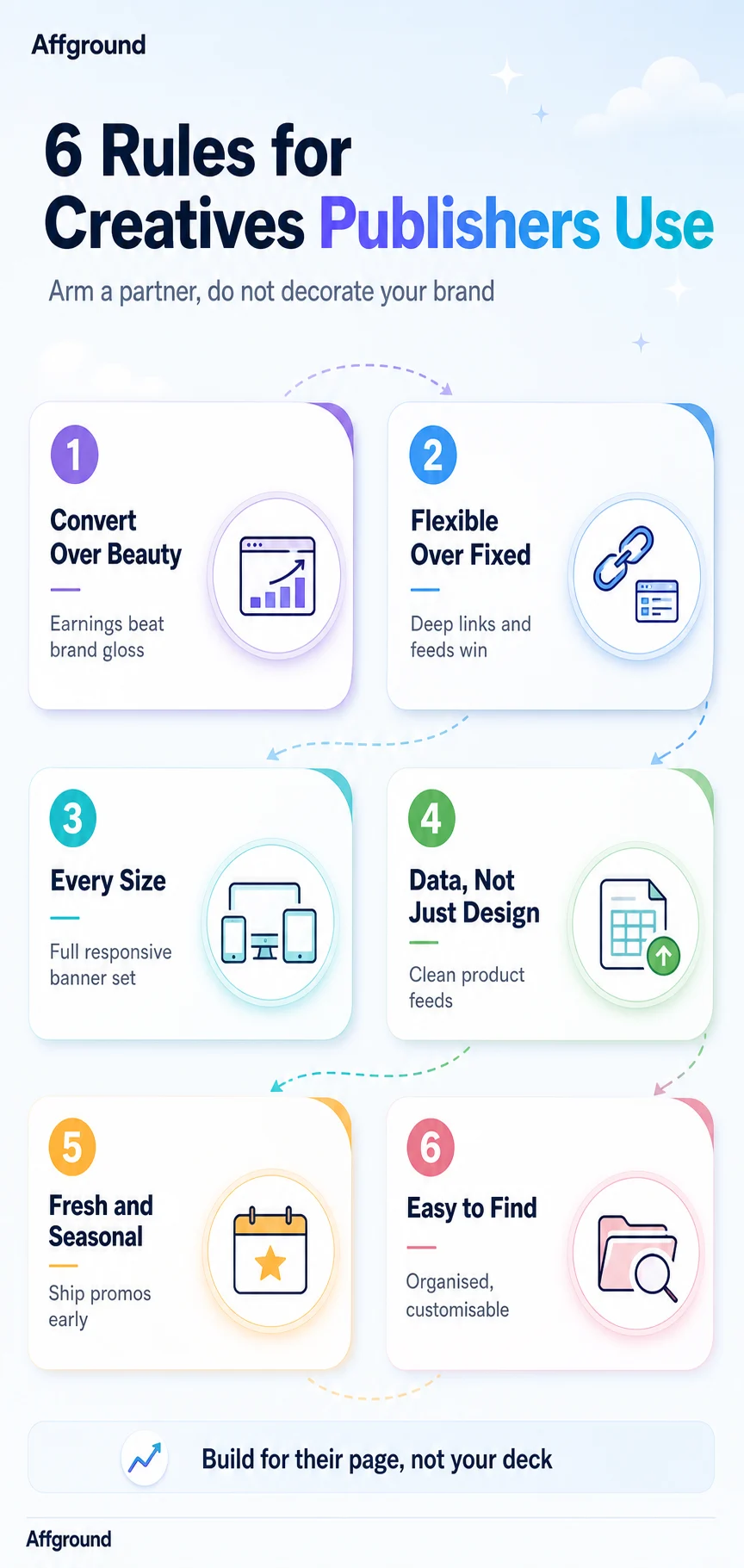
1. Optimise for conversion, not beauty
A publisher's only real question is "will this earn me money?" So build creatives that convert: clear value proposition, an obvious call to action, and social proof or a concrete benefit over brand gloss. A slightly less pretty asset that converts better will always win the placement. Give partners assets you'd bet your own money on.
2. Prioritise flexible over fixed
The most-used creatives are the most adaptable. Deep links (that drop a reader on the exact product or category, not the homepage) and product data feeds (that publishers plug into comparison tables and reviews) get used far more than fixed-size banners, because the publisher can weave them into their own content. Lead with flexibility; ship banners as a backup, not the centrepiece.
3. Provide the full range of formats and sizes
When you do ship banners, ship the whole set — every standard size, responsive where possible, plus light/dark variants. A publisher who can't find the size that fits their layout simply won't use one. Cover the common IAB dimensions and remove the "it doesn't fit my slot" excuse entirely.
4. Give them data, not just design
Comparison sites, reviewers and deal publishers run on data: current prices, availability, best-sellers, ratings, images, discounts. A clean, well-structured product feed is often the single most valuable creative you can offer, because it powers dynamic, always-current content that a static banner never could. Design is optional; good data is a superpower.
Six rules for building affiliate creatives publishers actually deploy — flexibility, data and conversion beat brand gloss every time.
5. Keep them fresh and seasonal
Stale creatives are dead creatives. Refresh your assets regularly, and — crucially — ship seasonal and promotional creatives ahead of the moments that matter (holidays, sales, product launches). A publisher planning their Black Friday content in October needs your Black Friday assets in October, not the week of. Timely, promotion-specific creatives are some of the most-used you'll ever make.
6. Make them effortless to find and use
Even a perfect creative goes unused if a publisher can't find it. Organise your assets clearly in the network, name them sensibly (by size, product, campaign), keep them current, and make grabbing a link or embed a two-click job. Friction in the dashboard is friction on your revenue.
7. Let publishers customise and co-brand
The best-converting native content is content that matches the publisher's voice and look. Where you can, let partners customise — swap the copy, adjust the styling, add their own angle, co-brand the asset. A creative the publisher can make theirs gets used far more than a locked-down brand lockup they have to bolt on awkwardly.
The modern additions: social, video and UGC
Affiliate content has moved well beyond the blog banner. Increasingly, publishers are creators who need short-form video, social-ready images, and UGC-style assets to promote you on the platforms where their audience actually lives. Providing good creatives is itself an act of partner enablement — one of the pillars of building trust with publishers. Providing (or licensing) social and video creatives — and giving creators the freedom to remix them — opens a channel that static banners can't touch. If your program only ships web banners in 2026, you're invisible to a fast-growing slice of the best publishers.
Common mistakes that leave creatives unused
Only shipping banners. The least-used format as your centrepiece; publishers want links, feeds and flexibility.
Designing for the brand, not the page. On-brand but off-fit assets that clash with the publisher's site get skipped.
No deep links. Forcing every click to the homepage tanks conversion and frustrates partners.
Stale, never-refreshed assets. Old creatives signal a neglected program.
Missing the seasonal moments. Shipping holiday creatives too late to be used at all.
Disorganised, hard-to-find assets. Great creatives buried in a messy dashboard might as well not exist.
Locked-down, un-customisable lockups. No room for the publisher to make it fit or make it theirs.
Where to host and distribute your creatives
Creatives live and get grabbed inside your affiliate network or platform, so the tooling matters: robust deep-linking, product-feed support, organised asset libraries and easy embedding all raise usage. These established platforms are known for strong creative and deep-link tooling:
Browse the full affiliate networks directory to compare platforms on deep-linking, product feeds and creative tooling — the infrastructure that decides whether your assets actually get used.
Build a creative kit publishers reach for: a step-by-step
1Start with the flexible core — deep-linking enabled everywhere, plus a clean, current product data feed.
2Add text and contextual link options — the format publishers deploy most.
3Ship the full banner set — every standard size, responsive, light/dark, as a backup layer.
4Create native and customisable units partners can style to match their site.
5Add social, video and UGC assets for creator-publishers.
6Build a seasonal calendar and ship promo creatives well ahead of each moment.
7Organise everything clearly in the network and keep it refreshed.
8Ask your top publishers what they need — then make exactly that.
That last step is the shortcut most programs skip. Your best partners will tell you precisely which creatives would help them sell more — building those is the highest-ROI design work you can do.
Affground's verdict
Creating affiliate creatives publishers actually use comes down to one shift in mindset: you're not decorating your brand, you're equipping a partner to sell. Publishers deploy what earns them money with the least friction — which is why plain text links, deep links and clean product feeds quietly out-perform the banners design teams pour their hours into. Flexibility beats polish, data beats decoration, and timely beats beautiful, every time.
So build for the publisher's page, not your brand deck: lead with deep links and feeds, ship the full range of formats, keep everything fresh and seasonal, make it effortless to find, and let partners make it their own. Do that and your creatives stop gathering dust in a dashboard and start doing the one job that matters — converting your partners' audiences into your customers. Affground's bet: the brands that treat creatives as tools for publishers, not billboards for themselves, will win the usage, the placements and the revenue that follow.
Frequently asked questions
What are affiliate creatives?
Affiliate creatives are the promotional assets a brand or program gives its publishers to promote its products — text and contextual links, deep links, banners in standard sizes, product data feeds, native and customizable units, coupons and promo assets, email swipe copy, and increasingly social and video assets. They're the tools publishers use to feature the brand in their content and earn commission on the sales they drive.
What types of affiliate creatives do publishers use most?
The most-used creatives are the most flexible and highest-converting: text and contextual links (used constantly because they blend into content), deep links (that send readers to the exact relevant product or category), and product data feeds (which comparison sites and reviewers plug into tables and dynamic content). Customizable native units and seasonal promo assets are used often, while standard banners are expected but deployed far less because they convert poorly.
Why do publishers ignore most banner ads and affiliate creatives?
Because banners are built for the brand, not the publisher's page. A banner announces itself as an ad, triggers banner blindness, clashes with the site's design, and converts poorly — so publishers skip it in favour of text links, deep links and product feeds that blend into their content and actually earn. Publishers are pragmatic: they deploy whatever makes them money with the least friction, and beautiful-but-generic banners rarely clear that bar.
What makes a good affiliate creative?
A good affiliate creative optimises for conversion over beauty (clear value proposition and call to action), is flexible rather than fixed (deep links and feeds over static banners), comes in the full range of formats and sizes, provides real data like current prices and availability, stays fresh and seasonal, is easy to find and grab in the network, and can be customised or co-branded to match the publisher's site. The test is simple: will a publisher actually put it on their page, and will it convert their audience?
What are deep links and why do publishers prefer them?
A deep link sends a reader directly to a specific product or category page rather than the brand's homepage. Publishers prefer them because relevance drives conversion — someone reading a review of a specific product should land on that product, not a generic front page they have to navigate from. Deep links are among the most-used affiliate creatives precisely because they let publishers weave precise, high-converting links into their content.
How often should you refresh affiliate creatives?
Refresh regularly, and align new creatives with the calendar. Stale, never-updated assets signal a neglected program and stop getting used. Crucially, ship seasonal and promotional creatives well ahead of the moments that matter — a publisher planning Black Friday content in October needs your Black Friday assets in October, not the week of the sale. Timely, promotion-specific creatives are some of the most-deployed you'll ever make.
Should affiliate programs provide video and social creatives?
Increasingly, yes. Many of today's best publishers are creators who promote brands with short-form video, social-ready images and UGC-style content on the platforms where their audiences live. Providing or licensing social and video assets — and giving creators freedom to remix them — opens a channel static web banners can't reach. A program that ships only web banners is invisible to a fast-growing segment of high-value creator-publishers.