What Is Affiliate Marketing? A Clear Guide for Publishers
Affiliate marketing lets publishers earn commission for recommending products they believe in. Here is exactly how it works, the payout models that matter, the numbers behind the channel, and how to start — written for content creators and publishers.
Jun 26, 2026 · 16 min read
Picture this: you write one honest, genuinely useful guide — "the best standing desks for small apartments," say — and hit publish. Eighteen months later, a stranger finds it on Google, clicks through to the desk you recommended, and buys it. You earn a commission. You were asleep when it happened. That quiet bit of magic is affiliate marketing, and it is why so many publishers fall for the model.
Affiliate marketing is how millions of creators turn an audience into income — not by inventing a product, holding inventory, or handling a single refund, but by recommending things they genuinely rate and earning a share when readers buy. It is one of the few business models where your best work keeps paying you long after you have moved on to the next piece.
This is the no-fluff, publisher's-eye view: what affiliate marketing actually is, how the money moves, what you get paid and when, the numbers that make it worth your time, and exactly how to start. Grab a coffee — we are going deep, but we will keep it human.
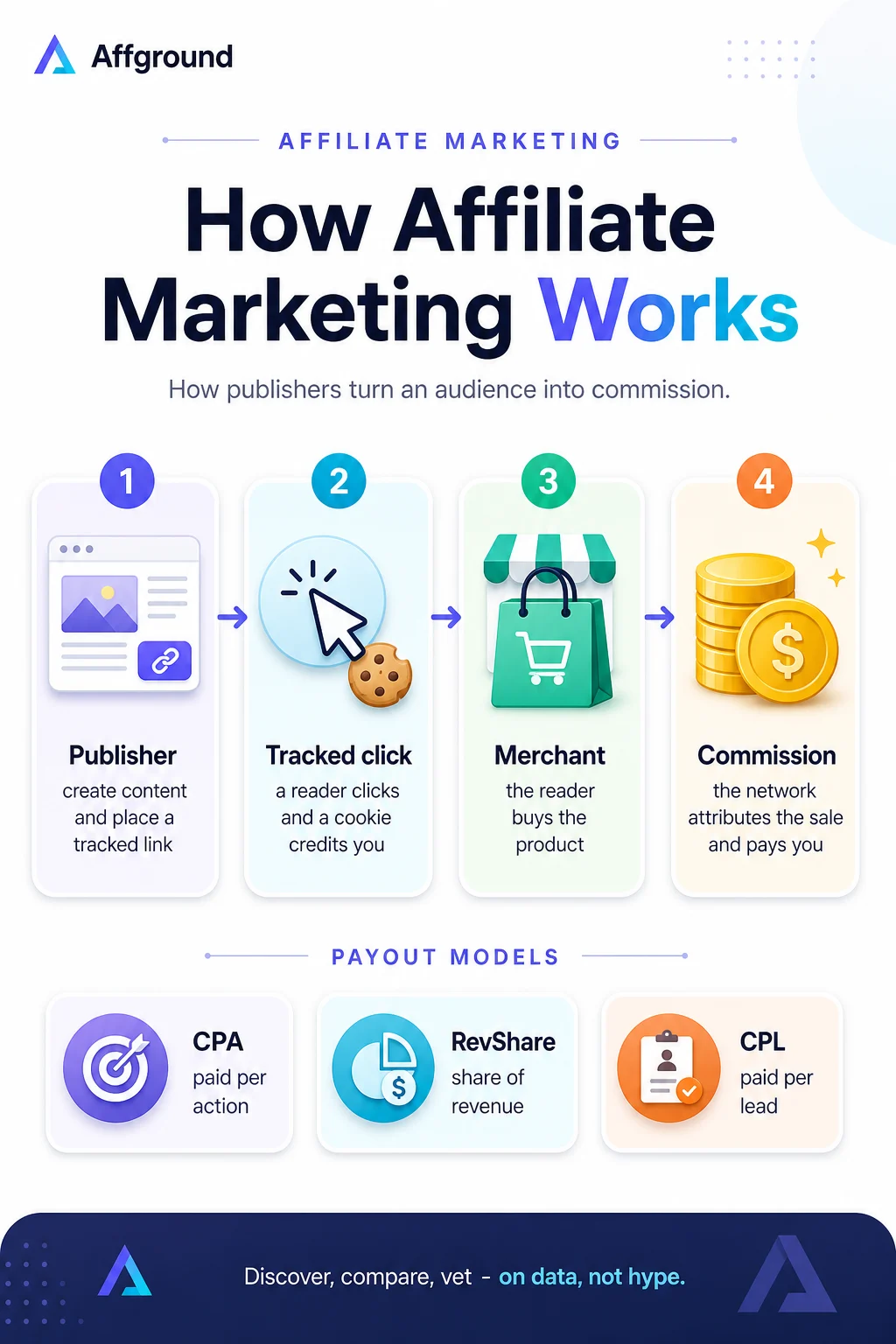
How affiliate marketing works, at a glance — from a publisher's tracked link to a paid commission, and the payout models in between.
What is affiliate marketing, really?
Strip away the jargon and affiliate marketing is just this: a performance-based partnership. You — the publisher (a blogger, reviewer, newsletter writer, YouTuber or comparison site) — recommend a merchant's product using a special link that is tagged to you. A reader clicks it, buys something, and the merchant pays you a slice of the sale. No click, no sale, no cost to anyone. Pure pay-for-results.
Here is the mental model that makes it click: you are the well-informed friend everyone texts before buying something. "Which robot vacuum should I get?" "Is that course actually worth it?" "Best VPN for travel?" You already answer these questions for free. Affiliate marketing simply pays you when your recommendation leads to a purchase — without changing the honest advice you would have given anyway.
The keyword is performance. A billboard charges whether anyone looks. A sponsorship pays a flat fee no matter what happens next. Affiliate marketing only pays when you deliver a real customer. That is exactly why brands adore it (zero wasted spend) and why it scales so beautifully for publishers (no inventory, no support tickets, no payment processing — just recommendations that happen to earn).
Affground's take: the publishers who win at affiliate marketing stop thinking of it as "putting links in posts" and start treating it as a media business whose product is trusted recommendations. The link is the last 1%. The trust is the other 99% — and it is the only part competitors cannot copy.
Trust is the real asset: an engaged audience that believes your picks is what converts clicks into commission.
Affiliate marketing vs the other ways to monetize
Affiliate income is not the only way to make money from an audience — but for most publishers it hits a sweet spot the others miss. Here is the honest comparison:
Model
You earn from
Upside
The catch
Affiliate
Commissions on what you recommend
No product, scales with content, compounds
Needs traffic with buying intent
Display ads
Impressions and clicks on banners
Passive, easy to set up
Pennies per visitor; needs huge volume
Sponsorships
Flat fees from brands
Predictable, paid upfront
Caps out; you trade time for money
Your own product
Full price of each sale
Highest margins, total control
You build, ship, support and refund everything
Dropshipping
Markup on each order
Real store, real margin
Logistics, ads and customer-service headaches
Display ads pay in pennies and need oceans of traffic. Sponsorships are nice but cap out — there are only so many you can run before your audience tunes out. Building your own product is the highest-ceiling play, but it is also a full-time job with refunds and support attached. Affiliate marketing sits in the gap: higher value than ads, more scalable than sponsorships, and dramatically less work than your own product. Plenty of publishers eventually do all of the above — but affiliate is usually where they start, because the only thing you have to make is content.
How affiliate marketing actually works
Behind every commission are four players and one piece of quiet technology.
The publisher (you) — create content and place tagged affiliate links.
The customer — your reader, who clicks and buys.
The merchant (advertiser) — the brand whose product sells; they fund the commission.
The network or platform — the plumbing that generates links, tracks clicks, attributes sales and pays you. Some brands run this in-house; most plug into a network.
The part that quietly decides your income: tracking
When a reader clicks your link, a cookie (a small file in their browser) or a server-side postback records that the visit came from you. If they buy within the attribution window — anywhere from 24 hours to 90 days — the sale is credited to your account and a commission is logged.
That window matters more than beginners realize. People rarely buy on the first visit; they research, sleep on it, come back. A 24-hour cookie quietly forfeits all those later purchases. A 30- or 90-day window captures them. Two programs can advertise the "same" commission rate, and the one with the longer window can earn you noticeably more from the exact same traffic.
Get the tracking wrong and you essentially work for free. Affground's rule: before you promote anything, confirm three things — the cookie length, the attribution model (last-click vs first-click), and whether the program supports server-to-server tracking for the platforms you publish on.
The money: how affiliates actually get paid
Not every commission is built the same way, and the structure you are offered shapes both how much you make and how predictable it is.
CPA (Cost Per Action) — a fixed payout per sale or signup. Clean and easy to forecast. Great for high-volume traffic where you want predictable cash flow.
CPS / RevShare (Revenue Share) — a percentage of the sale, sometimes recurring for the customer's entire lifetime. This is where the serious money hides: send one loyal subscriber to a SaaS tool and you might earn every month for years.
CPL (Cost Per Lead) — a payout per lead, like a form fill or free-trial signup. Lower value each, but far easier to convert, which suits top-of-funnel content.
Hybrid — a smaller upfront CPA plus ongoing RevShare. The pragmatic default: it de-risks the acquisition while keeping the long-tail upside.
A worked example: the math of one buyer's guide
Numbers make this real. Imagine a single "best email marketing tools" guide that pulls 2,000 visitors a month from search. Say 8% click an affiliate link (160 clicks), and 4% of those convert (about 6 sales). On a tool paying 30% recurring on a $40/month plan, that is roughly $72 in new monthly recurring commission — every month. Stack twelve months of compounding signups and one well-ranked guide can quietly become a four-figure monthly asset. (Illustrative numbers — yours will vary by niche and traffic quality, but the shape is real.)
Affground's take: beginners obsess over the headline rate. Do not. A 50% commission on a $9 ebook you can barely sell is worth less than 8% on a $1,200 product your audience already wants. Always multiply commission × realistic conversion × order value before you judge an offer. The boring math beats the big number almost every time.
The numbers: why this channel is worth your time
Affiliate marketing stopped being a "side hustle" a long time ago. A few widely cited industry figures explain why publishers keep leaning in:
Metric
Where it stands
Global industry size
~$17B in 2023, projected past $35B by 2030
Brands running an affiliate program
~80% of advertisers
Share of online orders influenced
~16% of e-commerce sales in some markets
Typical commission range
5%–30% of sale value, higher in digital and SaaS
Time to first meaningful income
6–12 months of consistent publishing
The real headline is not that the channel is big — it is that it compounds. A piece you publish today keeps earning as it ranks, gets shared, and gets updated. Unlike an ad campaign that dies the moment you stop paying, good affiliate content is an asset that appreciates.
Affground predicts: as AI-generated content floods every niche, the premium will swing hard toward first-hand, demonstrably expert publishers. Programs will increasingly reward originality and audience trust over raw traffic — and the affiliates who actually test products and document real results will out-earn the faceless aggregators within a few years.
The publisher's funnel: where your money leaks
Every commission is the end of a small funnel, and knowing it shows you exactly where revenue slips away.
01Traffic — readers arrive from search, social, email or referrals.
02Clicks — a share of them click your affiliate link. Your click-through rate depends on placement, context and intent.
03Conversions — a share of clickers actually buy, decided by the merchant's page, price and your pre-sell.
04Commission — conversions × payout, minus any reversals.
The single most useful number here is EPC — earnings per click (your commission divided by clicks). EPC is the great equalizer: it lets you compare a RevShare SaaS deal against a flat-fee CPA offer on one honest figure, no matter how differently they are structured. Track it religiously and you will know within weeks which programs deserve more of your real estate and which to quietly retire.
Affground's rule of thumb: optimize for intent, not volume. One reader who searched "best X for Y" is worth dozens of casual browsers, because they arrived with a wallet already half-open.
Which niches actually work for publishers
You can run affiliate content in almost any niche, but they do not pay equally. Broadly:
High-ticket and recurring (SaaS, web hosting, finance, B2B tools) — fewer sales needed, RevShare compounds, commissions are generous. The publisher's dream, but competitive.
Considered purchases (electronics, home, fitness gear, hobbies) — healthy order values and buyers who research, which is exactly where reviews and comparisons shine.
High-volume and low-ticket (everyday consumer goods, fashion, books) — small commissions, but huge addressable audiences and easy conversions.
The trap is chasing the highest payout into a niche you know nothing about. Affiliate income follows credibility, and credibility follows genuine interest. You will out-research, out-write and out-last competitors in a niche you actually care about — and readers can feel the difference between someone who has used the thing and someone who spun up a page to grab a commission.
"Isn't affiliate marketing saturated?"
Short answer: the lazy end is saturated; the expert end is wide open. Yes, every niche has a hundred thin "top 10" pages stitched together for a commission. That is precisely the opportunity. Search engines and readers are both getting ruthless about rewarding genuine, first-hand expertise — the stuff copy-paste affiliates and generic AI cannot fake. If you have actually used the products, tested the tools, and can say something true that the other hundred pages cannot, you are not walking into a crowded room. You are one of the few people in it worth listening to. Saturation is only scary if your plan was to be average.
Where to start: networks vs direct programs
You can join a brand's program directly, or join a network that bundles thousands of programs behind a single login, dashboard and payment.
For most newcomers, a network is the faster on-ramp: apply once, browse offers across every vertical, and get consolidated reporting and one payout instead of ten. Direct programs can pay more and often hand you a dedicated manager, but they scatter your tracking and payments across a dozen logins. The usual path: start on a network to learn what converts, then go direct with the brands that earn you the most.
Here are two well-established networks publishers routinely start with, compared head-to-head:
Browse the full affiliate networks directory to filter by vertical, commission type and payout terms, then shortlist two or three that fit your audience and traffic.
How to write affiliate content that actually converts
Traffic is worthless if it does not convert, and conversion is mostly decided long before the reader reaches your link. A few principles do the heavy lifting:
Lead with the reader's decision, not the product. People do not want a spec sheet; they want to know which one is right for me. Frame every piece around a choice you are helping them make.
Be specific and first-hand. "I tested six and returned four" beats "this is a great product" every time. Concrete detail is the cheapest trust you can buy.
Earn the click with context. A link lands best right after you have made the case — not bolted on at the end. Put the recommendation where the decision happens.
Use comparison tables and clear verdicts. Buyers skim. Give them a scannable "best for X, best for Y" structure and a confident pick, and you remove the friction that quietly kills conversions.
Answer objections before they bounce. Price, alternatives, "is it actually worth it?" — handle the doubt on the page, or the reader will leave to handle it on someone else's.
Do this and your click-through and conversion rates climb on the same traffic — which, as the funnel showed, multiplies everything downstream.
The tools you'll actually need (and the ones you don't)
Ignore the bloated "ultimate stack" listicles. To start, you need surprisingly little:
A platform you control — ideally a website (a blog on your own domain is the best long-term, compounding asset), but a YouTube channel or newsletter works too.
Content that answers intent — reviews, comparisons and buyer's guides. This is 90% of the job.
A way to manage links — even a simple link-cloaking plugin or your network's deep-link tool keeps things tidy and trackable.
Analytics — your network's dashboard plus basic site analytics is enough to compute EPC and spot winners.
Email (eventually) — the highest-leverage upgrade once you have traffic, because it is the one audience you actually own.
Everything else — paid SEO suites, fancy automation, premium themes — is optional until you are earning enough to justify it. Do not let tool-shopping become a substitute for publishing.
How long until you make money? An honest timeline
Let us be real, because the "I made $10k in my first month" thumbnails are lying to you. Affiliate income is a slow build that then compounds fast:
Months 1–3: you are publishing and learning. Expect little to no income. This is the part most people quit during.
Months 3–6: early content starts ranking and trickling in your first commissions — often small, but proof the machine works.
Months 6–12: with consistency, the compounding kicks in. Older posts climb, you have learned what converts, and income starts to feel meaningful.
Year 2 and beyond: your back catalogue does the heavy lifting. New posts rank faster because your site has authority, and updates to old winners pay off immediately.
The honest truth: affiliate marketing rewards patience and punishes dabbling. The people who win are not the most talented — they are the ones still publishing in month nine when everyone else has wandered off.
Common mistakes that quietly kill affiliate income
Promoting before you have earned trust — links without credibility convert badly and can torch an audience you spent months building.
Chasing commission over fit — relevance beats rate every single time. A perfect-fit 6% offer outperforms a random 40% one.
Skipping disclosure — clear affiliate disclosure is not optional; it is legally required in most markets, and done well it increases trust rather than denting it.
Never reading the terms — attribution windows, payout thresholds and clawback clauses decide whether you actually get paid. Read them before you promote, not after.
Betting on one program — if a single advertiser cuts its rate (and they do), an undiversified affiliate can lose half their income overnight. Spread across a few.
Writing for Google instead of humans — keyword-stuffed pages that help no one are exactly what the next algorithm update is built to bury.
How to start as a publisher: your first 30 days
01Pick a niche you can be genuinely credible in — interest first, payout second. Credibility is the moat.
02Choose a network or two that serve your vertical and accept your traffic type.
03Apply and get approved — add your site, traffic sources and promotion methods honestly; thin applications get rejected.
04Publish three intent-driven pieces — a review, a comparison and a "best X for Y" guide. These convert far better than generic posts.
05Place tracked links naturally and disclose them — in context, where a reader is already deciding.
06Measure EPC and conversion, then double down on what earns and quietly cut what does not.
Do that for thirty days and you will have something most aspiring affiliates never build: a real, measurable foundation instead of a folder of half-finished drafts.
Affground's verdict
Affiliate marketing is that rare channel where doing right by your reader and growing your revenue point in the same direction: the more genuinely useful you are, the more you earn. The mechanics — links, cookies, payout models — take an afternoon to learn. The advantage that actually compounds is trust, built one honest recommendation at a time.
So start with one niche, one or two networks, and content written for people who are ready to act. Track your EPC, reinvest in what works, and let the compounding do the quiet, patient thing it does. That is the entire game — and Affground is betting it only gets more rewarding for publishers who lead with genuine expertise.
Frequently asked questions
Is affiliate marketing free to start?
Yes — joining a reputable affiliate network or program is free. Your real costs are the time and content you invest to build an audience that trusts your recommendations. Be wary of any 'affiliate program' that charges an upfront fee to join.
How much can publishers earn from affiliate marketing?
Earnings vary enormously by niche, traffic quality and payout model. Beginners often make little in the first 6–12 months, while established publishers in high-value verticals like SaaS, finance and hosting can earn four to six figures a month. The honest metric to track is EPC (earnings per click), not headline commission rates.
How long does it take to make money with affiliate marketing?
Most publishers need 6–12 months of consistent, intent-driven content before affiliate income becomes meaningful, because it depends on building both traffic and trust. Content that ranks and gets updated keeps compounding well beyond that.
What is the difference between an affiliate network and an affiliate program?
An affiliate program is run by a single brand for its own products. An affiliate network aggregates thousands of programs behind one dashboard with consolidated tracking, reporting and payouts. Networks are usually the faster start; direct programs can pay more but fragment your tracking.
Do I need a website to be an affiliate?
No, but you need a platform where you can place tracked links and build trust — a blog, YouTube channel, newsletter or social following all work. A website you own gives you the most control and the best long-term, compounding asset.
What is a cookie window in affiliate marketing?
It is the period after a reader clicks your link during which a resulting conversion is still credited to you. Windows commonly range from 24 hours to 90 days. Longer windows favour publishers because buyers often return later to purchase.
Is affiliate marketing legal, and do I have to disclose links?
Yes, it is legal, and yes — you must clearly disclose affiliate relationships in most markets (for example, the FTC requires it in the US). Clear disclosure is both a legal requirement and a trust signal that, done well, improves conversions.