How sub-affiliate (referral) commissions work, what 5–10% overrides really pay on MaxBounty, FlexOffers, MyLead and Bybit, and when recruiting affiliates is worth it — including where listing data disagrees with official terms.
Nov 7, 2026 · 7 min read
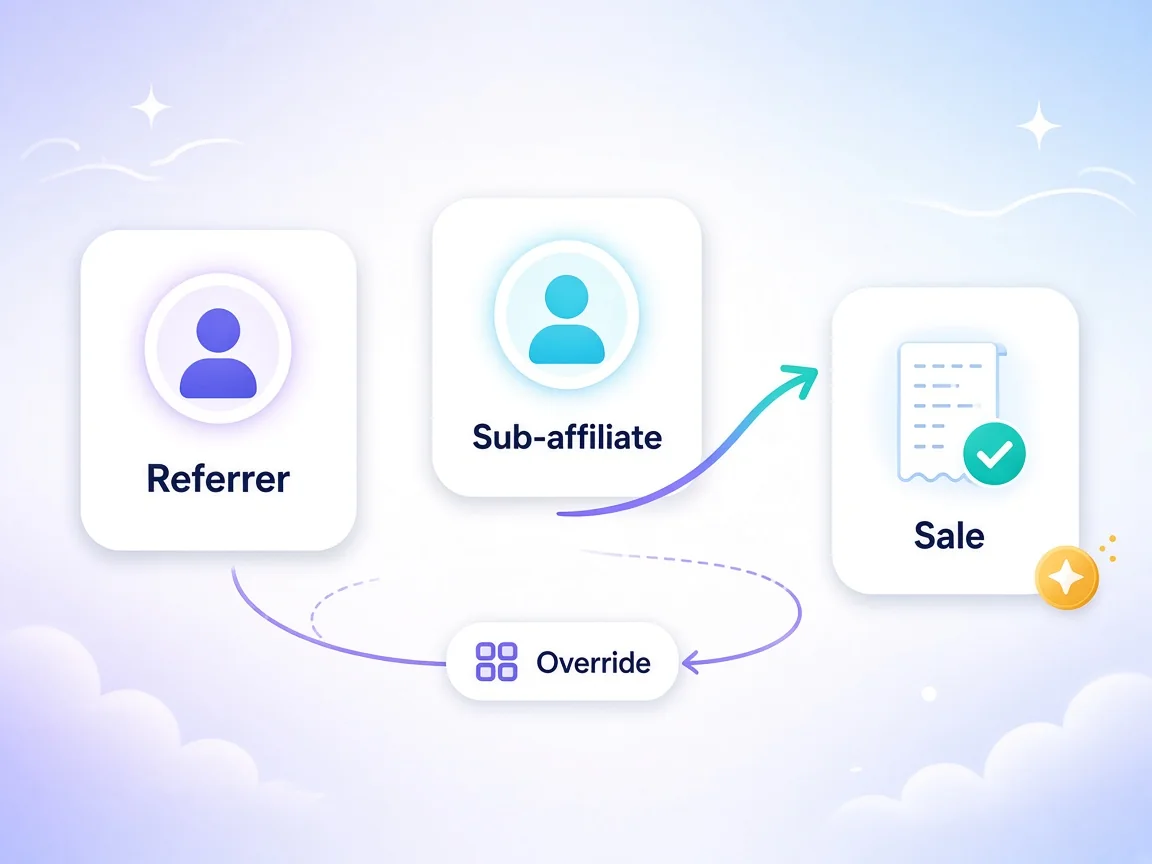
Second-tier affiliate marketing (also called a sub-affiliate or affiliate referral program) pays you a cut of the commissions earned by publishers you recruit into a network or program. You still earn your own first-tier commissions on sales you generate; the second tier is an override on someone else's performance.
That model suits creators who already teach, review or community-build around affiliate marketing — and it is a weak primary strategy for everyone else. This guide is for publishers deciding whether recruiting affiliates is worth the effort, how the typical rates work, and which Affground-listed programs actually pay a real second tier (versus a performance tier that only looks similar).
What second-tier actually means
In a first-tier relationship you promote an offer and earn when a visitor converts. In a second-tier relationship you promote the network or program itself to other affiliates. When someone joins through your referral link and later earns commissions, the network pays you a percentage of those earnings — usually from its own margin, so the recruited affiliate keeps their full payout.
Three labels get mixed up in the wild:
Second-tier / sub-affiliate / referral program — you earn on affiliates you recruit. That is this article.
Performance tiers (Bronze/Silver/Gold, Starter/Elite) — higher your own commission once you hit volume. Not second-tier.
MLM / multi-level marketing — deep downlines beyond one recruitment hop. Serious affiliate networks almost never do this; most second-tier programs stop at one level.
If a landing page says "tiers" without spelling out that you get paid when other affiliates earn, assume it means performance tiers until the terms prove otherwise.
How the money flows
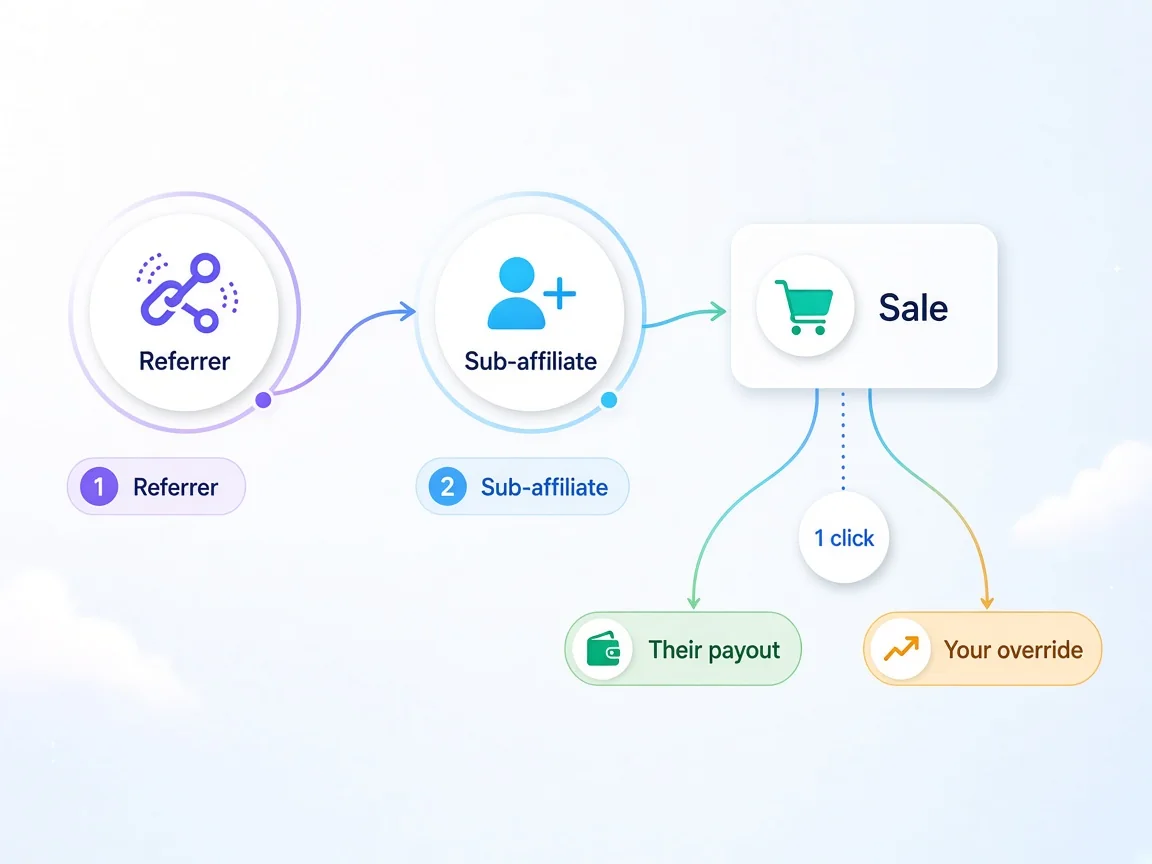
One sale can fund two cheques: the sub-affiliate's commission and your override.
The loop is short:
01You share a referral link from the network or program dashboard (not an offer link).
02A new affiliate applies through that link and gets approved.
03They promote offers and generate first-tier commissions as usual.
04You receive an override — a fixed percentage of their eligible earnings for a defined window, or for as long as they stay active, depending on the program.
05Payouts follow the network's normal schedule and threshold; referral bonuses often sit in the same balance as offer commissions.
Critical mechanics to check in the terms before you recruit anyone:
Base of the percentage. Is it their gross commissions, net revenue after advertiser funding, or only certain offer types? Bonuses, ad-network accounts and referral income are often excluded.
Duration. Lifetime, twelve months, six months, or first payment only.
Who pays. Almost always the network — the sub-affiliate should not see a reduced rate.
Caps and VIP rules. Crypto and exchange programs sometimes cap the combined rebate when a VIP client is involved.
The numbers: listing data vs official terms
Affground listings store a has_second_tier flag and a second_tier_rate. Those fields are useful for discovery, but they lag when networks rewrite referral programs. Verified against official pages where available:
6 months after approval (Give 10/Get 10; was 5% for 12 months). Referred affiliates get +10% on their first payment; $100 bonus at 10 approved referrals
Master/sub structure. For VIP clients, combined rebates are capped at 50% of trading fees — if the sub already takes 50%, the master gets 0% on that client
Not publicly documented as a classic sub-affiliate override for marketplace partners
PartnerStack's own product affiliate program is single-tier (15% of first-year contract value). Treat the 10% listing rate as listing-only until a merchant's program terms say otherwise
Official program is single-tier: 30% recurring for up to 12 months, 180-day cookie. Starter / Sprocket / Elite are performance tiers, not sub-affiliate commissions
Takeaways from that table: three networks (FlexOffers, MyLead, MaxBounty) publish clear publisher-referral programs in the 5–10% band; Bybit pays a documented 10% master override with a VIP cap; HubSpot's listing flag is wrong for second-tier; PartnerStack's listing rate is unverified on public pages.
For context on how those overrides actually clear into cash, see how affiliate payouts work. Second-tier income sits on top of the same thresholds, net terms and reversal rules as first-tier commissions.
When recruiting affiliates is worth it
Second-tier pays when you already have distribution to other marketers — a YouTube channel about media buying, a newsletter for indie publishers, a Slack or Discord community, a course, or a comparison blog that ranks for network reviews. In those cases the incremental cost of adding a referral CTA is low and a few productive sub-affiliates can out-earn a mediocre offer for months.
It is usually not worth building a recruitment funnel from scratch if:
Your audience is end consumers (shoppers, SaaS buyers, travellers), not affiliates.
The override lasts only a few months and your recruits churn fast.
The network's approval bar is low and referral traffic is mostly fraud or tire-kickers — your brand takes the hit, not just your override.
You would rather deepen first-tier EPC on offers you already understand.
A practical decision rule: if you cannot name three places you already reach affiliates weekly, treat second-tier as a bonus link in your footer, not a growth plan. Put the hours into finding programs that fit your niche and improving first-tier conversion instead.
Where to start
If your audience does include affiliates, start with networks that publish the override in writing, then add vertical programs only when the terms match. These six Affground listings are the shortlist for this topic — read the official-vs-listing notes above before you promote any of them as "second-tier":
For CPA-style recruitment, MaxBounty, FlexOffers and MyLead are the clearest documented options in that set. Bybit fits crypto educators who already run a master/sub structure (see also best crypto affiliate programs). PartnerStack remains excellent for promoting B2B SaaS as a first-tier partner — use how to use PartnerStack for that workflow, not as a proven second-tier play. HubSpot belongs in a CRM shortlist for its 30% recurring first-tier terms (best CRM affiliate programs), not for sub-affiliate income.
Common mistakes
Confusing performance tiers with second-tier. HubSpot Elite and PartnerStack partner tiers raise your rate; they do not pay you when someone else joins.
Promoting an outdated rate. MaxBounty's public case study and reviews now describe 10% for six months, not the older 5% for twelve months still frozen on some directories.
Ignoring the base of the percentage. FlexOffers FlexCash is on NET revenue of referred publishers; Bybit's 10% is an override of the sub's rebate, not of trading volume.
Recruiting into a program with no real second-tier. If official pages never mention a publisher referral link, do not invent one from a listing flag.
Spamming network signup links. Networks reverse referral bonuses for fraud, duplicate accounts and non-compliant traffic the same way they reverse offer commissions.
Expecting second-tier to replace offer work. Overrides are a multiplier on other people's output. Without first-tier skill — or recruits who have it — the percentage is noise.
How to turn on a second-tier stream
01Confirm the terms on the official site or in-dashboard docs — rate, duration, exclusions, and whether referred publishers keep their full commission.
02Get your referral link from the network's referral / FlexCash / Recommend tab (separate from offer tracking links).
03Disclose the relationship wherever you recommend the network; readers should know you earn if they join.
04Send traffic that can actually get approved — real sites, real traffic sources, honest applications beat mass signup campaigns.
05Track referrals in the panel for 30–60 days before judging the channel; most overrides need the sub-affiliate to clear validation and hit payout.
06Reinvest only after first-tier is stable. Use second-tier as optional leverage once your own offer economics work.
Affground's verdict
Second-tier is a real, narrow tool: valuable when you already reach affiliates, documented at roughly 5–10% on the networks that publish it, and frequently mislabelled on directories that confuse performance tiers with sub-affiliate overrides. Verify the official page, then recruit — never the other way around.
Frequently asked questions
What is second-tier affiliate marketing?
It is a referral model where you earn a percentage of the commissions generated by affiliates you recruit into a network or program, on top of any first-tier commissions you earn from your own traffic.
Is second-tier the same as multi-level marketing?
No. Most affiliate second-tier programs pay only one recruitment level (you → sub-affiliate). They are not deep MLM downlines. Performance tiers that raise your own rate are also different.
What second-tier rates do networks typically pay?
On programs that publish the terms, overrides commonly sit around 5–10% of the recruited affiliate's eligible earnings. FlexOffers and MyLead list 5%; MaxBounty's current Give 10/Get 10 program pays 10% for six months; Bybit pays a 10% master override of the sub-affiliate's rebate.
Does HubSpot have a second-tier affiliate program?
No. HubSpot's official affiliate program is single-tier: 30% recurring for up to 12 months with a 180-day cookie. Starter, Sprocket and Elite are performance tiers based on your own signups, not commissions on other affiliates.
Who pays the second-tier commission — the network or the sub-affiliate?
Almost always the network, from its own margin. Legitimate programs state that referred publishers keep their full first-tier payout; your override is paid on top.
When is recruiting affiliates worth the effort?
When you already reach other marketers through a channel, community, course or review site. If your audience is end consumers, second-tier is usually a weak primary strategy compared with improving first-tier offer conversion.
Why does Affground's listing rate differ from the official page?
Listing fields can lag program changes. MaxBounty moved from 5% for 12 months to 10% for 6 months; HubSpot's listing still shows a second-tier flag even though the official program is single-tier. Always verify the live terms before promoting a referral link.