What Is a CPA Network? How Offers and Payouts Work
How CPA networks actually work: offer terms, payout types, caps, affiliate managers, validation and net terms, and what decides when you get paid.
Oct 16, 2026 · 8 min read
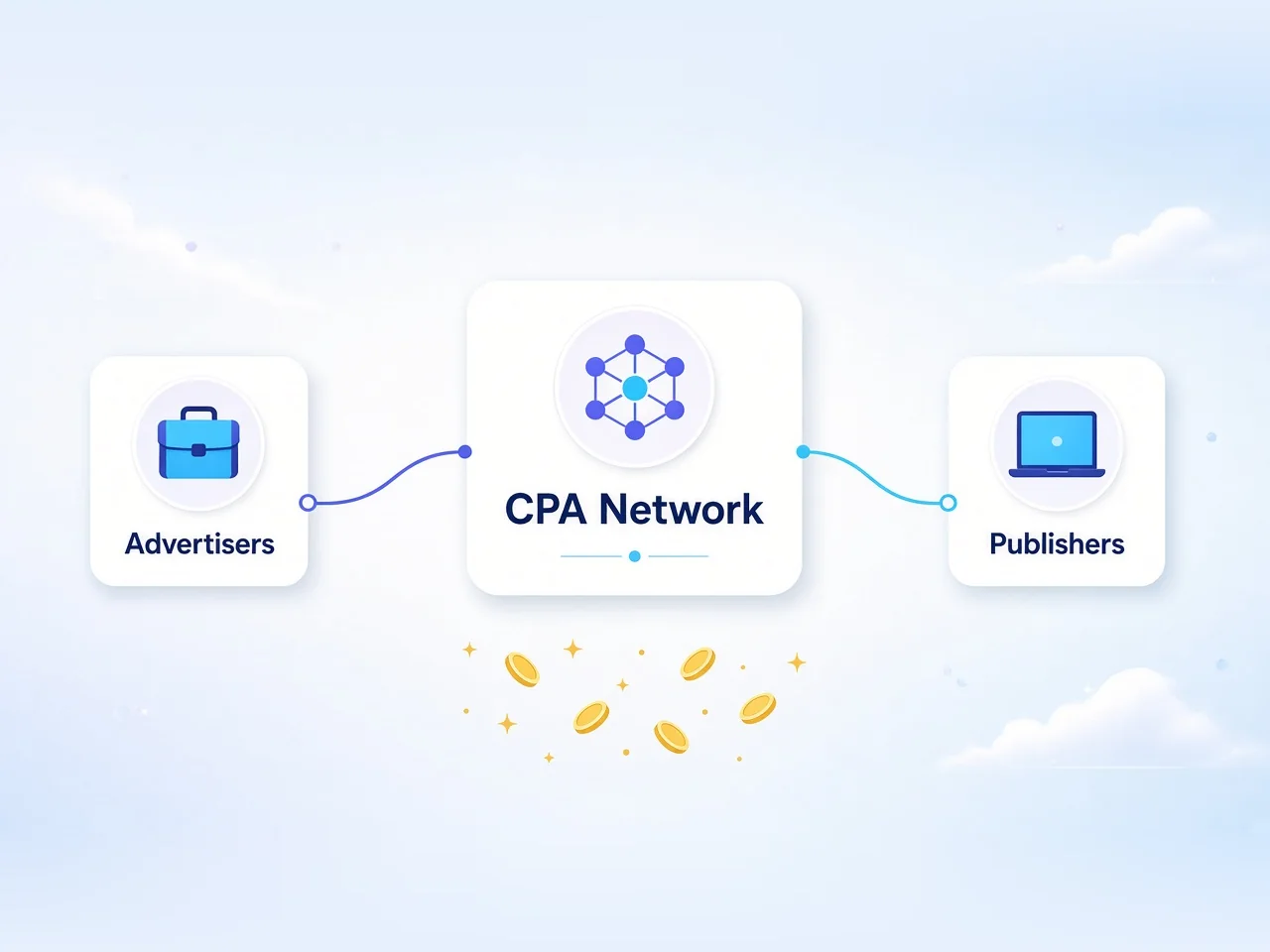
A CPA network is a marketplace that pays publishers a fixed amount when a visitor completes a specific action, such as a lead form, a trial signup, an app install or a first purchase. CPA stands for cost per action: the advertiser pays for outcomes, not impressions or clicks, and the network sits in the middle handling offers, tracking and payment.
This guide is for publishers and media buyers who already know the difference between CPA networks and affiliate networks and now want the mechanics: how offers are structured, why caps exist, what an affiliate manager actually does and how decide when the money arrives.
net terms
What a CPA network actually is
A CPA network signs advertisers who want a defined result and packages each request as an offer. Publishers apply to the network once, then request access to individual offers. When traffic converts, the network records the action, bills the advertiser and pays the publisher a fixed payout per approved action, keeping the spread between the two as its margin.
That middle position is the whole business. The network carries the credit risk of collecting from advertisers, runs the tracking platform, reviews traffic quality and decides who gets access to the best offers. It is a different shape from a classic affiliate network, where commission is usually a percentage of a sale tied to one merchant's program. If you are still weighing payout models, CPA vs revenue share vs hybrid covers that decision.
How a CPA offer works, step by step
Every offer follows the same loop, whatever the vertical.
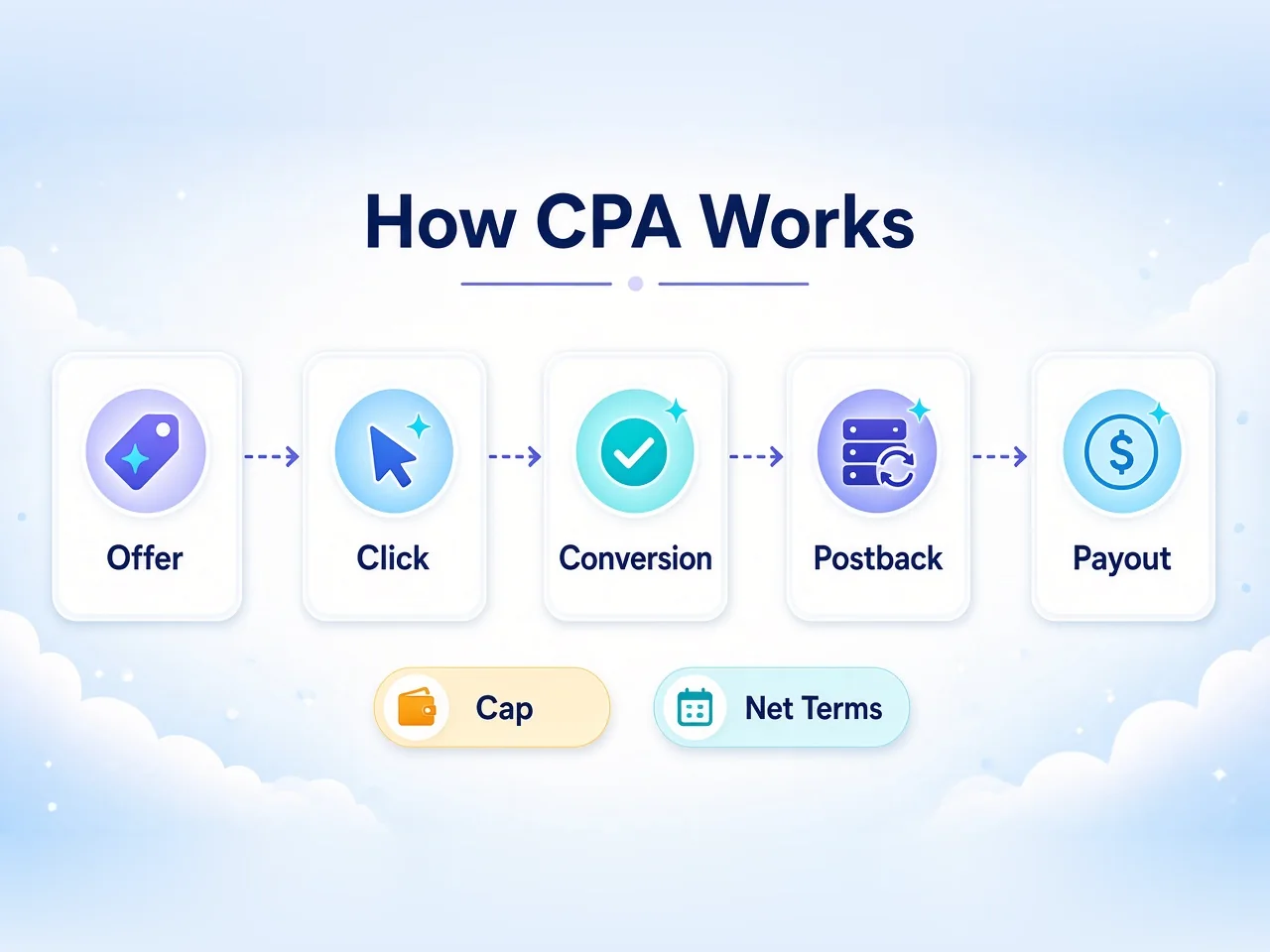
01Offer. The advertiser defines the action, the payout, the allowed traffic sources and the countries it will accept.
02Click. The publisher sends visitors through a tracking link that carries a click ID and, ideally, your own sub-IDs for source and placement.
03Conversion. The visitor completes the action on the advertiser's page.
04Postback. The advertiser's system fires a server-to-server call back to the network with the click ID, so the conversion is attributed to you.
05Payout. After validation and the payment cycle, the approved conversions are paid out.
Caps limit how many conversions get paid; net terms decide when they do
Tracking quality decides whether step four happens reliably. Server-side postbacks are the standard on serious networks because they survive ad blockers and browser cookie limits better than pixels; pixel vs postback tracking explains the trade-off, and using sub-IDs shows how to see which placement produced each conversion.
The anatomy of an offer
An offer page is a contract in compressed form. Read every field before you send a click.
Field
What it means
Why it matters
Payout
Fixed amount per approved action
Compare it with your traffic cost, not with other offers in isolation
Conversion type
CPL (lead), CPS (sale), CPI (install), SOI or DOI (single or double opt-in)
Harder actions pay more but convert less
GEOs
Countries the advertiser accepts
Out-of-GEO traffic is usually unpaid
Allowed traffic
Search, social, email, push, native, incentivised and so on
Using a restricted source is the fastest route to reversals
Cap
Maximum paid conversions per day, week or month
Traffic sent past the cap may go unpaid
Landing page rules
Approved creatives, claims and pre-landers
Unapproved claims, especially in nutra and finance, get accounts closed
Validation window
How long the advertiser can review and reject actions
Determines how final your reported earnings are
Payout types
CPL and SOI/DOI offers pay for a lead or an email signup, so they convert easily and pay modestly. CPS and first-deposit offers pay only when money changes hands, so payouts are higher and conversion rates lower. CPI pays per app install, often with a requirement that the user opens the app. Some networks also run revshare or hybrid deals on the same offer, which turn a one-off payout into ongoing income at the cost of waiting longer to see it.
Caps: why your best offer can stop paying
A cap is the ceiling on conversions an advertiser will pay for in a period. Advertisers set caps because their sales team can only call so many leads, their budget is fixed, or they are testing a new source before scaling. Networks pass those limits down to publishers, sometimes per affiliate.
Caps matter because conversions above them are often unpaid or redirected to a fallback offer. Three habits keep you on the right side of them:
Ask your manager whether the cap is global (shared across all affiliates) or per affiliate.
Check the cap status before scaling a campaign, and again mid-day if you buy traffic.
Request a cap increase with evidence: lead quality, refund rates and steady daily volume carry more weight than a raw conversion count.
Affiliate managers: what they do and why they matter
Most CPA networks assign each approved publisher an affiliate manager. Their job is to place good traffic on offers that fit it. In practice they approve offer access, negotiate payout bumps and cap increases, share which offers are converting for similar traffic, and warn you before an offer pauses.
The relationship is commercial. Managers prioritise publishers who send consistent, clean volume and answer questions honestly about traffic sources. Being upfront about where your traffic comes from at signup prevents most rejected applications and nearly all reversal disputes later.
Net terms and payment schedules
Net terms describe how long after a billing period closes you get paid. Net-30 means the earnings for a month are paid about 30 days after that month ends; Net-15 and Net-7 shorten the gap, and some networks pay weekly once you have a track record.
Term
What happens
Who it suits
Net-30
Period closes, payment follows roughly a month later
New accounts; the most common starting term
Net-15 / Net-7
Faster payout after the period closes
Proven publishers with stable volume
Weekly
Paid every week, usually after approval
High-volume media buyers who need cash flow for ad spend
Minimum threshold
Earnings carry over until they pass a set amount
Small sites; check it before you start
The delay exists because advertisers validate conversions before paying the network. During that window, actions can be scrubbed (rejected as fraud, duplicates or out-of-GEO) or reversed (a sale is refunded or a lead is invalid). The network deducts those before payment, which is why your dashboard figure and the amount paid can differ. If you buy traffic, model that gap into your cash flow, because ad platforms bill you long before Net-30 clears.
How networks decide who gets approved
Applications to CPA networks are reviewed by people, and the bar is higher than at most retail affiliate programs. Expect questions about your traffic sources, monthly volume, verticals you have run and, sometimes, a call. Networks are protecting advertisers from fraud and incentivised traffic, so vague answers read as risk.
What helps: a real site or a documented paid-traffic history, screenshots of previous campaign stats, and a clear statement of which verticals and GEOs you plan to run. New publishers often start with lower-risk lead-generation offers and earn access to premium offers after a few clean payment cycles.
Where to start
These networks cover a useful spread: a large North American lead-gen network, a broad global network, a nutra-focused network with its own offers, and a Europe-based network that is popular with newer publishers. The embed pulls live listing data from the Affground directory.
Global CPA/CPL network with 4,000+ offers and low payouts.
Affiliate NetworkMobile AppseCommerceDating
Commission
CPI
Min payout
$20
Cookie
You can compare more options on the networks directory, and if you run health offers, our shortlist of nutra CPA networks goes deeper on that vertical.
Common mistakes
Chasing the highest payout instead of the best margin after traffic cost and reversals.
Ignoring traffic restrictions, especially sending incentivised, email or brand-bidding traffic to offers that forbid it.
Scaling past a cap without checking it, then discovering a day of unpaid conversions.
Skipping postback setup and relying on a pixel that loses conversions.
Treating dashboard revenue as cash before the validation window and net terms have passed.
Hiding your real traffic source from your manager, which turns a fixable issue into a closed account.
Step-by-step: running your first CPA offer
01Apply to one or two networks with honest details about your traffic, verticals and GEOs.
02Talk to your manager about offers that suit that traffic, then request access.
03Read the full offer terms: payout, conversion type, GEOs, allowed sources, cap and creative rules.
04Set up postback tracking and sub-IDs before sending a single click.
05Launch with a small test budget or a limited placement, and track cost per conversion against payout.
06Watch for scrubs and reversals over the first payment cycle before you scale.
07Once results hold, ask for a cap increase or a payout bump with your quality data in hand.
Affground's verdict
A CPA network is a broker of outcomes. The payout gets attention, but caps, traffic rules, validation and net terms decide what you actually get paid and when. Publishers who read the offer terms, track by postback and treat their affiliate manager as a partner tend to last.
Frequently asked questions
What does CPA stand for in affiliate marketing?
CPA stands for cost per action. The advertiser pays a fixed amount each time a referred visitor completes a defined action, such as a lead form, signup, install or purchase, rather than paying for impressions or clicks.
How is a CPA network different from an affiliate network?
A CPA network aggregates many advertisers' offers and pays a fixed amount per approved action, managing tracking, fraud review and payment in the middle. A classic affiliate network usually hosts individual merchant programs that pay a percentage of each sale.
What is a cap on a CPA offer?
A cap is the maximum number of conversions an advertiser will pay for in a day, week or month. Conversions sent after the cap is reached may go unpaid or be redirected, so check cap status with your affiliate manager before scaling.
What does Net-30 mean on a CPA network?
Net-30 means earnings for a billing period are paid roughly 30 days after that period closes. Networks often move reliable publishers to shorter terms such as Net-15, Net-7 or weekly payments.
Why were some of my CPA conversions scrubbed or reversed?
Advertisers validate conversions before paying. Actions can be rejected as fraud, duplicates, out-of-GEO or from a forbidden traffic source, and sales can be reversed after refunds. Those are deducted before payout.
Do I need a website to join a CPA network?
Not always. Many CPA networks accept media buyers who run paid traffic, but they will ask for your traffic sources, volume and past results, and a site or documented campaign history makes approval easier.
Can beginners get approved by CPA networks?
Yes, but approval is manual and stricter than most retail programs. Be honest about your traffic, start with lower-risk lead-generation offers and build a clean record before requesting premium offers.