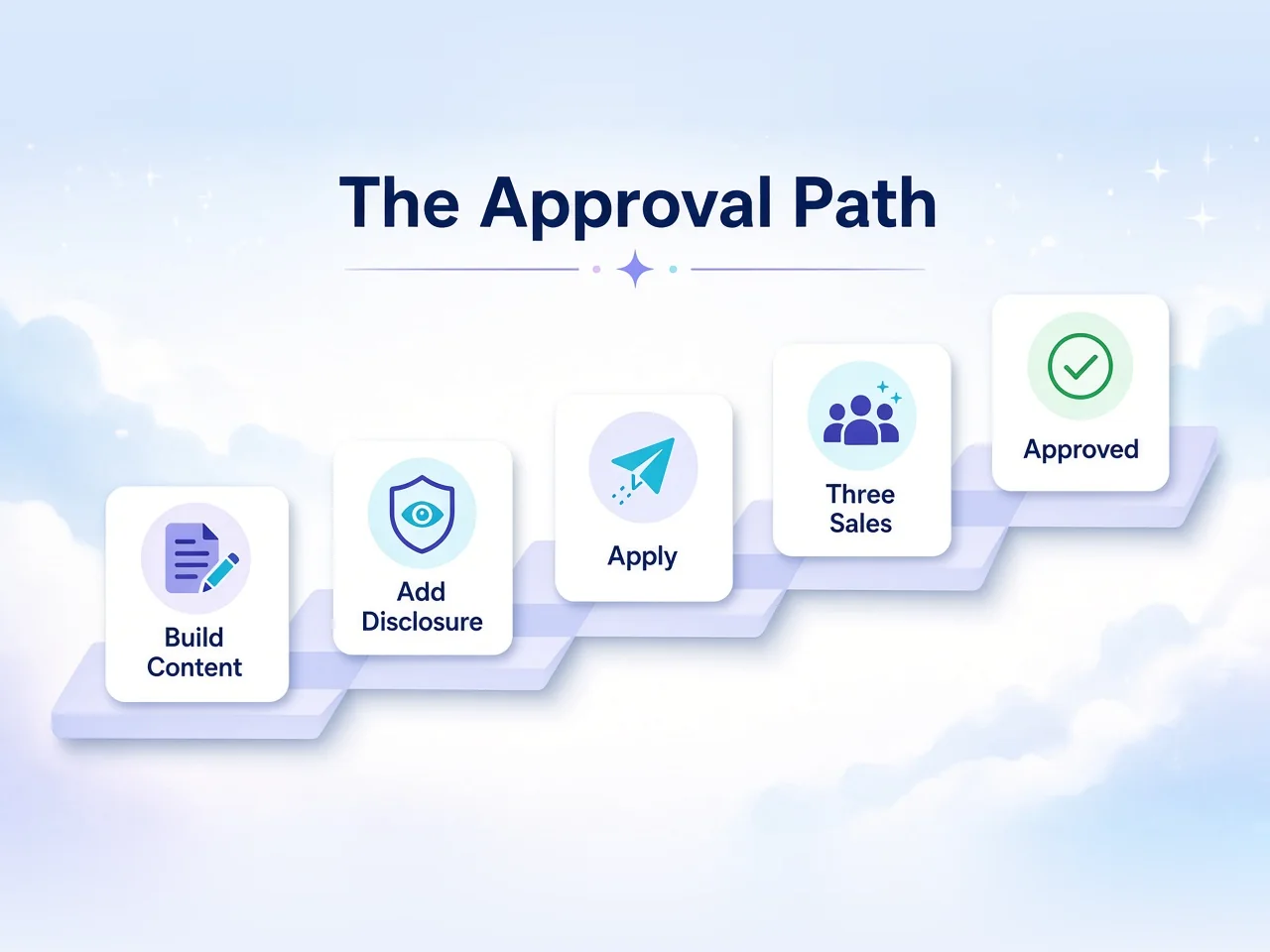
Amazon gives new Associates 180 days to make three qualified sales. Here is how to prepare your site, earn those first sales and avoid the common rejection reasons.
Oct 16, 2026 · 6 min read
Getting into Amazon Associates is easy; staying in is the hard part. Amazon accepts most applications on the spot, then gives you 180 days to refer three qualified sales. Miss that, and the account is closed, whatever your site looks like.
This guide is for bloggers, YouTubers and social creators who want to pass that first review without starting over. It covers what Amazon checks, how to get the site ready before you apply, how to earn the first three sales cleanly, and the rejection reasons that catch most new accounts.
How Amazon Associates approval actually works
Amazon's process has two stages, and most people only prepare for the first.
01Application. You submit your website, app or social accounts, describe your audience and how you drive traffic, and set up tax and payment details. You get your tracking ID straight away and can start linking.
02Final review. Once your account has referred three qualified sales within 180 days, Amazon reviews your account, including your site, links and disclosures, against the Operating Agreement and Program Policies. Pass, and you are a full Associate. Fail, or never reach three sales, and the account is closed.
"Qualified" matters. Your own purchases, orders from family or friends you prompted, and orders driven by incentives don't count and can get you banned. The sales have to come from genuine visitors clicking your links.
The rules at a glance
Rule
What Amazon requires
Sales to clear review
3 qualified sales within 180 days of applying
Disclosure
The statement "As an Amazon Associate I earn from qualifying purchases" on your site or channel
Cookie window
24 hours from the click; 90 days for items added to the cart during that 24 hours
Payment timing
Paid about 60 days after the end of the month the earnings occurred in
Price display
No hard-coded prices that can go stale; show live prices only through Amazon's approved tools
Link placement
No links in emails, PDFs, e-books or other offline content
Self-purchases
Not allowed through your own links
Rates differ by product category and change from time to time, so check Amazon's current fee schedule rather than an old blog post.
Get your site ready before you apply
The 180-day clock starts when you apply, so don't apply with an empty site. Amazon doesn't publish a minimum post count, but the reviewer needs to see a real, finished property that adds value.
The 180-day clock starts at step three, so finish the first two first
A readiness checklist
Original content that is already live, not "coming soon" pages. Product reviews, comparisons and how-to posts in one niche make your intent obvious; our guide to writing product reviews that convert shows the format.
Content with buying intent. Posts that answer "which one should I buy" get clicks that turn into sales; general news rarely does.
Clear navigation and basic pages: about, contact and a privacy policy.
The Amazon disclosure in place before your first link. On WordPress, adding affiliate disclosures takes a few minutes.
Public access. No password protection, no members-only areas for the content you list in the application.
Accurate application details. The URLs, traffic methods and audience you describe should match what the reviewer finds.
Social and video creators can apply with their channels instead of a website. The same logic holds: an active account with original, relevant content and a disclosure in your descriptions or bio. Amazon's separate Influencer Program has its own eligibility rules and isn't the same application.
How to get your first three sales
Three sales sounds trivial until a new site gets a few dozen visits a week. These tactics stay inside the rules.
01Link from your highest-traffic pages first. Add Amazon links to existing posts that already rank or get shared, rather than waiting for new ones.
02Target low-competition buying keywords. "Best X for Y" and "X vs Y" searches with narrow modifiers bring fewer, better visitors.
03Use Amazon's cart window. Anything a visitor adds to their cart within 24 hours of your click is credited if they buy within 90 days, so links to items people consider over time still count.
04Share genuinely useful posts in communities where you're an active member and links are allowed. Read the community's rules first.
05Link to the products people actually buy in your niche, not just the most expensive ones. Every item in the visitor's cart can earn commission, not only the one you linked.
Common rejection and closure reasons
Most failed reviews come from a short list of avoidable problems.
Reason
What it looks like
How to fix it
Fewer than 3 sales in 180 days
Account closed automatically
Apply only once content and traffic exist
Missing disclosure
No Amazon Associate statement on site or channel
Add it sitewide and near links
Thin or unfinished site
Placeholder pages, very few posts, copied content
Publish original, useful posts before applying
Mismatched application
Listed URLs or traffic methods don't match reality
Keep application details current in your account
Prohibited promotion
Links in emails or PDFs, incentives, self-purchases
Remove them and stick to on-site and on-channel links
Stale or invented prices
Hard-coded prices or price claims that drift
Remove prices or use Amazon's approved tools
Restricted content
Content that breaks Amazon's policies
Review the Program Policies before you apply
If your account is closed
A closed account isn't permanent. If you missed the three-sale window, you can usually submit a new application once your site has more content and traffic, and the 180-day window starts again. If the closure was for a policy violation, fix the issue completely before reapplying, because a second review will look at the same things.
To avoid going through it twice, wait until your site has steady traffic, apply, then put your effort into the posts most likely to drive sales in the first few months.
Where Amazon fits in your mix
Amazon converts well because shoppers already trust it, but the short cookie and category rates mean many publishers pair it with other programs. If you're weighing that trade-off, Amazon Associates vs ShareASale compares it with a multi-merchant network.
02Publish a set of original reviews, comparisons and guides, plus about, contact and privacy pages.
03Add the Amazon Associate disclosure sitewide.
04Apply with accurate URLs, traffic methods and audience details.
05Add your tracking links to the pages that already get the most traffic.
06Monitor clicks and orders in your Associates dashboard each week.
07Once you reach three qualified sales, keep your site compliant while Amazon completes its review.
Affground's verdict
Amazon approval is a traffic test, not a paperwork test. Build the site first, put the disclosure in place, apply when real visitors are already arriving, and the three-sale review takes care of itself.
Frequently asked questions
How many sales do I need to get approved for Amazon Associates?
You need three qualified sales within 180 days of applying. Once you reach them, Amazon reviews your account and site; if you don't, the account is closed.
How long does Amazon Associates approval take?
Your account and tracking ID work as soon as you apply. The final review happens after your third qualified sale, and Amazon doesn't publish a fixed review time.
Can I join Amazon Associates without a website?
Yes. Amazon accepts apps and social media accounts such as YouTube, Instagram or TikTok, as long as they are active, carry original content and include the required disclosure.
Do my own purchases count toward the three sales?
No. Buying through your own links is prohibited, and so are orders you prompt from friends or family or drive with incentives. Only genuine customer purchases count.
What disclosure does Amazon Associates require?
You must clearly state "As an Amazon Associate I earn from qualifying purchases" on your site or channel, alongside any other disclosures your local rules require.
What happens if I don't make three sales in 180 days?
Amazon closes the account. You can usually reapply with a new application once your site has more content and traffic, and the 180-day window starts again.
How long does the Amazon Associates cookie last?
The cookie lasts 24 hours from the click. If the visitor adds an item to their cart during that time, the purchase is credited if they buy within 90 days.