ClickBank pays high percentages on digital offers; ShareASale hosts retail brand programs. Here is how to choose by product type, not headline rate.
Oct 9, 2026 · 7 min read
ClickBank and ShareASale sit on opposite ends of the affiliate catalog. ClickBank is a digital-product marketplace where vendors list ebooks, courses, software and info offers at commissions that often land in the 50–75% range. ShareASale is a retail-and-brand network (now part of Awin) with thousands of merchant programs whose commissions, cookies and creatives are set advertiser by advertiser.
If you promote digital how-tos, health info products or subscription tools, ClickBank is usually the closer fit. If you review fashion, home, beauty or multi-brand retail, ShareASale (and sibling brand networks) is where those merchants already live. This comparison is for publishers choosing which network to join first — or how to split traffic between the two.
What each network actually is
ClickBank launched in 1998 as a digital marketplace. Affiliates browse vendor listings, grab a HopLink, and promote — often with little or no per-merchant approval for open offers. The catalog skews toward info products, supplements sold as digital funnels, online courses and software. Many offers pay a high percentage of the sale; subscription products can pay recurring commissions on rebills. Tracking, payments and dispute handling all run through ClickBank's own platform.
ShareASale is a classic affiliate network in the CJ / Awin / Impact mold. You join once, then apply to each merchant. Advertisers set their own commission (often a percentage of sale), cookie window, creative set and traffic rules. ShareASale's catalog is large — Affground's listing puts it in the tens of thousands of merchants — spanning retail, fashion, software, home and niche DTC brands. Tracking and consolidated payouts sit on ShareASale; the merchant still decides whether you get approved.
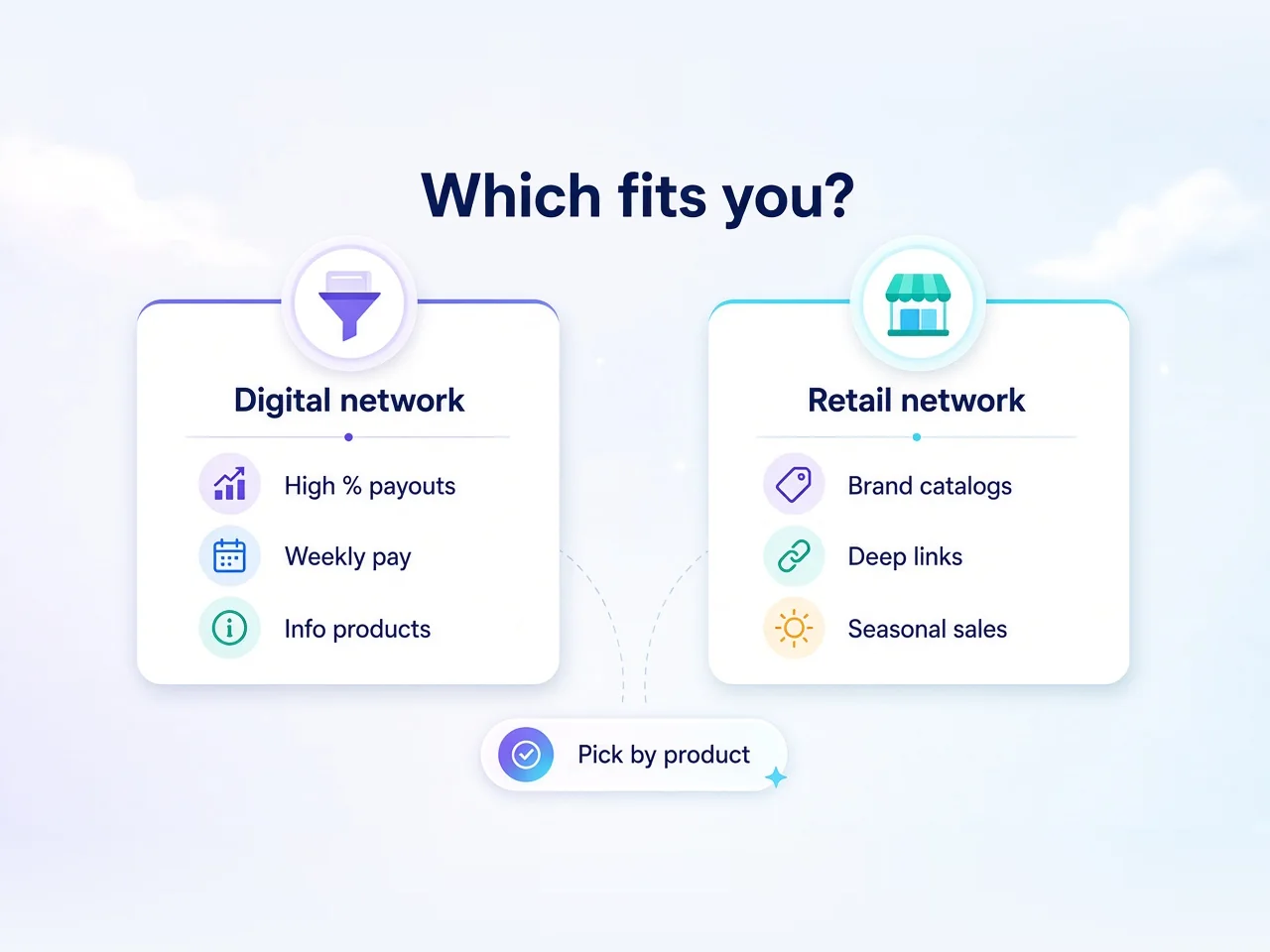
The useful mental model: ClickBank sells you a menu of high-payout digital offers; ShareASale sells you a catalog of brand programs. For the broader network-versus-offer distinction, see CPA networks vs affiliate networks.
How the economics compare
Headline rates look dramatic until you map them to real cart sizes and conversion rates. A 75% ClickBank commission on a $47 ebook is still ~$35. A 8% ShareASale commission on a $180 fashion order is ~$14 — but that order may convert more cleanly from a style guide, and the brand may approve you for lookbooks and seasonal codes that lift AOV.
Dimension
ClickBank (typical)
ShareASale (typical)
Catalog focus
Digital info, courses, software, funnels
Retail, fashion, DTC, multi-category brands
Commission shape
Often 50–75% of sale; recurring on rebills
Merchant-set % of sale (or flat CPA on some offers)
Cookie
Network default around 60 days (offer terms vary)
Merchant-set; commonly ~30 days, sometimes longer
Approval
Many offers open / self-serve
Per-merchant application
Payments
Weekly; low ~$10 direct-deposit threshold
Net-style schedule; ~$50 minimum on Affground's listing
Tracking
HopLinks on ClickBank's platform
ShareASale links + merchant deep links
Best traffic fit
Reviews, listicles, paid tests into funnels
Content + lifestyle sites, seasonal retail
EPC (earnings per click) bridges the two models. What matters is your EPC on your traffic: a ClickBank offer at 1% conversion with a $40 average commission is $0.40 EPC; ShareASale fashion at 2% with a $12 average commission is $0.24 EPC. Run that math on your analytics before declaring a winner.
Treat the commission and cookie figures as industry-typical ranges, not guarantees. Vendors and merchants change terms; always read the live offer or program page before you build a content plan around a number. Cookie mechanics in general are covered in what an affiliate cookie is.
Tracking, creatives and day-to-day workflow
Day-to-day work feels different on each platform even when the affiliate link itself looks simple.
On ClickBank, you generate a HopLink per offer and often send traffic to the vendor's sales page. That speeds paid-traffic tests, but your brand sits behind someone else's funnel. Promo quality varies by vendor; checkout is usually theirs.
On ShareASale, you apply per merchant, then pull banners, text links and deep links into product or category URLs. Content publishers write their own reviews and gift guides — slower to start, stronger for SEO and email because the page is yours. Merchant dashboards also expose seasonal creatives, coupon feeds and datafeeds.
Reporting mirrors the model: ClickBank centers offer-level EPC; ShareASale centers merchant-level performance in one login. Plan for net commission after info-product clawbacks on ClickBank, and expect per-merchant trademark, coupon and content rules on ShareASale.
Where each one wins
ClickBank tends to win when:
Your content is problem → solution (weight loss, productivity, niche how-tos) and readers buy digital downloads or courses.
You want high per-sale payouts and are willing to handle refund/chargeback friction that comes with info products.
You need fast cash flow — weekly payouts and a low threshold matter if you're testing paid traffic.
You prefer self-serve joining over waiting on merchant approvals.
ShareASale tends to win when:
Your audience shops physical or brand products — apparel, home, beauty, gadgets, niche retail.
You want deep linking into specific SKUs, lookbooks and seasonal landing pages.
Brand trust matters: readers recognize the merchant, which can lift conversion even at a lower percentage.
You already work across Awin-family tools or want a path into larger brand programs (for a sibling comparison, see ShareASale vs Awin).
Amazon Associates is another retail path with its own rules; if that fork matters to you, Amazon Associates vs ShareASale covers the trade-offs.
Digital marketplace vs retail network — pick by product type, not headline rate
A practical decision rule
Ignore the bigger percentage for a minute and ask four questions:
01What does my reader actually buy? If the answer is ebooks, courses or digital tools, start on ClickBank. If it's branded physical goods or multi-merchant retail, start on ShareASale.
02What is my average order value? High % × low AOV can lose to modest % × high AOV. Estimate earnings per click, not just commission rate.
03How fast do I need to get paid? Weekly ClickBank deposits help paid-traffic testers. Content sites with slower sales cycles usually tolerate ShareASale's Net schedule.
04Can I get approved? ClickBank's open offers remove a gate. Premium ShareASale merchants may reject thin sites — build enough topical content before you apply.
A workable split for many publishers: ClickBank for digital-niche reviews and funnel tests; ShareASale for brand and seasonal retail content. Keep disclosures, landing pages and traffic sources clean on both.
Head-to-head on live data
The comparison below pulls current listing data from the Affground directory, including ratings and payout details as they're updated.
Chasing the highest percentage. A 75% rate on a low-converting info offer can earn less than 10% on a trusted retail brand that fits your audience.
Treating cookie length as destiny. A 60-day cookie does not help if the reader never returns; a 30-day cookie is fine when intent is high and the purchase is same-session.
Ignoring refunds and chargebacks. Digital products often see higher refund rates; model net payout, not gross commissions.
Applying to ShareASale merchants with an empty site. Brand managers approve publishers who already cover their category.
Running the same landing page for both. ClickBank funnels and ShareASale brand pages need different proof, CTAs and disclosure tone.
Skipping the directory. Browse networks on Affground before you lock a stack — adjacent networks may fit a niche better than either of these two.
How to choose in one afternoon
01List your top 10 URLs by traffic and note what each page sells (digital vs brand retail).
02Estimate AOV and a conservative conversion rate for each cluster.
04Join the network that wins on projected earnings for your current content — not the niche you hope to have next year.
05Add the second network only after one cluster is converting; don't dilute creative testing across both from day one.
Affground's verdict
Pick by product type first, commission second. ClickBank is the stronger home for digital info and high-percentage funnels with weekly cash flow. ShareASale is the stronger home for retail and brand catalogs where trust and deep links matter more than a headline rate. Most serious publishers eventually use both — just not on the same article.
Frequently asked questions
Is ClickBank or ShareASale better for beginners?
It depends on what you promote. ClickBank is easier to start if you review digital products and want open offers with weekly payouts. ShareASale is better if your content covers retail brands, but you must apply to each merchant and may wait on approvals.
What commission rates does ClickBank typically pay?
Many ClickBank offers pay roughly 50–75% of the sale, and some subscription products pay recurring commissions on rebills. Exact rates are set by each vendor and change over time, so always check the live offer terms.
How does ShareASale pay affiliates?
ShareASale consolidates earnings across approved merchants and pays on a Net-style schedule. Affground's listing notes a payment minimum around $50. Individual merchant commissions and cookie windows are set by each advertiser.
Which has the longer cookie window, ClickBank or ShareASale?
ClickBank's network default is often cited around 60 days, while ShareASale cookies are merchant-set and commonly around 30 days — though many brands set longer or shorter windows. Always read the specific offer or program terms.
Can I use ClickBank and ShareASale at the same time?
Yes. A common split is ClickBank for digital-niche reviews and funnel tests, and ShareASale for brand and seasonal retail content. Keep disclosures clear and avoid forcing the same landing page style onto both.
Is ShareASale part of Awin?
Yes. ShareASale is part of the Awin group. Many publishers still treat ShareASale as its own workflow and catalog even while using related Awin tools for other merchants.
Does ClickBank require merchant approval for every offer?
Many ClickBank offers are open or self-serve once you have an affiliate account, which is one reason it feels faster than classic brand networks. Some vendors still restrict traffic types or require approval — check each listing.
Should I choose based on the highest commission percentage?
No. Compare estimated earnings per click using your real traffic, conversion rate and average order value. A lower percentage on a trusted retail brand can beat a high percentage on a low-converting digital offer.