The best affiliate publishers have infinite options and long memories — they promote the brands they trust to track honestly, pay on time and treat them like partners. This is the operational playbook for advertisers and affiliate managers: the six pillars of publisher trust, the trust-killers to avoid, and how to build a program the best publishers choose.
Jul 11, 2026 · 13 min read
Here's an uncomfortable truth for anyone running an affiliate program: the publishers you want most don't need you. A great affiliate — the reviewer with real authority, the newsletter with a loyal list, the comparison site that ranks — has a hundred brands competing for their next placement. They pick who to promote, not the other way around. And they pick, overwhelmingly, the brands they trust.
That's the whole game. Affiliate marketing is a business where the publisher does the work first — writes the content, sends the traffic, waits weeks or months — and only then finds out whether you tracked it honestly and paid on time. Every recommendation they make spends a little of their own credibility with their audience. So before a good publisher will risk that on you, they need to believe you'll hold up your end. Break that belief once and they don't file a complaint — they just quietly move their best real estate to your competitor and never come back.
This is the playbook for earning and keeping that trust — written for advertisers, brands and affiliate/partnership managers who want the publishers worth having. Not vague "build relationships" advice, but the specific, operational things that make a publisher choose you, stay with you, and send you their best.
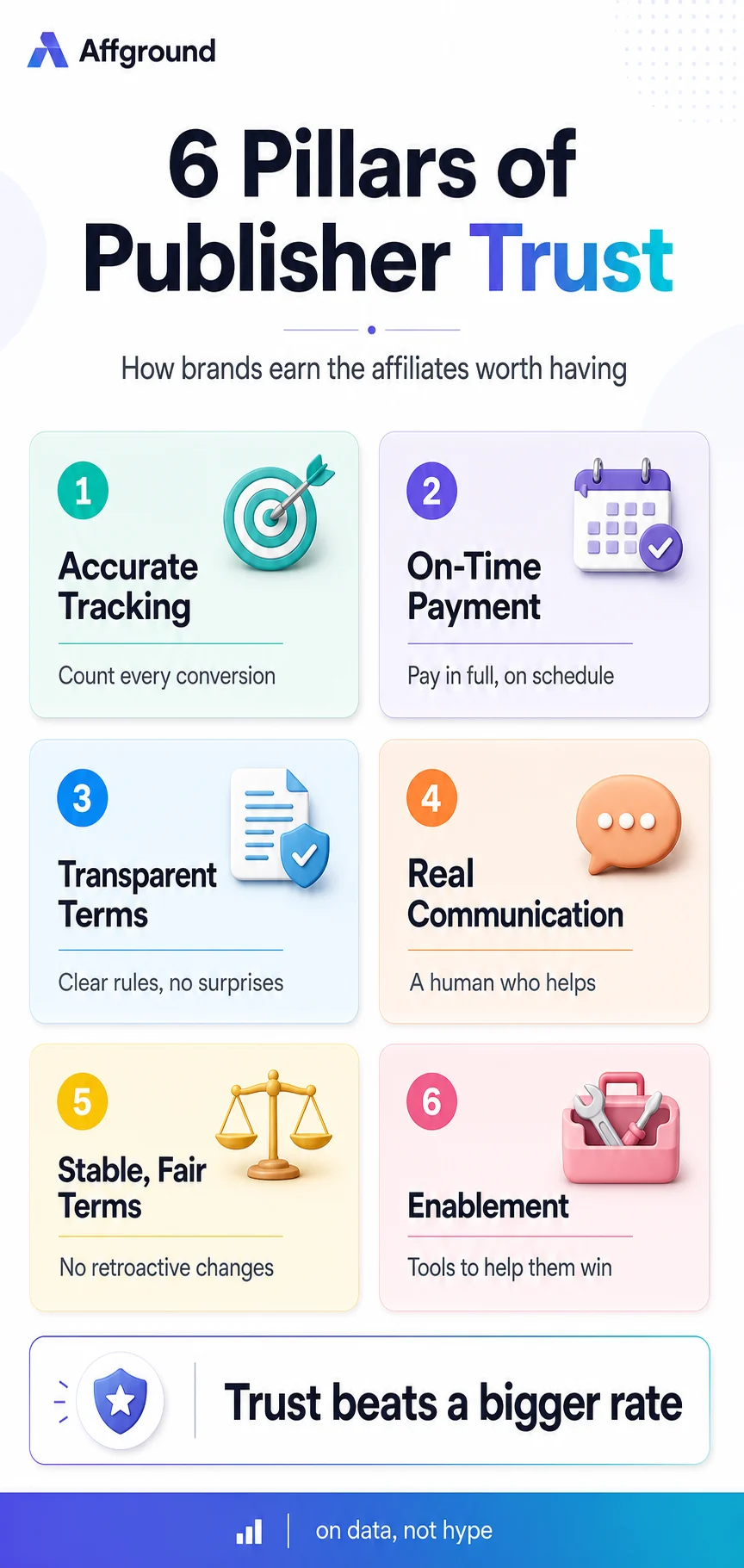
The six pillars of publisher trust — get these right and the best affiliates choose you over competitors.
Why trust is the real currency of affiliate marketing
Most program owners think they're competing on commission rate. They're not — or not mainly. They're competing on trust, because the publisher carries all the risk in the relationship.
Think about the asymmetry. The publisher invests real time and their hard-won audience credibility upfront, sending you traffic and sales. You hold the tracking, the data, the attribution rules and the money. Between their click and their payout sits a black box they can't see into — and they're trusting you not to under-count conversions, not to reverse sales unfairly, not to change the terms retroactively, and not to pay late or not at all. From where the publisher sits, promoting you is an act of faith.
That's why the highest-earning, most selective publishers filter brands on trust before they ever look at the rate. A trustworthy 15% program beats a sketchy 40% one every time, because 40% of a commission that mysteriously never gets credited is zero.
Affground's take: stop thinking of your affiliate program as a media channel and start thinking of it as a product you sell to publishers. Your "customers" are the affiliates, your "price" is the friction and risk of working with you, and trust is the entire value proposition. Programs that internalise this out-recruit and out-retain competitors paying far higher rates — because the best publishers are buying reliability, not a headline number.
What publishers actually need to trust you on
"Build trust" is useless as advice until you break it into the concrete things publishers are actually evaluating. There are six, and they map to the moments where a program can betray a partner:
"Will the deal I signed up for still exist next quarter?"
Retroactive rate cuts, sudden program changes
Enablement
"Do they help me succeed, or just extract from me?"
No creatives, no data, no deep links
Every one of these is a place a publisher has been burned before — by some brand — and is now watching for. Your job is to be visibly, provably safe on all six.
Pillar 1 — Track accurately (the foundation everything sits on)
Nothing else matters if the tracking leaks. A publisher who suspects you're under-counting their conversions will abandon you no matter how friendly your manager is, because you're effectively stealing their income — whether you mean to or not.
Getting this right means: reliable, tested tracking links; support for server-side / postback tracking so conversions aren't lost to ad blockers and cookie restrictions; clear, generous attribution windows; and fast investigation when a publisher flags a discrepancy. The single most trust-building thing you can do here is take tracking complaints seriously and show your work when you resolve them.
Affground's rule: treat every "my conversions aren't showing up" ticket as a five-alarm fire, not a support annoyance. Tracking disputes are where trust dies fastest — a publisher who feels robbed once tells other publishers, and affiliate communities talk. Over-invest in tracking integrity and the transparency to prove it.
Pillar 2 — Pay on time, every time
This is the one that gets remembered. A publisher can forgive a clunky dashboard; they will never forgive a missed payment. On-time payment is the clearest, most tangible proof that you're a real, solvent, honest partner — and it's shocking how many programs fumble it.
The trust-builders are unglamorous and absolute: pay on the schedule you promised (net-30 means net-30, not "when we get to it"), keep payout thresholds reasonable so affiliates can actually cash out, offer the payment methods they use (PayPal, wire, and increasingly others), and — above all — communicate proactively if anything will be late. A delay with a heads-up is a hiccup; a silent missed payment is a betrayal.
Affground's take: your payment reliability is the single loudest trust signal you emit, and it compounds. Every flawless payout cycle buys a little more of a publisher's confidence and a little more of their real estate; every late one spends months of goodwill in an afternoon. If you optimise one thing, optimise this.
Pillar 3 — Be radically transparent
Publishers have been trained by bad actors to expect hidden clauses and moving goalposts. You earn outsized trust simply by being clearer than the industry norm. That means spelling out, in plain language: your commission structure, cookie window and attribution model; exactly when and why sales get reversed (returns, fraud, duplicate orders); your payment schedule and thresholds; and any restrictions on traffic or promotion methods.
Transparency in reporting matters just as much as transparency in terms. Give publishers real, timely data — clicks, conversions, earnings, reversals — not a lagging, vague dashboard. When affiliates can see what's happening, they stop suspecting the worst. Opacity breeds distrust automatically; publishers assume a black box is hiding something, even when it isn't.
Trust is a bridge you build plank by plank: accurate tracking, on-time pay and open reporting are the planks publishers actually walk on.
Pillar 4 — Communicate like a partner, not a vendor
The programs publishers love feel like a partnership, and that feeling comes from communication. A responsive affiliate manager who actually replies, understands the publisher's business, and proactively shares what's working is worth more than a few points of commission. Ghosting your affiliates — dead-air emails, no one to escalate to, canned autoresponses — signals that you don't value them, and value is the soil trust grows in.
Practically: give active partners a real human contact; respond within a business day; share upcoming promotions, new creatives and seasonal opportunities before they happen; and ask for feedback (then act on it). Publishers can tell the difference between a brand that sees them as a growth partner and one that sees them as a traffic faucet to squeeze.
Pillar 5 — Keep terms stable and fair
Nothing torches publisher trust faster than a retroactive or surprise change — slashing commission rates overnight, tightening attribution without warning, or quietly disqualifying a traffic type an affiliate built content around. Even when a change is justified, springing it destroys the predictability that lets publishers invest in you.
The fix is process, not perfection: give generous notice before any change (weeks, not hours), grandfather existing partners where you can, explain the why, and never apply changes retroactively to work already done. Publishers make months-long content bets on your program; if the ground can shift under them without warning, the rational move is to never build on you in the first place.
Affground predicts: as affiliate programs proliferate and switching costs fall, program stability will become a bigger competitive edge than rate. The brands that publicly commit to fair-notice, no-retroactive-change policies will win the loyalty of exactly the professional publishers everyone else is fighting over — because those publishers have long memories and shrinking patience for programs that move the goalposts.
Pillar 6 — Enable them to succeed
Trust isn't only about not harming publishers — it's about visibly helping them win. Programs that provide real enablement signal that they're invested in the partnership's success, not just extracting from it. That means ready-to-use creatives and assets, deep linking to specific products, useful product and conversion data, timely info on promotions and bestsellers, and sometimes exclusive offers or bonuses for top partners.
When you make a publisher more successful, you're not just being generous — you're aligning incentives and proving you're on their side. And a publisher who earns well with you, with your help, becomes your most powerful recruiting tool: affiliates talk, and "this brand actually helps you make money" is the referral you want spreading.
The trust-killers: what destroys it (often permanently)
Trust is slow to build and fast to lose. These are the things that end relationships — usually without a formal complaint, just a quiet exit:
Late or missing payments — the cardinal sin; rarely forgiven.
Shaving or under-tracking conversions — real or merely suspected, it's fatal.
Retroactive term changes — cutting rates or attribution on work already done.
Unexplained reversals — clawing back commissions with no clear reason.
Ghosting — no reachable human when something goes wrong.
Opaque reporting — a black-box dashboard that invites the worst assumptions.
Unfair account terminations — banning affiliates and withholding earned commissions.
Notice how many are about communication and fairness, not money. Publishers will tolerate a lot from a brand that's honest and reachable; they'll tolerate nothing from one that goes dark or moves the goalposts.
Run your program on infrastructure publishers already trust
Here's a shortcut that does a lot of the trust-building for you: run your program on a reputable network or partnership platform. When a publisher sees you operating through infrastructure they already know handles tracking accurately and pays reliably, a big chunk of the trust question is answered before you say a word. The platform's credibility becomes a signal about yours.
These established platforms are known for transparent tracking, dependable payouts and publisher-friendly tooling — the operational backbone of a trustworthy program:
Browse the full affiliate networks directory to compare platforms on payout terms, tracking and reputation — and choose one whose credibility reinforces your own.
Recruiting trust vs retaining trust
Building trust isn't one event; it runs on a timeline, and the two halves need different things.
Recruiting trust (before they join) is about signals: a professional program page, clear public terms, presence on a reputable network, visible social proof, and reachable contacts. A cautious publisher is scanning for reasons to say no — remove them.
Retaining trust (after they join) is about consistency: every payment on time, every dispute handled fairly, every change well-telegraphed. Recruiting trust gets a publisher to try you once; retaining trust — delivered flawlessly over months — is what earns their best content and their word-of-mouth. The programs that win treat the first payout not as the finish line but as the start of proving themselves, over and over.
How to measure trust (yes, you can)
Trust feels soft, but it leaves hard fingerprints in your data:
Partner retention rate — do affiliates stay active, or churn after a cycle or two?
Reactivation rate — do dormant partners come back? Trust makes them.
Time-to-first-payout and dispute resolution time — friction here erodes trust fast.
Share of a publisher's placements — are you their top recommendation or a buried afterthought?
Partner feedback / NPS — ask directly, and watch whether the score moves when you fix things.
Watch these and trust stops being a vibe and becomes a managed metric — one you can see rising or falling in response to how you actually treat partners.
A playbook: building a trusted program from day one
01Get tracking bulletproof first — test every link, offer server-side tracking, set fair attribution. Nothing else counts until this does.
02Run on a reputable platform so your infrastructure borrows credibility from day one.
04Pay early or exactly on time, always — and communicate proactively if anything changes.
05Give every active partner a real human contact and reply within a business day.
06Provide creatives, deep links and data so partners can actually succeed.
07Commit publicly to fair notice — no retroactive changes, generous warning on any update.
08Measure retention and partner feedback, and treat every dispute as a chance to prove you're trustworthy.
Do these consistently and trust compounds: the best publishers try you, stay with you, send you more of their traffic, and tell their peers. That flywheel — not a higher headline rate — is how programs win the affiliates everyone else is chasing.
Affground's verdict
Building trust with publishers isn't a soft skill or a nice-to-have — it's the core competitive advantage of every affiliate program that actually works. The best publishers have infinite options and long memories; they choose the brands that count their conversions honestly, pay them without fail, tell them the truth, and treat them like partners rather than a resource to be mined. Do that reliably, over time, and you become the program they build their business around.
The mechanics are almost boringly concrete: track accurately, pay on time, be transparent, communicate, keep terms stable, and help partners win. None of it is clever. All of it is hard, because it demands consistency where competitors cut corners — and that consistency is the moat. Affground's bet is simple: in a market where every brand can offer a big rate, the ones that offer trust will quietly win the publishers who matter, and keep them long after the rate-chasers have churned through and burned out.
Frequently asked questions
Why is trust so important in affiliate marketing?
Because the publisher carries all the risk. They invest their time and audience credibility upfront — creating content and sending traffic — and only find out later whether you tracked it honestly and paid on time. The best publishers have many brands competing for their placements, so they filter on trust before they even look at the commission rate. A trustworthy 15% program beats a sketchy 40% one, because a commission that never gets credited is worth zero.
How do brands build trust with affiliate publishers?
Through six operational pillars: accurate, tested tracking (with server-side support); reliable on-time payment at reasonable thresholds; radically transparent terms and reporting; real, responsive communication with a human affiliate manager; stable, fair terms with no retroactive changes; and genuine enablement — creatives, deep links and data that help partners succeed. Trust is built by delivering all six consistently, cycle after cycle, not by a single gesture.
What is the fastest way to lose a publisher's trust?
Late or missing payments, and any sign you're under-counting or shaving their conversions — these are rarely forgiven. Close behind are retroactive term changes (cutting rates on work already done), unexplained commission reversals, ghosting affiliates when something goes wrong, opaque black-box reporting, and unfair account terminations that withhold earned commissions. Most trust-killers are about broken communication and fairness, not the size of the rate.
How do you recruit publishers who have never heard of your brand?
Recruiting trust is about signals a cautious publisher can verify before joining: a professional program page, clear public terms, presence on a reputable affiliate network, visible social proof, and reachable human contacts. The goal is to remove every reason to say no. Running on an established platform is especially powerful because the platform's credibility for accurate tracking and reliable payment transfers to you before you've said a word.
Does using a reputable affiliate network help build publisher trust?
Significantly. When a publisher sees you operating through a network or partnership platform they already know handles tracking accurately and pays reliably — such as Impact, PartnerStack or Awin — a large part of the trust question is answered up front. The platform's reputation becomes a proxy for yours, which lowers the perceived risk of trying you and shortens the path to a first placement.
How do you measure trust with publishers?
Trust leaves measurable traces: partner retention rate (do affiliates stay active?), reactivation rate (do dormant ones return?), time-to-first-payout and dispute-resolution time, your share of a publisher's placements, direct partner feedback or NPS, and referral inflow (trusted programs get recommended affiliate-to-affiliate). Track these and trust becomes a managed metric you can watch rise or fall as you change how you treat partners.
Is offering a higher commission rate enough to attract good publishers?
No. Rate gets attention, but the most selective, highest-earning publishers won't build on a program they don't trust to track and pay reliably, no matter how high the headline number. They've learned that a big rate on unreliable infrastructure pays nothing. Reliability, transparency and fair, stable terms consistently out-recruit and out-retain higher-paying but less trustworthy competitors.