Taboola and Outbrain (now Teads) compared for publishers: entry requirements, revenue share, payment terms, ad-quality controls and which fits your site.
Nov 1, 2026 · 7 min read
Taboola and Outbrain are the two names publishers hit first when they look at native discovery widgets, the "around the web" tiles that sit under an article and pay when a reader clicks. Both are now much bigger than that widget: Taboola booked $1.91 billion in 2025 revenue across roughly 14,000 digital properties, and Outbrain merged with Teads in February 2025 and now trades as Teads Holding Co.
This comparison is for content publishers deciding which recommendation partner to put below their articles. We cover how each one gets you in, how the money actually flows, what control you keep over ad quality, and which fits which kind of site.
Both networks sell the same slot: the space directly below your article
The short answer
Taboola is the safer default for most independent publishers that want a single, well-documented native partner. Its onboarding, payment schedule and reporting are published openly, and it does not post a minimum traffic number. Outbrain, now inside Teads, makes the most sense for larger publishers that also want video, high-impact display and brand budgets through the same sales relationship.
Neither is a fit for a new blog with a few thousand monthly page views. Native widgets earn on clicks per page view, so the revenue only becomes meaningful at real volume. If you're still small, start with the options in how to monetize a blog without AdSense.
The Outbrain you may remember is not quite the company you'd sign with today.
Outbrain acquired Teads on 3 February 2025, and the combined business operates under the Teads brand.
The parent company was renamed from Outbrain Inc. to Teads Holding Co. in June 2025, and its Nasdaq ticker changed from OB to TEAD.
Publisher contracts now carry the Teads Engage name, while the contracting entity for many partners remains Outbrain UK Limited for now.
Taboola changed direction too, though not through a merger. Its 2025 annual report describes a deliberate shift from native-only toward the broader performance advertising market through Realize, its advertiser platform. For a publisher, both moves point the same way: the demand behind your widget increasingly includes display and video budgets, not just classic sponsored headlines.
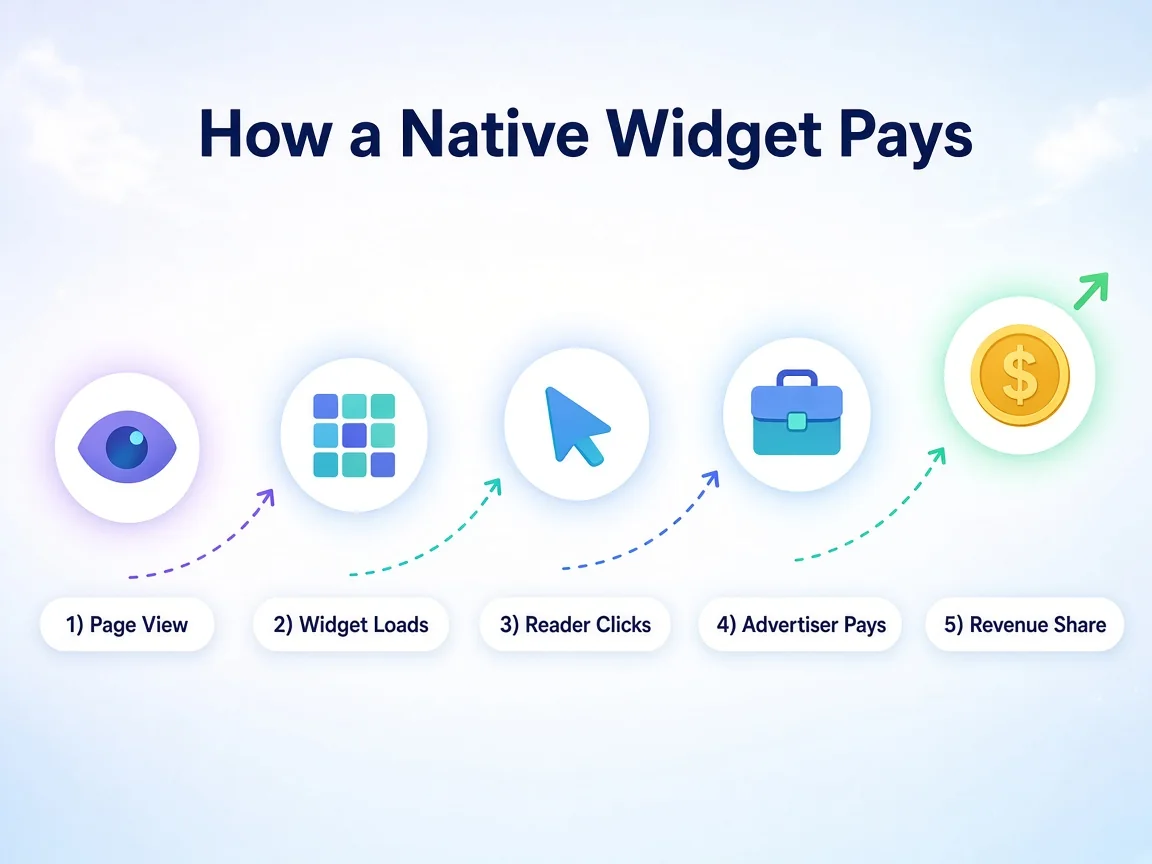
How a native widget earns
You only earn when the widget is seen and clicked, so placement decides revenue
Both platforms run on the same basic model. Advertisers pay per click (and sometimes per impression or conversion), and the network shares that revenue with the site where the click happened. Your income is a function of three things:
01Page views on pages that carry the widget.
02Click-through rate (CTR) on the widget, which depends heavily on whether readers actually scroll to it.
03Cost per click (CPC) paid by the advertisers who win the slot.
Taboola's own onboarding guide spells out the arithmetic: RPM = CTR × CPC × 1,000. Its worked example uses a 3.5% CTR and a $0.05 CPC to reach a $1.75 RPM. Treat that as an illustration of the formula, not a benchmark. Real RPMs swing widely by geography, niche and device.
The same guide asks publishers to place recommendations directly below the end of the article and to keep the below-article feed's visibility rate at 40% or higher. Outbrain's Engage terms carry a similar placement rule: recommendations must appear directly below the main content, or each page must include at least one advertiser recommendation link.
Head-to-head: entry, payouts and terms
Taboola
Outbrain (Teads)
Corporate status
Independent, Nasdaq: TBLA
Merged with Teads; Teads Holding Co., Nasdaq: TEAD
2025 revenue
$1.91 billion
$1.30 billion (combined company)
Publisher partners
About 14,000 digital properties
About 10,000 media owners (combined company)
Published traffic minimum
None stated
None stated; sales-led review
Revenue share
Set in your publisher order
Set in your Partner Enrollment Form
First payment
45 days after the end of your launch month
Per your enrollment form
Payment cadence
Every 30 days, on the 15th
Set in your contract
Minimum payout
No general minimum published
Balances under US$50 roll over
Payment method
Payoneer only
Contract-dependent
Two things in that table deserve a closer look.
Revenue share is never on the website. Both companies set your percentage in a private order or enrollment form. Teads' 2025 filing says its revenue-share percentages can vary by page-view volume or total revenue, and that larger partners may get guaranteed minimum payments instead of a pure share. If anyone quotes you a "standard" Taboola or Outbrain rate, ask where it comes from.
Taboola's payment process is unusually transparent. It publishes the exact schedule (a site that launches on 1 January gets its first payment on 15 March) and pays only through Payoneer, without transfer fees on its side. Publishers in India also need PAN details, and GST-registered ones must invoice Taboola monthly or that month's revenue isn't paid.
Control over ad quality
The fair criticism of both networks is the quality of what shows up in the widget: clickbait headlines, aggressive health and finance offers, and low-quality landing pages. That's a real cost to your brand, and you should plan for it before you sign.
Taboola lets publishers block sponsored content in its Backstage dashboard by keyword, by domain or URL, and by individual recommendation. Through header bidding it also supports blocking by IAB category and advertiser domain.
Outbrain supports category and advertiser-domain blocking in its header-bidding integration. Most finer-grained controls are agreed with your account team rather than self-serve.
In practice, the network matters less than how strict you are. Set your block lists on day one, review the live widget on mobile weekly, and treat a run of embarrassing ads as a reason to tighten filters even if RPM dips slightly. For the wider context on format and disclosure, see what native advertising is.
Choose Taboola if you run a content site with steady traffic and want a self-serve style relationship: published payment rules, a dashboard you manage yourself, and keyword-level blocking. It also has the deeper bench of premium partners, including Yahoo, which has a 30-year exclusive agreement with Taboola, and Microsoft.
Choose Outbrain (Teads) if you're a larger publisher that wants one sales relationship covering native, video and high-impact display, or you're being courted with a guaranteed minimum. The merger makes it a broader monetization partner, but expect a sales-led process rather than self-serve.
Choose neither yet if most of your traffic is search visitors who leave after one page, or your audience is small. Low scroll depth means low widget visibility, and low visibility drags CTR toward zero. Display networks covered in Mediavine vs Raptive or a general guide to choosing an ad network may serve you better.
Common mistakes
Running both widgets at once. Recommendation contracts commonly restrict other third-party recommendation services on the same pages, so check your order before testing.
Judging on the first month. CTR and CPC settle as the algorithm learns your audience. Compare at least a full month on similar traffic.
Placing the widget too low. If it sits below comments or a long footer, visibility collapses and so does revenue.
Skipping block lists. A few bad ads can cost you more reader trust than the widget earns.
Ignoring the paperwork. Payoneer verification, tax forms and (in India) invoices all delay payment if they're incomplete.
How to evaluate both in practice
01Pull your last 90 days of page views, scroll depth and geography so you can show real numbers to both sales teams.
02Apply to both and ask each for its revenue share, payment terms, exclusivity clause and contract length in writing.
03Compare the offers on expected RPM on your traffic, not on the headline share.
04Run the winner on a representative section first, with block lists already set.
05After a full month, compare RPM, reader complaints and on-site engagement against your baseline before rolling it out site-wide.
Affground's verdict
For most independent publishers, Taboola is the easier first native partner because its rules are public and its tools are self-serve. Outbrain under Teads is the stronger pick for larger media owners that want native, video and brand demand in one deal. Whichever you choose, your placement and your block lists decide the result more than the logo on the widget.
Frequently asked questions
Is Outbrain still a separate company from Teads?
No. Outbrain acquired Teads in February 2025, the combined business operates under the Teads brand, and the parent company was renamed Teads Holding Co. in June 2025. Publisher contracts now use the Teads Engage name.
Does Taboola have a minimum traffic requirement for publishers?
Taboola does not publish a numeric page-view minimum. A person reviews each site, and you need to own or license your content and follow its publisher policy. In practice, native widgets only earn meaningful revenue at substantial traffic.
What revenue share do Taboola and Outbrain pay publishers?
Neither publishes a standard percentage. Taboola sets it in your publisher order and Outbrain in your Partner Enrollment Form. Teads says shares can vary with page-view volume or total revenue, and larger partners may get guaranteed minimums.
When does Taboola pay publishers?
Taboola issues the first payment 45 days after the end of the month you launched, then pays every 30 days on the 15th. Payments go through Payoneer only.
What is Outbrain's minimum payout?
Outbrain's standard Engage terms say that if the amount owed is under US$50, it accrues until the balance exceeds US$50. Payment timing is set in your enrollment form.
Can I run Taboola and Outbrain on the same site?
Usually not on the same pages. Recommendation contracts commonly restrict other third-party recommendation services, so check the exclusivity clause in your order before testing both.
How do I calculate native widget RPM?
Taboola's onboarding guide defines RPM as CTR multiplied by CPC, multiplied by 1,000. For example, a 3.5% CTR at a $0.05 CPC gives a $1.75 RPM, though real results vary widely by niche and geography.
Oct 23, 2026 · 6 min read
Best Online Course Platform Affiliate Programs
Recurring affiliate programs from the platforms creators use to sell courses: Systeme.io, Teachable, Kajabi and ClickFunnels, compared on rates, cookies and payouts.