Instagram is built for product discovery, which makes it one of the best places to start affiliate marketing — once you route around its link limit. This guide covers how it works, the six ways to share affiliate links, the content formats that convert, disclosure, the best niches and programs, and how to grow.
Jul 27, 2026 10 min read
Instagram is where people go to discover things to buy — the outfit, the skincare, the gadget, the trip. That makes it one of the most natural places on the internet for affiliate marketing: you show a product you genuinely love, your audience wants it, and you earn a commission when they buy. The catch — the one thing that trips up every beginner — is that Instagram famously won't let you drop a clickable link in a caption. Learning to route around that is 80% of the skill.
The good news: you don't need to show your face, go viral, or have a huge following. Plenty of the best-earning Instagram affiliates are small, focused accounts with an engaged niche audience that trusts their taste. What you need is a clear niche, content that makes people want the product, and a smart system for getting them to your links.
This is the complete guide to starting affiliate marketing on Instagram: why it converts, how it actually works around Instagram's link limits, the six ways to share your links, the content formats that sell, disclosure, the best niches and programs, and how to grow. Written for creators and beginners who want their Instagram to earn. (Prefer video? See the sister guide, how to start affiliate marketing on YouTube; brand new to it all? Start with what affiliate marketing is.)
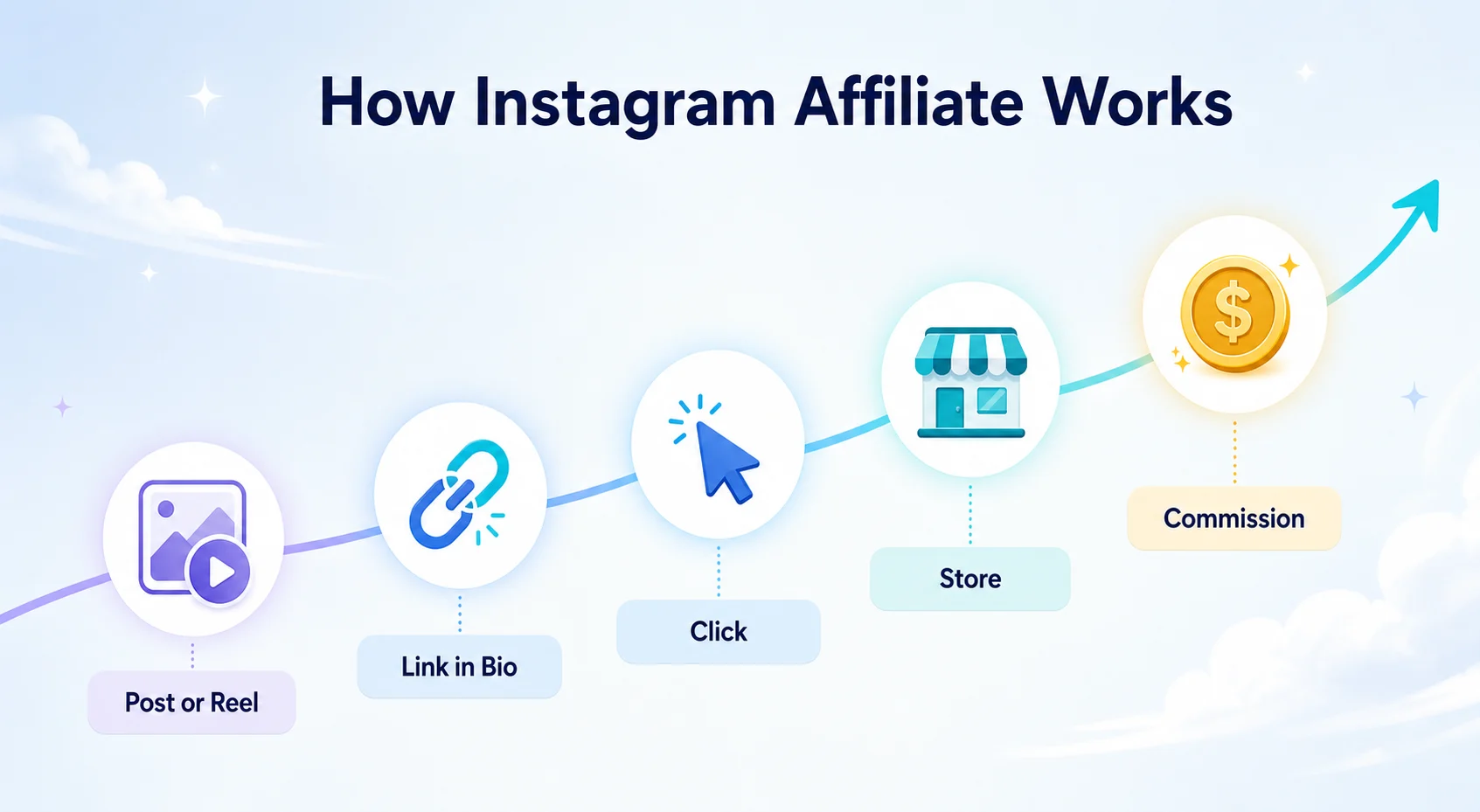
The Instagram affiliate journey — content drives viewers to your link in bio or story link, and a purchase there pays you a commission.
Why Instagram works for affiliate marketing
Instagram is a visual discovery engine, and discovery is exactly the moment affiliate marketing thrives. A few things make it uniquely good:
It's product-native. People come to Instagram to be inspired by things — fashion, beauty, home, fitness, travel. Recommending products isn't an interruption; it's the content people are already there for.
Visuals sell. Seeing a product styled, used and loved builds desire that plain text can't. A great Reel or photo does the persuading before anyone reaches your link.
Reels put small accounts in front of new people. Instagram's reach engine can push a well-made Reel far beyond your followers, so a small niche account can reach real buyers.
Trust converts. An engaged audience that likes your taste acts on your recommendation — parasocial trust is the currency, and Instagram builds it fast.
Add that it's completely free to start, and Instagram becomes one of the most accessible places for a new affiliate to earn.
Affground's take: on Instagram, followers are a vanity metric and trust in a niche is the real one. A 5,000-follower account that all care about, say, minimalist home decor will out-earn a 100,000-follower "general lifestyle" account, because the small account's audience actually buys what it recommends. Pick a lane, become the person people trust for that thing, and the commissions follow the trust — not the follower count.
How it works — and Instagram's link problem
The model is simple: you promote a product with your tracked affiliate link, a follower clicks and buys, and you earn a commission. The complication is Instagram-specific: you cannot put a clickable link in a normal post caption. Links only work in a few places, so the whole game is driving people from your content to where a link actually lives.
That constraint shapes everything. Your Reel or photo creates the desire; then a clear call to action ("link in my bio," "tap the link in my story," "use my code") sends the viewer to the one place they can actually click and buy. Master that hand-off and every post becomes a soft storefront.
The 6 ways to share affiliate links on Instagram
Because captions can't hold links, you route around it. The main options, in rough order of usefulness:
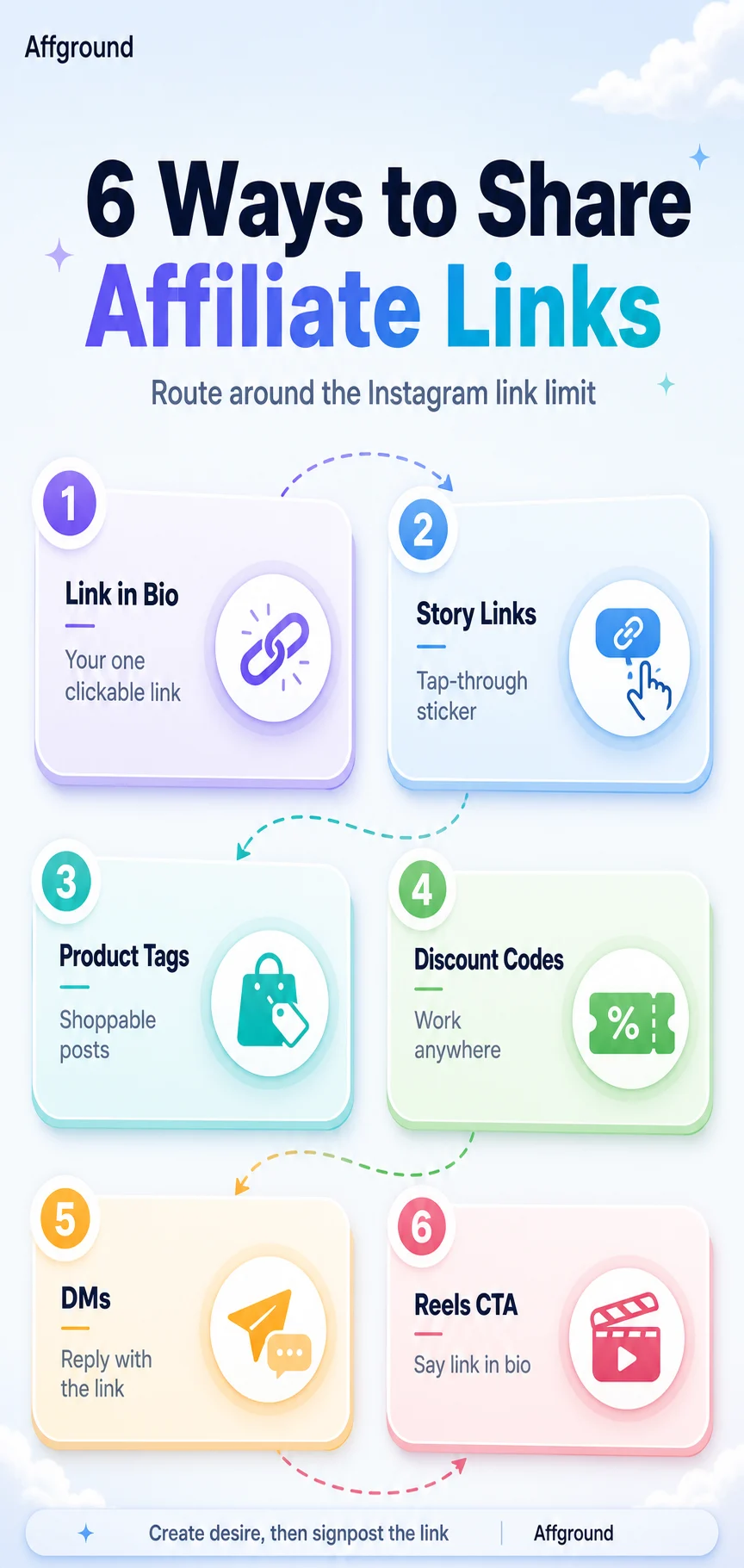
Six ways to share affiliate links on Instagram — the link-in-bio and a clear call to action do most of the work.
Link in bio — your one clickable profile link. Use a free bio-link tool (a simple landing page of your current links) so it holds several offers, not just one. This is the workhorse.
Story links — add a link sticker to a Story so viewers tap straight through. High-intent and clickable, though Stories disappear in 24 hours (save the best as Highlights).
Product tags / Instagram Shopping — tag shoppable products directly where supported, turning a post into a tappable storefront.
Discount / affiliate codes — a trackable promo code works anywhere, including captions, so it sidesteps the link limit entirely and adds a buy-now incentive.
DMs — reply to "where's that from?" comments and messages with your link. High-intent, one-to-one, and genuinely helpful.
Reels calls to action — you can't link in a Reel, but a strong verbal/on-screen "link in bio" is what actually drives the clicks from your highest-reach content.
The pattern that wins: create desire in the Reel or photo, then always tell people exactly where to click. Viewers won't hunt for a link they don't know exists.
The content formats that convert
Different formats do different jobs on Instagram. The mix that sells:
Format
Best for
Link route
Reels
Reach & discovery (biggest upside)
"Link in bio," codes
Stories
High-intent, direct clicks
Link sticker
Carousels
Reviews, "best of," how-to steps
Link in bio, codes
Feed posts
Evergreen showcase & taste-building
Link in bio, product tags
Reels are the growth engine (they reach new buyers), Stories are the conversion engine (they're directly clickable), and carousels are the persuasion engine (room to review, compare and educate). A healthy affiliate account uses all three: Reels to be found, carousels to convince, Stories to close.
Disclosure on Instagram (do it right)
Affiliate links pay you, so you must disclose them — clearly. On Instagram that means a plain, visible disclosure a normal viewer will notice: #ad or "affiliate link" up front (not buried in a wall of hashtags), and, where relevant, Instagram's own Paid Partnership label. Say it in the caption and, for Stories/Reels, on screen.
Done honestly, disclosure doesn't cost you sales — audiences already assume creators earn from links, and being upfront is exactly what keeps the trust that makes them buy.
The common thread: things people see and want. Pick a niche you genuinely love and know — credibility is what converts, and it's obvious on camera when you don't have it.
The best programs for Instagram creators
Instagram creators do best with retail and consumer brands people love to buy — which is exactly what the big retail networks bundle behind one dashboard. These are strong, creator-friendly starting points:
Browse the full affiliate networks directory to find networks carrying the brands your audience already wants, then grab tracked links and codes for your content.
How to grow an Instagram affiliate account
Reach and conversion both start with getting the right followers. The levers that matter:
Lead with Reels. They're the discovery engine — the fastest way for a small account to reach new buyers.
Pick and hold a niche. A focused account builds the trust that converts; a scattered one builds nothing.
Post consistently. A steady cadence of niche content compounds; sporadic posting doesn't.
Engage and use DMs. Reply to comments and questions with genuine help (and your link) — high-intent conversions hide in the DMs.
Always signpost the link. A clear "link in bio" on every relevant post lifts click-through more than anything else.
Save your best links as Highlights. So your top offers don't vanish with your Stories.
You don't need a huge following — you need an engaged one that trusts your taste in a specific niche.
Forgetting the call to action — a great post with no "link in bio" earns nothing; viewers won't guess.
Promoting anything for a commission — off-niche or low-quality picks torch the trust that converts.
Skipping disclosure — it's required, and done well it builds trust rather than costing sales.
Only using the link in bio — layer in Story links, codes and DMs to capture more intent.
Being inconsistent — Instagram rewards regular, niche-focused publishing; one viral Reel won't carry you.
How to start: your first steps on Instagram
1Pick a visual niche you love — fashion, beauty, fitness, home, travel, tech.
2Set up a bio-link tool so your one profile link can hold several offers.
3Join a few relevant affiliate programs and get your tracked links and codes.
4Make Reels and carousels that show products in a genuinely useful, desirable way.
5Always add a clear call to action and disclosure — "link in bio," "#ad."
6Use Stories, codes and DMs to capture high-intent buyers, and post consistently.
Affground's verdict
Instagram is one of the best places a new affiliate can start: it's free, it's built for product discovery, its Reels put small accounts in front of real buyers, and visuals sell desire in a way text can't. The only real hurdle is the link limit — and once you internalise that your job is to create desire in the content and route people to where the link lives (bio, Story, code, DM), the whole thing clicks into place.
So pick a niche you genuinely love, build trust with an audience that cares about it, lead with Reels, and always tell people exactly where to buy. You don't need a million followers — you need a few thousand who trust your taste and act on it. Affground's bet: the Instagram creators who optimise for niche trust and a clean link hand-off, not vanity follower counts, will build the most durable affiliate income on the platform.
Frequently asked questions
How do you start affiliate marketing on Instagram?
Pick a visual niche you genuinely love (fashion, beauty, fitness, home, travel or tech), set up a free bio-link tool so your one profile link can hold several offers, and join a few relevant affiliate programs to get tracked links and discount codes. Then make Reels and carousels that show products in a useful, desirable way, always add a clear call to action ('link in bio') and disclosure ('#ad'), and use Stories, codes and DMs to capture high-intent buyers. You earn a commission when a follower clicks your link and buys.
Can you put affiliate links on Instagram?
Not in normal post captions — Instagram doesn't make those clickable. You route around it: your one clickable link in bio (ideally a bio-link landing page holding several offers), tappable link stickers in Stories, product tags via Instagram Shopping, trackable discount codes that work anywhere including captions, and links shared in DMs. The skill is creating desire in your content, then clearly telling viewers where to click.
Do you need a lot of followers to do affiliate marketing on Instagram?
No. Affiliate earnings track niche trust and engagement, not follower count. A small, focused account whose audience all care about one topic often out-earns a large 'general lifestyle' account, because its followers actually buy what it recommends. Instagram's Reels also push good content beyond your followers, so even a small account can reach new buyers. Aim for an engaged, on-niche audience rather than a big vanity number.
What are the best niches for Instagram affiliate marketing?
Visual, aspirational, product-heavy niches perform best: fashion and style, beauty and skincare, fitness and wellness, home and decor, travel, and tech and gadgets. The common thread is things people see and want. Choose a niche you genuinely love and know, because credibility is what converts and it shows when you don't have it.
How do you disclose affiliate links on Instagram?
Make the disclosure clear and visible, not buried. Put #ad or 'affiliate link' up front in your caption rather than hidden in a block of hashtags, add it on screen for Stories and Reels, and use Instagram's Paid Partnership label where relevant. Disclosure is legally required, and done honestly it doesn't cost you sales — audiences already assume creators earn from links, so being upfront protects the trust that drives conversions.
Which content formats convert best on Instagram?
Use all three main formats for different jobs: Reels are the discovery engine that reaches new buyers, Stories are the conversion engine because their link stickers are directly clickable, and carousels are the persuasion engine with room to review, compare and educate. Feed posts add evergreen showcase and taste-building. A healthy affiliate account uses Reels to be found, carousels to convince, and Stories to close.
What are the best affiliate programs for Instagram creators?
Instagram creators do best with retail and consumer brands their audience already loves to buy, which the large retail networks bundle in one place — Rakuten Advertising, ShareASale, Awin and CJ Affiliate all carry many fashion, beauty, home and lifestyle brands. Start by finding networks that carry the brands relevant to your niche, then grab tracked links and discount codes for your posts. Match the program to what your specific audience genuinely wants.